Why Learn English Fast?
Learning English quickly is the goal for millions of people around the world. Whether you want to learn English for traveling, for career purposes, or just to enjoy English media such as music and TV shows in their original form, speaking fluent English can open up a world of possibilities.
A research named “Bilingual and Immersion Programs”, conducted by Jim Cummins of “The University of Toronto” emphasises that “immersion is one among the most successful methods to learn a language where one is immersed in their environment and later submerged to the same language.”
The English language is everywhere, but the path to fluency can feel overwhelming. In this article, we will guide you through different ways to learn English fast and efficiently.
Proven Strategies to Learn English Fast
These steps are backed by expert research and real learner results. Let’s have a look at the steps that are proven to learn English fast.
Step 1: Immerse Yourself in the English Language
The first and most important stage is to fully immerse yourself in the English language. This entails incorporating English into every part of your life. The English language is everywhere, and technology and the internet have made this process easier than ever.
However, to fully immerse yourself, you should make an active effort to incorporate as much English as possible into your daily life. You can practice immersive learning by watching English movies or series, or listening to English music, podcasts, or audiobooks while commuting. Even small changes like changing the language on your phone and computer can make a difference. Social media groups, AI-powered apps like Jolii, or even gaming in English are also strategies to increase your exposure to the English language. Find content that you enjoy, try to think in English, and remember that the key is consistent and varied exposure, which will allow you to become comfortable with various accents, slang, and expressions.
You can read more about the benefits of an immersive language learning experience to get a more detailed insight.
Step 2: Use Smart Memory Techniques for Fast Vocabulary Building
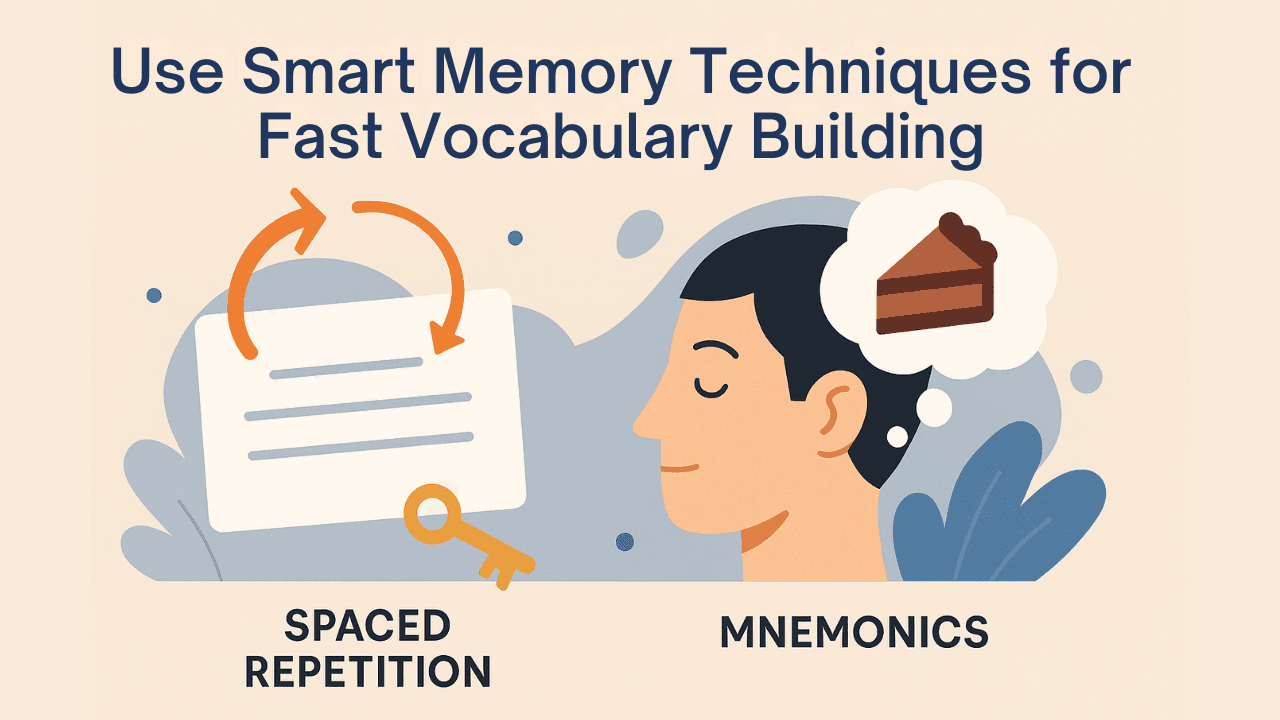
To accelerate your English learning journey, embracing effective techniques can lead to substantial improvements in retention and recall. Two standout methods—spaced repetition and the use of mnemonics—are particularly potent for mastering a new language quickly.
Spaced Repetition
Spaced Repetition Software (SRS) is a methodological powerhouse in the field of language learning. It takes advantage of the psychological spacing effect, which suggests that knowledge is better remembered in our long-term memory when exposure periods are spread out across time rather than being jammed into a short period. In other words, seeing a word once is not enough to learn it. Research shows that in order for a word or phrase to become part of your long-term memory and be remembered, you need to see it regularly at different intervals of time.
How Spaced Repetition Accelerates English Vocabulary
Top apps/services of 2025 to help with spaced repetition
Apps like Anki and Quizlet, which are at the forefront of using this method, allow you to make personalized flashcards for vocabulary, phrases, and even grammar rules. These platforms then use algorithms to find the best time intervals for studying each flashcard. Early on, you may see a card only a day after learning it, but with each successful recall, the time between seeing the card again increases. This way, the app makes sure that you are really learning the word and saving it into your long-term memory.
It could take days, weeks, or even months to find the terms you find the most difficult. The intervals are carefully adjusted to challenge you just when you’re about to forget a word, reinforcing its memory more strongly. You should consider using AI-powered flashcards for English learners, as they are a powerful way to increase your vocabulary.
Ready to learn through entertainment?
Download the app now and start improving your skills!
The beauty of spaced repetition is its effectiveness; it targets your weaker regions more frequently, ensuring that you don’t waste time revisiting content you’ve previously learned. For English learners, this means faster vocabulary development and a significant improvement in language retention.
Using Mnemonics to Remember English Words Fast
While spaced repetition helps determine when to study, mnemonics are essential for good memorization. A mnemonic is any learning practice that improves memory retention. The importance of mnemonics in language learning cannot be emphasized enough, especially when dealing with vocabulary that appears abstract or distant from your own language.
Creating a vivid, weird, or emotionally charged image or tale to go with a new word will greatly boost your capacity to remember it. For example, to recall the English term “lavish” (which means to spend abundantly or freely), imagine a luxurious lavatory made of gold and diamonds. The image’s ridiculousness and vividness help you remember the word.
Similarly, acronyms (words formed by combining the first letters of a series of words) might help you remember sequences, such as grammar rules. Mnemonic patterns and linkages make recall more intuitive and natural, transforming learning into a creative and pleasant undertaking.
Integrating these tactics into your studying encourages active engagement with the topic, making learning more dynamic and effective. This not only improves your capacity to retain English vocabulary and rules faster, but also makes the learning process more enjoyable and less of a burden. Remember that learning is most effective when it is pleasant, so make sure you enjoy your English learning!
Step 3: Learn Practical Grammar and Real-World Vocabulary
Mastering the grammar and vocabulary of English is a foundational part of becoming fluent in the language. However, the approach you take to this learning can significantly affect your retention rates and understanding. Systematic learning, contextual practice, and situation-based vocabulary acquisition are key strategies to employ.
Context-Based English Vocabulary
Memorizing large lists of terms may be daunting and ineffective. Instead, learning vocabulary in context can significantly improve understanding and retention. This strategy can really make a difference in your language learning. It entails examining words as they appear in complete phrases or in real-life settings, which might reveal information about their meaning and usage. You shouldn’t only remember the word, but also a sentence or expression that contains it. For example, instead of simply memorizing the word advantage, you could learn it in context by practicing a sentence like “Speaking English fluently gives an advantage.”
Thematic Vocabulary for Everyday Life
Thematic vocabulary lists are an excellent approach to learn words in context, focusing on one subject or circumstance at a time. For example, if you’re learning words linked to ‘food’, you may look up the names of various meals, utensils, and cooking and eating activities. Each category provides a unique context, allowing for a more complete grasp of how each term fits into real-world circumstances.
Engaging with Authentic Materials
Immerse yourself in a variety of English-language materials to expand your vocabulary. This may include:
Reading: Newspapers, books, journals, and blogs provide a varied range of language and topic matter, allowing you to see how words are used naturally.
Listening: Watching movies, listening to podcasts, and watching TV shows on YouTube and Netflix in English are all great ways to hear terminology employed in natural speech patterns. This exposure is beneficial not only for comprehending pronunciation but also for memorizing colloquial phrases and idiomatic expressions.
If you want to actually learn more about methods of learning a language effectively using videos, you can read our dedicated article to dive deeper and.
Speaking and Writing Exercises: Using new terminology when speaking and writing helps to consolidate your knowledge. Practice utilizing new terms in discussions, or try composing essays or stories using vocabulary lists related to the current theme you’re studying.
Mastering English Grammar for Fast Progress
Grammar is the structure that keeps a language together; hence, thorough study is essential. To efficiently master English grammar, use the following technique.
Progressive Learning
Plan your grammar study in a progressive approach. Begin with the fundamentals, such as nouns, verbs, and adjectives, before moving on to more advanced topics like tense conjugations, voice (active vs. passive), and modal verbs. This block-by-block technique reduces overwhelm and strengthens understanding. You might consider asking for the help of an English teacher who can give you advice on how to learn grammar in the right sequence.
Use of Grammar in Context
Grammar, like vocabulary, is best learnt in context. Examine how various grammatical constructs are utilized in the context of real sentences. Language learning systems and textbooks frequently include tasks that put grammar rules into context, which can be extremely useful.
Regular Practice
Regular practice is essential for understanding grammar. Use exercises that require you to correct language errors, rework sentences, or fill in grammar gaps in paragraphs. This active interaction helps to improve your grammar abilities over time.
Step 4: Best Technology and Apps to Learn English Fast
In the digital age, the process of learning English—or any language—has been revolutionized by the availability of technology-based learning tools, such as using the best AI apps to learn English. These resources range from AI mobile applications to comprehensive online courses, interactive games, and virtual classrooms. They provide dynamic and interactive learning experiences that can supplement traditional learning methods effectively. Here’s how you can leverage these technological tools to enhance your English learning journey:
Harness Online Communities and Interactive Platforms
Websites such as italki, Tandem, and HelloTalk connect you with native speakers all over the world for one-on-one courses or language exchanges. This real-time practice with native speakers will significantly improve your speaking and listening abilities.
Best YouTube Channels and Podcasts for English Learners
There are innumerable English study channels on YouTube, covering grammar, vocabulary, pronunciation, and even exam preparation suggestions. Podcasts are also an excellent method to immerse oneself in English, with broadcasts suitable for all skill levels, from beginner to advanced.
They provide free, diverse information, helping students to develop their listening skills and learn while on the go. Listening to actual speech, stories, and conversations helps you grasp varied phrases and terminology.
Here are our top picks by level:
Beginner Level
- English with Lucy — A channel in which teacher Lucy explains grammar, pronunciation, and helps expand vocabulary in a very clear way.
- VOA Learning English — This channels has slow-paced news stories and different resources for improved listening comprehension. They offer podcasts and you can also find video course for learners of different native languages.
Intermediate Level
- Speak English With Vanessa — This channels focuses on helping learners speak naturally and fluently with practical exercises.
- Easy Languages (English) — Offers authentic street interviews with subtitles, perfect for improving listening and learn English in realistic contexts with native speakers.
Advanced Level
- English with Emma (engVid) — Emma covers advanced topics such as idioms, exam prep (IELTS/TOEFL), writing, and pronunciation. lessons.
- Geoff Lindsey — A linguist who explains phonetics, pronunciation systems, and deep linguistics, ideal for those refining their accent and willing to getting into English on a deeper level.
Try Virtual Reality (VR) and Augmented Reality (AR) for English Practice
Emerging technologies like VR and AR offer immersive language learning experiences where you can interact with virtual environments or simulations in English. These technologies are still developing, but promise exciting possibilities for realistic language practice.
To learn how AI can supercharge your English learning, read our full guide: “Unlocking the Power of AI for English Learning”.
Step 5: Should You Take Professional English Lessons for Faster Results?
Self-study, with the use of technology and various online resources, plays a significant role in the journey to language mastery. However, the addition of professional lessons can significantly enhance this learning process.
Platforms such as iTalki and Preply have become increasingly popular for those seeking to learn English, offering direct access to native English tutors and professionally structured lessons that can be immensely beneficial. Here’s a deeper look into how these services can enrich your learning experience:
Benefits of Personalized English Tutoring
One of the primary benefits of professional classes is the personalized assistance they provide. Tutors can evaluate your present competence level, identify your strengths and areas for improvement, and personalize classes to your individual requirements and objectives. Unlike one-size-fits-all solutions, personal tutors tailor their teaching tactics to your specific learning style, making your educational journey more efficient and successful.
How to Choose the Right Online Tutor
Professional tutors teach planned classes that frequently follow a curriculum meant to gradually enhance your English skills in speaking, listening, reading, and writing. This systematic approach ensures a thorough comprehension of the language. Furthermore, the immediate feedback from these sessions allows you to identify errors, learn complex concepts, and improve your skills in real time.
Real Conversation Practice with Native Speakers
Speaking with native speakers is still one of the quickest ways to improve your language skills. Professional lessons provide for frequent, controlled conversation practice, providing a secure venue to express yourself and receive feedback as needed. This practice can considerably boost your confidence and familiarity with the language, which is more difficult to attain through self-study alone.
Wrap up
Learning English is a marathon, not a sprint. It takes patience, commitment, and a desire to immerse oneself in the language. Adopting these tactics and incorporating English into your daily life will result in faster growth than you could have imagined. Remember that each language learner’s journey is unique, so be curious, stay motivated, and, most importantly, enjoy the experience! Happy learning!
FAQs
Q: Which is the fastest way to learn English?
A: The fastest way is full immersion: combine daily speaking practice with native speakers, active listening (movies, podcasts, YouTube), and vocabulary and grammar study with spaced repetition. Using AI apps like Jolii or human tutors can speed things up, but consistency is the real key.
Q: Can we learn English in 7 days?
A: No, you can’t master English in 7 days, even if some programs promise it. But you can definitely learn basic greetings, essential phrases, and survival vocabulary. Think of 7 days as a solid “kickstart” rather than fluency. We recommend staying consistent and start at least with a 30-day plan to boost your English fluency.
Q: How to speak English fluently in 2 weeks?
A: Fluency in 2 weeks isn’t realistic, but you can make noticeable progress by focusing on conversation-based learning. Practice speaking daily, record yourself, shadow native speakers, and stick to common everyday expressions. You may also consider taking part in an immersive English learning course to boost your English skills.
Q: How to speak basic English?
A: Start with the most common words and phrases (introductions, numbers, directions, food, time). Practice short, simple sentences daily and don’t be afraid of mistakes. Learning a language at an early stage is about communication, not perfection.
Q: Is it possible to improve English in 1 month?
A: Of course. With consistent practice, you can improve listening, vocabulary, and speaking noticeably in one month. This way, you can boost your vocabulary and confidence, but you need to commit to daily learning.