So, you landed the new job, promoted to a new position, or got stuck in a global team where everyone sounds like they’re auditioning for Suits.
Congrats!
Now the catch: if you can’t follow the meeting banter, decode jargon, or fire off emails without Google Translate, your career upgrade feels more like a downgrade.
This isn’t about just “studying harder.” It’s about hacking the English code for the real-world workplace.
Table of contents
- Why English is Your Career Superpower
- Immersion on a Busy Schedule: Integrate English into Your Day
- 1. Audit Your Workplace Needs
- 2. Set Micro-Goals for Fast Progress
- 3. Practice in Real Work Scenarios
- 4. Build Vocabulary That Matters
- 5. Use Daily Immersion Strategies
- 6. Strengthen Core Skills
- 7. Learn in the Flow of Work (LIFOW)
- 8. Leverage Tools & Feedback
- 9. Boost Retention & Confidence
- FAQs
- Final Word
Why English is Your Career Superpower
English is a universal language that runs the world’s economy. It’s what gets your ideas heard in meetings.
Promotions, cross-border gigs, and client trust move faster when your words hit.
Research confirms the value of English skills. The British Council found that individuals with strong English language abilities are twice as likely to be employed in jobs that involve international work.
The workplace doesn’t reward perfect grammar; it rewards the pro who can jump into a meeting, throw down the right jargon, and keep momentum alive.
Companies around the globe are always desperate for people who can smoothly handle international communication, manage remote teams, and close deals in English.
Knowing how to speak proper English makes you a high-value asset, not just another employee. It’s the skill that ensures you’re always chosen for the big projects and get that extra zero on your salary.
Immersion on a Busy Schedule: Integrate English into Your Day
You don’t need a year abroad or 4 hours of class time to achieve immersion. English fluency also equals a higher paycheck. Analysis from the EF English Proficiency Index (EPI) consistently shows a direct, positive link between a country’s average English skills and its individual earning power (GNI per capita)
True fluency comes from consistent, sneaky integration. The goal is to make English a consistent part of your daily life, ensuring you practice the language regularly, even while managing a demanding schedule.
Your 30-Day Workplace Immersion Sprint
This 30-day plan turns wasted minutes into language gains. Commit just 15-30 minutes of targeted engagement daily, often using accessible tools.
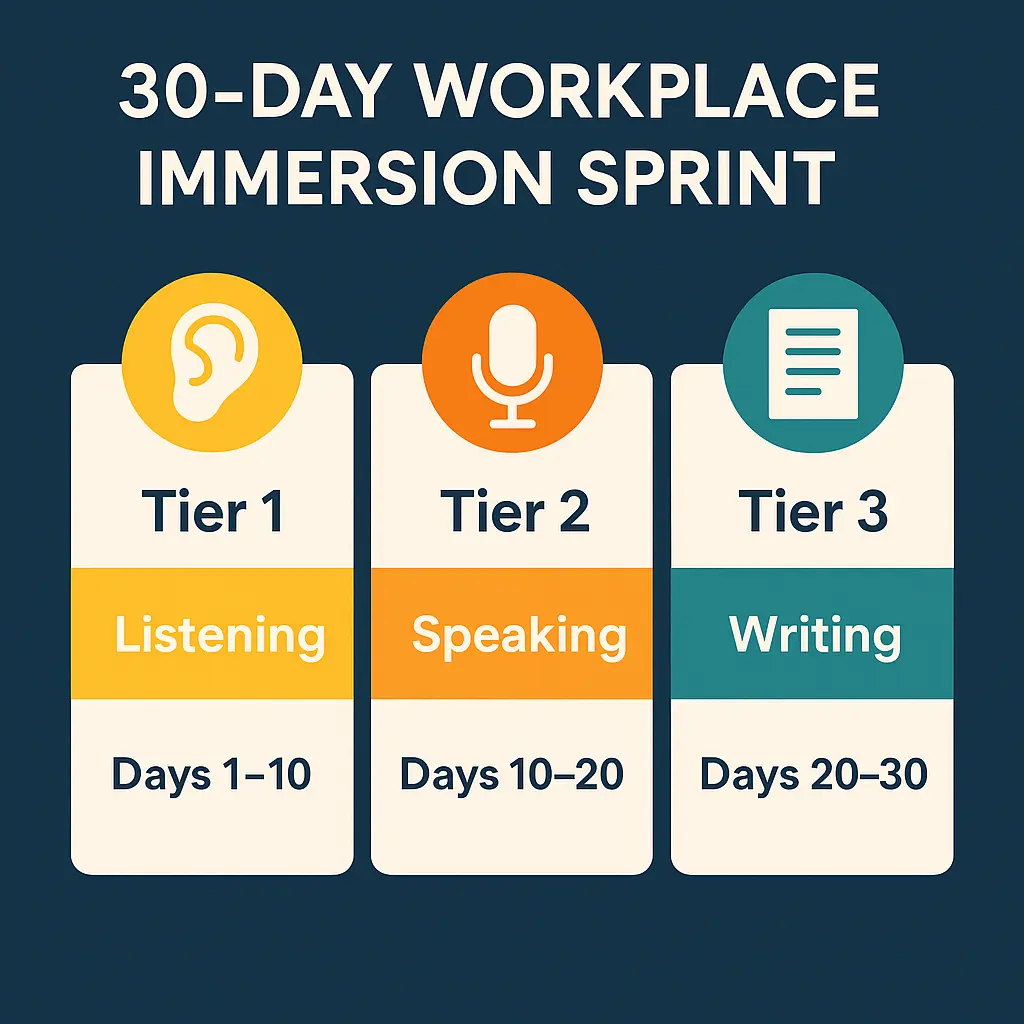
Tier 1 (Days 1–10): The Digital & Auditory Switch
Focus on low-effort, high-impact changes to your environment.
| Activity | Daily Focus (15min) | Immersion Skill |
| Digital Reset | Change your phone/computer language to English. | Reading (Painless vocab acquisition) |
| Auditory Loop | Listen to an English work-related podcast or news brief during your commute or lunch. | Listening (Training the ear to rhythm) |
| Subtitles Rule | Watch all entertainment videos (YouTube/Netflix) with English subtitles ON. | Reading/Listening Connection |
Tier 2 (Days 10–20): The Active Input Challenge
Move beyond passive listening; start actively engaging with English content.
| Activity | Daily Focus (15min) | Immersion Skill |
| Targeted Reading | Force yourself to read 1-2 work reports, industry blogs, or documentation only in English. | Vocabulary & Context |
| Shadowing | Listen to a segment of a podcast or dialogue and try to repeat the intonation/speed immediately after. | Pronunciation & Flow |
| Summary Habit | Read a complex email, then take 60 seconds to summarize its main points out loud to yourself. | Speaking Activation |
Tier 3 (Days 20–30): The Output & Integration Phase
This is where you push yourself to use the language professionally and where focused apps shine.
| Activity | Daily Focus (15min) | Immersion Skill |
| Voice Dictation | Use your phone’s voice-to-text feature (in English) to compose your daily to-do list or reminders. | Pronunciation Correction |
| Pre-Meeting Prep | Write down or mentally rehearse 3 complex sentences you plan to use in an upcoming meeting or call. | Professional Output |
| Micro-Journaling | Write a short (5-sentence) journal entry describing your workday or biggest challenge only in English. Pro Tip: Use the writing prompts or conversation features on jolii.ai for instant feedback! | Writing/Grammar Application |
1. Audit Your Workplace Needs
Forget generic textbooks.
You don’t need “The cat is on the table.”
What you need is: “Let’s circle back after the QBR.”
Start by spotting the 2–3 biggest English-heavy pain points in your workday—meetings, emails, and presentations.
Pay attention to recurring jargon (a.k.a. corporate spells) and idioms.
Prioritize the stuff that keeps popping up in your office, not random SAT words.
Use company Slack threads, client emails, and meeting notes as your vocabulary goldmine—real language, real context, zero fluff.
2. Set Micro-Goals for Fast Progress
“Become fluent in six months” = delusion.
“Learn 20 meeting phrases this week” = progress.
Use the SMART framework: Specific, Measurable, Achievable, Relevant, Time-bound.
That’s corporate jargon for “set tiny, doable goals.”
Celebrate when you crush them.
Yes, even if that means only surviving one Zoom call without panicking.

3. Practice in Real Work Scenarios
Role-play your next presentation.
Pretend you’re pitching Elon Musk—because if you can survive that imaginary chaos, Monday’s client call is nothing.
Speak out loud for 10–15 minutes daily about your work topics.
Record it. Listen. Cringe. Improve. Repeat.
4. Build Vocabulary That Matters
Business English isn’t about knowing “quixotic.” It’s about dropping “let’s align on deliverables” with confidence.
Focus on industry-specific jargon.
Build word families: suggest → suggestion → suggestive.
Keep a personal phrase log stolen straight from meetings and reports.
Industry glossaries + AI-powered apps (Grammarly, Quillbot) can auto-detect and explain business lingo you’d otherwise miss.
5. Use Daily Immersion Strategies
Skip binge-watching Friends for the tenth time.
Instead, queue up Wall Street, Mad Men, or Bloomberg clips.
Read BBC Business over Buzzfeed.
Plug into podcasts on your commute. It’s like osmosis—except with quarterly earnings calls instead of memes.
6. Strengthen Core Skills
- Emails: Clear, concise, tone-checked. (Use AI tools for instant tone adjustment—yes, even Slack messages.)
- Meetings: Train your ears to catch the TL;DR, not every syllable.
- Presentations: Use signposting: “First…, Moving on…, In conclusion…” Like a GPS for your audience.
- Small Talk: Master harmless stuff—“How was your weekend?” not “So, who did you vote for?”

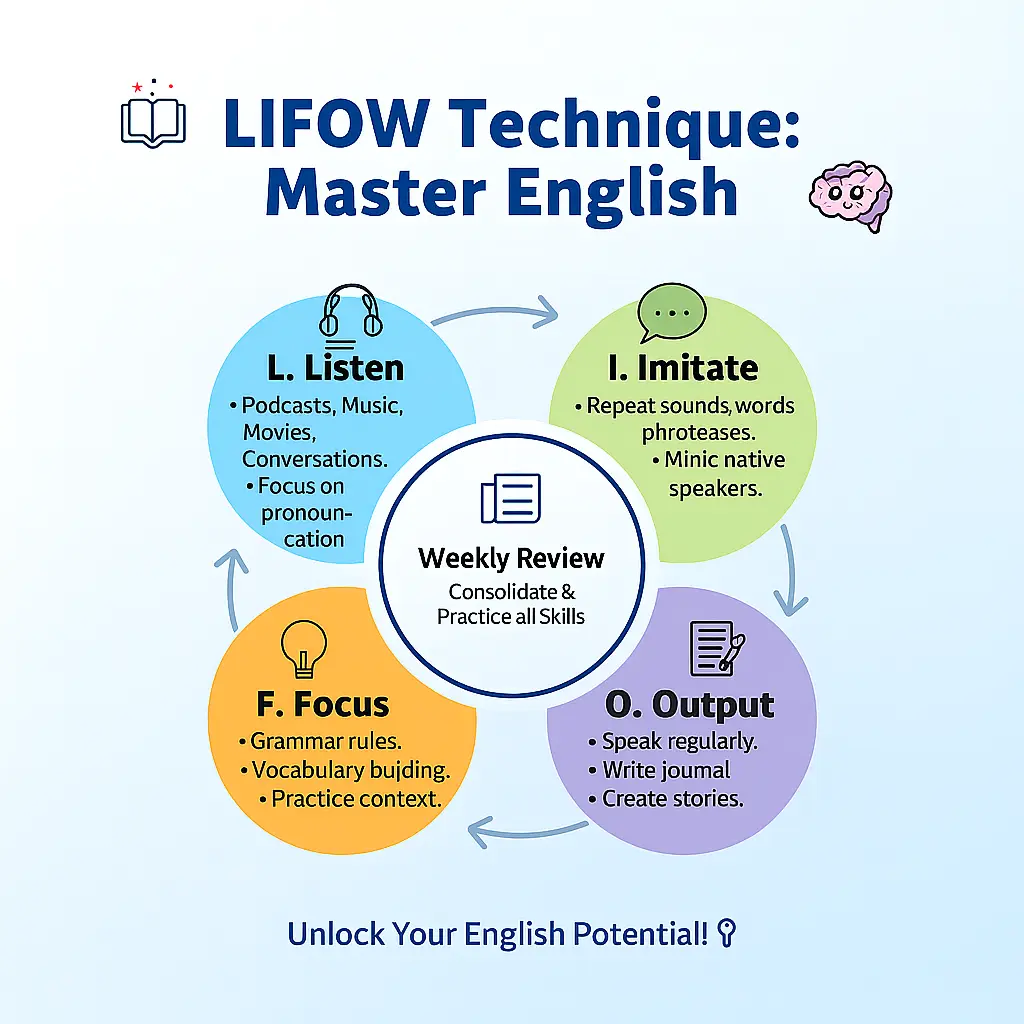
7. Learn in the Flow of Work (LIFOW)
This is the ninja hack.
Learning in the Flow of Work (LIFOW) turns your tasks—emails, reports, meetings—into live study material, instead of wasting time on irrelevant drills.
Gartner’s 2023 findings show that LIFOW strategies boost performance by driving a 25% surge in productivity and a 20% improvement in how often employees use their new skills.
Use your actual tasks as practice. Rewrite yesterday’s email better.
Note phrases colleagues use and repurpose them. Cannibalize company docs for vocab.
8. Leverage Tools & Feedback
Courses like Talaera or Coursera’s Business English are legit.
Pair them with AI-powered tools that flag fossilized mistakes (the ones you keep making forever).
Bonus points if you get feedback from a colleague who won’t sugarcoat.
AI + human feedback loops = fastest way to kill “fossilized mistakes.”
9. Boost Retention & Confidence
Science says reviewing before bed helps memory stick. Flashcards work (yes, even in 2025).
Reuse new words in Slack chats, emails, or meetings.
Most importantly: reframe mistakes.
That time you said “execute the client” instead of “execute the project”?
Embarrassing, yes. But also proof you’re learning.
FAQs
Q. How fast can I realistically improve my workplace English?
If you commit 15 minutes a day with targeted, workplace-specific practice, you’ll see noticeable improvements in 4–6 weeks. Forget “instant fluency”—go for consistent micro-wins.
Q. What are the 5 skills to learn English?
The core skills are Listening, Speaking, Reading, Writing, plus Grammar, which acts as the foundation for the other four.
Q. How to speak English fluently in the office?
Focus your daily 15 minutes on practicing workplace idioms and actively contributing to small talk or meetings without fear of mistakes.
Q. How can I improve my English for work?
Improve by regularly reviewing industry-specific documents (emails, reports) and dedicating your practice time to an ESP (English for Specific Purposes) curriculum.
Q. What’s the biggest mistake professionals make when learning English for work?
Wasting time on generic vocabulary or academic grammar drills. Focus on your industry jargon and recurring workplace phrases.
Q. Are AI tools like Grammarly enough to improve my writing?
They’re great for catching tone and grammar slip-ups, but not enough alone. Pair them with human feedback—from colleagues, mentors, or tutors—for real growth.
Q. I get anxious in meetings. How do I stop freezing?
Prep 10–15 “go-to phrases” in advance (“Can you clarify that?” or “Let’s circle back to this point”). That way, your brain doesn’t short-circuit when it’s your turn.
Q. Do I need to sound like a native speaker to succeed at work?
Nope. Clarity beats perfection every time. Colleagues care about understanding you, not whether you sound like you grew up in New York.
Final Word
You don’t need a lifetime of grammar drills to sound workplace-ready.
What you need is relevance, repetition, and a healthy dose of confidence.
Even 15 minutes a day—done smart—can change your entire work vibe.
Remember: no one cares if your grammar is perfect. They care only if they get you.
Recap:
- Mine real company materials (emails, Slack, reports) for vocab.
- AI-powered apps to decode jargon and fix fossilized mistakes.
- LIFOW = turning daily tasks into English practice.
- Review before bed for faster memory retention.
If you’re done wasting time on generic apps, try Jolii.ai app, which is basically an AI coach built to sharpen your English for actual workplace scenarios.
Because the fastest way to sound professional… is to practice like one.