Learning a new language has always been a demanding but deeply rewarding experience.
These days, that experience looks nothing like it did just a few years ago. Artificial intelligence has firmly established itself at the heart of our learning methods, and it’s here to stay, transforming our habits day after day.
In 2025, AI-powered tutors can correct your pronunciation in real time, adapt to your learning pace, and even simulate natural conversations with impressive fluency. On the other hand, teachers continue to bring what technology still struggles to replicate: sensitivity, motivation… a human touch, though.
In a world where the line between human and machine is becoming increasingly blurred, one question is on everyone’s lips:
In 2025, is it better to learn with an AI tutor or a real teacher?
How AI Has Redefined Language Learning
In 2025, learning a new language with a virtual tutor… has become the norm for millions of people around the world. What truly sets these new tools apart is their ability to adapt to each individual. AI analyzes your rhythm, your common mistakes, your accent, and even your level of motivation to create an experience that feels almost tailor-made. Nothing escapes it (well, almost).
Unlike traditional methods, AI never sleeps. It’s available 24/7, anytime, anywhere — whether you want to practice at two in the morning, during your lunch break, or even… on the toilet. But the most impressive part (or creepy) is how fast it’s evolving. Thanks to the holy progress of voice recognition and those brilliant generative language models, these apps can now simulate smooth, natural conversations, with intonations strikingly close to those of native speakers (pretty amazing, right?).
Some platforms, like Jolii.ai, now offer conversational tutors that instantly correct your pronunciation while providing contextual interactions, whether you’re practicing with an AI English tutor, improving your speaking with an AI Spanish tutor, or exploring new idioms with an AI language tutor in general. Duolingo Max also relies on generative AI to provide personalized explanations, while Babbel AI focuses on immersive cultural scenarios that help you grasp language nuances beyond mere vocabulary.
All in all, artificial intelligence has turned language learning into a kind of living, responsive adventure and let’s not forget, a deeply personalized one. It almost gives you the illusion that the technology is learning to know you as well as a real teacher would.
The Strengths of Human Teachers

As impressive as it is, artificial intelligence still can’t (at least for now) compete with what humans truly bring to learning: emotion, nuance, and motivation.
Back in 6th grade, when I was taking German as my second language, our teacher didn’t just teach us grammar or vocabulary, she shared a whole culture, a way of thinking, a way of feeling the words. She’d go and on about the things she’d seen and done in Hamburg, Munich, and Berlin.
An algorithm can correct you when you say “gracias” with a slightly closed accent, but it won’t detect whether your hesitation comes from shyness, lack of confidence, or something else entirely. A teacher, they’ll see it, feel it, and know when to encourage you, or when to let you breathe for a moment.
– Clara, an English student learning Spanish in hopes of traveling to Buenos Aires, experienced this first-hand. Her teacher, originally from Argentina, would tell her stories about his city, explain the differences in intonation and local expressions, and even why Argentinians, and Uruguayans, for that matter, use vos instead of tú. That kind of real, cultural context turns language learning into a human experience, not just a linguistic skill.
That kind of cultural context is what makes language learning a human experience, not just a linguistic one. And that’s the real difference: technology can teach you how to speak, but only a person can teach you how to feel a language. That emotional connection, that subtle understanding of feelings and cultures, is what still makes teachers an essential piece of the learning puzzle.
AI vs Human teacher: finding the right balance
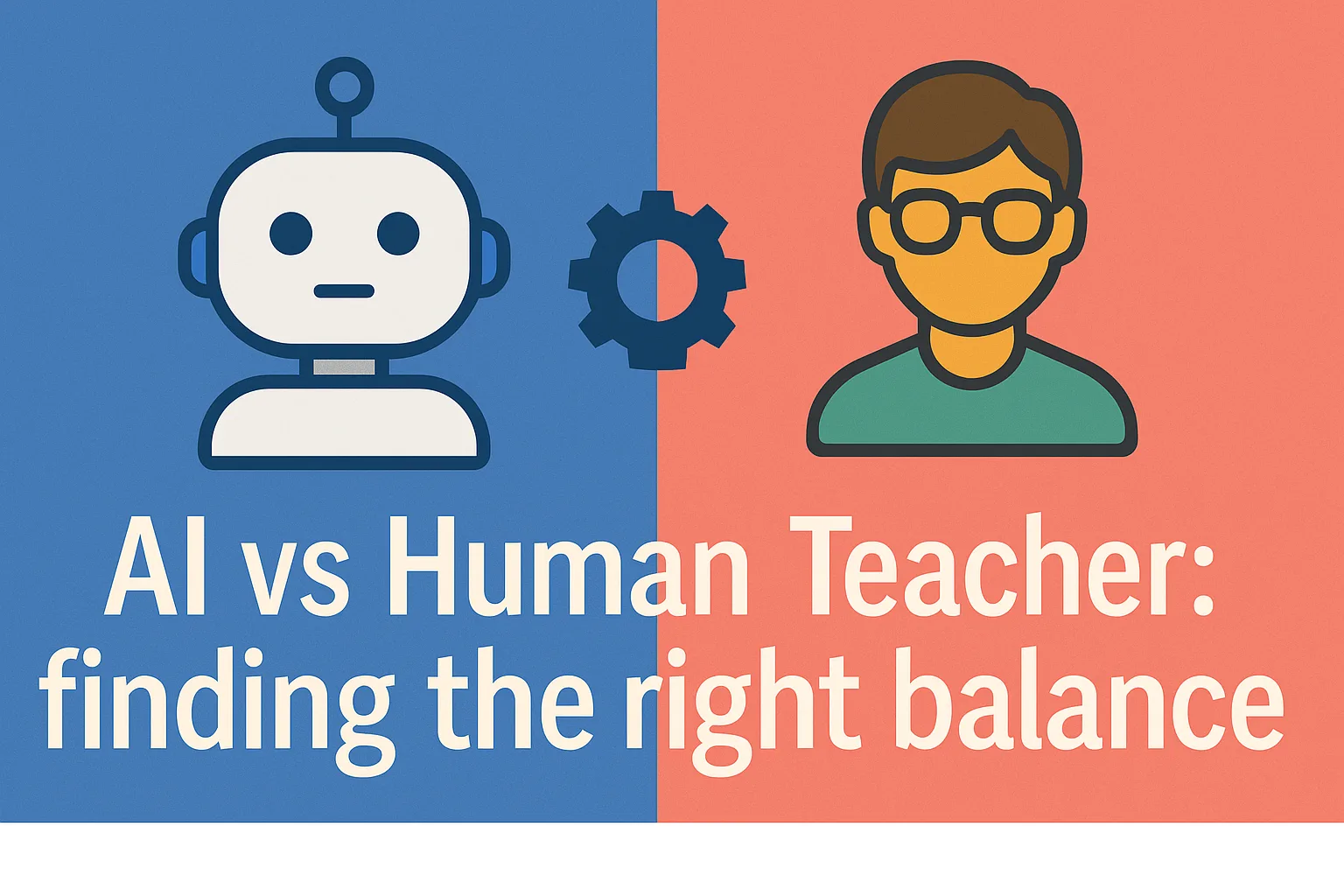
Here it is the million-dollar question: Should you learn with an AI tutor or a human teacher?
The truth is, there’s no single right answer. It all depends on your learning style, your motivation, and what keeps you engaged. Here’s a clear comparison to help you see things more clearly.
Interaction & Feedback
● AI: Offers instant and precise feedback. It detects pronunciation or grammar errors down to the millisecond.
● Human Teacher: Provides emotional and contextual feedback and knows when to correct you without killing your motivation.
Accessibility & Cost
● AI: Available 24/7, often at a lower cost or even for free. Perfect for busy schedules.
● Human Teacher: Less flexible, but every session becomes a true moment of exchange and active listening.
Personalization & Progress
● AI: Adapts lessons based on your performance and skill level. It identifies your weaknesses and automatically adjusts your learning path.
● Human Teacher: Also personalizes lessons, but through intuition and emotional understanding, a field where AI still struggles.
Motivation & Emotional Experience
● AI: Can motivate through challenges, streaks, or daily reminders, but remains impersonal.
● Human Teacher: Inspires, motivates, and creates a genuine human connection that builds confidence.
In the end, AI shines for its efficiency and availability, while human teachers bring warmth, understanding, and passion.
The ideal choice? Combine both use technology to progress faster, and human connection to truly feel the language.
In 2025: Hybrid AI + Human Tutors
The line between human learning and artificial intelligence has never been thinner. Modern education platforms no longer try to pit one against the other, they make them work together. This is what’s known as hybrid AI + human tutoring: a model where technology handles the adaptive side, tracking progress, analyzing mistakes, adjusting difficulty, while the human teacher remains at the heart of motivation and meaningful interaction.
Platforms like LanguaTalk, Preply AI and Speakly Pro are already experimenting with this approach. Their success lies in combining the precision and availability of AI with the emotional and cultural understanding of real teachers.
For instance, a human coach can now monitor several learners through an intelligent dashboard that automatically flags areas of difficulty. The AI system manages real-time evaluation, leaving the teacher free to step in where human presence matters most to encourage, reassure, and correct with empathy.
According to a 2024 study by Carnegie Mellon University, presented at the Learning Analytics and Knowledge Conference in Kyoto (China et al., 2024), this type of tutoring can double learner progress compared to purely software-based training. It’s particularly effective for struggling students, while keeping annual costs around $700, well below the price of traditional one-on-one tutoring.
Today, this hybrid approach stands out as the most promising path forward: machine drives progress, humans give it meaning.
Mini FAQ – Hybrid Tutors: Common Questions
Are hybrid tutors more expensive?
Not necessarily. Many platforms offer mixed plans where AI handles exercises between human sessions, reducing overall costs.
Does AI eventually replace the teacher?
No. In this model, AI assists the teacher rather than replaces them like a co-pilot giving educators deeper insight into each learner’s progress.
Is it really more effective?
Yes. Recent studies show that learners progress faster thanks to the consistency of AI combined with the human guidance that prevents demotivation.
Conclusion: The Perfect Balance Between AI and Humans
In the end, after looking at both sides, one thing is clear: AI tutors and human teachers each bring their own strengths and weaknesses to language learning. Artificial intelligence offers precision, availability, and personalized feedback to help learners progress in a structured, independent way. Teachers, on the other hand, bring understanding, motivation, and cultural richness that human touch that technology can’t, and maybe never will, replicate.
Together, they complement each other. AI handles the analysis and adaptation, while teachers bring meaning, emotion, and encouragement. There it is, the hybrid fusion that makes learning not only more effective, but also more human, engaging, and far more sustainable.
● Takeaway : The future of education isn’t a battle between humans and machines, it’s a smart collaboration designed to serve the learner.
Want to experience it yourself?
Discover Jolii.ai, a platform that combines the power of AI with human expertise to offer you a personalized learning journey, tailored to your pace, your level, and your unique way of learning.