First published: August 2025. Last updated: May 2026
Many language learners spend months watching Netflix, YouTube, or TikTok in their target language and still struggle to speak. The problem usually isn’t the content — it’s passive consumption. Videos become powerful language learning tools when they shift from background entertainment into active interaction with real speech, real expressions, and repeated output.
This guide covers why video works, how to use subtitles and other tools strategically, which platforms suit different learning goals, and how to build a daily routine that actually produces results.
Quick Answer: How to Learn a Language with Videos Effectively
The most effective way to learn a language with videos is through active viewing rather than passive watching. Choose content slightly above your current level (i+1), use subtitles strategically, repeat short scenes multiple times, shadow native speakers aloud, and actively reuse the vocabulary and expressions you hear. Videos work best when they combine comprehensible input with speaking practice, repetition, and emotional engagement.
Why Video Is One of the Best Tools for Language Learners
Text and audio give you one signal at a time. Video gives you several simultaneously — speech, facial expressions, body language, setting, and cultural context all working together. That combination is why video produces faster comprehension gains than most other formats, particularly at beginner and intermediate level when your listening alone isn’t strong enough to carry full understanding.
Three specific advantages make video particularly effective for language learners:
Real speech patterns. Authentic video content — films, vlogs, interviews, news — exposes you to how people actually speak rather than how textbooks present language. Contractions, filler words, regional accents, and natural rhythm all appear in video in ways that scripted audio exercises rarely replicate.
Cultural context. Language and culture are inseparable. Watching native content gives you the cultural associations, social norms, and implied meanings behind expressions that no dictionary definition captures. Understanding why something is funny, rude, or formal in your target language requires cultural immersion — and video is the most accessible form of it.
Flexible input levels. Video works at every stage of learning. Beginners benefit from visual context filling comprehension gaps. Intermediate learners use it to absorb natural speech patterns. Advanced learners use authentic content to close the gap between textbook language and native-level fluency.
How to Use Video Actively to Build Vocabulary and Listening Skills
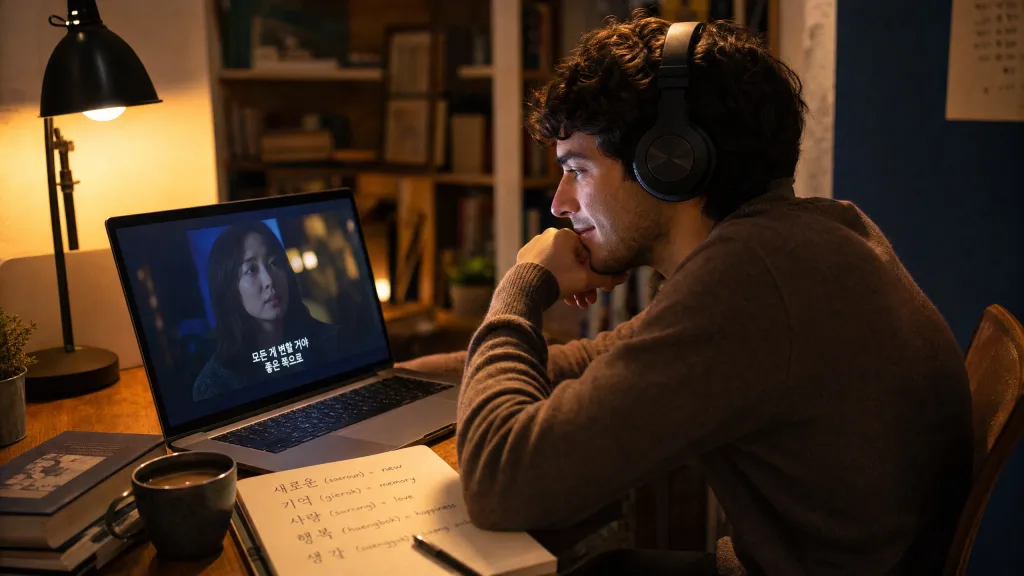
Passive watching builds comprehension slowly. Active watching builds comprehension and production simultaneously. The difference isn’t how much you watch but how you watch.
Use subtitles strategically. Start with subtitles in your target language rather than your native one. As your listening improves, watch a scene without subtitles first, then check to fill gaps. Bilingual subtitles work for complete beginners but should be phased out quickly.
Shadow what you hear. Repeat speech immediately after — or simultaneously with — the speaker, mimicking pace, rhythm, and intonation. Start with 30–60 second scenes. The goal isn’t perfect accuracy — it’s physical familiarity with how the language sounds coming out of your mouth.
Learn with music and lyrics. Songs reinforce the same vocabulary and structures as video but with repetition built in. Use lyrics actively — read along, identify grammar patterns, look up recurring expressions. The music analyses on this site break down specific songs in Spanish and Italian line by line using the same method.
Keep a vocabulary journal. Write down phrases and expressions in context — not isolated words. A phrase learned in a memorable scene sticks far longer than a vocabulary list entry. Review entries from the previous session before starting a new one.
Rewatch before moving on. Rewatching the same short scene two or three times across different days produces stronger retention than watching three different scenes once each. The third watch is where patterns start feeling automatic.
Control your pace. Pause, rewind, and replay whenever something is unclear. Slowing to 0.75x for dense dialogue is not cheating — it’s calibration.
Choosing the Right Videos for Your Level and Goals
The biggest mistake language learners make with video is choosing content that’s either too easy or too overwhelming. Both stall progress. Especially content that is too difficult can kill motivation and confidence.. it happened to me before and I know how frustrating it can be.
The guiding principle is i+1 — content that’s mostly understandable at your current level but includes a few new words, grammar structures, or expressions to push you forward. Too far below your level and you’re not learning. Too far above and you’re guessing rather than acquiring.
Beginners (A1–A2): Look for slow, clearly articulated speech — children’s shows (Peppa Pig is particularly good), beginner YouTube channels, and language learning series designed for new learners. Visual context does a lot of the comprehension work at this stage, so content with strong visual cues helps significantly. Short videos of two to three minutes are more manageable than full episodes.
Intermediate learners (B1–B2): This is where authentic content becomes genuinely useful. Choose shows and films with dialogue-heavy scenes rather than action-heavy ones — conversations give you more usable language per minute than chase sequences. Pay attention to register: formal, informal, regional. Mixing content from different Spanish-speaking countries or Italian regions at this stage builds flexibility.
Advanced learners (C1+): Dive into unscripted content — interviews, podcasts with video, documentaries, stand-up comedy. These expose you to natural hesitation, filler words, overlapping speech, and humour — the aspects of language that scripted content smooths out and that AI tools rarely replicate well.
Regardless of level: Choose content you actually want to watch. Motivation is the most underrated variable in language learning. A show you’re genuinely curious about will hold your attention through confusion in a way that educational content rarely does.
Top Platforms for Learning a Language with Video Content
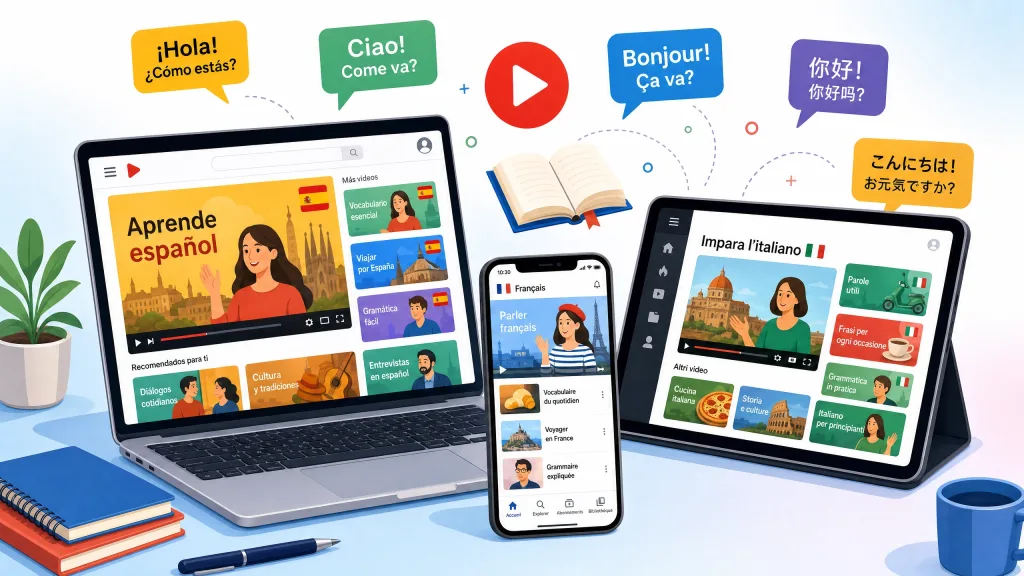
Learning a language with videos is achievable at a very low cost. Several platforms offer a wide variety of content. Here are some top options and how to get the most from them.
YouTube: The most accessible starting point for any language and any level. Search for content on topics you already care about in your target language — cooking, travel, sport, comedy — rather than defaulting to channels made specifically for language learners. Authentic content produced for native speakers is more valuable at intermediate level and above than scripted educational videos.
For structured learning, channels like Easy Languages offer street interviews with native speakers and dual subtitles across dozens of languages. Combine YouTube with an app like Jolii, which adds interactive exercises, vocabulary reviews, and speaking practice to any YouTube video you import.
Netflix: Ideal for immersive learning through longer-form content. Choose shows with everyday dialogue and culturally relevant themes — or rewatch something you already know in your native language, which reduces the cognitive load of following the plot and lets you focus on the language.
Jolii integrates directly with Netflix content, turning episodes into structured lessons with vocabulary tracking, comprehension checks, and AI speaking practice built around what you just watched.
Jolii: Where YouTube and Netflix provide the raw input, Jolii converts it into active learning. Import any video, and Jolii generates interactive exercises, pronunciation feedback, and personalised vocabulary review based on your level and the specific content you watched. It’s the difference between watching in your target language and actually learning from it.
How to Maximize Results from Language Learning Video Lessons
The gap between learners who improve quickly and those who plateau usually comes down to one thing: output. Watching is input. Speaking, writing, and reproducing what you’ve heard is output. Both are necessary — input alone is never enough.
A few principles that apply regardless of level or language:
Balance passive and active watching. Not every session needs to be intense. Watching something you enjoy without pausing or analysing is valuable for building familiarity and staying motivated. But at least some of your watching time should be active — pausing, rewinding, shadowing, noting. Find a ratio that keeps you consistent without burning out.
Prioritise speaking early. Most learners delay speaking until they feel ready. That feeling rarely arrives on its own. Use shadowing, self-talk, and AI conversation practice to start producing the language from the beginning — even badly. Speaking badly early is better than speaking perfectly late.
Use AI to close the feedback gap. The biggest limitation of self-directed video learning is the absence of correction. You can watch for months and reinforce the same errors without realising it. AI tools like Jolii provide real-time feedback on pronunciation and grammar, turning solo practice into something closer to tutored learning.
Stay consistent over intensity. Thirty minutes daily produces faster progress than three hours once a week. Video learning fits naturally into existing routines — commuting, eating, exercising. The learners who improve fastest are rarely the ones who study hardest in a single session. They’re the ones who show up every day.
.
Are Free Video Resources Enough? (And What to Combine Them With)
For most learners, free resources are enough to make significant progress — YouTube alone contains more language learning content than anyone could consume in a lifetime. The real limitation of free resources isn’t quantity, it’s structure.
What free resources do well:
- Unlimited authentic content across every language and level
- Flexible and self-paced with no pressure or deadlines
- Genuinely excellent channels like Easy Languages, BBC Learning English, and countless native-speaker creators
Where they fall short:
- No feedback on your output — you can watch indefinitely without anyone correcting you
- No progress tracking — it’s hard to know what you’ve retained or what to focus on next
- Time-consuming to curate — finding the right content at the right level requires effort that could go into learning
What paid or premium tools add: Not a replacement for free content but a layer on top of it. The most useful additions are personalised feedback, spaced repetition for vocabulary review, and speaking practice with correction — things free video platforms don’t offer.
Jolii bridges both worlds — import free YouTube or Netflix content and get the structured learning layer on top. You keep the authentic content you already watch and add the feedback and tracking that free platforms can’t provide.
Conclusion
Video is one of the most powerful tools available for language learners — but only when used actively. Passive consumption builds familiarity. Active engagement builds fluency.
The method is simple: choose content at the right level, watch with intention, shadow what you hear, note what you learn, and rewatch before moving on. Add music and lyrics for variety. Use subtitles as a scaffold, not a crutch.
The platforms are accessible and mostly free. The content is unlimited. The only variable is how deliberately you use it.
If you want structure built around the content you already watch, Jolii turns any video into a personalised lesson — vocabulary tracking, pronunciation feedback, and AI speaking practice included.
Start with one short video today. Watch it twice. That’s enough.