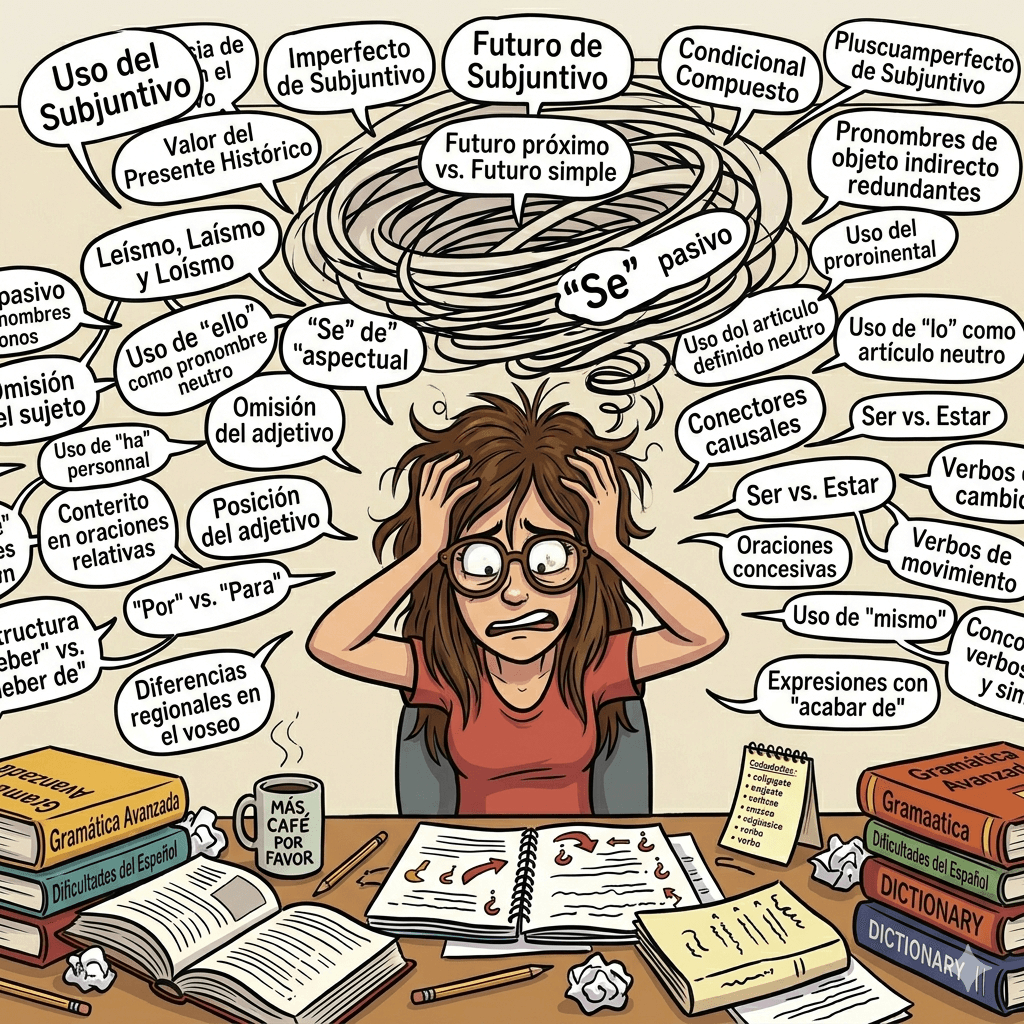
You freeze when you try to speak a foreign language because speaking requires real‑time production under pressure, while your brain is trained mainly for understanding. Accuracy monitoring and stress create a temporary production bottleneck that blocks speech.
Why This Feels So Frustrating
Short answer: Because your understanding is ahead of your speaking, and your brain notices the gap the moment you’re put on the spot.
If you can follow a Netflix episode, understand a podcast, or read articles in your target language but suddenly go blank when it’s your turn to speak, you’re not failing. You’re stuck in a very common learning gap.
Most adult learners hit this wall after the beginner stage. You know the words exist. You can recognize them instantly. But when you try to speak, your mind goes silent or painfully slow. The result feels like panic, embarrassment, or the urge to switch back to your native language.
This freeze isn’t random. In our experience working with adult learners who already understand real content, it follows a very consistent cognitive pattern with specific causes.
What Actually Happens in Your Brain When You Freeze
Short answer: Your brain switches from understanding mode to self-monitoring mode, slowing or blocking speech.
What learners experience here is often called an output inhibition or production bottleneck: your brain understands the language but temporarily blocks access to it under pressure.
1. Your Brain Freezes
When adult learners freeze, it’s rarely because they don’t know the language. It’s because their brain is prioritizing error control over communication.
Freezing happens when production hasn’t been trained enough to keep up. We see this most often in learners who consume a lot of authentic input but rarely practice structured speaking, as illustrated in Why I Could Read Spanish Fluently but Still Avoided Speaking.
2. Your Brain Switches Into “Accuracy Mode”
Adult learners care deeply about sounding correct. When you open your mouth, your brain tries to:
- Avoid mistakes
- Avoid embarrassment
- Avoid sounding “bad”
That internal filter slows everything down. If the sentence isn’t ready and correct, your brain pauses output entirely.
This is not shyness. It’s cognitive self-monitoring, a pattern we repeatedly observe in adult learners who care deeply about accuracy.
3. Stress Temporarily Blocks Language Access
Speaking activates social pressure. Even low‑stakes situations (ordering coffee, answering a question) can raise stress levels. Stress reduces access to:
- Vocabulary recall
- Grammar patterns
- Automatic phrasing
That’s why you remember the word five minutes later, once the pressure is gone.
A Real‑World Example You’ll Recognize
You’re watching a show in your target language. Someone asks a simple question:
“Where are you from?”
- You understand it instantly.
- You know the answer.
But when you try to respond, your brain stalls:
- Do I use past tense?
- Is the preposition correct?
- What if my accent sounds bad?
By the time your brain finishes checking, the moment has passed.
Real learner example:
In one of our speaking programs, a learner who could easily follow full Netflix episodes in Spanish completely froze when doing simple tasks like ordering coffee or introducing herself. She knew the vocabulary and grammar, but under time pressure her brain switched into self-monitoring mode and blocked output.
After two weeks of short timed speaking drills and shadowing familiar phrases from shows she already understood, her response speed improved noticeably and her hesitation dropped. The content didn’t change, the way her brain accessed it did.
How Different Language Skills Affect Speaking Fluency
| Language skill | What the brain does | Time pressure | Error monitoring | Why it feels easy or hard |
| Listening | Recognizes words and meaning automatically | None | None | You can focus only on understanding, not producing language |
| Reading | Decodes meaning at your own pace | Low | Low | You control the speed and can reread when needed |
| Speaking | Retrieves words, builds sentences, and pronounces them in real time | High | High | Your brain must produce and monitor language at the same time |
| Speaking under pressure | Produces language while anticipating judgment or mistakes | Very high | Very high | Error control overrides communication, causing freezing |
Why More Grammar or Vocabulary Doesn’t Fix This
Short answer: Because freezing is not a knowledge problem, but a retrieval and automation problem.
From a teaching and product-testing perspective, this is one of the most persistent misconceptions we see.
Many learners try to solve freezing by studying more:
- More verb tenses
- More word lists
- More rules
You don’t need more information. You need practice moving from understanding → speaking without stopping to analyze.

What Helps You Stop Freezing (And Why)
At Jolii.ai, we refer to this breakdown as the Speakability Gap — the gap between what a learner can understand effortlessly and what they can produce under pressure. Closing this gap requires training language in forms that are immediately usable, not just recognizable.
Short answer: You reduce freezing by lowering cognitive load and training automatic speech patterns.
1. Train Short, Complete Responses
Your brain needs safe, repeatable speaking units. So, instead of generating sentences from scratch, practice:
- Fixed phrases
- Short reactions
- High‑frequency sentence patterns
This reduces decision‑making load.
2. Practice Speaking Without Time to Overthink
Fluency improves when you remove the pause for self‑correction. Techniques that help:
- Timed responses
- Shadowing audio
- Speaking along with subtitles
The goal is not perfection. It’s continuity.
3. Connect What You Understand to What You Say
If you already understand real content, your speaking practice should come from that same material, not isolated drills.
Using familiar phrases from shows, videos, or conversations lowers cognitive effort and increases confidence.
The Speakability Gap, Explained
| Stage | What the learner can do | What breaks down | Why freezing happens |
| Understanding | Recognize words, phrases, and meaning instantly | Nothing — comprehension is automatic | No time pressure, no output required |
| Preparing to speak | Knows what they want to say | Sentence planning slows down | Brain starts monitoring accuracy |
| Speaking under pressure | Must retrieve words + grammar in real time | Retrieval stalls | Error control overrides communication |
| After the moment | Remembers the correct sentence | Access returns | Stress drops, monitoring relaxes |
How Jolii.ai Fits Into This Gap
Jolii.ai is designed specifically for learners who understand real content but freeze when speaking. Instead of starting from rules, Jolii.ai:
- Uses authentic material you already comprehend
- Breaks it into speakable chunks
- Helps you practice turning recognition into output
The focus is not “learning more Spanish,” but learning how to use what you already know.
FAQs
Why do I understand everything but can’t speak?
Because comprehension develops faster than production. Speaking requires real‑time retrieval and self‑monitoring, which needs separate training.
Is freezing a sign I’m bad at languages?
No. Freezing is a normal stage for adult learners with strong passive skills but low speaking automation.
Will speaking more eventually fix this?
Only if speaking practice is structured to reduce pressure and overthinking. Random conversation alone often reinforces freezing.
Does freezing ever go away?
Yes. Once speaking patterns become automatic, your brain stops blocking output and fluency improves quickly.
Should I wait until I feel ready to speak?
No. Readiness comes after speaking practice, not before.