Quick Answer (TL;DR)
You don’t need to speak early to learn a language. During the silent period, your brain builds patterns through listening and context, making speaking easier and more natural later.
You don’t need to force yourself to speak early to make progress in a new language.
In fact, in many cases, staying silent for a period—while focusing on listening and understanding—actually helps your brain build the foundation needed for confident speaking later.
So this “silent period” is not a delay.
It is preparation.
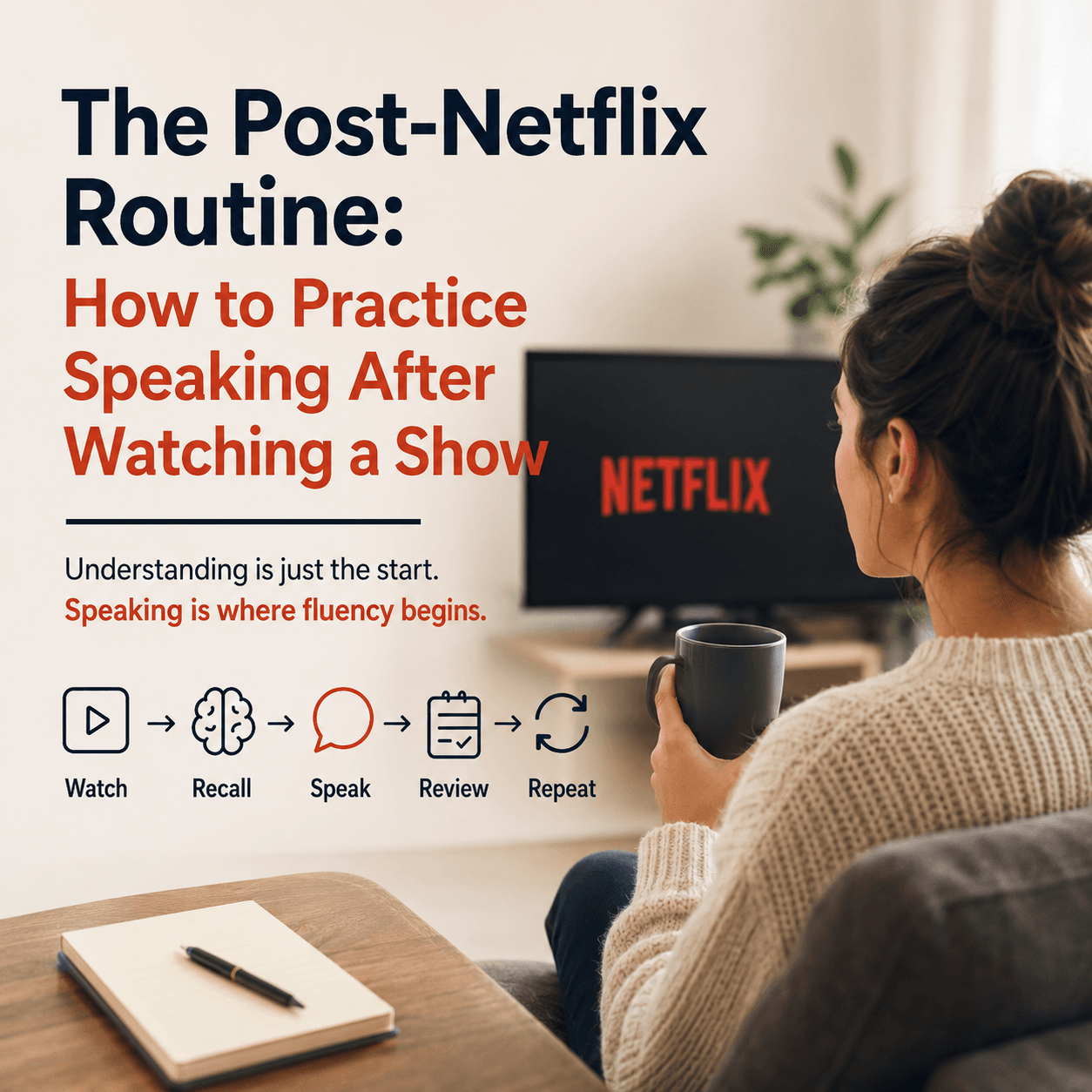
This guide focuses specifically on how to use Netflix during the silent period — what to watch, how long, and how to engage with it actively rather than passively. For the research and psychology behind why waiting to speak is a legitimate strategy in the first place, The “Speak From Day 1” Myth covers the full case, including why early speaking can cause fossilized errors.
Why Many Learners Feel Pressure to Speak Too Early
Because of this, many learners push themselves to:
“If you don’t speak, you’re not learning.”
So learners push themselves to:
- Respond quickly
- Form sentences before they feel ready
- “practice speaking” even when everything feels unclear
At first, this feels productive.
Like you’re doing the “real work.”
But something often happens underneath.
You start hesitating more, and your thoughts slow down as you try to translate everything in your head.
As a result, mental overload builds up quickly, making speaking feel heavier than it should.
And over time, speaking becomes stressful instead of natural.
The issue is not effort.
It’s timing.
That pressure often comes from a high affective filter — explored in The Affective Filter — where anxiety actively blocks the brain’s ability to process and produce language.
The Cognitive Insight: Why the Brain Needs a Silent Period
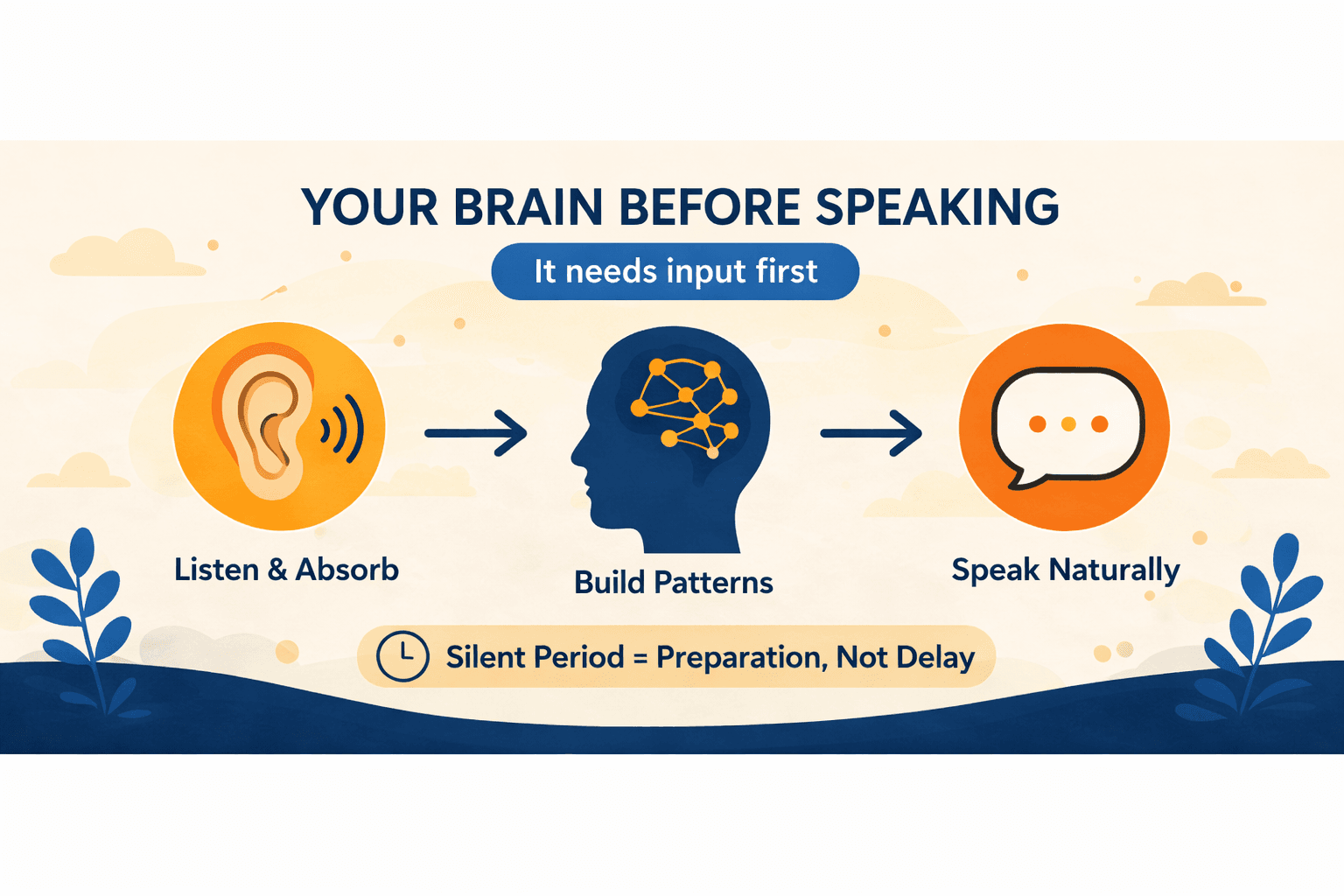
Before the brain can produce language, it needs to build internal patterns.
This is where a few key ideas matter:
1. Recognition vs Retrieval
At the beginning, your brain is still learning to recognize:
- Sounds
- Word boundaries
- Sentence patterns
But speaking requires retrieval:
- Pulling language out
- Assembling it in real time
- Adapting to context
If recognition is weak, retrieval becomes unstable.
2. Exposure vs Study
Studying teaches you about the language.
Exposure teaches your brain how it actually behaves.
During the silent period, exposure becomes more important.
This is because your brain is:
- Absorbing rhythm
- Noticing patterns
- Building familiarity
Without this stage, speaking eventually feels forced.
3. Efficiency vs Precision
When learners speak too early, the brain often prioritizes:
👉 “say something quickly”
Instead of:
👉 “say something correctly”
This creates habits that are:
- Imprecise
- Hard to fix later
As a result, the silent period gives your brain time to build clean patterns first.
4. Multimodal Input & Pattern Recognition
When you watch Netflix, language doesn’t come as separate pieces.
Tone, emotion, and situation all arrive together, and your brain starts linking them automatically.
This creates stronger memory connections.
Your brain is not memorizing words.
It is recognizing patterns across situations.
That’s what speaking will later rely on.
This reflects Krashen’s Input Hypothesis along with broader research on multimodal learning — combining visual, auditory, and contextual signals strengthens language processing and retention more effectively than any single channel alone.
In simple terms, this means:
Your brain needs to experience language before it can use it.
A Moment I Realized This Myself
There was a time when I tried to force myself to speak Korean every day.
Even when I wasn’t ready.
I would:
- Build sentences slowly
- Translate in my head
- Second-guess every word
And conversations felt… heavy.
Eventually, I stopped pushing.
Instead, I spent more time just watching shows.
Not passively—but paying attention.
Short scenes.
Repeated lines.
Natural reactions.
Then, after a few weeks, something changed.
I didn’t “try” to speak anymore.
But when I did, sentences came out more smoothly.
Not perfect.
But less forced.
That was the first time I understood this:
👉 The brain speaks better when it has seen enough patterns.
Silent Period vs Forced Speaking
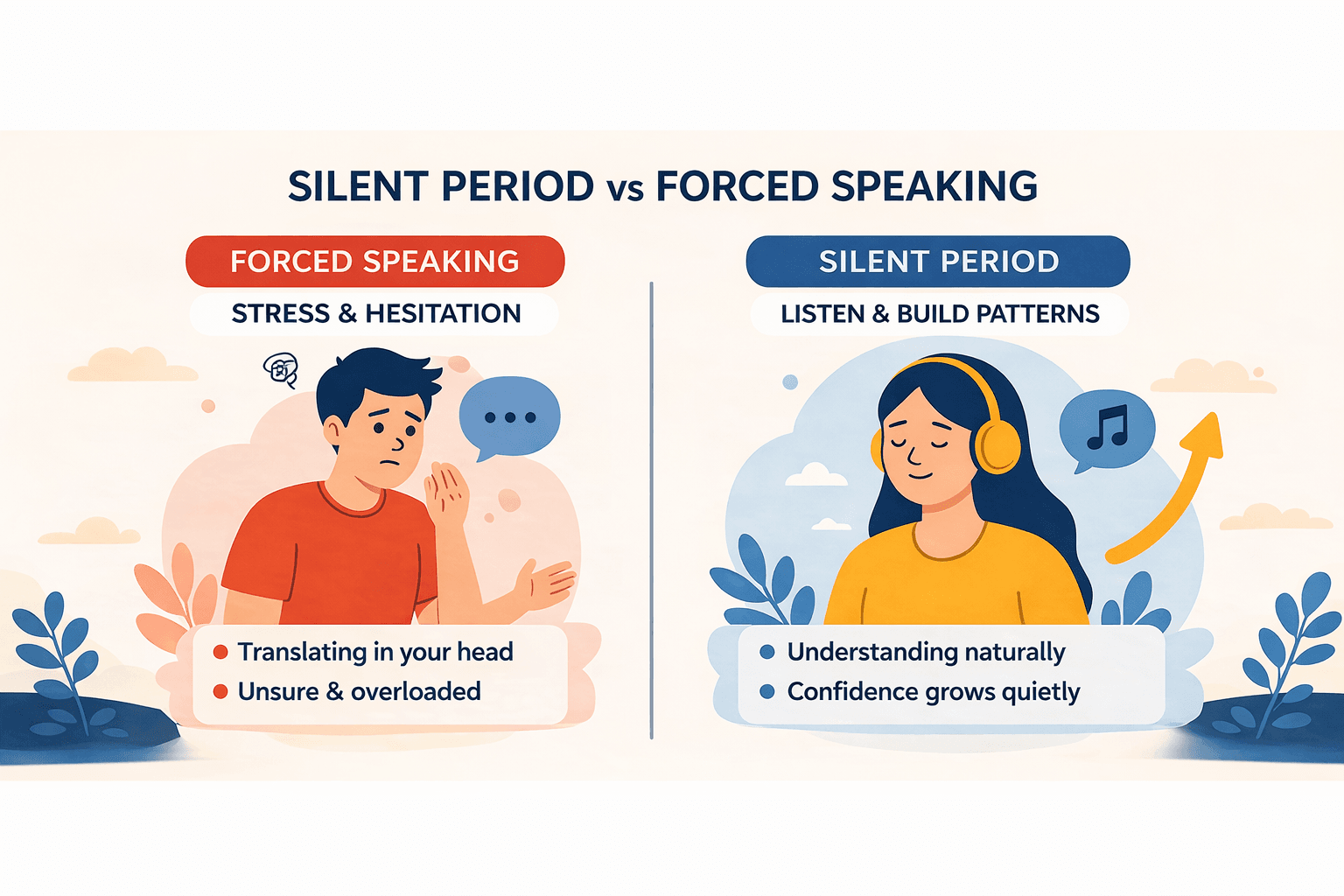
| Learning Phase | What It Feels Like | What the Brain Is Doing |
| Forced speaking early | Stressful, slow, unnatural | Struggling to retrieve without patterns |
| Silent period | Passive but stable | Building recognition and patterns |
| Post-silent speaking | More natural, smoother | Retrieving from established patterns |
How to Use Netflix During the Silent Period
At this stage, the goal is not to “just watch.”
It’s to build usable language patterns.
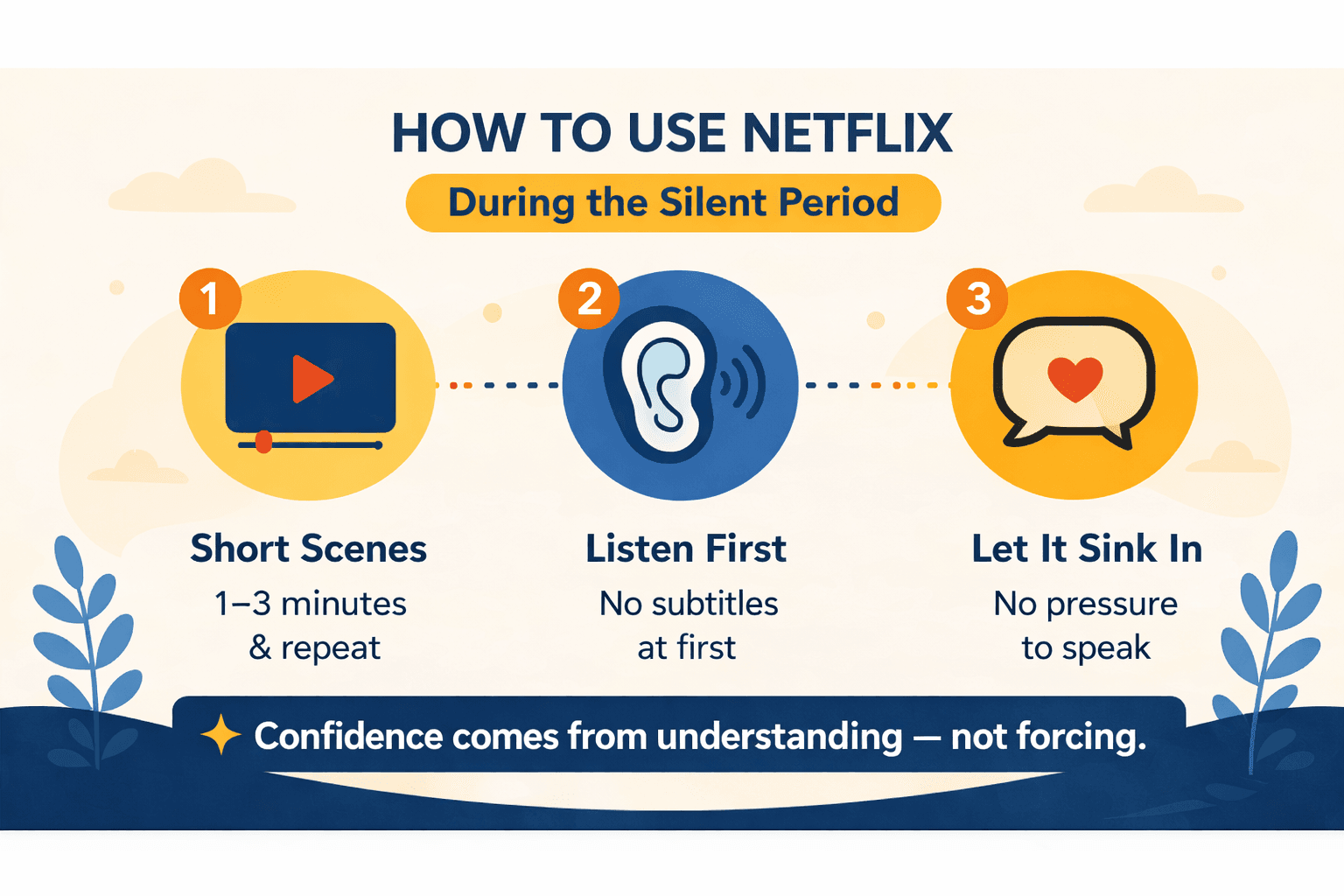
1. Focus on Understanding, Not Speaking
Do not force output.
Instead:
- Follow the meaning
- Observe reactions
- Notice how sentences are used
This builds internal clarity.
2. Use Short, Repeatable Scenes
Avoid full episodes.
Work with:
- 1–3 minute segments
- Simple conversations
- Emotional moments
Over time, repetition helps patterns stick.
3. Let Listening Lead (Not Reading)
One common mistake during the silent period is relying too much on subtitles.
As a result, this creates a hidden problem:
👉 your brain reads instead of listens
If you want to transition properly, this article explains it in detail:
👉 Stop “Reading” Netflix: How to Transition from Subtitles to Pure Listening
So the key idea is simple:
- Listen first
- Use subtitles as support
- Gradually reduce dependence
Because real speaking depends on sound, not text.
Why the Silent Period Builds Confidence
Confidence does not come from speaking more.
Instead, it comes from:
It comes from:
👉 understanding more
When your brain:
- Recognizes patterns quickly
- Predicts what comes next
- Feels familiar with the language
Speaking becomes easier automatically.
Without that foundation, speaking feels like guessing.
There is another layer behind this.
Understanding doesn’t come from words alone.
It comes from context.
During the silent period, your brain is not just hearing language.
It is connecting tone, situation, and meaning at the same time.
That is why some scenes suddenly feel clear—even if you don’t know every word.
Your brain is using context to fill the gaps.
This is also why watching random content is not always effective.
Without clear context, language remains fragmented.
If you want to understand how this process works more deeply, you can explore it here:
👉 Context is King: How Netflix & Jolii AI Rewire Your Brain for Fluency
Because in the end, confidence doesn’t come from speaking more.
It comes from understanding faster.
Practical Framework: The Silent Period Strategy
Step 1 — Build Daily Exposure
- 10–20 minutes
- Short scenes
- Consistent repetition
👉 Why: frequency builds familiarity
Step 2 — Train Listening First
- Focus on sound
- Not subtitles
- Replay unclear parts
👉 Why: speaking depends on listening
Step 3 — Allow Natural Output
- Don’t force speaking
- Let it emerge gradually
👉 Why: retrieval becomes easier when patterns exist
FAQs
1. Do I need to speak from day one?
No. Early speaking is not required for progress. Understanding comes first.
2. How long should the silent period last?
It depends on exposure. For many learners, a few weeks of consistent input is enough to notice change.
3. Will I forget how to speak if I don’t practice?
No. You’re building the system that speaking depends on.
4. Is Netflix enough for this stage?
It can be very effective if you actively engage with the content instead of watching passively.
A Simple Way to Make This Work
The challenge with the silent period is balance.
Too passive → no progress
Too forced → burnout
That’s where tools like Jolii help.
Instead of choosing between:
- Watching
- Or studying
You combine both.
You can:
- Watch short scenes
- Replay naturally
- Notice patterns without breaking the flow
So learning happens inside the experience, not outside it.
Final Thoughts
The silent period is often misunderstood.
It looks like:
👉 doing nothing
But internally, your brain is doing something very important.
It is:
- Organizing sound
- Building patterns
- Connecting meaning
Speaking is not the beginning of learning.
It is the result of it.
And when you give your brain enough time to absorb the language first,
something changes.
Speaking no longer feels like effort.
It starts to feel like recognition—
just happening in reverse.