First published: February 2026. Last updated: May 2026
Is it normal to understand more than you can say in a foreign language?
Yes. This happens because comprehension (listening and reading) develops faster than speaking. Understanding is passive and recognition-based, while speaking requires active recall, sentence construction, and real-time pronunciation. This pattern is a normal part of language learning.
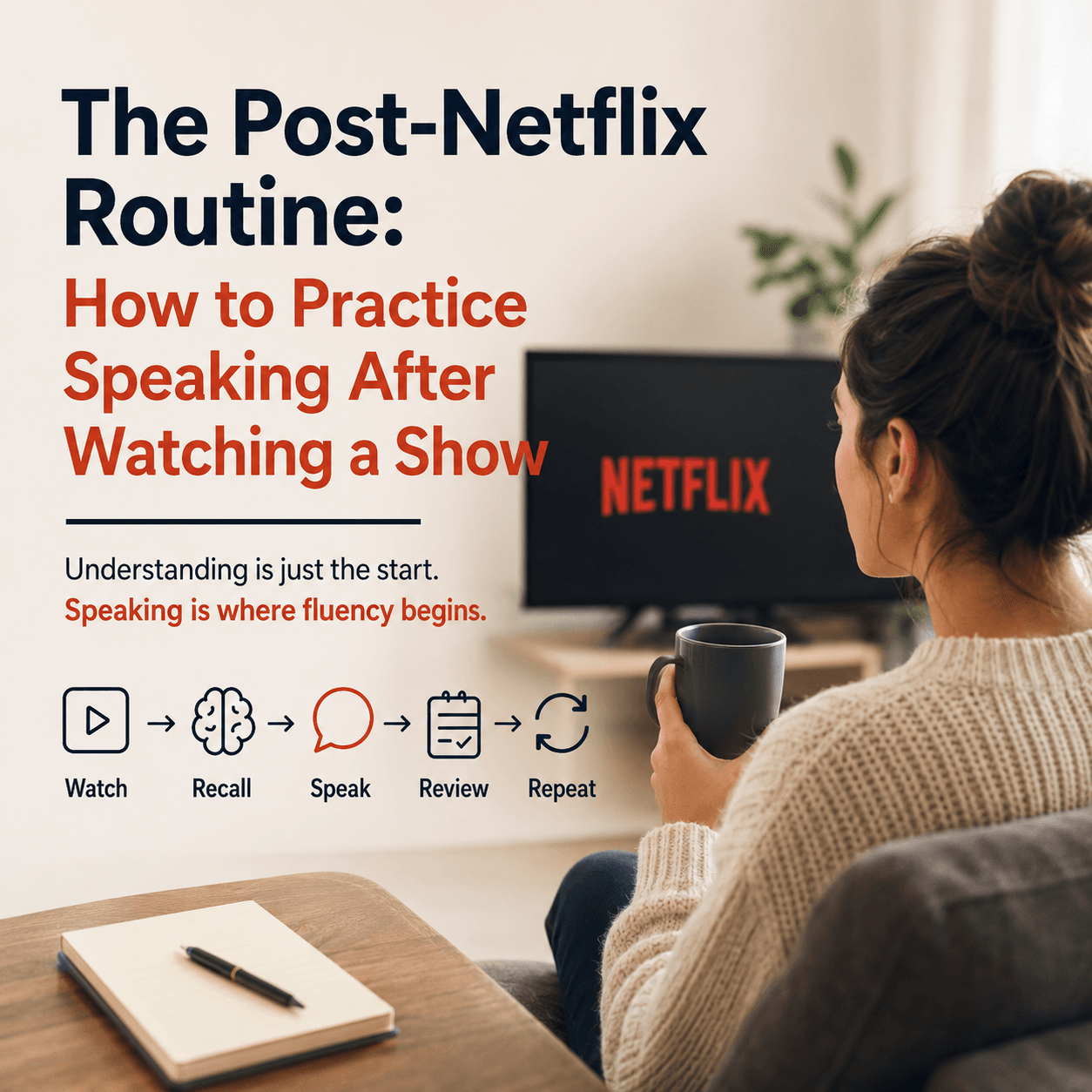
This is why you’ll binge-watch an entire Spanish drama series without subtitles or nod along to French podcasts during your commute, but the second you try to speak to someone? Crickets.
Most language learners experience the input-output gap, where they understand but can’t speak. So what causes this gap? And how can you bridge it? Let’s break it down:
Why Is It Normal to Understand More Than You Can Say in a Foreign Language?
It all comes down to a phenomenon called receptive-productive asymmetry.
Basically, your brain is way faster at processing language when you’re listening or reading (the receptive) than when you’re trying to speak or write (the productive).
Understanding requires recognition. You hear a word, and your brain goes, “Oh yeah, I know that one.”
On the other hand, speaking demands active retrieval. Your brain has to fish that word out of storage, construct a grammatically correct sentence, and produce it with proper pronunciation, all in real time.
Research consistently shows that second language learners have major difficulties developing productive vocabulary skills despite strong receptive knowledge. A 2022 study by Teng and Xu published in Language Teaching Research found that productive tasks — speaking and writing exercises — produced significantly stronger vocabulary recall than receptive tasks like reading and listening, regardless of how many times learners were exposed to the material. Repetition alone doesn’t close the gap. Output does.
And it all makes sense because when you’re listening or reading, your brain just needs to match sounds or written words to meanings you’ve already stored. But when you’re speaking, you have to use more cognitive effort to create meaning from scratch.
This is the same pattern explored in depth in Why Passive Watching Doesn’t Build Speaking Skills — if you’ve ever felt fluent while watching a show but frozen when speaking, that article explains exactly why.
Understanding vs. Speaking: What’s the Difference?
Here’s what’s actually happening:
| When You Understand | When You Speak |
| Recognize familiar words | Retrieve words from memory |
| Context helps fill gaps | Must create context yourself |
| Process at your own pace | Respond in real time |
| Errors don’t matter | Fear of mistakes increases |
| Passive recognition only | Active grammar construction required |
| Can replay or reread | One shot to get it right |
How Long Does This Gap Usually Last?

The honest answer. It varies, but the gap is widest during the intermediate plateau phase. This stage is often referred to as the A2 to B1 transition, which is where many learners feel stuck and eventually give up, even though real progress is happening under the surface.
For most learners, the understanding-speaking gap begins to narrow noticeably after months of consistent output practice (not just input). You need to ask yourself:
- Are you dedicating enough time to practice the language?
- What tools are you using to help you speak much faster?
The truth is your input-to-output ratio matters most. If you’re watching hours of content on Netflix or YouTube but never speaking, the gap widens.
Many learners report feeling “fluent” while watching content, only to freeze completely when asked a simple question in real life.
Language similarity plays a role too. For instance, Spanish speakers learning Italian might close the gap faster, thanks to the shared vocabulary between the two languages.
The bottom line? You need to practice consistently if you want to build your conversational skills.
How Do You Turn Understanding Into Speaking?

The understanding you’ve built is the foundation. Now you need to activate it.
Shadow Real Content
When was the last time you listened to native speakers?
Repeating what native speakers say in real time — mimicking their intonation, rhythm, and pronunciation — builds fluency faster than any passive method. It forces your mouth to produce sounds your ear is still calibrating to.
The most effective version of this combines shadowing with content you already enjoy. Jolii turns YouTube videos and songs you already watch into structured speaking practice — so instead of passively consuming content you understand, you’re actively producing language from it. That’s the fastest way to close the recognition-retrieval gap.
Practice Retrieval
Yes, you already recognize the German words. You can read “Ich bin müde” (I am tired) and immediately know what it means. But can you produce that sentence when you’re actually tired without looking at your notes? That’s the difference.
Here’s what to do: After watching a video or reading an article, close it and try to summarize what you learned out loud. Force your brain to retrieve the vocabulary. This is called active recall. Neurologically, it has been shown to strengthen memory pathways.
Lower Your Speaking Standards (Temporarily)
You’re allowed to sound like a learner for a while. In fact, for a long while!
You’re allowed to sound like a learner for a while. Trying to be perfect from day one creates a paralysis that stops output before it starts.
Linguists call the intermediate stage of language production interlanguage — the systematic, rule-governed language that learners produce while moving between their native language and the target language. As Stephen Krashen and others have noted, interlanguage errors are not failures. Instead, they are evidence that acquisition is happening. Every mistake you make in speech is your brain testing a hypothesis about how the language works.
Whenever you’re afraid to speak, remember this: you’re not supposed to speak perfectly. Your goal is to communicate. If your message comes through, you’ve succeeded. I always repeat this to my students and to myself when trying to speak another language I am not confident with.
Your goal right now is activation — getting words out of recognition and into production, even imperfectly. In practice that looks like:
- Ordering coffee in your target language even when you know the server speaks English
- Describing a film you watched to yourself in the car, badly, without stopping to find the right word
- Sending a voice message to a language exchange partner in your target language instead of typing it
Make grammar mistakes. Mispronounce words. Get the sentence out. Accuracy improves through practice, not through waiting until you feel ready. Your interlanguage today is not your final language — it’s the bridge to it.
Create Output Routines
Language output takes time. But you can start by narrating your cooking or recording voice memos describing your day.
These small, low-pressure speaking habits add up faster than you think.
Final Takeaway
The gap between understanding and speaking is not a sign that something has gone wrong. It’s a predictable stage in language acquisition — one that every learner passes through and that closes reliably with the right kind of practice.
The shift happens when you stop treating output as a test of your current level and start treating it as the method for reaching the next one. You already have the foundation. The only thing left is to use it — imperfectly, consistently, and starting now.
FAQs
Why can I understand a language but not speak it? Because comprehension and production use different cognitive processes. When you listen or read, your brain matches incoming sounds or words to meanings already stored — a recognition task. When you speak, your brain has to retrieve words independently, construct grammatically correct sentences, and produce them in real time with correct pronunciation. These are separate skills that develop at different rates, and input practice only trains the first one.
How long does the gap last? It varies significantly depending on how much deliberate output practice you do. The gap is widest at the intermediate plateau — roughly A2 to B1 — where comprehension feels strong but speaking still freezes. Most learners notice meaningful improvement within a few months of consistent speaking practice. The key word is consistent — occasional speaking sessions don’t move the needle the way daily output does, even in small amounts.
Will I ever speak as well as I understand? Yes — but it requires deliberately practising production rather than just consuming more input. Shadowing, active recall, and low-pressure speaking practice are the most effective methods. Most learners who close the gap do so by committing to speaking output daily, even for just ten to fifteen minutes, rather than waiting until they feel ready.
Should I wait until I feel ready to speak? No — and this is the most common mistake intermediate learners make. The feeling of readiness doesn’t come from more input. It comes from speaking itself. Start in low-pressure settings: narrate your day aloud, describe what you just watched, record voice memos. Each small output session builds the retrieval pathways that make the next one easier.
Does the gap affect some languages more than others? Yes. Languages that share vocabulary with your native language — Spanish and Italian for English speakers, for example — tend to produce a smaller gap because recognition transfers more directly to production. Languages with very different structures, scripts, or sound systems — Mandarin, Arabic, Japanese — typically produce a wider and longer-lasting gap because both comprehension and production require building from scratch.