TL;DR
Forgetting words while speaking a foreign language is normal and happens even at advanced levels. Instead of stopping the conversation, learners should use strategies like paraphrasing, filler expressions, and contextual description to keep communication flowing. With immersive practice and real conversation exposure, this skill improves naturally over time.
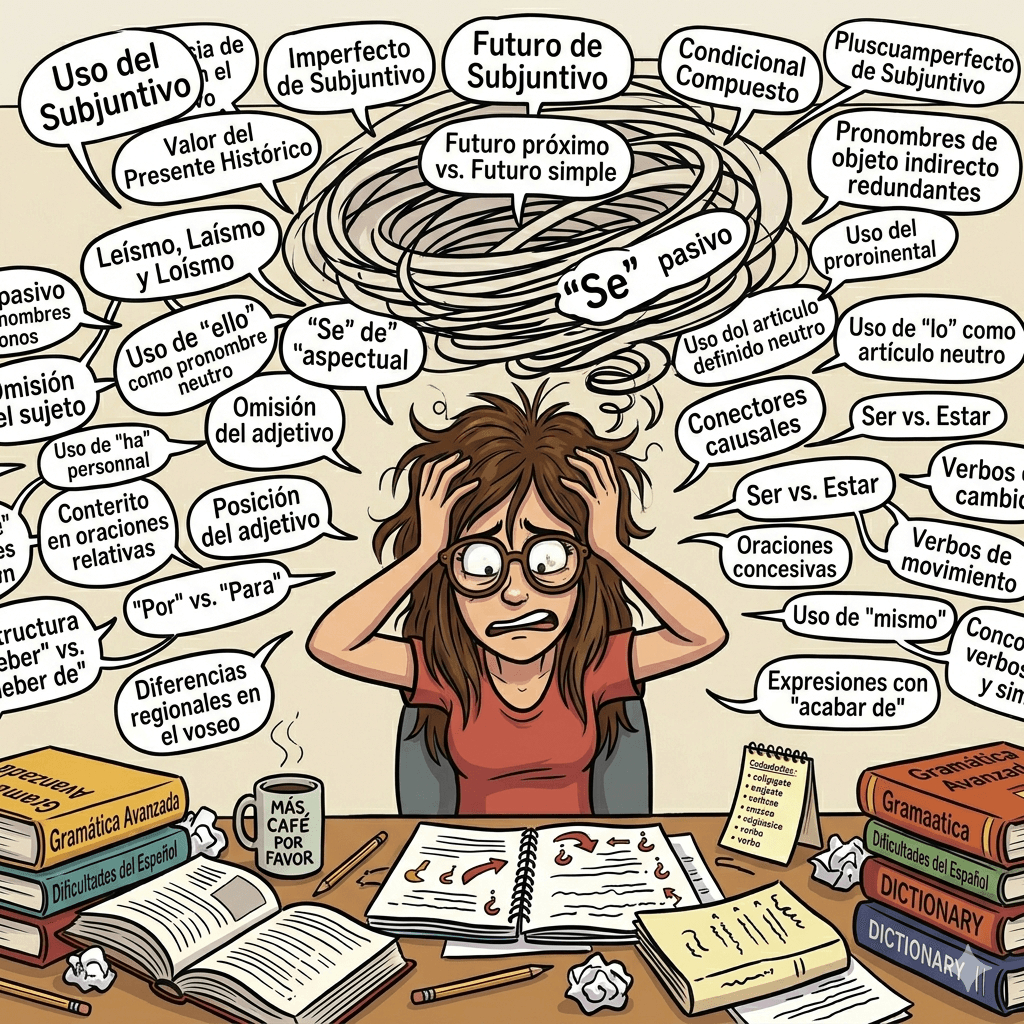
The learner problem: “I know the word… but it disappears”
You’re speaking confidently when suddenly — your mind goes blank.
You know the word.
You’ve seen it before.
Maybe you even studied it yesterday.
But in conversation, it’s gone.
This experience is one of the biggest confidence killers in language learning. Many learners discover that they understand more than they can say, which creates frustration and self-doubt during conversations. Some interpret it as lack of vocabulary or preparation. In reality, it’s usually a retrieval problem, not a knowledge problem.
This distinction between recognition and retrieval is well documented in cognitive psychology. The testing effect — the finding that actively recalling information strengthens memory more than passively reviewing it — is one of the most replicated results in learning science. Applied to language, this means that speaking practice does more for vocabulary retention than reading or listening alone, even when the speaking is imperfect.
Why this happens (and why it’s normal)
Forgetting words during speech is part of how the brain processes language. Learners may recognize words but struggle to retrieve them actively, which is also why passive exposure alone isn’t enough to develop speaking ability.
| Cause | Effect on speaking |
|---|---|
| Vocabulary stored passively | Harder to access quickly |
| Cognitive overload | Focus shifts to grammar or pronunciation |
| Fear of mistakes | Anxiety blocks recall |
| Insupfficient speaking repetition | Words not fully automated for fast retrival |
Many learners also often freeze mid-conversation, because anxiety and cognitive load temporarily block recall even when vocabulary is known.
The good news is that even native speakers forget words — they just use communication strategies without noticing.
What actually helps when words disappear
Instead of stopping or switching languages (especially back to English), strong speakers rely on communication strategies.
As a language teacher and avid language learner myself, I believe learning more words alone is not the solution. Being able to paraphrase the idea, find another way to keep communication going is probably the most useful skill to develop while learning a language. It takes practice, like a muscle being trained. The more you train it, the easier learning a language (or even more languages!) becomes.
1. Paraphrase the idea
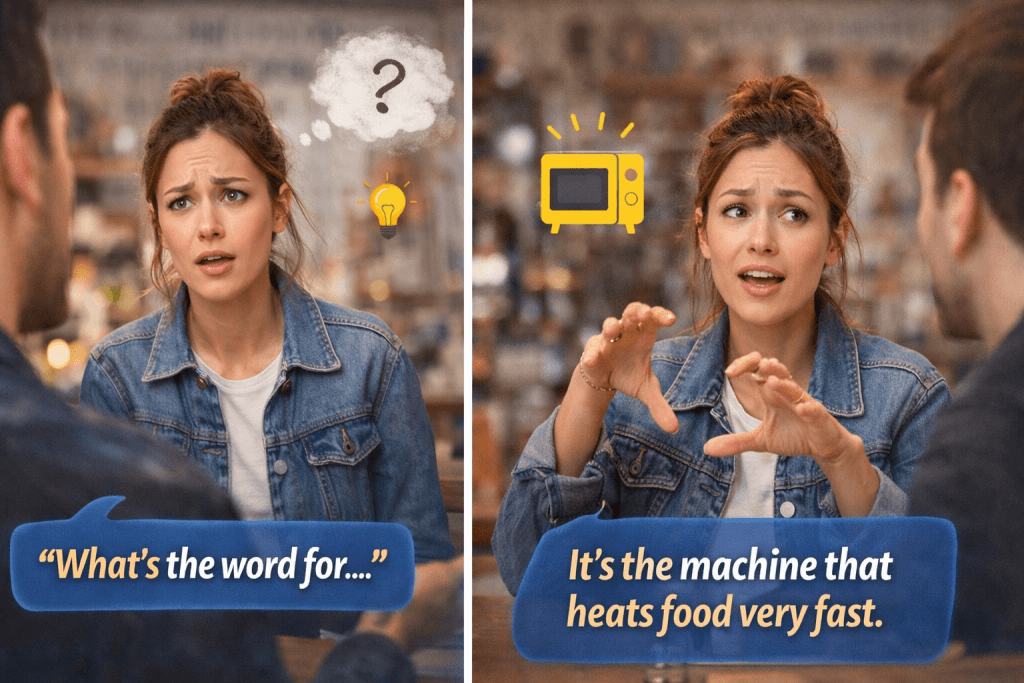
If you don’t remember a word, just avoid it! Describe the concept using simpler words.
Example
“I forgot the word for (microwave)… it’s the machine that heats food very fast.”
This keeps the conversation alive and strengthens fluency.
2. Use filler expressions
Fillers give your brain time to retrieve vocabulary.
Examples:
- “How do you say…”
- “It’s like…”
- “I mean…”
- “You know…”
These are not mistakes — they are natural fluency tools.
3. Use gestures and context
Communication is multimodal. Gestures, tone, and context often compensate for missing words.
In real conversations, meaning matters more than lexical precision.
4. Ask for help (strategic interaction)
Strong learners collaborate with their conversation partner.
Example
“What’s the word for… the thing you use to cut paper?”
This turns forgetting into learning.
5. Keep talking anyway
The biggest mistake is stopping the conversation. Skip the word, change the subject, but keep the conversation going!
Fluency is not about perfect vocabulary — it’s about continuity of communication.
The real insight: Fluency = communication strategies, not perfect vocabulary
Many learners believe fluency means knowing every word.
In reality, fluency means handling gaps smoothly.
This is why immersion and conversation-based learning accelerate speaking confidence: learners should practice speaking very often to get used to navigating uncertainty in real time.
How immersive learning reduces “word blanks”
When vocabulary is learned through context — videos, dialogues, and emotional situations — recall becomes faster and more automatic.
This happens because:
- Words are tied to situations
- Emotional memory strengthens recall
- Repeated exposure builds automaticity
Immersive tools like Jolii use real media and guided speaking prompts to help learners practice these strategies naturally, transforming passive vocabulary into active communication skills.
Practical exercise to build recall flexibility
Try this simple training technique:
- Pick 3 everyday objects
- Describe them without using the exact word
- Use gestures and examples
Example:
- “It’s a place where you buy medicine” (pharmacy)
- “You use it when it rains” (umbrella)
You can make this a game with a fellow language learner or with a native speaker you know.
This builds communicative resilience — a core fluency skill.
A Tip for Teachers and Language Partners
When learners forget a word, do not provide it immediately. Invite them to find a way to describe what they want to say. This helps them develop communication strategies and reduces speaking anxiety more effectively than simply supplying the missing vocabulary. They might struggle at first, but over time they will gain confidence and fluency!
A reassuring reminder
Forgetting words doesn’t mean you’re bad at languages. In fact, many learners experience this during a language learning plateau, when progress slows and confidence temporarily drops — a stage we break down in detail in A1 to A2 Is Easy. A2 to B1 Is Where Most People Quit, including what to do when speaking practice stops feeling effective.
In fact, moments of struggle often lead to stronger memory formation.
So next time a word disappears, don’t panic — improvise. That’s exactly what fluent speakers do. And the more you practise improvising, the less often the words disappear in the first place.
FAQs
Is forgetting words a sign of low vocabulary?
Not necessarily. Many learners know far more words than they can actively recall. Often they just lack regular speaking practice, which helps convert passive vocabulary into active usage.
Do advanced learners forget words too?
Yes — even advanced speakers experience retrieval gaps. The difference is they use strategies like paraphrasing and fillers to maintain fluency.
Should I switch to my native language when I forget a word?
It’s better to stay in the target language when possible. Paraphrasing strengthens recall and builds confidence.
How can I reduce forgetting words long term?
Consistent speaking practice, contextual exposure, and repetition through meaningful input (videos, conversations, storytelling) help automate vocabulary recall and improve speaking confidence over time.