First published: February 2026. Last updated: June 2026

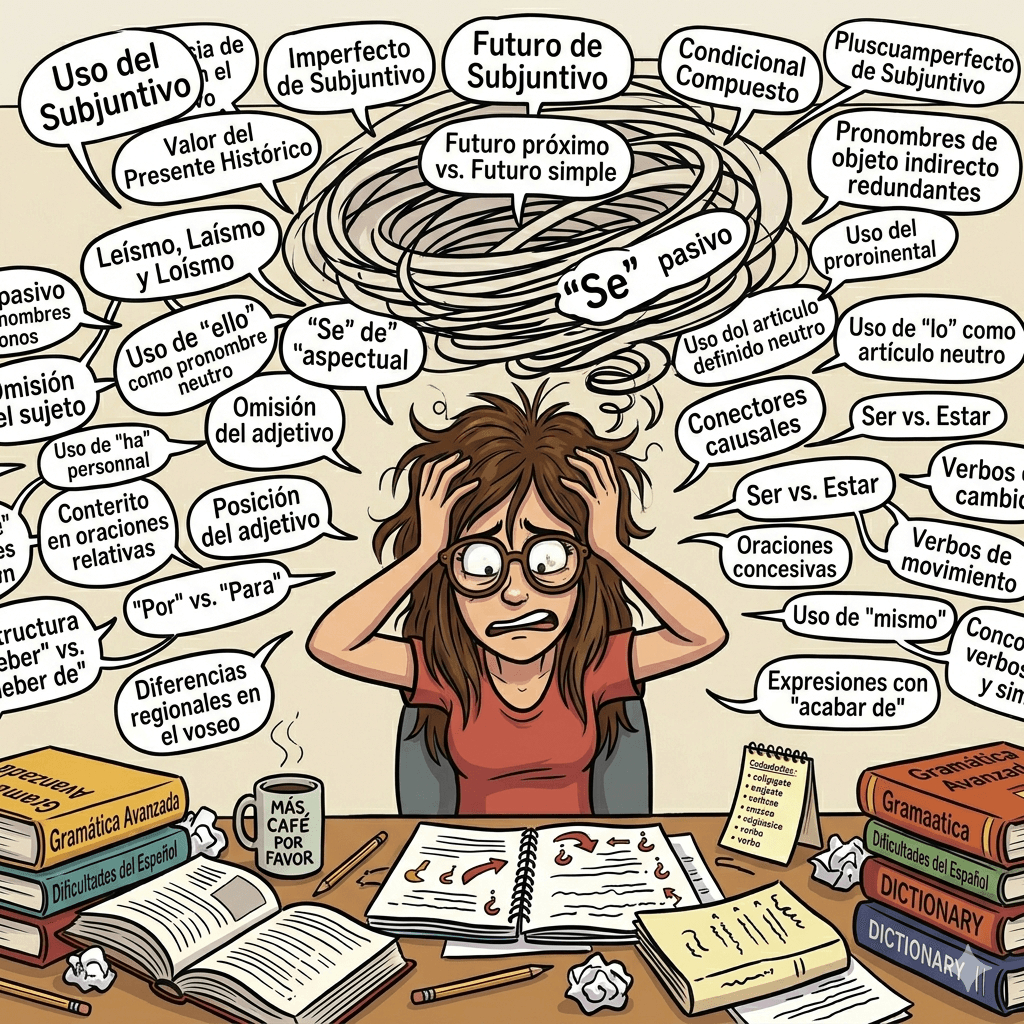
A1 to A2 feels easy because you memorize the basics. A2 to B1 feels hard because you must start using language independently. Most learners quit because understanding content does not automatically turn into speaking ability. I see this pattern constantly with adult learners: they understand podcasts and shows, but freeze when asked a follow-up question.
Why Do Learners Feel Stuck After A2?
With A2, you can follow basic conversations, videos and read articles. But talking still seems slow, agonizing or out of the question.
This stage is a source of anguish for many adult learners because nothing happens that you can see. Apps are too easy, real conversations are too hard, and the motivation is lost. I’ve experienced this plateau myself as a language learner, especially while learning Chinese, and it’s one of the most discouraging stages.
The initial stages until A2 were very exciting. After a few months of studying, I was proud of myself because I could follow basic conversations and read simple texts, but the moment someone asked me a spontaneous question or whenever I faced with a real-life situation like asking a shop assistant something, I was struggling a lot. What eventually broke it wasn’t more input — it was forcing myself to summarise what I’d watched or read aloud, badly, every day until the retrieval started feeling less like excavation.
If you have also experienced this sudden drop in enthusiasm, you might be interested in our guide “Why Motivation Drops After 3 Months of Language Learning”, which explains why motivation often fades once the novelty of learning disappears.
Many learners respond by watching more Netflix or YouTube, assuming exposure will eventually unlock speaking — but passive watching builds understanding, not fluency.
This is normal. The transition from A2 to B1 is the first true fluency barrier.
Why Is A2 to B1 So Hard?
1. You Hit the Input–Output Gap
You understand much more than you can say. This gap appears when learners consume lots of content but rarely speak. We explain this in detail in Why You Understand a Language but Can’t Speak It.
Understanding ≠ speaking. Speaking requires retrieval, grammar, and speed—all at once.
2. Learning Stops Being Linear
At A1–A2, progress feels fast. You learn greetings, numbers, and common verbs. At B1, growth becomes complex and layered. You refine grammar, add nuance, and improve fluency.
The brain works harder, but the results feel slower.
3. Mistakes Become More Visible
Beginner mistakes feel cute. Intermediate mistakes feel embarrassing. Many adults stop speaking to avoid sounding wrong.
This fear of sounding wrong is also why many learners freeze mid-sentence, a reaction we break down in Why You Freeze When You Try to Speak a Foreign Language.
Avoiding speaking slows progress more than any grammar problem.
4. You Must Create Language, Not Repeat It
A2 learners repeat patterns. B1 learners build sentences in real time. This cognitive shift is demanding and tiring, especially after work or studies.
A2 vs B1: What Actually Changes
| Skill Area | A2 Level | B1 Level | Why It Feels Hard |
| Vocabulary | Common daily words | Topic-based and abstract terms | Requires deeper recall |
| Grammar | Simple present/past | Complex structures and clauses | More cognitive load |
| Speaking | Short prepared answers | Spontaneous conversation | No scripts available |
| Listening | Clear speech | Natural fast speech | Less predictable input |
| Independence | Guided tasks | Self-directed communication | More mental effort |
Real Learner Example: What A2 vs B1 Feels Like
Jennifer, 31, has been using Duolingo to learn English as well as watching television shows and YouTube. She was able to comprehend basic, everyday content but was nervous speaking.
At A2 Level (Understanding Without Fluency)
Jennifer is able to describe her everyday life, but she uses short, simple sentences. For example: “Yesterday I go to the store and I buy vegetables. The man is nice. I love more the store because is cheap.”
She gets TV shows and podcasts, but she pauses frequently. When the conversation speeds up, she lingers back and listens and doesn’t feel comfortable speaking.
At B1 Level (Independent Speaking)
A few months into intensive speaking practice, her speech flows more naturally: “Yesterday I went to the grocery store because I needed vegetables for dinner. The cashier was super nice, and I like that store because it’s cheaper than the other ones.”
She still messes up, except now she talks in longer sentences, stresses reasons and manages to keep a conversation alive.
What Actually Changed
These results weren’t simply about Jennifer learning more words. She knew how to use language in real time.
She rehearsed repeating scenes from her favorite series out loud, and recording herself to check her progress, using new phrases in brief conversations with acquaintances. This helped her transition from comprehending English to thinking and speaking in English.

How to Move From A2 to B1 Without Quitting
Practice Output Daily
- Retell short stories aloud
- Summarize what you watched or read
- Answer prompts with your own opinions
- Record yourself speaking
What matters most at this stage isn’t perfection but consistency. In How Often Should You Practice Speaking to Improve?, we break down what actually works at intermediate level.
Reduce Cognitive Load
- Use sentence starters (“I think that…”, “In my opinion…”)
- Practice common connectors (because, although, however)
- Focus on clarity, not perfection
Track Real Progress
- Measure speaking time, not vocabulary size
- Record weekly speaking samples
- Count minutes of active speaking practice
Avoid Frustrations
- Don’t expect quick results: Intermediate learning is slow and nonlinear
- Don’t overconsume input: 20 to 45 minutes a day is enough
- Don’t be afraid of sounding like a newbie: perfectionism blocks practice
This jump from simple sentences to connected speech is why A2 to B1 feels so hard. You stop memorizing phrases and start creating language yourself. That’s the point of no return for many learners, even though progress is taking place.
According to the Output Hypothesis, which was suggested by Merrill Swain, output should not be overlooked because it has a very important role in Second Language Acquisition: it pushes learners to notice the gap in their linguistic knowledge and correct their usage of language. It is not enough to have understandable input; learners also need the opportunities for output and correction.

What Should You Study at B1?
Focus on:
- Phrase chunks and collocations
- Connectors (however, although, therefore)
- Topic-based vocabulary
- Storytelling frameworks
Grammar matters, but usage matters more.
How to Practice at B1: Structured Activity Table
| Skill Type | Learning Activity | Why It Works at B1 | Example |
| Input (Comprehension) | Graded news articles | Builds vocabulary and complex sentence recognition | Read simplified news and highlight unknown phrases |
| Input (Comprehension) | Short podcasts with transcripts | Connects spoken and written language | Listen once, then read transcript and re-listen |
| Input (Comprehension) | YouTube explanations in target language | Exposes you to structured discourse | Watch a tutorial and summarize key points |
| Output (Speaking) | Daily spoken summaries | Forces sentence production and fluency | Summarize what you read or watched in 2 minutes |
| Output (Speaking) | Shadowing short clips | Improves pronunciation and rhythm | Repeat a sentence immediately after hearing it |
| Output (Writing) | Micro-journaling | Builds grammar accuracy and personal language | Write 5 sentences about your day |
| Output (Writing) | Reformulation exercises | Improves syntactic flexibility | Rewrite a sentence in a different way |
| Interaction (Feedback) | Language exchange conversations | Reveals real communication gaps | 10–15 minutes of guided conversation |
| Interaction (Feedback) | AI or tutor correction | Prevents fossilization of mistakes | Get corrections and rewrite the same text |
| Metacognitive Practice | Error logging | Turns mistakes into learning data | Keep a list of recurring grammar errors |
Jolii.ai uses structured speaking exercises, controlled prompts, and precise language output. This closes the input–output gap and transforms comprehension into actionable speech. If you are stuck from A2 to B1, output training is the quickest way out of there.
FAQs
Why is A2 to B1 a higher difficulty level than A1 to A2?
Because B1 requires independent speaking and complex sentence formation.
How long does it take to go from A2 to B1?
Most students should take 6 to 18 months with regular practice. The lower end (6 months) assumes consistent daily output practice of 30+ minutes. The upper end (18 months) reflects learners who rely primarily on passive input. The variable that matters most is how much deliberate speaking practice you do, not total study hours.
What should I focus on to reach B1?
Speaking practice, phrase chunks, connectors, and topic vocabulary.
Are apps enough to reach B1?
Apps help, but speaking practice is essential.
Why do many learners quit at A2?
Their progress seems to slow and speaking requires conscious effort.
We know A1 to A2 is like climbing stairs, and A2 to B1 seems like Mount Everest. This is because A1 to A2 is about memorisation. A2 to B1 is about production.
That shift is harder, slower, and less visible — which is exactly why most learners quit here rather than anywhere else. But it’s also the stage where real language acquisition begins. The structured activity table above isn’t a shortcut — it’s a map through the hardest part of the journey. Follow it consistently and the plateau becomes a transition rather than a stopping point.