First published: October 2024 · Last updated: May 2026
Can You Really Learn Spanish by Watching TV Shows?
Yes — but only if you watch the right way.
Passive watching builds comprehension over time. But if you’re at an intermediate level and still struggling to speak naturally, the problem usually isn’t exposure — it’s that you’ve been consuming Spanish without producing it. This is the binge-watcher’s paradox: you understand more every month, but still struggle to produce the language yourself. TV shows fix that only when you use them actively: short scenes, focused attention, deliberate repetition, and trying to reproduce what you hear.
This page is a practical hub. It explains the method once, helps you choose the right show for your level, and links to detailed scene-by-scene analyses where the real learning happens.

Why TV Shows Work for Intermediate Learners Specifically
Textbooks and language learning apps help you build foundations and reach intermediate level. They fall short after that, simply because at an intermediate level you need real, meaningful exposure to the language.
At A2–B1 level, most learners have solid grammar foundations and a working vocabulary — but they freeze in real conversation because classroom Spanish and spoken Spanish are genuinely different languages. Native speakers compress words, drop pronouns, use regional slang, and shift register constantly. No grammar table prepares you for that.
TV shows bridge that gap because they give you:
Authentic rhythm and speed. Real conversations don’t sound like audio exercises. Regular exposure to natural-speed dialogue trains your ear to parse speech the way natives produce it — not the way textbooks present it.
Regional and cultural variation. Spanish across Latin America and Spain differs significantly in accent, vocabulary, and expression. Choosing shows from different regions deliberately exposes you to that variation rather than leaving you dependent on one variety.
Emotional and contextual anchoring. Words learned in emotionally charged or memorable scenes stick longer than words learned from lists. A phrase heard during a tense confrontation or a funny exchange is far more likely to surface when you need it in conversation.
Colloquial constructions textbooks skip. Everyday Spanish is full of expressions, filler words, and informal structures that formal study never covers. Shows are where you find them in their natural habitat.
This method of language learning will work especially well with people who don’t do well with theoretical learning and instead prefer fun and interactive methods of learning. For instance, if you enjoy videos and pictures, this means you are a visual learner. TV shows offer both visual learning and improved listening. Plus, they are entertaining! Learning a language should ultimately be an enjoyable experience, and TV shows are one of the best ways to combine learning with entertainment.
Passive Watching vs Active Learning
This distinction matters more at intermediate level than at any other. Beginners benefit from passive exposure because everything is new. Intermediate learners already understand a lot — which makes it easy to feel like you’re learning when you’re actually just recognizing words and sentences.
| Passive Watching | Active Learning |
|---|---|
| Full episodes in one sitting | Short scenes of 2–5 minutes |
| Subtitles carrying comprehension | Subtitles as a check, not a crutch |
| General understanding without recall | Pausing to repeat and reproduce phrases |
| Moving on when something is unclear | Rewinding until the construction clicks |
| Consuming expressions | Reusing expressions in your own sentences |
The shift from passive to active doesn’t mean watching less. It means watching differently — treating each scene as a lesson rather than entertainment, even if the show itself is genuinely entertaining. Pair subtitles with active practice — a process explained step by step in How I Used Jolii to Learn Spanish Fast — And Why It Worked.
How to Choose the Right Spanish Show for Your Level
Not every show works equally well at intermediate level. Fast dialogue, heavy slang, or strong regional accents can push even solid B1 learners into passive mode — understanding the gist without catching the detail.
When choosing a series, consider:
Clarity of speech. Shows with well-articulated dialogue — dramas, character-driven series — give you more time to process each line. Fast-paced thrillers and youth dramas are better once your ear is more trained.
Accent familiarity. If your Spanish foundation is Latin American, starting with Castilian Spanish requires adjustment and vice versa. Choose shows that match your existing exposure before branching out. Once you get more confidence, you can explore different accents.
Scene structure. Shows built around dialogue rather than action give you more usable language per minute. A two-person conversation scene is more teachable than a chase sequence.
Your genuine interest. Boredom is the enemy of active learning, you should avoid it at all costs! As a language teacher, I often struggle in recommending the right show to learn from, because the choice is very personal. A show you actually want to watch is one you’ll rewatch and enjoy watching even when you’re not catching every word. That is where the real retention happens: when you forget you’re ‘learning Spanish’, and focus on enjoying a good show!
The goal isn’t to watch more.
It’s to watch better.
6 Spanish Series With Full Learning Analyses
Each show below has a dedicated article breaking down real scenes — slang, grammar patterns, cultural context, and examples you can practise immediately. These aren’t general recommendations — they’re structured learning resources built around specific episodes.
Valle Salvaje: Contemporary Spanish with everyday slang and practical grammar used in natural conversation. Good for learners who want modern, relatable language rather than period or formal register. → Read the Valle Salvaje analysis
El Eternauta: Distinctive vocabulary and strong cultural context, ideal for learners ready to move beyond mainstream series and expand comprehension into less familiar territory. → Read the El Eternauta analysis
Las Chicas del Cable: Clear Castilian accent, emotionally rich dialogue, and well-articulated speech that gives you time to process each line. One of the best options for learners consolidating B1 toward B2. → Read the Las Chicas del Cable analysis
Élite: Contemporary youth language, informal expressions, and fast conversational Spanish. Better suited to learners already comfortable with natural speech speed who want to close the gap with native-level informal register. → Read the Élite analysis
La Casa de Papel: High-frequency vocabulary, emotionally charged language, and exposure to multiple accents and registers within a single series. Useful for learners who want variety without switching shows. → Read the La Casa de Papel analysis
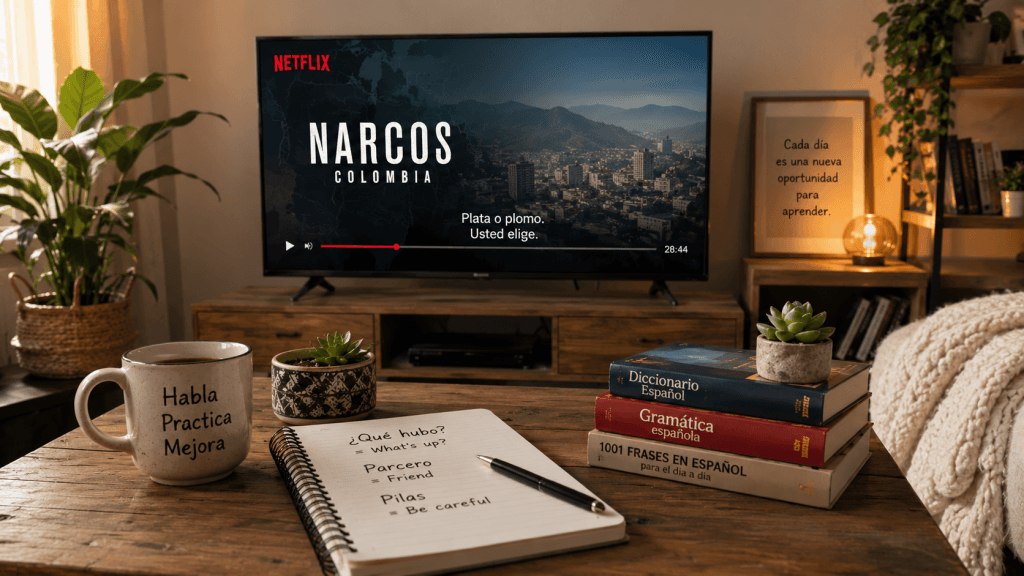
Narcos: Colombian Spanish at its most intense — street slang, assertive grammar structures, and culturally loaded expressions rooted in 1980s Medellín. The opening Escobar monologue alone covers more ground than most textbook chapters, including a natural subjunctive construction, regional filler words, and one of the most famous phrases in Latin American popular culture. Best for intermediate learners comfortable with fast, emotionally charged speech. → Read the Narcos analysis
How to Use These Analyses
Each linked article follows the same structure: a scene breakdown, a slang and expression table, grammar insights, and practice examples. The method works best when you:
- Watch the scene cold — no preparation, just observe what you catch
- Read the analysis — expressions, grammar patterns, cultural context
- Watch the scene again — notice how differently it lands
- Practice the expressions — reproduce them in new contexts, not just recognise them
That gap between your first and second watch is where your intermediate plateau starts to break.
If you want a tool that turns this process into structured speaking practice, Jolii lets you work through scenes interactively — practising the expressions and constructions from each analysis with an AI tutor until they move from recognition into production.
Beyond TV Series
TV shows work best as part of a varied input diet. Each format below targets a different aspect of Spanish and suits different moments in your day.
Movies to Learn Spanish: Denser, often more formal language than episodic series. Good for focused sessions when you have more time than a single episode requires.
Spanish-speaking YouTubers to Learn Spanish: Short-form native content, often subtitled. Ideal for daily practice in smaller doses.
Spanish Songs to Learn Spanish: Effective for intonation, rhythm, and colloquial expressions. Includes dedicated lyric breakdowns — slang and grammar analysed line by line, the same method as the show analyses applied to music.
Spanish Podcasts: Audio-only input without subtitles or visual support — the closest format to real unscripted conversation. Challenging but highly effective for learners preparing to speak with natives.
Where to Start
If you’re not sure which show to begin with, start with Las Chicas del Cable — the speech is clear, the grammar is rich, and the emotional weight of the dialogue makes expressions memorable. Once you’re comfortable with the pace, move to Élite for faster, more colloquial Spanish.
One scene at a time. That’s the method.