First published: March 2026. Last updated: June 2026
Quick Answer (TL;DR)
Watching Netflix alone doesn’t improve speaking because it is a passive activity where your brain prioritizes understanding the plot over processing language. To turn watching into speaking, you must shift to active immersion by using tools like interactive subtitles, shadowing, and AI-driven conversation practice that force your brain to produce, not just consume, the language.
It’s a common frustration: you’ve finished three seasons of a Spanish drama, you understand almost everything with subtitles, but when you try to order a coffee in Madrid, you freeze. You feel stuck because your listening comprehension has outpaced your speaking ability, leaving you in the “Binge-Watcher’s Paradox”—the more you watch passively, the less you actually learn to say.
A Personal Note:
I remember spending an entire summer binge-watching Plan Cœur in French. I felt like I understood everything… until I visited France and people started switching to English because they couldn’t understand my French. I could understand entire shows, but my speaking ability was still far behind.. That experience is exactly what the Binge-Watcher’s Paradox describes — comprehension running far ahead of production, with no bridge between the two.
Why Passive Watching Fails the Speaking Test
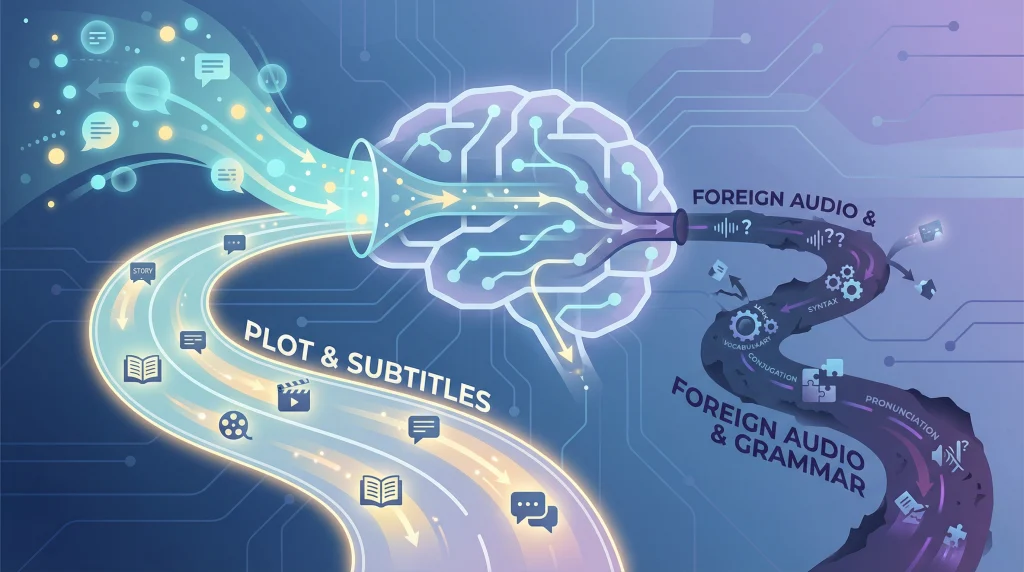
The primary reason passive watching fails is what we can call cognitive triage — the brain’s tendency to find the path of least resistance to understanding a story.
When subtitles in your native language are available, your brain routes comprehension through reading rather than audio processing. It’s faster and requires less effort. This is Cognitive Load Theory in action: working memory offloads the harder task — decoding foreign audio — in favour of the easier one — reading familiar text. The result is that you understand the show perfectly while barely processing the spoken language at all.
Stephen Krashen’s Input Hypothesis established that we acquire language when we understand messages slightly above our current level. The problem with passive Netflix watching is not that the input is incomprehensible — it’s that the subtitles may make comprehension too easy, removing the productive struggle that drives acquisition.
Your brain is designed to find the path of least resistance to understand a story. When you watch with subtitles, your brain “shuts off” the difficult task of decoding foreign audio and instead relies on the familiar text.
Passive vs. Active Immersion: The Difference
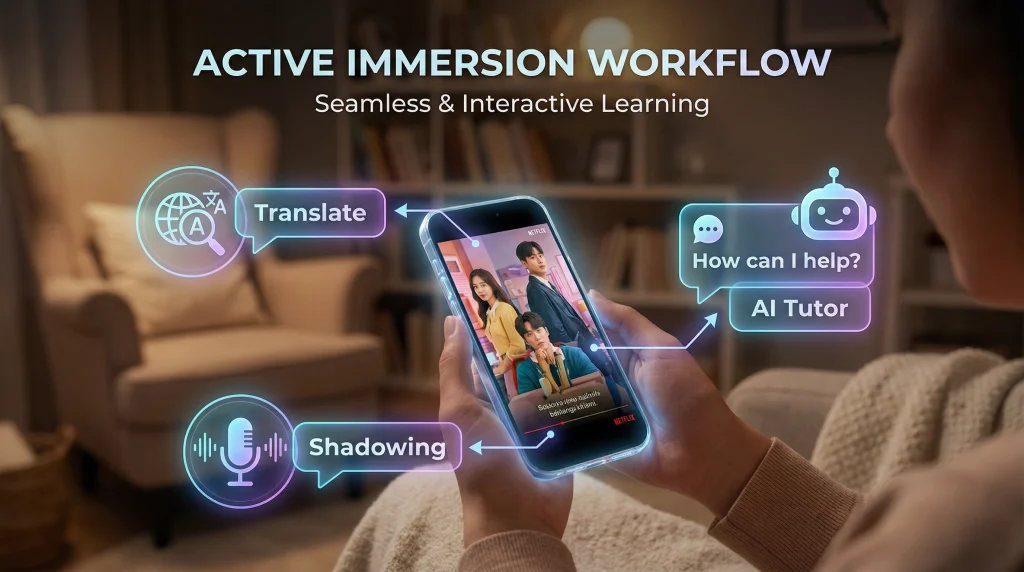
| Feature | Passive Watching (Commodity) | Active Immersion (Jolii Approach) |
| Brain State | Relaxed, consuming plot | Engaged, analyzing structures |
| Primary Goal | Entertainment | Skill Acquisition |
| Output | None (Silent) | Frequent (Shadowing/Speaking) |
| Retention | Low (Short-term memory) | High (Context-based retention) |
For a detailed breakdown of the strategies that turn passive watching into active speaking practice, Can You Learn a Language With Netflix? What Actually Works covers the specific methods — subtitle progression, shadowing, weekly routines — that close this gap.
The “Subtitle Crutch”
When you read subtitles in your native language, you aren’t actually “listening” to the target language; you are merely hearing it as background noise. This prevents your brain from building the phonetic maps necessary for speaking. To break this, you must engage with the text interactively.
Try This 5-Minute Exercise
- Watch a 30–60 second scene with target-language subtitles.
- Replay it and repeat one sentence aloud.
- Pause and explain the sentence in your own words.
- Use the key expression in a new sentence.
- Replay the scene one final time.
Even one short scene practiced actively can improve speaking confidence more than passively watching an entire episode.
Real Example: The “Squid Game” Scenario
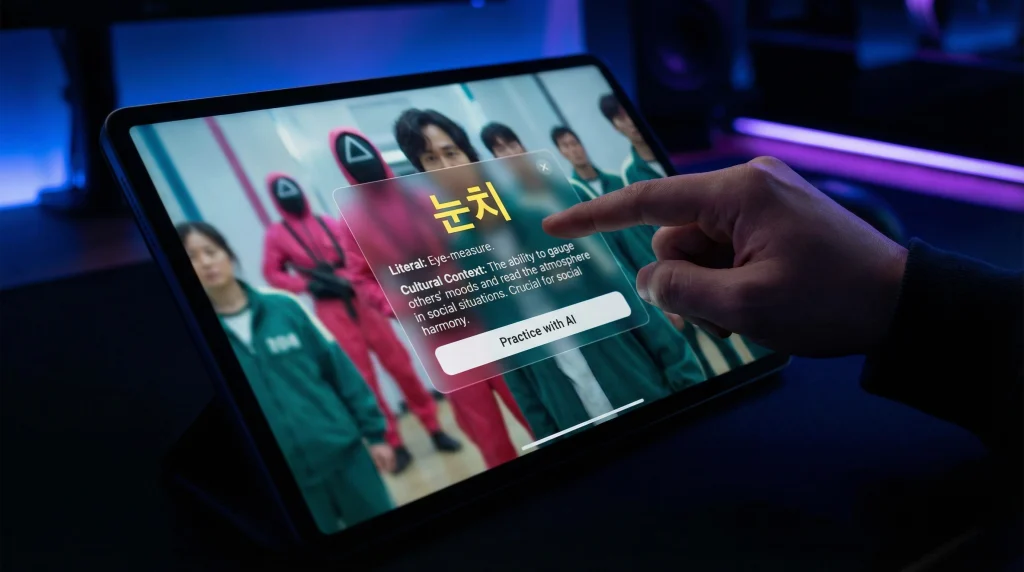
Imagine watching a scene in Squid Game where a character uses a specific honorific.
•Passive Learner: Reads the subtitle “Yes, sir,” and moves on to the next scene.
•Active Learner (Jolii): Pauses, clicks the word to see the literal meaning and cultural context, and then uses the AI Chatbot to practice using that same honorific in a simulated conversation.
Follow-Up Questions Every Learner Asks
Should I watch with or without subtitles?
For intermediate learners, dual subtitles (target language + native language) are the most effective. They provide a safety net while forcing you to map the sounds you hear to the words you see. However, the goal should always be to eventually move to target-language-only subtitles.
How much should I watch per day?
Quality beats quantity. Fifteen minutes of active immersion — pausing, repeating, shadowing, and interacting with the content — produces more speaking improvement than three hours of passive binging. Your working memory has a limited capacity for high-intensity language processing, and passive watching rarely pushes anywhere near that limit. The goal is not to watch more but to extract more from what you watch. Twenty to thirty minutes of active engagement three to four times per week consistently outperforms daily passive binging in measurable speaking improvement. Even with a busy schedule, you can learn actively for 15 minutes during your lunch break or your commuting!
Can I learn slang and idioms from Netflix?
Yes, but only if you see them in context. Netflix is a goldmine for authentic, colloquial language that textbooks often miss. Using an AI tool to highlight these idioms in real-time ensures you don’t just hear them, but understand when and how to use them.
Moving from Understanding to Speaking
The final step in breaking the paradox is Output. You cannot learn to speak by only listening. You must use the vocabulary you hear in a low-stakes environment before trying it in the real world.
If you’re tired of just “understanding” and want to start “speaking,” Jolii’s AI Tutor & Chatbot can take the exact dialogue from the Netflix show you just watched and turn it into a real-time conversation practice session.
FAQs
What is the Binge-Watcher’s Paradox?
It is the phenomenon where a language learner spends significant time watching foreign media but fails to improve their speaking skills because the immersion is passive rather than active.
How does Jolii AI help with Netflix?
Jolii AI integrates with Netflix to provide interactive dual subtitles, instant word translations, and AI-generated speaking exercises based on the show’s content.
Is watching Netflix enough to become fluent?
No. While it is excellent for listening and vocabulary, fluency requires active production (speaking and writing), which must be practiced alongside immersion.
Can I use Jolii on my phone?
Yes, Jolii is a dedicated mobile app for iOS and Android, allowing you to turn your Netflix time into learning time anywhere.