Have you ever spoken Spanish and felt your mind go blank mid-sentence? Chances are, if you are a Spanish leaner then you have, and you’re not alone. Native speakers don’t speak in perfectly polished sentences either; they use filler words to think, hesitate, soften opinions, and keep conversations flowing.
Similarly, in English, we say things like “um,” “like,” “you know,” or “I mean.”
Spanish has its own natural filler words, and learning them is one of the fastest ways to sound more fluent and more confident, even when you don’t know what to say and need to pause for thought.
In this guide, you’ll learn 25 common Spanish filler words, what they really mean, and how native speakers use them in everyday conversation.
Why Learn Spanish Filler Words?
Spanish filler words, known as muletillas, are short expressions speakers use to:
- Buy time while thinking
- Sound less direct or more polite
- Keep the conversation natural
- Emphasise feelings or opinions
They don’t usually add new meaning, but they add fluency. Personally, I think they are a lot of fun to say and help keep conversations flowing.
Hesitation & Thinking Fillers (Like “um” and “uh”)
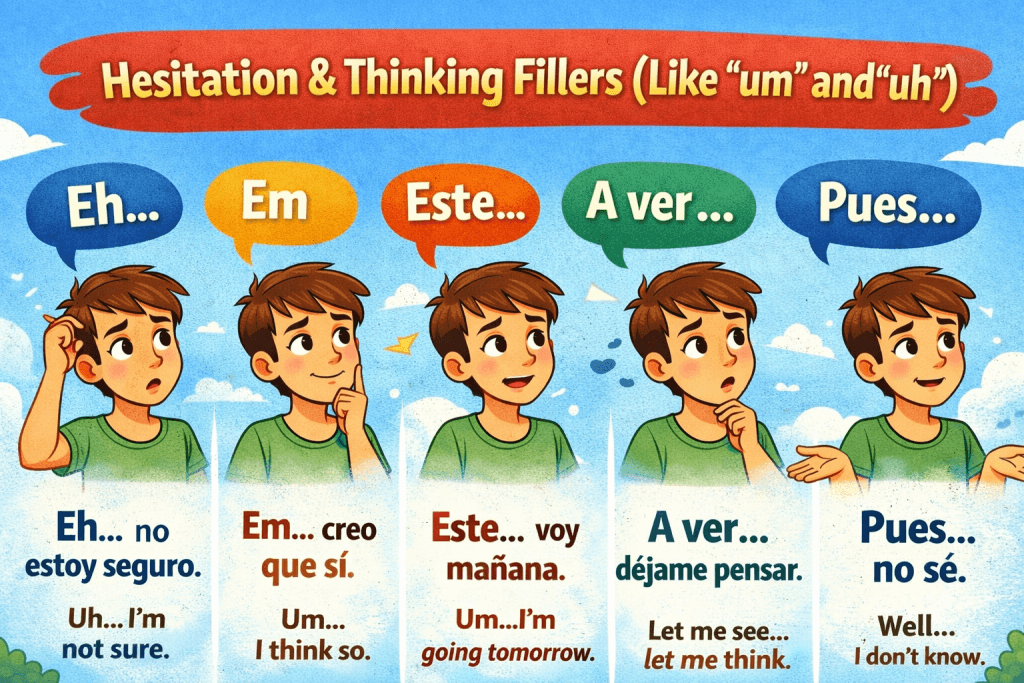
These are the most common fillers when you’re thinking.
1. Eh
Equivalent to “uh”
Eh… no estoy seguro.
Uh… I’m not sure.
2. Em
Very natural hesitation sound
Em… creo que sí.
Um… I think so.
3. Este
Extremely common in spoken Spanish
Este… voy mañana.
Um… I’m going tomorrow.
4. A ver
Used while thinking or checking
A ver… déjame pensar.
Let me see… let me think.
5. Pues
Can mean “well” or act as a pause
Pues… no sé.
Well… I don’t know.
“Like” Fillers (Very Common in Casual Speech)
These help soften statements or sound less rigid.
6. Como
Spanish version of “like”, this is a very common filler word
Es como raro.
It’s kind of weird.
7. O sea
One of the most important fillers, considering how often it is used. It is also my personal favorite.
O sea, no es tan fácil.
I mean, it’s not that easy.
8. En plan (Spain)
Very informal, especially with young people
Estoy en plan cansado.
I’m like really tired.
9. Tipo
Used like “kind of”
Es tipo difícil.
It’s kind of difficult.
“You Know?” Fillers (Checking Understanding)
These keep the listener engaged.
10. ¿Sabes?
You know?
It’s complicated, you know?
11. ¿Me entiendes?
Do you understand?
It’s expensive, do you understand?
12. ¿Vale?
Right? / OK?
This one is used all over the Spanish-speaking world, but it is particularly common in Spain.
We arrive at 8, right?
13. ¿Sí?
Yes? Used as a soft confirmation check
It’s tomorrow, yes?
Softening Opinions & Politeness
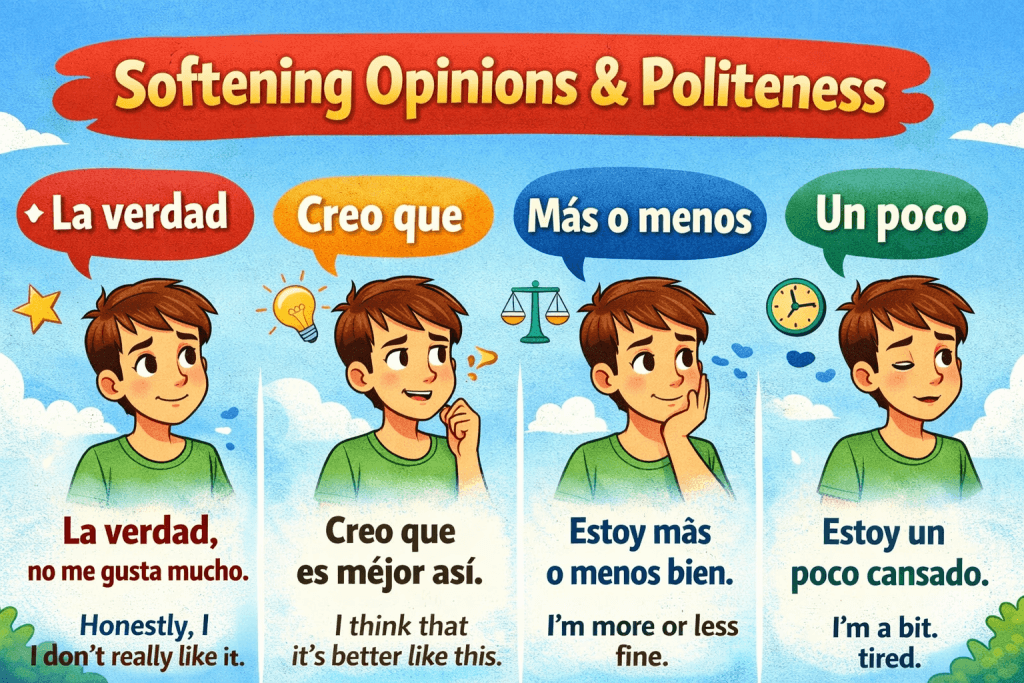
These make your Spanish sound less blunt.
14. La verdad
Like “to be honest” in English
Honestly
15. Creo que
I think that…
I think it’s better like this
16. Más o menos
More or less
I am more or less okay
17. Un poco
A bit
I am a bit tired.
Emphasis & Emotional Fillers
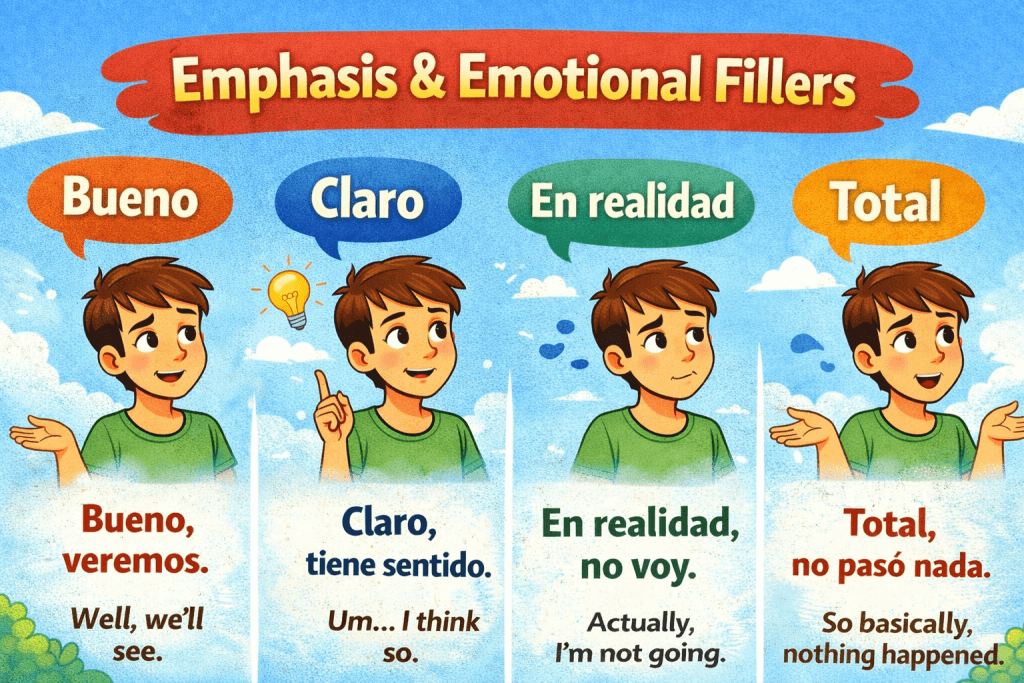
Used to express feeling, surprise, or emphasis.
18. Bueno
Well…
Well, we will see.
19. Claro
Of course / obviously
Of course, makes sense.
20. En realidad
Actually / In reality
Actually, I am not going
21. Total
So / basically
Basically, nothing happened
22. Oye
Hey / listen
Listen, one thing..
Conversation Flow Fillers
These help you hold the floor naturally.
23. Entonces
So / then
Then, what do we do?
24. Mira
Look…
Look, let me explain
25. Nada
Used to downplay something
Nada, fue rápido.
Oh, nothing, it was quick.
How to Use Spanish Filler Words Naturally
- Don’t translate word-for-word from English
- Listen to native speakers (podcasts, YouTube, TV)
- Use 1–2 fillers per sentence, not all of them
- Start with the most commonly used, like o sea, pues, como, bueno
Tip: Fluency isn’t about speaking fast — it’s about sounding natural.
Conclusion
If your Spanish sounds “correct but stiff,” filler words are often what’s missing. They help you think in Spanish and also buy you some time when you’re searching for that missing word that’s on the tip of your tongue.
Surround yourself with Spanish natives, and you can’t help but pick up some of these filler words. Practice using them, and soon they will come naturally.