TL;DR
Language anxiety is the fear reaction elicited whenever there is communication in a different language. It affects fluency through avoidance, not lack of vocabulary. This anxiety involves fear of social errors, which can block language even when the correct words are known. One can get rid of it by using low-pressure self-talk, and AI communication software.
Key Takeaways
- Anxiety is a performance issue, not a knowledge issue
- Avoidance locks in errors through fossilization
- Peer judgment is feared more than teacher correction
- AI tools cut speaking anxiety by removing social risk
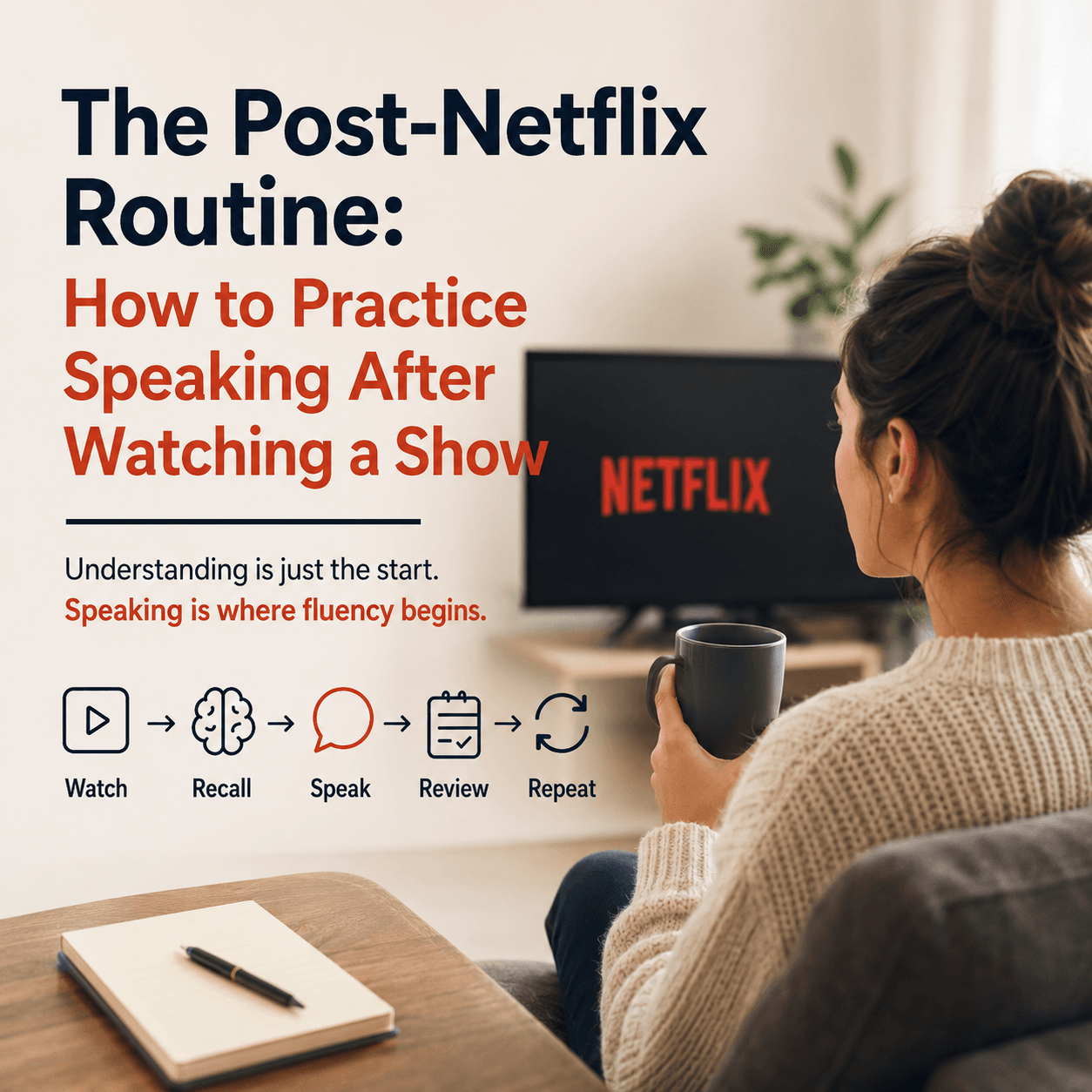
- Fluency is built through output, not more input
What Is Language Anxiety?
Language anxiety is the specific fear that gets activated when a second language is used or learned. This type was defined by Horwitz, Horwitz, and Cope in 1986 as a distinct form of performance anxiety. It is also called foreign language anxiety (FLA) or speaking anxiety.
Core parts include communication apprehension, test anxiety, and fear of negative evaluation. Beginners, intermediates, and even polyglots are affected. Fluent speakers report the same freezing response at the C1 level that beginners feel at the A1 level.
Real-world example: A learner can read a Spanish novel with ease but gets stuck ordering coffee in Madrid. The knowledge is there. The access is blocked.
Why Does Fear Stop You From Speaking a Language?
Fear inhibits speech as errors are treated by the brain as a social threat. Amygdala activation and the fight-or-flight response occur. There is a release of cortisol into the system and a redirection of blood flow away from Broca’s area and the prefrontal cortex.
As a result, known vocabulary becomes temporarily inaccessible. This is called the “amygdala hijack.” Working memory is overloaded by intrusive thoughts like “don’t mess up.” Only 4±1 chunks can be held at once, and anxiety consumes 30–50% of that capacity under stress.
Grammar errors are registered by evolved brain circuits as threats to social status. Being wrong feels like being excluded from the tribe.
Symptoms of Language Anxiety
Symptoms are both mental and physical. The body signals stress before the learner consciously notices it.
| Symptom Type | Examples |
| Cognitive | Blank mind, word retrieval failure, constant mental translation |
| Physical | Racing heart, sweating, dry mouth, shaky voice |
| Vocal | Pitch rises, jitter in tone, laryngeal tightness |
| Behavioral | Avoiding conversations, over-preparing, and staying silent |
Heart rate variability (HRV) drops as sympathetic activation rises. Voice changes can act as measurable indicators of anxiety.
What Causes Language Anxiety?
Language anxiety is caused by four compounding factors. Each factor feeds the next.
- Fear of making mistakes. Perfectionism is reinforced by years of school grading. Wrong answers were punished, and “right” was rewarded. This conditioning was internalized as identity.
- Fear of judgment. Native speakers are perceived as evaluators. Peer judgment is feared more than teacher correction (see table below).
- Lack of practice. Passive learning is chosen over active output. Netflix feels safer than speaking.
- Past negative experiences. A harsh correction or public embarrassment creates a lasting trigger.
FLCAS-Based Anxiety Triggers (2026 Data)
| Trigger | Severity (1–5 scale) |
| Fear of mispronunciation | 3.85 |
| Fear of being misunderstood | 3.64 |
| Fear of negative peer evaluation | 3.47 |
| Fear of teacher correction | 3.06 |
Peers are feared more than authority figures. Language anxiety is fundamentally a social problem, not an academic one.
The Psychology Behind Language Anxiety
Adult egos are more fragile than child egos in language learning. Identity has been built around sounding competent. Sounding child-like in a new language is experienced as identity loss.
Three cognitive distortions amplify the response:
- Spotlight Effect: How much others notice mistakes is overestimated
- All-or-Nothing Thinking: Output is judged as either perfect or a failure
- Illusion of Transparency: Internal nervousness is assumed to be visible
Children accept low competence as normal. Adults resist it because their professional identity is threatened.
How Language Anxiety Sabotages Your Progress
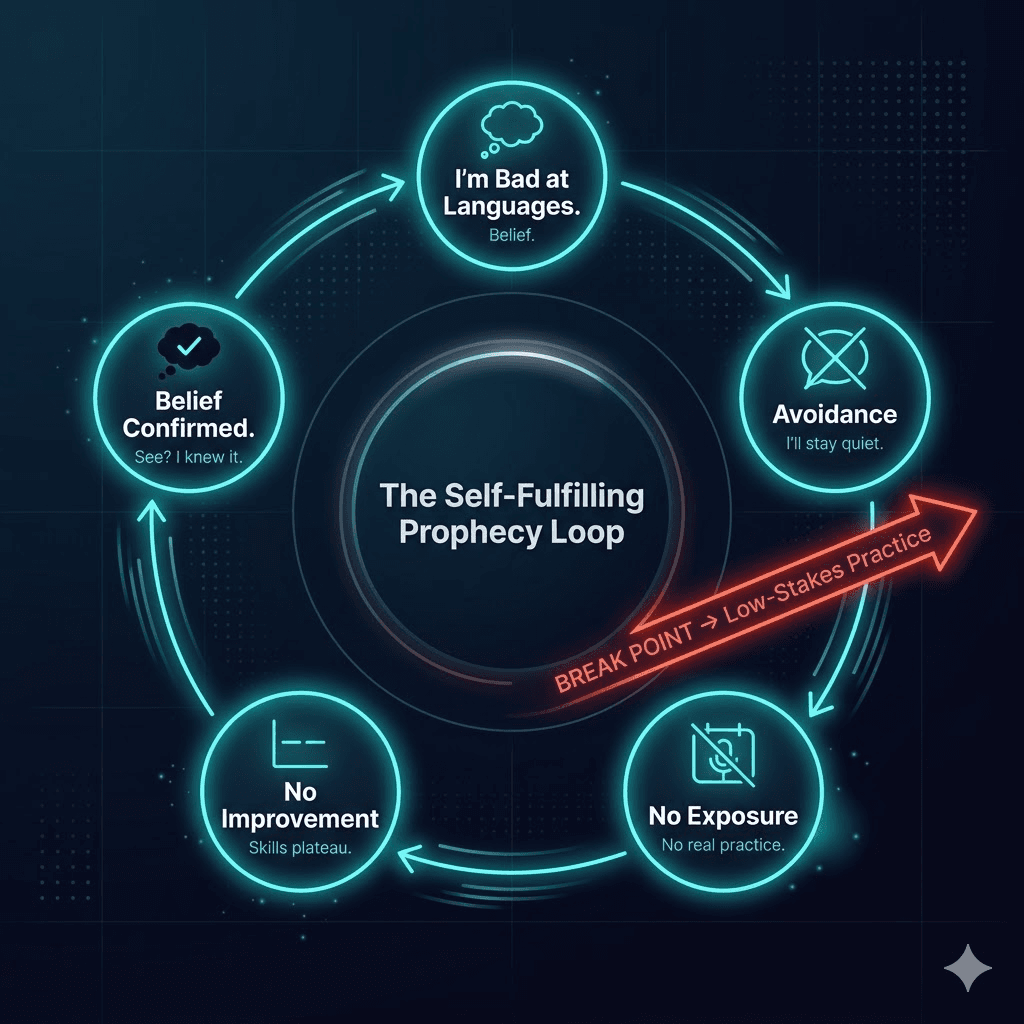
Anxiety predicts speaking performance more accurately than knowledge does. The correlation between language anxiety and oral fluency sits between r = -0.25 and r = -0.40 across studies.
Three sabotage patterns are observed:
- You avoid speaking. Output stops. Production pathways weaken. Errors are never exposed to feedback, so fossilization sets in. Avoidance protects your mistakes from being corrected.
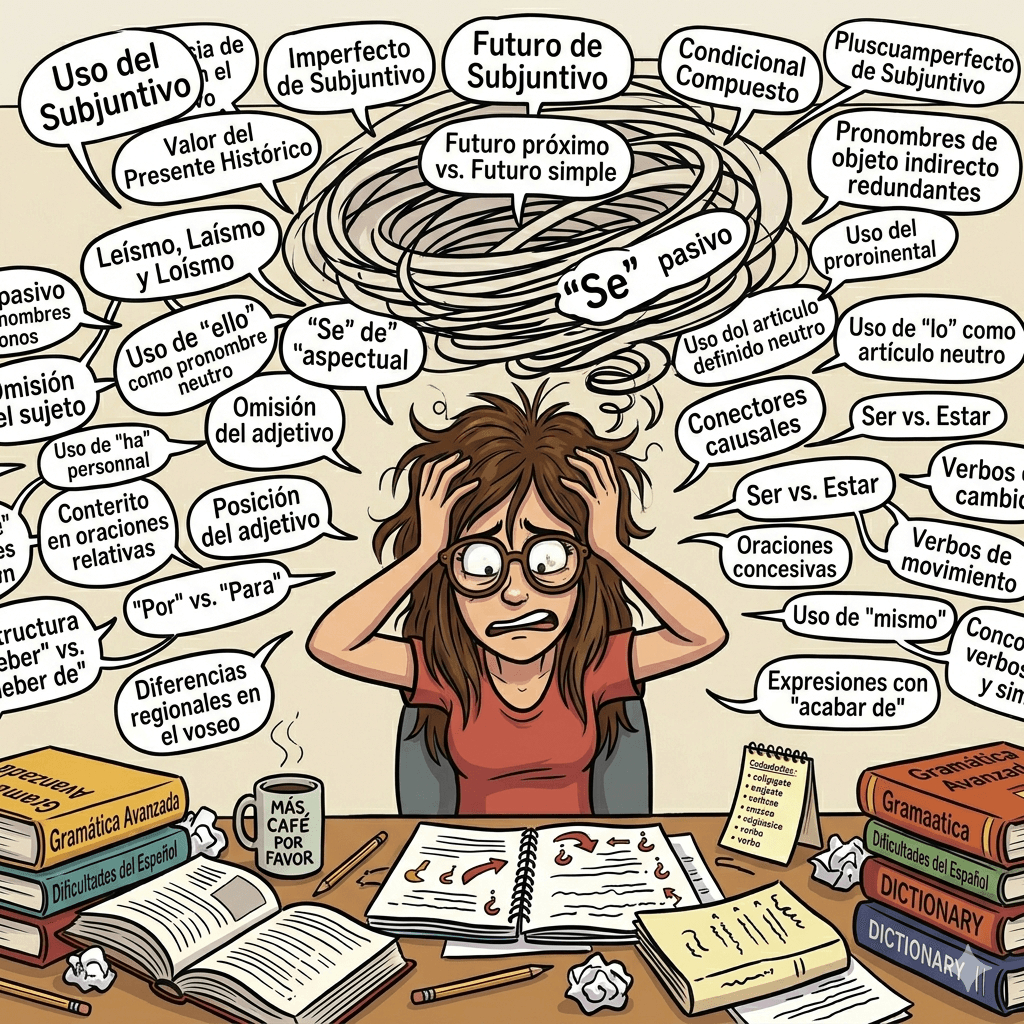
- You stay in study mode. Passive input is consumed endlessly. Recognition improves, but retrieval does not. A false sense of progress is created.
- You build false beliefs. “I’m not a language person” becomes a self-fulfilling prophecy. Avoidance is used as evidence. The loop closes.
Receptive vs Productive Skill Gap
| Skill | Typical Level Reached | Why |
| Reading | B2–C1 | Passive exposure scales easily |
| Listening | B2–C1 | Recognition-based |
| Writing | B1–B2 | Time pressure is low |
| Speaking | A1–A2 | Anxiety blocks real-time output |
How to Overcome Language Anxiety (Step-by-Step)
Mastering a new language requires a steady, structured approach. Follow these specific steps to build lasting confidence.
1. Accept Mistakes as Required Data
Mistakes are reframed as feedback, not failure. Each error reveals a gap in the retrieval pathway. Without that data, fluency cannot be built.
2. Start Speaking Early
The “wait until ready” strategy backfires. Readiness is built through speaking, not before it. This is called the Perfectionism Paradox.
3. Use Low-Pressure Practice
Self-talk is used to lower cortisol and rebuild the retrieval loop. Target-language narration of daily activities works well. One-minute voice recordings to yourself also work.
4. Prioritize Message Over Grammar
The Swain Output Hypothesis applies here. “Comprehensible output” means adjusting speech until meaning is understood. Perfect grammar is not required. Successful communication is.
5. Build Through Repetition
Exposure therapy principles apply. Small daily wins rewire the amygdala’s threat association. Speaking is slowly tagged as “safe.”
Best Techniques to Reduce Language Anxiety Fast
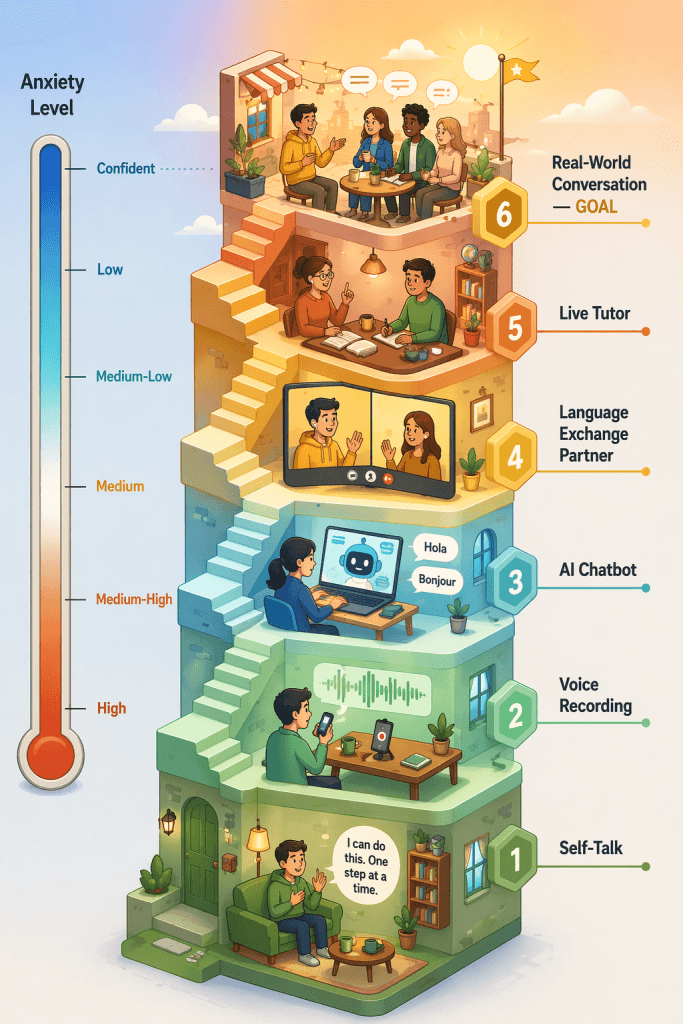
Managing language anxiety requires prioritizing connection over perfection. Simple, daily habits quickly build speaking confidence.
- Shadowing. Native audio is repeated almost simultaneously. The thinking brain is bypassed, and articulatory muscle memory is built directly.
- Self-recording. Your own voice is played back. The Spotlight Effect is weakened when actual output is compared to the internal perception.
- AI chatbots. A judgment-free zone is created. Errors can be made 1,000 times without social cost.
- Low-stakes language exchanges. Platforms like Tandem and HelloTalk create forgiving peer interactions.
Practice Method Comparison
| Method | Anxiety Level | Feedback Quality | Best For |
| Self-talk | Very low | None | Initial warm-up |
| Shadowing | Low | Self-monitored | Pronunciation |
| AI chat | Low | Instant | Pre-conversation reps |
| Language exchange | Medium | Peer-based | Real-world transfer |
| Live tutor | Medium-high | Expert | Targeted correction |
2026 Update and Future Predictions
The biggest shift of 2026 is the rise of emotionally intelligent AI tutors. Voice stress is detected in real time. Difficulty is adapted when anxiety spikes. Non-judgmental correction loops are now standard.
Reported outcomes from 2025–2026 studies:
- Learners using adaptive AI tutors reach conversation milestones ~40% faster
- Around 80% of learners now use AI-assisted tools in some form
- The global online language learning market hit ~$115 billion by end of 2026.
- About 71% of self-study learners still report higher confidence when paired with human interaction
Future Predictions (2026 and Beyond)
| Development | Expected Impact |
| AR glasses with real-time whisper coaching | Live conversation support without pausing |
| Failure-positive communities | Mistakes are gamified as bravery points |
| Neurofeedback headbands | Flow state is trained via brainwave tracking |
| VR language cafés | Immersion without social risk |
The pattern is clear. Technology is used as a bridge to human interaction, not a replacement for it. Real fluency still requires real exposure.
FAQs
Is language anxiety normal?
Yes. It is reported by beginners and polyglots alike. Even experienced learners like Ellen Jovin describe persistent perfectionism after mastering many languages.
Can you be fluent but still have language anxiety?
Yes. Situational anxiety can be triggered in specific contexts even at C1 level. Trait anxiety makes it more persistent.
How long does it take to overcome language anxiety?
The timeline depends on practice frequency. Measurable reduction is typically seen after 4–8 weeks of consistent low-stakes output.
What is the fastest way to reduce fear of speaking?
Immediate, repeated, and low-stakes exposure is the fastest method. AI chat, self-recording, and daily voice notes are recommended.
Does grammar study help with anxiety?
No. More input does not fix an output problem. Anxiety is reduced by speaking, not by studying more rules.
Why do I feel anxious with native speakers but fine with AI?
Social evaluation risk is removed with AI. The amygdala does not classify an AI as a judge. Confidence built with AI must then be bridged to human interaction.
Final Word
Confidence is not needed before speaking. Confidence is produced by speaking.
Fluency fails because access to knowledge is blocked under social pressure, not because knowledge is missing.
The dam must be lowered. That is done through repetition, not waiting. The first imperfect sentence is where fluency begins.
Try Jolii for Real-World Speaking Practice
Jolii is designed for the blocked speaker who already understands the language but cannot speak it like a native.
To solve this, short, guided speaking drills are built into the app to move comprehension into output.