Quick Answer (TL;DR)
Yes—but only partially. You can learn vocabulary, recognize patterns, and improve comprehension by reading subtitles. However, you cannot build real fluency this way. Subtitles do not train your brain to retrieve language, respond in real time, or process spoken input independently.
So while they help you understand, they don’t help you use the language.
👉 Learn language with subtitles feels effective, but it builds recognition, not real fluency or the ability to respond naturally.
This article focuses on a narrower question: is reading subtitles alone — without any other strategy — enough to build fluency? The short answer is no, and the cognitive reasons explain why. For a practical framework on how to use different subtitle modes deliberately at different learning stages, Dual Subtitles vs Single Subtitles breaks down exactly when to switch between them.
Why This Feels Like Real Progress
At the beginning, the experience is encouraging.
You start by watching a show, and everything feels manageable.
As the dialogue unfolds, it becomes easier to follow what is happening.
Over time, certain words begin to stand out more clearly.
Because of that, everything feels smoother.
And naturally, your brain interprets that smoothness as improvement.
However, what’s improving is not your ability to use the language.
It’s your ability to understand it with support.
That difference is subtle.
But it changes everything.
So the problem is not subtitles themselves.
It’s how they are used.
At this stage, subtitles feel like learning.
But without structure, they mainly support understanding—not development.
And that’s where many learners get stuck.
The Cognitive Insight: What Your Brain Is Actually Doing
To understand why subtitles feel effective, you need to look at how learning works.
1. Recognition vs Retrieval
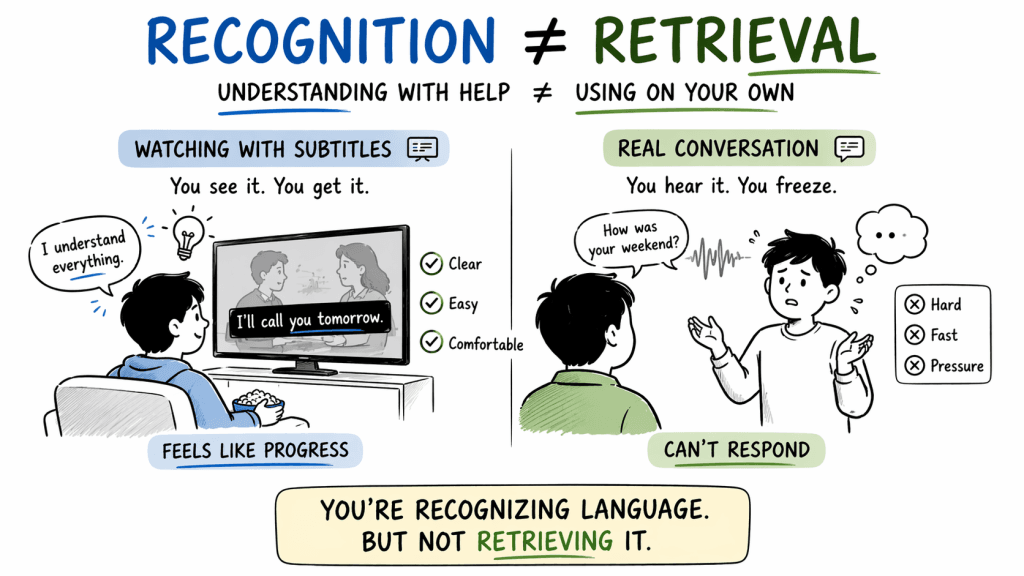
When you read subtitles, your brain is recognizing language.
You see a phrase.
You understand it instantly.
There is no need to:
- search for words
- construct meaning
- respond under pressure
However, real communication depends on something else.
Retrieval.
That means:
- recalling words without prompts
- forming sentences in real time
- responding without support
This is often called active recall or retrieval practice.
Subtitles don’t train this. They replace it.
2. Exposure vs Active Use
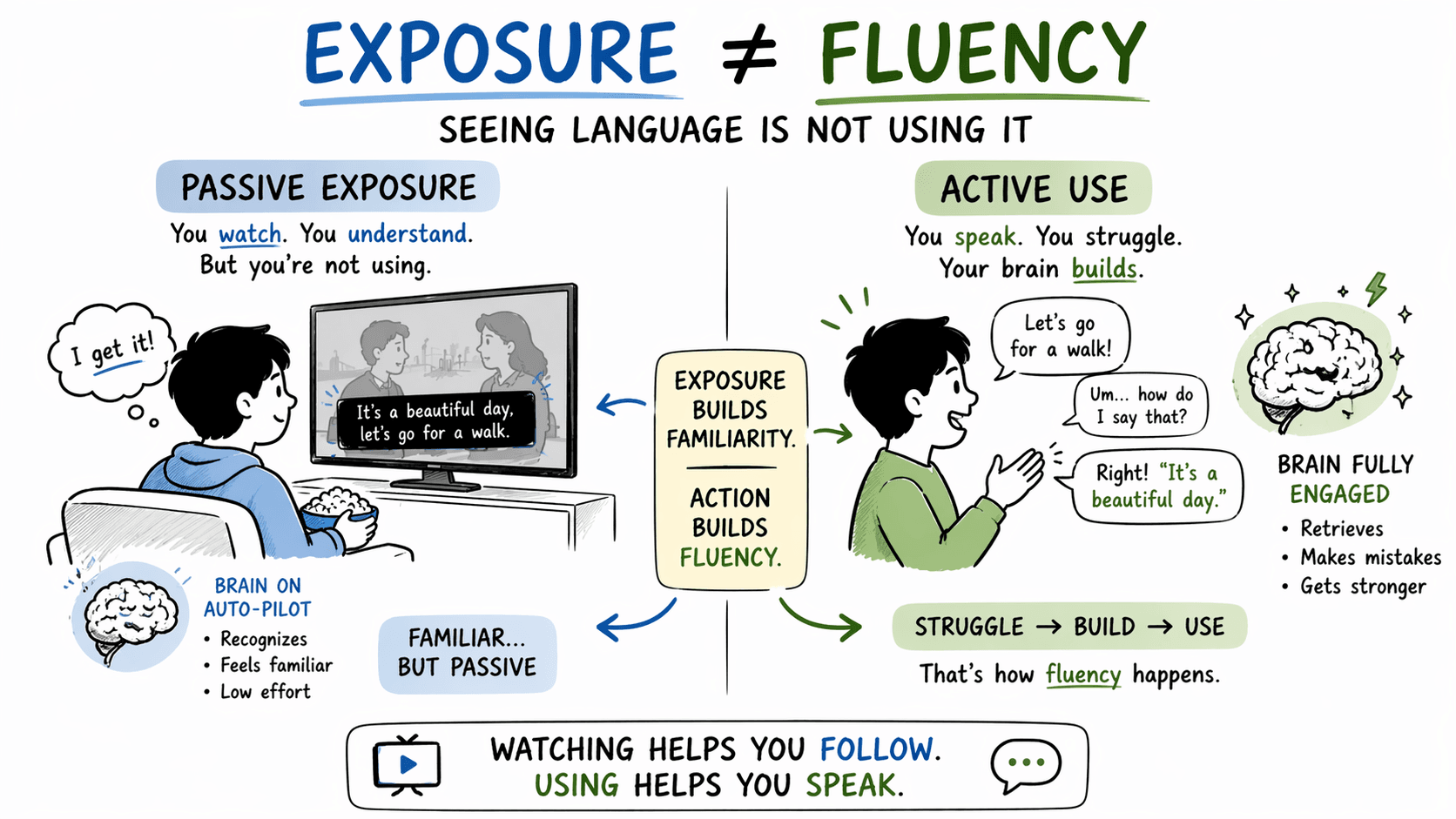
Subtitles give you exposure.
In language learning, this is often described as comprehensible input—input that you can understand.
And that’s why subtitles feel effective.
You follow the story.
Meaning becomes clear.
And you stay engaged without much effort.
However, exposure alone is not enough.
Because there is no pressure to respond.
No need to choose words.
No moment where you have to build meaning yourself.
Everything is already there.
So your brain stays passive.
It observes.
It follows.
But it doesn’t engage.
Subtitles can provide comprehensible input.
But without active use—without retrieval—they remain passive input.
3. Efficiency vs Depth
Subtitles make everything easier.
Understanding happens faster.
Following the story requires less effort.
And because of that, everything feels efficient.
However, efficiency comes at a cost.
When something is too easy, your brain stops working deeply.
It doesn’t need to:
- hold information
- resolve uncertainty
- make connections
So the experience becomes smooth.
But shallow.
You move forward.
But nothing really stays.
4. The Illusion of Accuracy
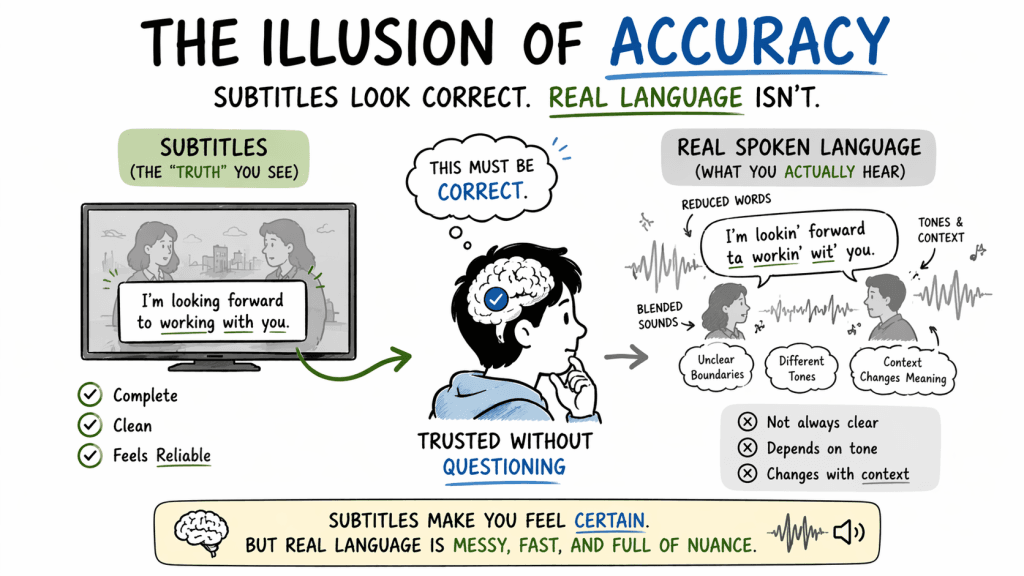
Subtitles don’t just help you understand.
They make you feel certain.
When you read a sentence, it looks complete.
It feels correct.
So your brain stops questioning it.
However, spoken language is not that clean.
In real conversations:
- words are reduced
- sounds blend together
- meaning depends on context
Subtitles remove that complexity.
So over time, something shifts.
You don’t just rely on subtitles to understand.
👉 You rely on them to decide what is “correct.”
And that’s where learning becomes fragile.
A Moment I Noticed This Myself
For a long time, I watched Netflix with a clear goal.
Not just for entertainment.
But to improve my language.
So I paid attention.
I followed subtitles closely.
And over time, everything felt easier.
Because of that, I trusted subtitles completely.
They became my reference.
But then something small happened.
In one scene, a subtitle translated a word incorrectly.
It was subtle.
The kind of mistake you wouldn’t question
if you were used to relying on subtitles.
And I didn’t question it.
Later, I used that exact word in a real conversation.
And something felt off.
Not confusion.
Not correction.
Just that slight pause
that tells you something isn’t quite right.
That moment stayed with me.
Because I realized:
I wasn’t using the language.
I was repeating what I had read.
What Subtitles Actually Build
| Learning Mode | What It Feels Like | What Your Brain Builds |
| Subtitles ON | “I understand everything” | Recognition |
| Repeated Exposure | “This feels familiar” | Familiarity |
| No Production | “I can’t respond” | Weak retrieval |
| Active Use | “I can say it naturally” | Usable fluency |
The Science Says No (And Here’s Why)
This is where things become clearer.
This reflects several well-established findings in cognitive psychology. Subtitles improve comprehension but shift attentional focus toward text rather than audio — which is part of why listening skills can lag behind reading comprehension for heavy subtitle users. Separately, retrieval practice research consistently shows that actively recalling information builds much stronger memory than passive recognition. And research on active learning suggests that when engagement is passive, learners often overestimate how much they’re actually retaining.
Together, this explains why subtitles feel effective even when they aren’t building the skills needed for real conversation.
Put simply:
👉 Subtitles help you understand
👉 But they don’t train you to retrieve, respond, or use the language
And that’s why:
👉 The science says no. Not because subtitles are useless.
But because they are incomplete—and only become effective when used intentionally as part of the learning process.
So What Should You Do Instead?
The goal is not to remove subtitles.
It is to use them intentionally.
1. Listen Before You Read
Try to understand the audio first.
Then check subtitles.
👉 Why: forces retrieval instead of recognition
2. Turn Passive Input into Active Processing
Pause and repeat key lines.
👉 Why: activates retrieval practice
3. Focus on Patterns, Not Words
Notice:
- recurring expressions
- sentence structures
👉 Why: patterns are reusable in real conversation
4. Simulate Responses
After hearing a line, ask:
👉 “What would I say here?”
👉 Why: builds real-time production ability
Why This Connects to Subtitle Dependency
At some point, many learners notice something.
They understand everything with subtitles.
But without them, comprehension drops.
That is not a coincidence.
It is a pattern.
This transition is explained more clearly here:
👉 Stop “Reading” Netflix: How to Transition from Subtitles to Pure Listening
Because the issue is not subtitles themselves.
It is the role they play in your learning process.
FAQs
1. Can subtitles help me learn a language?
Yes. They support comprehension and exposure—but only when used intentionally.
2. Why can’t I speak even if I understand everything?
Because recognition does not equal retrieval.
3. Should I stop using subtitles completely?
No. You should change how you use them, not remove them entirely.
A Simple Way to Make This Work (Jolii Approach)
The problem is not subtitles.
It is how your attention is guided.
And that’s exactly where most learning breaks down.
Without structure, your attention naturally drifts toward what feels easier—reading instead of listening.
Jolii is an AI-powered language learning app that turns real-world content,
like Netflix, YouTube, and music—into structured learning experiences.
Instead of learning from isolated examples,
you learn directly from how language is used in context.
At the same time, Jolii lets you switch between dual and single subtitles based on your level,
so you’re not just watching,
but using subtitles in a way that actually supports learning.
Instead of:
passively reading
following subtitles
It helps you:
notice patterns
connect sound with meaning
revisit key moments intentionally
So instead of replacing thinking,
it supports it.
And that’s what turns exposure into real learning.
Final Thoughts
Subtitles feel helpful because they reduce effort.
However, language learning is not just about understanding faster.
It is about processing deeper.
At some point, you will notice something subtle.
You understand everything with subtitles.
But without them, you hesitate.
That gap is not a failure.
It is a signal.
Not that subtitles don’t work—but that they are being used in the wrong way.
And once you see that,
you can start changing it.
Because fluency is not built on what you read.
It is built on what you can hear—and respond to—without support.