Quick Answer (TL;DR)
Neither is inherently better. Each one supports a different stage of learning. Dual subtitles are more useful for early understanding, while single subtitles improve focus and deeper processing. So progress becomes faster when you know when to switch between them.
This article focuses on choosing between subtitle modes — when dual subtitles help, when single subtitles help more, and when to remove them entirely. For the deeper question of whether subtitles alone, used passively, can ever build real fluency on their own, Can You Actually Learn a Language Just by Reading Subtitles? explains the cognitive reasons why the answer is no.
Subtitles can make content easier to understand and reduce confusion. However, each type shapes how your brain processes the language.
At first, this doesn’t feel obvious.I remember feeling confused about this for a long time. Subtitles clearly helped, making everything easier to follow. So I assumed using them more would lead to better learning.
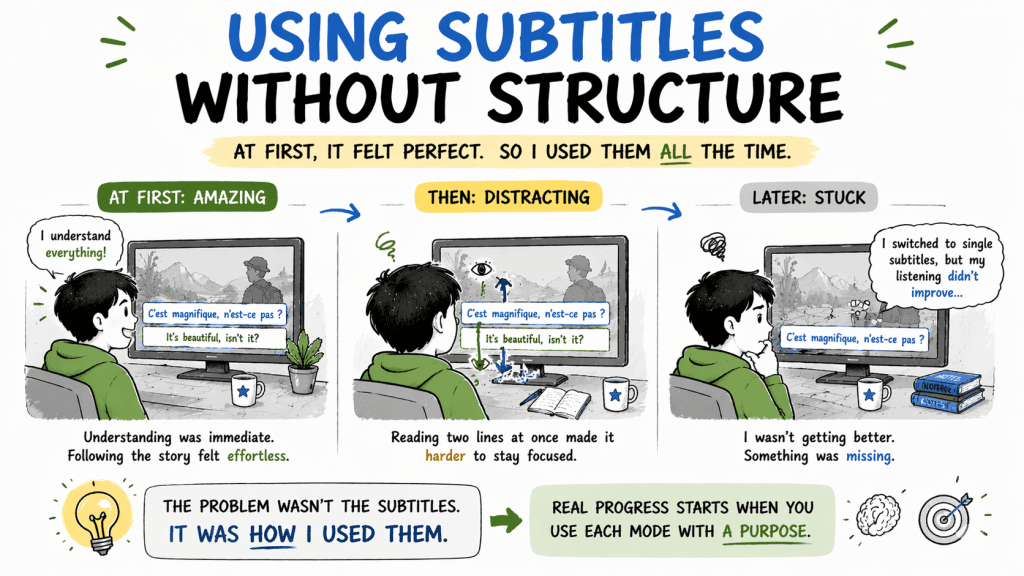
And at first, it worked. With dual subtitles on, everything felt clear. At first, it felt great. Understanding became immediate, and following the story no longer required effort. So I started using them all the time.
However, something slowly changed. Reading two lines at once made it harder to stay focused. My attention kept shifting between languages instead of staying on the content.
So I switched to a single subtitle, thinking it would fix the problem. And for a while, it did. But after some time, my listening stopped improving. That’s when I paused and looked deeper.
It wasn’t that subtitles didn’t work. It was that I had been using them without any structure.
And that was the real issue.
Why This Is Not Just About “Which One Is Better”
At first, it seems like a simple comparison. Which is better—dual subtitles or single subtitles?
However, that question misses something important. Because the real difference is not the subtitles themselves. It’s how your brain uses them.
The same setup can feel helpful at one stage, and limiting at another. Not because it changed—but because your needs changed.
So instead of asking:
👉 “Which one is better?”
A more useful question is:
👉 “What role does each one play in my learning right now?”
And that’s where things start to become clearer.
The Cognitive Insight: What Different Subtitle Modes Actually Do
To understand which subtitles help, you need to look at how attention works.
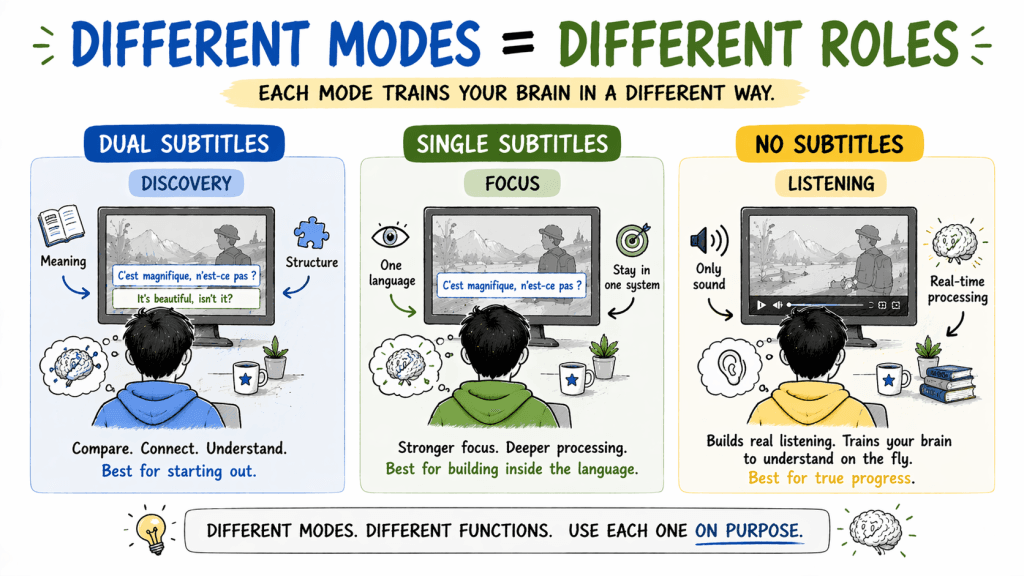
1. Dual Subtitles → Discovery
At the beginning, dual subtitles feel incredibly powerful.
They allow you to:
- connect meaning quickly
- compare structures
- reduce confusion
Because of that, everything feels smooth. And at this stage, that’s exactly what you need. At the same time, your brain is exposed to both meaning and structure together.
However, this also shapes how you process language. Instead of staying in one system, your attention moves between two.
So rather than building meaning fully from context, you often confirm it through translation.
That’s why dual subtitles work best as a starting point—for discovery, not long-term reliance.
2. Single Subtitles → Focus
When you remove one language, something shifts.
Now your brain is no longer splitting attention between two systems.
Instead, you can choose how you want to process the input.
There are two ways this can work.
Option 1: Keep Only the Target Language
When only your target language is visible, your brain has to stay inside that system.
You read and listen together. Gradually, sound starts to connect with text.
And if you combine this with repeating or following highlighted phrases,
you start activating more than just recognition.
Because of that:
- attention becomes more stable
- reading and listening begin to align
- your ability to adapt inside the language improves
This is where real processing starts to develop.
Option 2: Keep Only Your Native Language
However, if meaning is still unclear, you don’t have to force full immersion immediately.
You can remove the target language and keep only your native language as support. Now your brain is guided by meaning first.
But instead of reading both at the same time, you separate the process. You listen first. Then you check meaning when needed.
Because of that:
- listening becomes more active
- translation becomes occasional, not constant
- cognitive load is reduced
And this is what makes single subtitles powerful.
Not because you choose one language.
But because you can control how and when each one appears.
3. Listening Stage → No Subtitles
At some point, both subtitles need to be removed.
Because as long as text is present, your brain will always have something to rely on.
And when that happens, listening never becomes the main process.
So instead of adjusting subtitles, you remove them completely.
Now there is only sound.
Meaning is no longer supported by text.
It has to be built in real time.
At first, this feels uncomfortable.
You don’t understand everything. You miss parts of the conversation.
However, that is exactly the point.
Because this is the stage where your brain starts adapting to real listening.
Not reading.
Not checking.
But actually processing spoken language.
Research on multimedia learning shows that processing multiple streams of information at once can increase cognitive load and reduce learning efficiency. Studies comparing bilingual and monolingual subtitles support this — dual subtitles can split visual attention and don’t always lead to better comprehension outcomes, even though they do support initial understanding.
In simple terms: subtitles support understanding, but not all of them build fluency equally.
Dual vs Single vs Listening
| Mode | What It Feels Like | What Your Brain Does |
| Dual Subtitles | “Everything is clear” | Mapping + comparison |
| Single (target language) | “I process inside the language” | Focused processing |
| Single (native language) | “I check meaning when needed” | Listening-first + support |
| Structured Use | “I’m improving” | Pattern building |
So What Actually Works?
The answer is not choosing one mode.
It’s changing how you use them over time.
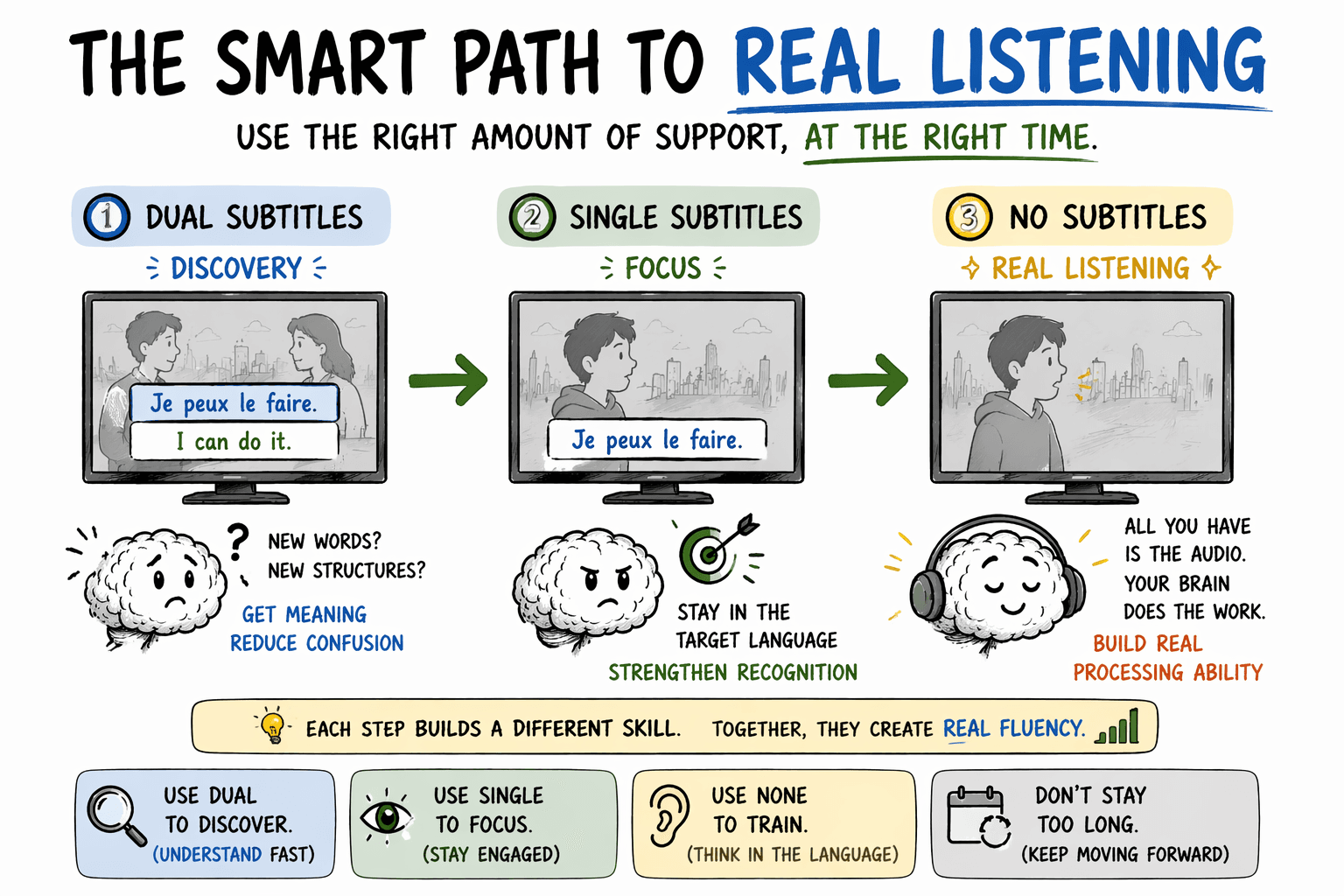
1. Start with Dual Subtitles
When content is new:
- use dual subtitles
👉 Why: reduces confusion and builds initial understanding
2. Move to Single Subtitles
When things become familiar:
- use your target language for processing
- or your native language for support when needed
👉 Why: balances understanding and adaptation
3. Shift to Listening
At a later stage:
- remove all subtitles
👉 Why: forces your brain to rely on sound and build meaning in real time.
4. Keep Switching Intentionally
Progress doesn’t come from staying in one mode.
It comes from knowing when to switch.
Why This Connects to Subtitle Dependency
If subtitles feel necessary, there is a reason.
They reduce uncertainty.
However, learning requires some level of uncertainty. This transition is explained more clearly here:
👉 Stop “Reading” Netflix: How to Transition from Subtitles to Pure Listening
Because eventually,
you need to move from:
👉 “I understand with support”
to
👉 “I process language in real time”
FAQs
1. Are dual subtitles better than single subtitles?
They are useful at early stages, but should not be used all the time.
2. Why do dual subtitles feel so effective?
Because they reduce uncertainty and provide instant confirmation.
Should I remove subtitles completely?
Not necessarily. Instead, change how you use them as you improve.
A Simple Way to Make This Work (Jolii Approach)
The issue is not subtitles.
It is how you use them.
Jolii allows you to move between subtitle modes intentionally:
- dual subtitles → for discovery
- single subtitles → for focus
- flexible control → for listening-first training
So instead of staying in one mode,
you adapt based on your stage.
And that’s what turns passive watching into real progress.
Final Thoughts
Subtitles are not the problem.
They are tools.
And like any tool, their value depends on how you use them.
So the real question is not:
“Which subtitle is better?”
But:
“Am I using the right one at the right time?”
Because once you understand that, learning becomes much more effective.