Relying too much on subtitles can slow down listening development.
To improve listening, you need to gradually shift from reading subtitles to processing spoken language directly. The goal is not to remove subtitles completely—but to reduce dependence on them over time.
Why Subtitles Feel Helpful (But Can Hold You Back)
Subtitles feel like a safety net.
When you don’t understand something, you can:
- Glance down
- Confirm meaning
- Keep going
This makes watching less stressful.
And in the early stages, subtitles are genuinely useful.
They help:
- Connect sound with meaning
- Build vocabulary
- Reduce frustration
But after a certain point, something changes.
At that moment, you are no longer listening first.
You are reading first.
And listening becomes secondary.
This shift is subtle.
Most learners don’t notice it happening.
But over time, it becomes the default way the brain processes language.
The Subtle Shift: From Listening to Reading
At intermediate levels, many learners develop a hidden habit.
They think they are practicing listening.
But what they are actually doing is:
- Reading subtitles
- Confirming with audio
- Not processing sound independently
This creates a dependency.
The brain learns:
👉 “meaning comes from text”
instead of:
👉 “meaning comes from sound”
As a result, over time, this slows down listening improvement.
And more importantly, it prevents the brain from building automatic listening skills.
The Cognitive Problem: Recognition vs Processing
There is a key difference between:
- Recognizing language
- Processing language in real time
When you read subtitles, recognition becomes easy.
But listening requires something else:
- Decoding sound
- Predicting structure
- Holding meaning in memory
Research shows that multimodal input can support comprehension, but learners still need to process auditory signals directly to develop listening ability.
Because of this, if subtitles are always present, the brain often avoids deeper processing.
It chooses the easier path.
And the easier path does not build strong listening skills.
Subtitle vs Listening Processing
| Learning Mode | What It Feels Like | What the Brain Actually Does |
|---|---|---|
| Subtitles (Reading-first) | “I understand everything” | Recognizes written words quickly |
| Listening (Audio-first) | “I miss some parts” | Processes sound in real time |
| Mixed (Dependent) | “I follow but need subtitles” | Relies on text as support |
| Independent Listening | “I understand through sound” | Builds automatic auditory processing |
Why Listening Feels Harder Than It Should
There is another reason this transition feels difficult.
Spoken language is not clean.
It includes:
- Reduced sounds
- Connected speech
- Unclear word boundaries
For example:
“I don’t know”
often sounds like
“I dunno”
If you are used to reading, your brain expects clarity.
But real listening is messy.
Without training, everything feels blurred.
As a result, this is why many learners feel stuck at this stage.
Not because they lack vocabulary.
But because they have not trained their brain to process sound.
Why Removing Subtitles Suddenly Doesn’t Work
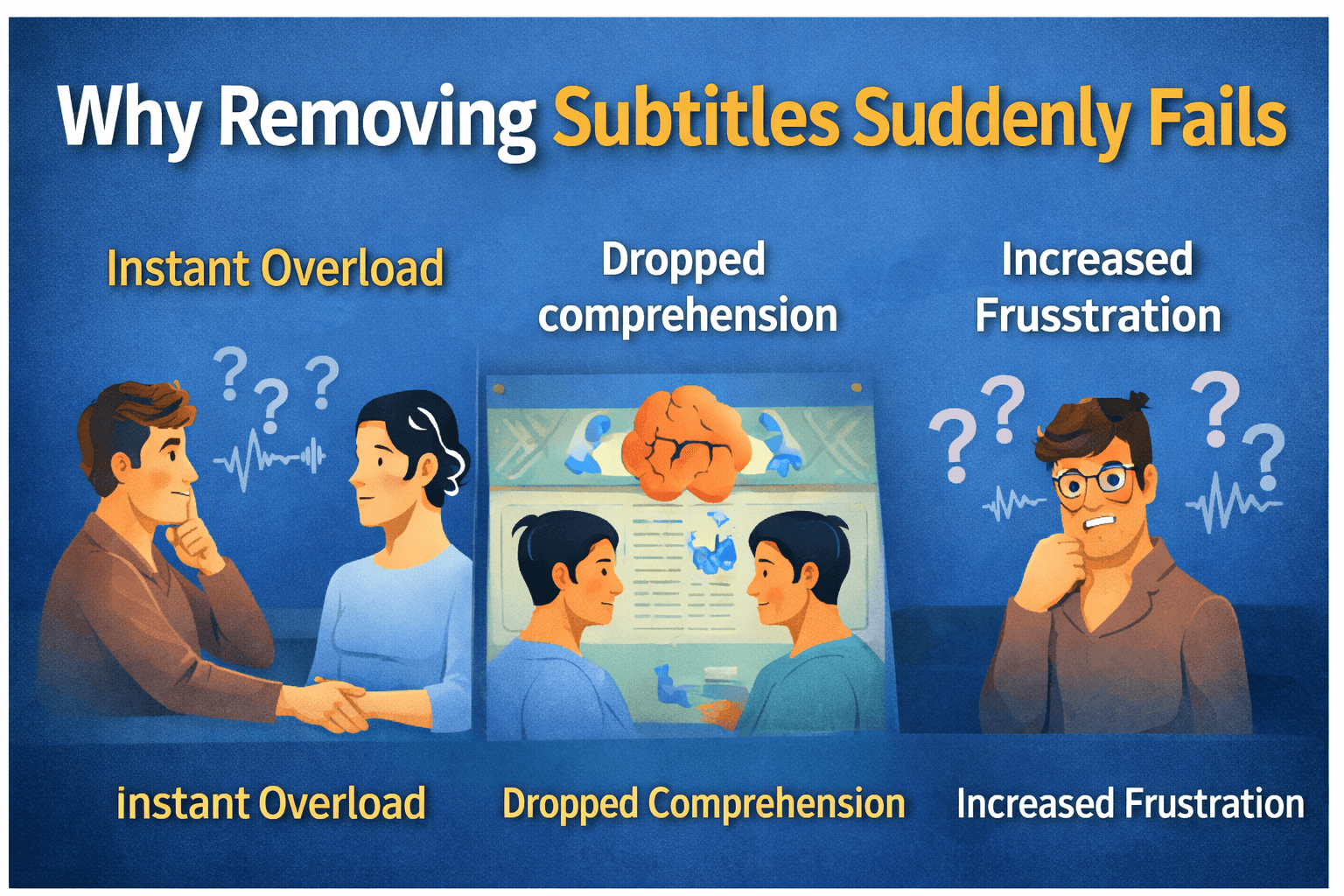
Some learners try to solve this by doing something extreme.
They turn off subtitles completely.
At first, it feels like progress.
But after a few minutes:
- Comprehension drops
- Frustration increases
- Attention breaks
However, the problem is not effort.
The problem is cognitive overload.
Without enough support, the brain cannot process fast speech.
So it stops trying.
A Moment I Noticed This Myself
I remember a time when I was watching Korean dramas regularly.
At first, it felt like I was improving.
I could follow the story, and I recognized a lot of vocabulary.
In fact, most scenes felt easy to understand.
But one day, I tried turning off subtitles.
And something strange happened.
I couldn’t follow the conversation anymore.
Not completely.
I caught a few words.
Some phrases felt familiar.
But the overall meaning kept slipping away.
It felt like I had gone backwards.
At first, I thought something was wrong.
But later, I realized the problem.
I wasn’t really listening.
I had been reading.
And because I had been reading for so long, my brain never fully learned how to process fast speech.
Why This Connects to the B2 Plateau
This is exactly what happens at the intermediate level.
You can understand a lot.
You can follow conversations.
But something stops improving.
Listening doesn’t feel sharper.
Pronunciation doesn’t feel clearer.
If you want to understand this stage more deeply, you can read here:
👉The B2 Efficiency Trap: Why Your Brain Stopped Improving Your Accent (And How to Re-Wire It)
At this stage, the brain becomes efficient.
It uses shortcuts.
Subtitles become one of those shortcuts.
And shortcuts can slow down deeper skill development.
What Real Listening Practice Looks Like
Listening is not passive.
It is an active process.
The brain needs to:
- Segment sounds
- Identify patterns
- Predict meaning
- Adjust in real time
This only happens when listening is the primary source of information.
Not the secondary one.
A Better Transition Strategy
Instead of removing subtitles completely, the goal is to change how you use them.
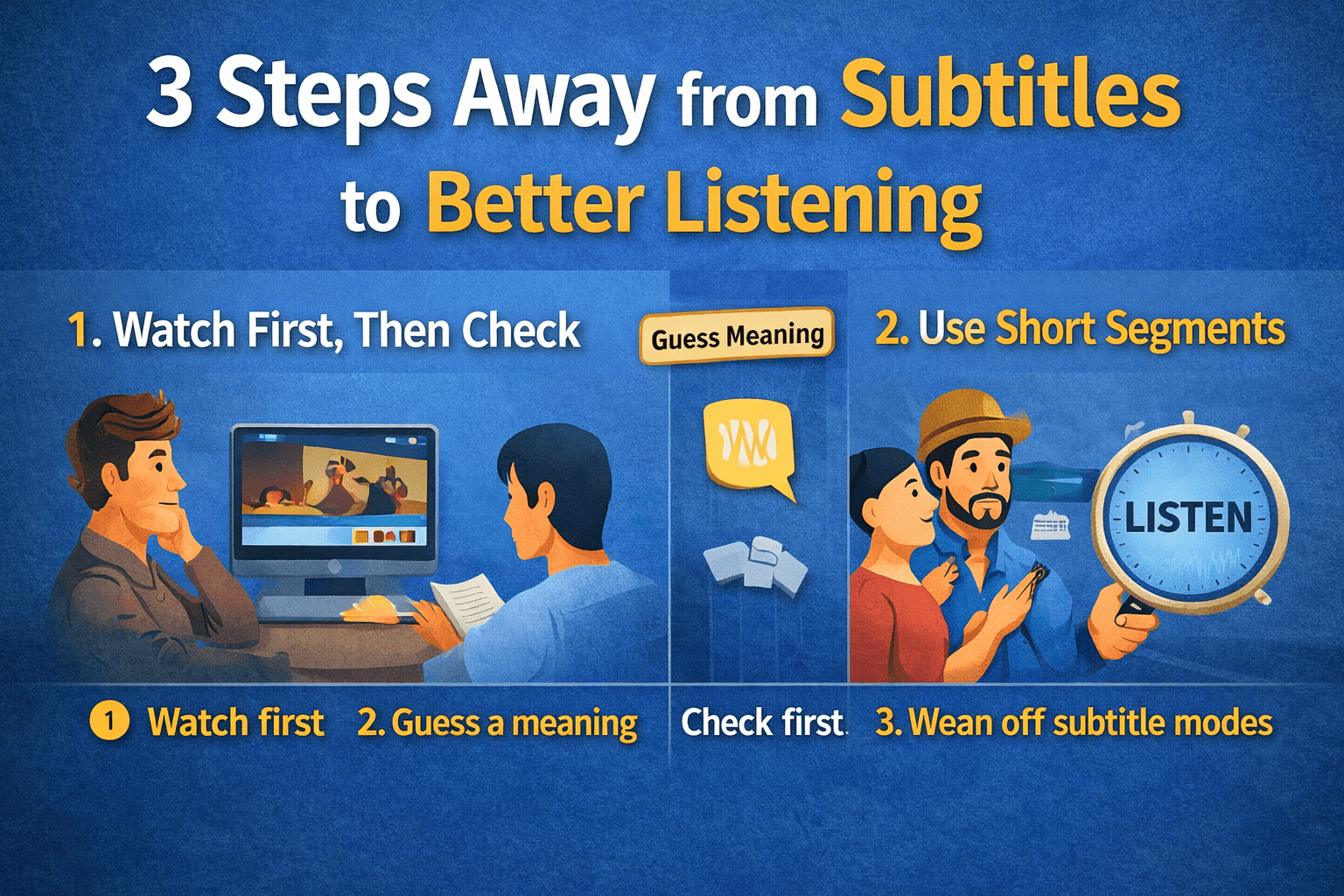
1. Watch First, Then Check
Try this simple shift:
- Listen first
- Guess meaning
- Then check subtitles
This forces the brain to process sound before reading.
2. Use Short Segments
Do not rely on full episodes.
Instead:
- 1–2 minute scenes
- Short dialogues
- Replay key moments
Short segments reduce overload and improve focus.
3. Alternate Subtitle Modes
You can rotate between:
- Target language subtitles
- No subtitles
- Dual subtitles (temporarily)
This variation strengthens learning.
Why Gradual Transition Works Better
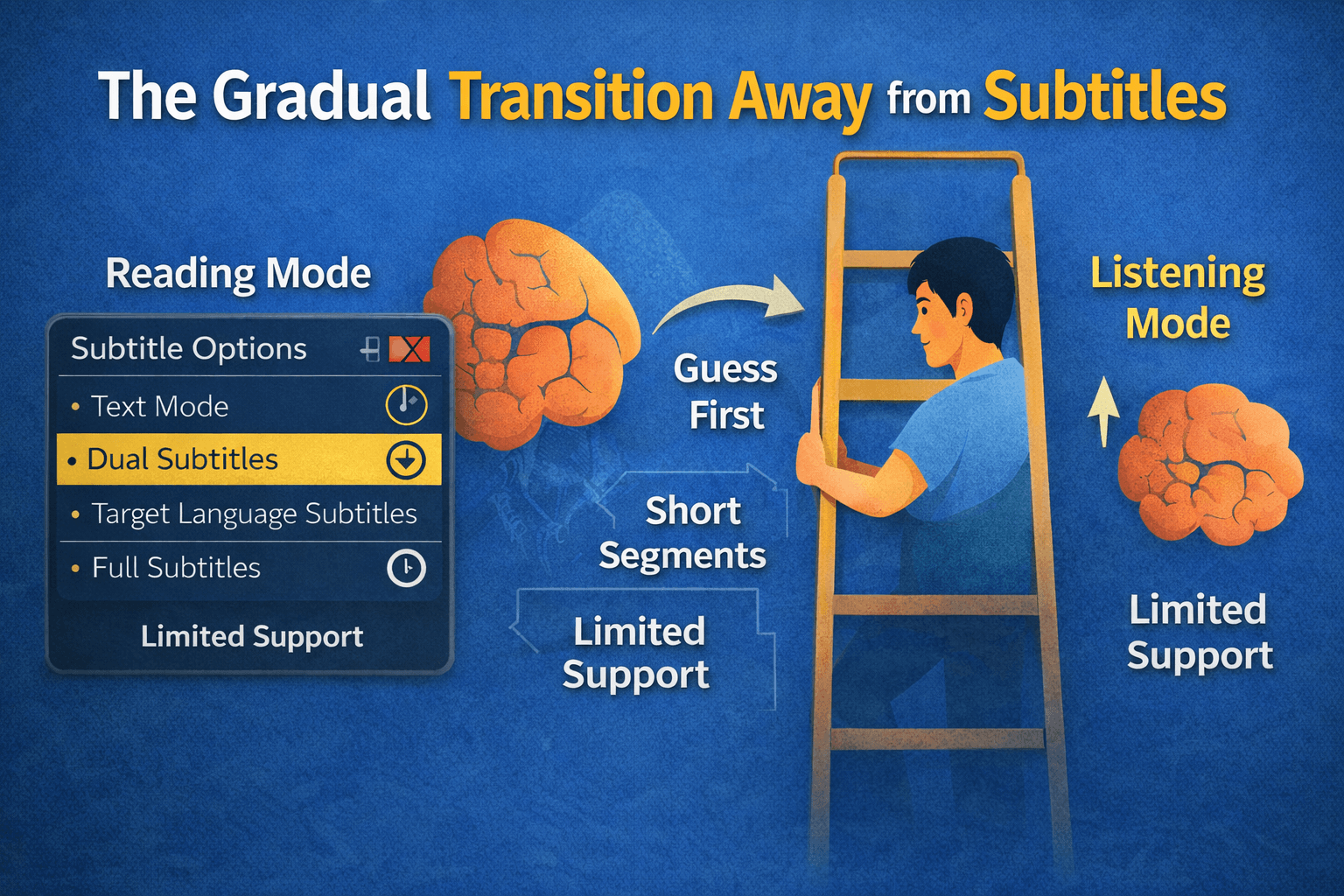
The brain adapts gradually.
If you remove support too quickly, performance drops.
But if you reduce support step by step:
- Listening improves
- Confidence increases
- Comprehension stabilizes
Research on language learning suggests that learners benefit from input that is slightly challenging but still understandable, rather than input that is either too easy or too difficult.
This balance allows the brain to keep learning without becoming overwhelmed.
The Role of Attention in Listening
Listening is closely tied to attention.
If your attention is on text, the brain prioritizes reading.
If your attention shifts to sound, the brain adapts.
Over time, this changes how you process language.
You begin to:
- Hear word boundaries more clearly
- Recognize patterns faster
- Rely less on subtitles
FAQs
1. Should I stop using subtitles completely?
No.
Subtitles are useful, but they should be used strategically.
2.Why do I understand with subtitles but not without?
Because you are relying on reading, not listening.
3. How long does it take to improve listening?
It depends on consistency.
But gradual exposure without heavy reliance on subtitles is key.
A Simple Way to Make This Work
One of the hardest parts of this transition is managing the balance.
Too much support → no listening growth
Too little support → frustration
That’s where tools like Jolii can help.
Instead of switching between modes manually, you can:
- Control subtitle visibility
- Replay short segments
- Focus on key phrases
This makes it easier to move from:
👉 reading → listening
without breaking the experience.
Final Thoughts
At some point, most learners realize something feels off.
You’re watching more.
Understanding more.
But listening doesn’t feel clearer.
It feels… the same.
That’s usually not a lack of effort.
It’s a sign that your brain has been taking a shortcut.
Subtitles made things easier.
But they also changed how you process language.
Instead of learning to hear, you learned to confirm.
And that habit is hard to notice—until you try to remove it.
The goal isn’t to stop using subtitles completely.
It’s to slowly change the role they play.
From something you rely on
to something you check.
Because real listening doesn’t come from understanding everything.
It comes from learning how to stay with the sound—even when it’s not fully clear yet.
That’s the uncomfortable part.
But it’s also where listening actually starts to improve.