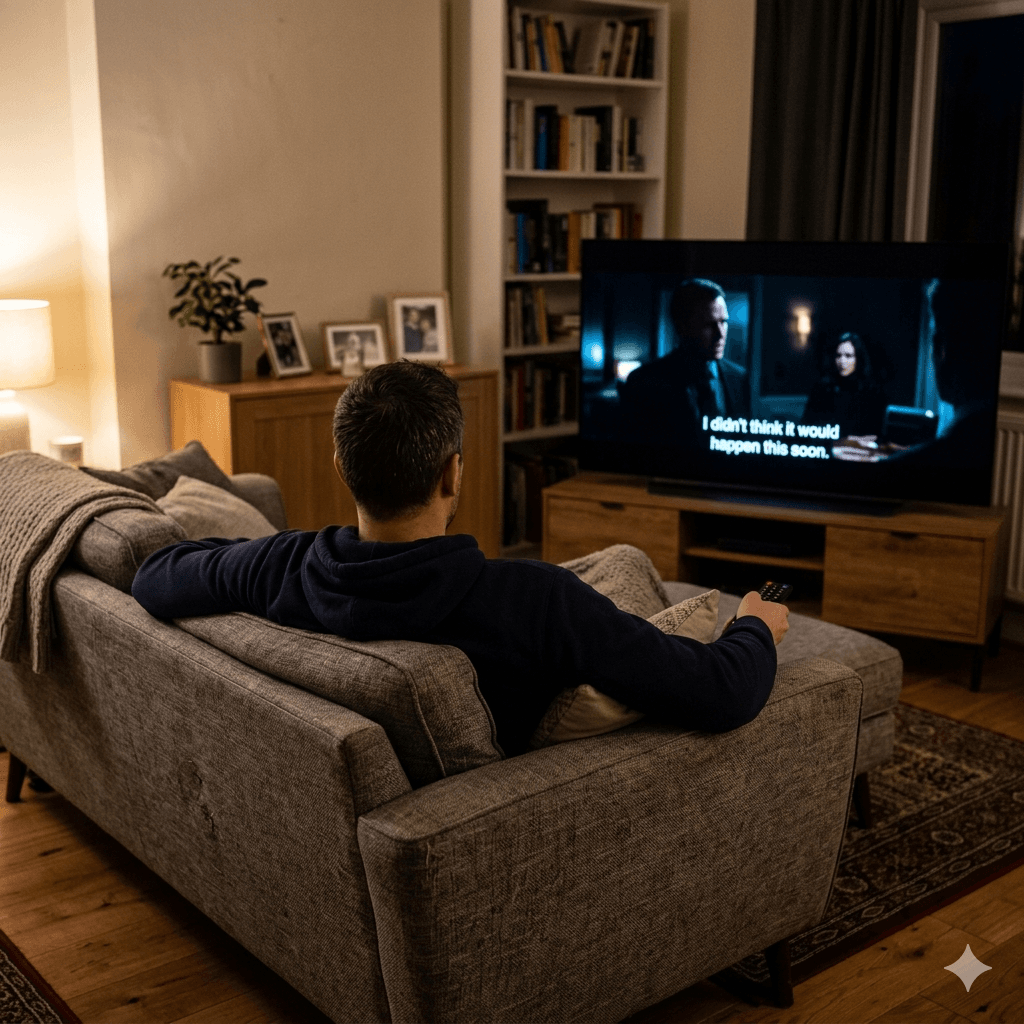
One of the first tips you hear when you’re learning a new language is: “Watch your favorite tv show with subtitles!” And you do. Subtitles feel like progress. You follow the story, you catch the jokes, and you recognize words we’ve studied before. It feels like learning is happening.
But then comes the real test: someone speaks to you, and your mind goes blank. So what happened?
The issue isn’t the subtitles themselves. It’s the role they’ve quietly taken over: doing the listening for you.
So, it’s time to figure out whether they’re helping you, and what to do if they’re not.
The Hidden Trade-Off Most Learners Miss
Subtitles make content easier to understand. That’s their job.
But language learning isn’t just about understanding; it’s about processing sound in real time.
When subtitles are always on, your brain naturally defaults to the easier path, which is reading.
This isn’t a motivation problem, it’s anatomy. The visual cortex processes written text significantly faster than the auditory cortex processes speech. Research on multimedia learning (Mayer, 2001) suggests that when text and audio compete for attention, visual processing tends to win, a phenomenon that has direct implications for subtitle-dependent learners. So while you feel like you’re watching in French, your brain is largely reading in French. The sound becomes background noise. And background noise doesn’t build listening skills.
.
Over time, that creates a gap:
- You recognize the language
- But you don’t process it fast enough to respond
And that gap is exactly where fluency breaks down. People do learn better from words and pictures than from words alone, but only when both are processed actively.
Quick Self-Check: Are Subtitles Helping You?
Time to be honest with yourself here.
| Situation | What’s actually happening |
| You read faster than you listen | Your brain prioritizes text over sound |
| You understand with subtitles but not without | Listening isn’t being trained |
| You feel anxious without subtitles | You’ve built dependence |
| You rarely notice pronunciation details | Audio processing is being skipped |
If this feels familiar, subtitles aren’t neutral. Your problem is that they’re doing too much of the work.
It’s Not On vs. Off. It’s Passive vs. Active
When you have this problem, most advice oversimplifies this by simply saying: “Just turn subtitles off.” That usually backfires. Instead, the real shift is this:
| Passive Use | Active Use |
| Subtitles always on | Subtitles used selectively |
| Reading automatically | Listening first, then checking |
| Trying to understand everything | Accepting partial understanding |
| Following the story easily | Engaging with the language itself |
Here’s the uncomfortable truth. If it feels effortless, you’re probably not training the skill you think you are, so watch out!
There’s a well-known idea in learning science called “desirable difficulty”: when something feels slightly harder, it often leads to better long-term results, because your brain is actually engaged.
What Should Subtitles Look Like?
Your approach should evolve as you improve.
1. If You’re a Beginner: Build the Connection
At the start, subtitles are helpful, but only if they support listening.
| Do this | Avoid this |
| Use subtitles in your target language | Relying on your native language |
| Focus on sound ↔ text connection | Translating every word |
| Accept not understanding everything | Constant pausing |
Goal: Start recognizing how the language sounds, not just what it means.
2. If You’re at Intermediate Level: Introduce Friction
This is where many learners plateau. You understand a lot, but subtitles are still carrying you.
| Do this | Avoid this |
| Watch short segments without subtitles first | Keeping them on the whole time |
| Turn them on to confirm meaning | Using them as a default |
| Rewatch strategically | Passive binge-watching |
Goal: Get comfortable not understanding everything immediately.
3. If You’re an Advanced Student: Remove the Safety Net
At this point, subtitles should be optional, never necessary.
| Do this | Avoid this |
| Watch mostly without subtitles | Using them out of habit |
| Focus on tone, rhythm, speed | Over-focusing on individual words |
| Use subtitles only when stuck | Defaulting to reading |
Goal: Process language as it’s actually spoken: messy, fast, and imperfect.
Techniques That Actually Help (Without Burning You Out)
Worried about leaving subtitles behind? Don’t worry, you don’t need extreme methods. Just better ones.
1. Delayed Subtitles
Watch first without subtitles, then rewatch with them.
→ You force your brain to try before helping it.
2. Layered Rewatching
- First pass: no subtitles
- Second pass: with subtitles
- Optional third: no subtitles again
→ This builds understanding progressively instead of instantly.
3. Light Shadowing
Repeat short phrases right after hearing them.
→ This connects listening with speaking in real time.
4. The “Let It Go” Rule
Miss something? Keep going.
→ This builds fluency under pressure instead of perfection in isolation.
Research on memory shows that trying to recall or understand something before checking it leads to stronger learning than simply reviewing it again.
A Real Case: When “I Understand Everything” Isn’t Enough
Lucía, a 35 year-old engineer, had a routine.
Every night after work, she’d watch one episode of a series in English with subtitles. She understood almost everything. It felt productive, even relaxing.
But when she ended up having a casual conversation in English with a colleague from London, something strange happened. You guessed it: She froze.
Not completely, but enough to be noticed by her and worrying her. Words didn’t come out the way they did in her head. She hesitated, overthought and simplified everything.
Later, she realized something uncomfortable. She had never practiced listening without support.
So, she tried something small. She went to Netflix again, and hit play on her series. What was different this time? She watched:
- 10 minutes without subtitles
- Then rewatched with them
- No pausing, no rewinding
The first few days were super frustrating because she missed entire chunks. It felt like going backwards. But then something shifted.
She stopped chasing every word, she started catching phrases and her brain adjusted to the pace.
A few weeks later, conversations felt different. It was still imperfect, but it was way more natural and she felt much less blocked. Not because she learned more words, but because she finally trained the skill she was missing.
Her next casual conversation in English went much better. She felt more confident and had less blocks!
A Softer Way to Practice
If you are trying to stop using subtitles so much, the secret is finding a way to practice well.
That’s where tools like Jolii.ai are ready to step in. You are not passively consuming; you use the language: speaking, responding, and building confidence without that safety net of having to read or listen.
Because the goal is not to understand what they say, it’s having something to say back.
So… Are Subtitles Helping or Hurting You?
They’re helping you if:
- They come after effort
- They support listening
- They’re temporary
They’re hurting you if:
- They replace listening
- They’re always on
- You rely on them to feel comfortable
Remember that subtitles aren’t the problem, but their automatic use is. The goal here isn’t to remove support, it’s simply to use it with intention, so your brain actually practices the skill that leads to fluency: real-time understanding.
FAQs
Are subtitles good or bad for language learning?
The truth is that it all depends how you use them. What’s good about subtitles is that they really help you understand what’s being said, and when you do, your frustration goes to a minimum. Sounds great, right? But you can’t use them constantly because then you limit your capacity to understand spoken language, and you need this skill to become fluent.
Should I watch with subtitles or without?
The answer lies in the middle. You should use them, and then… not use them. How? Well, you first watch a segment of a movie or series without any subtitles, so you’re forced to pick up on cues, context and understanding of the spoken language. Then, you confirm the meaning by rewatching with the subtitles on.
Why do I understand with subtitles but not without?
Ah, that’s because you’re exercising different skills. You see, when you have the subtitles on, you’re practicing reading, which is super easy to process and understand in your brain. But when you take them off, you have to make the effort of real-time listening, which may feel harder.
How do I stop relying on subtitles?
It’s a gradual process. The idea is to start removing them, then add them back to check if you understood. Start increasing the time you process your target language with no subtitles so your brain builds that confidence muscle in processing spoken language.
Is it better to use subtitles in my native language or my target language?
You should use them in your target language! That way you don’t succumb to the temptation of translating in your head and you also reinforce the connection between sound and meaning. Remember that you want to develop fluency, so the answer is always to work with your target language as much as possible.
How long should I watch without subtitles?
Start small! Around 5 or 10 minutes without subtitles can be effective if you stay focused and consistent. Little by little you will notice your improvement without feeling overwhelmed.
What should I do when I don’t understand anything without subtitles?
Oh, it absolutely happens to everyone at the start, don’t worry! You basically need to try and catch keywords, tone, and general meaning through context instead of every single word. Then, try and rewatch with subtitles to fill in the gaps.