Quick Answer (TL;DR)
You rely on subtitles because your brain is trying to reduce effort.
Reading feels faster, clearer, and more stable than listening.
So instead of processing sound, your brain shifts toward text.
Over time, this creates a hidden dependency.
You don’t just use subtitles.
You start needing them.
And that’s exactly what slows down your listening development.
Why This Happens (But You Don’t Notice It)
At first, subtitles feel like support.
They help you:
- follow the story
- recognize words
- stay engaged
So naturally, it feels like learning.
However, something subtle is happening underneath.
Your brain is making a decision:
👉 “Why struggle with sound when text is easier?”
And from that point on, a pattern forms.
Instead of decoding audio, you begin:
- reading ahead
- confirming meaning through text
- ignoring unclear sounds
It doesn’t feel like avoidance.
But it is.
The Cognitive Insight: Why Subtitles Become Addictive
This is not about discipline.
It’s about how your brain optimizes effort.
1. Recognition Is Easier Than Processing Sound
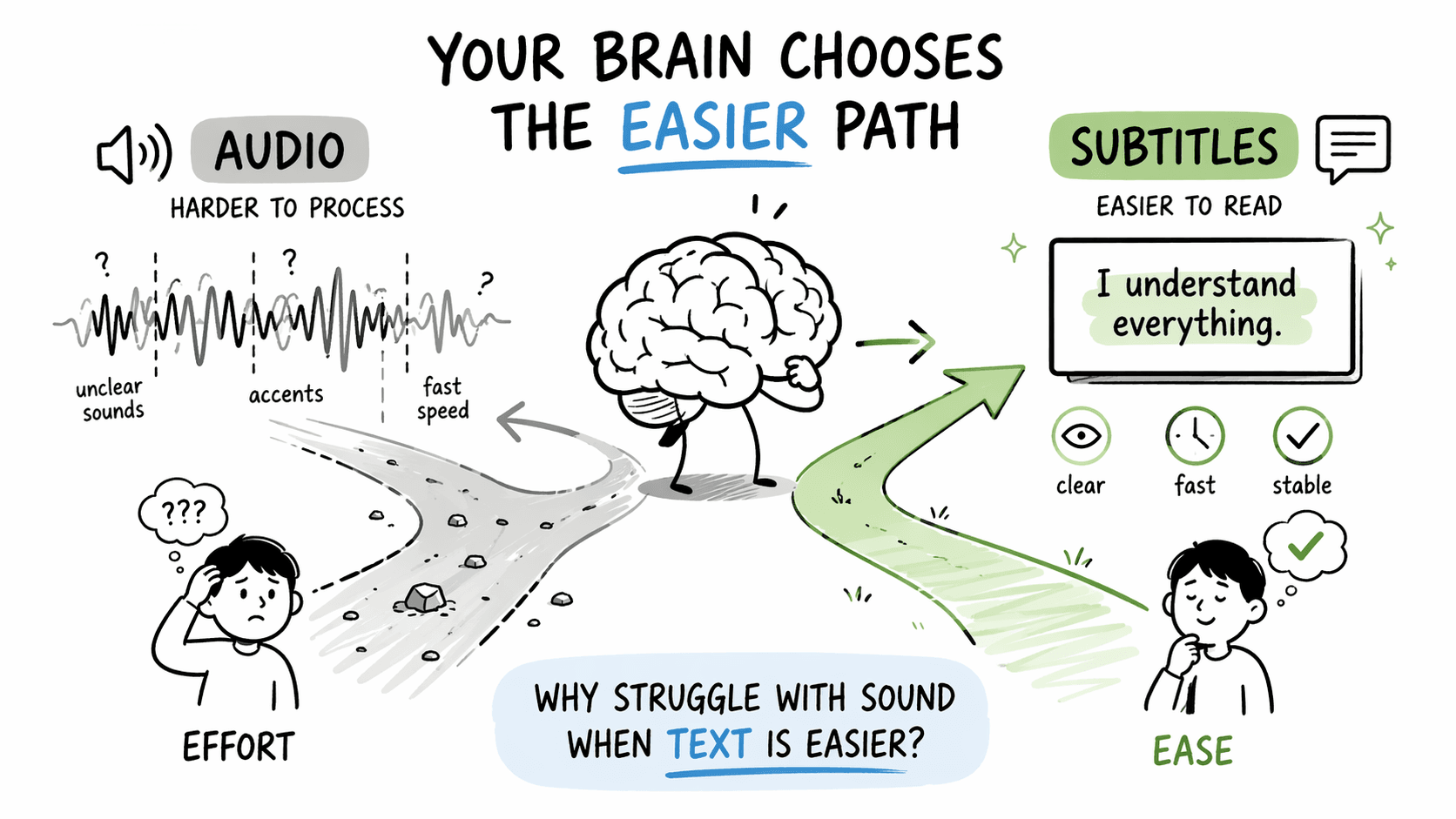
When you read subtitles, your brain operates in recognition mode.
You see a word.
You instantly understand it.
No need to:
- parse sound
- deal with accents
- process speed
Listening, on the other hand, requires reconstruction.
You hear:
👉 fragmented sounds
👉 unclear boundaries
👉 reduced syllables
So your brain naturally chooses the easier path.
2. Efficiency vs Depth
Subtitles create efficiency.
You understand faster.
You follow more easily.
However, efficiency comes at a cost.
Because when processing becomes too easy:
- attention decreases
- effort disappears
- memory weakens
So while it feels productive,
your brain is not building strong listening pathways.
3. Multimodal Input Can Backfire
In theory, subtitles + audio = better learning.
But only if attention is balanced.
In reality, something else happens.
Text dominates.
Because:
- it is stable
- it is complete
- it removes ambiguity
So instead of combining inputs,
your brain prioritizes one—and ignores the other.
4. The Shift From Listening to Reading
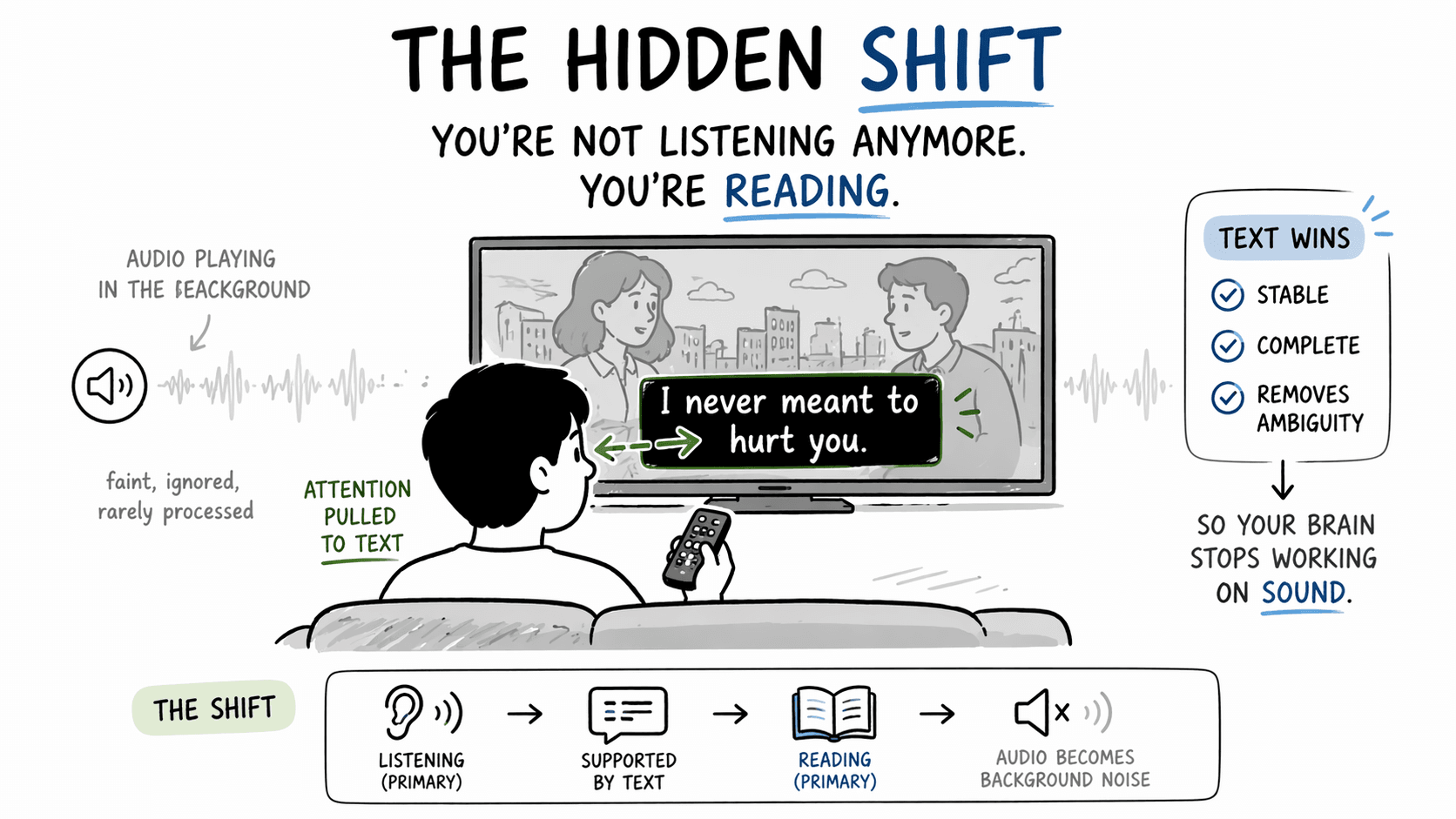
At some point, the experience changes.
You are no longer:
👉 listening and supported by text
You are:
👉 reading, with audio in the background
And that shift is critical.
Because fluency depends on sound processing—not text recognition.
Research shows that subtitles can improve immediate comprehension by helping learners connect spoken and written forms.
However, they also come with a hidden trade-off. When subtitles are present, learners often shift their attention toward text instead of sound, which reduces auditory processing.
At the same time, studies on multimedia learning show that when multiple inputs compete, one tends to dominate attention—making the others less effective.
In simple terms:
👉 The more your brain relies on text, the less it trains your ears.
A Moment I Realized This Myself
For a long time, I thought my listening was improving.
I watched shows every day.
Subtitles were always on.
Everything felt smooth.
I could follow conversations easily.
Even fast dialogue didn’t feel overwhelming.
So I assumed:
👉 my listening was getting better
But one day, my favorite show released a new episode—but there were no subtitles yet.
Because of that illusion of progress, I was quite confident that I could watch it without subtitles.
But no.
I couldn’t understand much without them.
Not completely zero.
But in important scenes—
especially ones with new vocabulary or unfamiliar context—
I couldn’t fully follow what was happening.
That’s when it became obvious.
I thought I was improving.
But in reality,
I was only getting better at reading subtitles.
Recognition vs Listening Dependency

| Learning Mode | What It Feels Like | What Your Brain Builds |
| Subtitles ON | “I understand everything” | Recognition (text-based) |
| Audio Focus | “This feels harder” | Sound processing |
| Subtitles Dependence | “I need text to follow” | Weak listening pathways |
| Audio + Training | “I can follow naturally” | Strong auditory patterns |
How to Break the Subtitle Habit (Without Feeling Lost)
You don’t need to remove subtitles completely.
That usually backfires.
Instead, shift how you use them.
1️⃣ Delay the Subtitles
Watch a scene without subtitles first.
Then turn them on and watch again.
👉 Why: forces initial sound processing before support
2️⃣ Use Subtitles as Confirmation, Not Primary Input
Instead of reading continuously:
- listen first
- check after
👉 Why: prevents passive reading
3️⃣ Focus on Sound Patterns, Not Words
Ask yourself:
- Where does the sentence rise or fall?
- What sounds repeat?
👉 Why: listening is pattern recognition, not translation
4️⃣ Reduce Gradually, Not Suddenly
Move from:
- full subtitles
→ partial checking
→ no subtitles
👉 Why: your brain needs time to adapt
Why This Connects to Listening Fluency
At some point, you need to make a shift.
From:
👉 “I understand when I see it”
To:
👉 “I understand when I hear it”
That shift is uncomfortable.
Because it removes support.
However, it is necessary.
This transition is explained in more detail here:
👉 Stop “Reading” Netflix: How to Transition from Subtitles to Pure Listening
Because the goal is not to remove subtitles.
It is to stop depending on them.
FAQs
1. Do subtitles help or hurt language learning?
They help at the beginning. However, over time, they can create dependency if not used intentionally.
2. Why do I understand with subtitles but not without?
Because you are relying on recognition instead of sound processing.
3. Should I stop using subtitles completely?
No. Instead, you should change how you use them.
A Simple Way to Make This Work (Jolii Approach)
The problem is not subtitles.
It is how they are used.
Jolii structures your attention differently.
Instead of:
- passively reading
- following text
It helps you:
- focus on key expressions
- connect sound with meaning
- revisit patterns in context
So instead of replacing listening,
it supports it.
And over time,
you stop needing subtitles—not because you removed them,
but because your brain no longer depends on them.
Final Thoughts
Subtitles feel helpful because they reduce effort.
However, language learning is not just about understanding faster.
It is about processing deeper.
At some point, you will notice something subtle.
You understand everything with subtitles.
But without them, you hesitate.
That gap is not a failure.
It is a signal.
Your brain has learned to rely on text.
And once you see that, you can start changing it.
Because fluency is not built on what you read.
It is built on what you can hear—and respond to—without support.