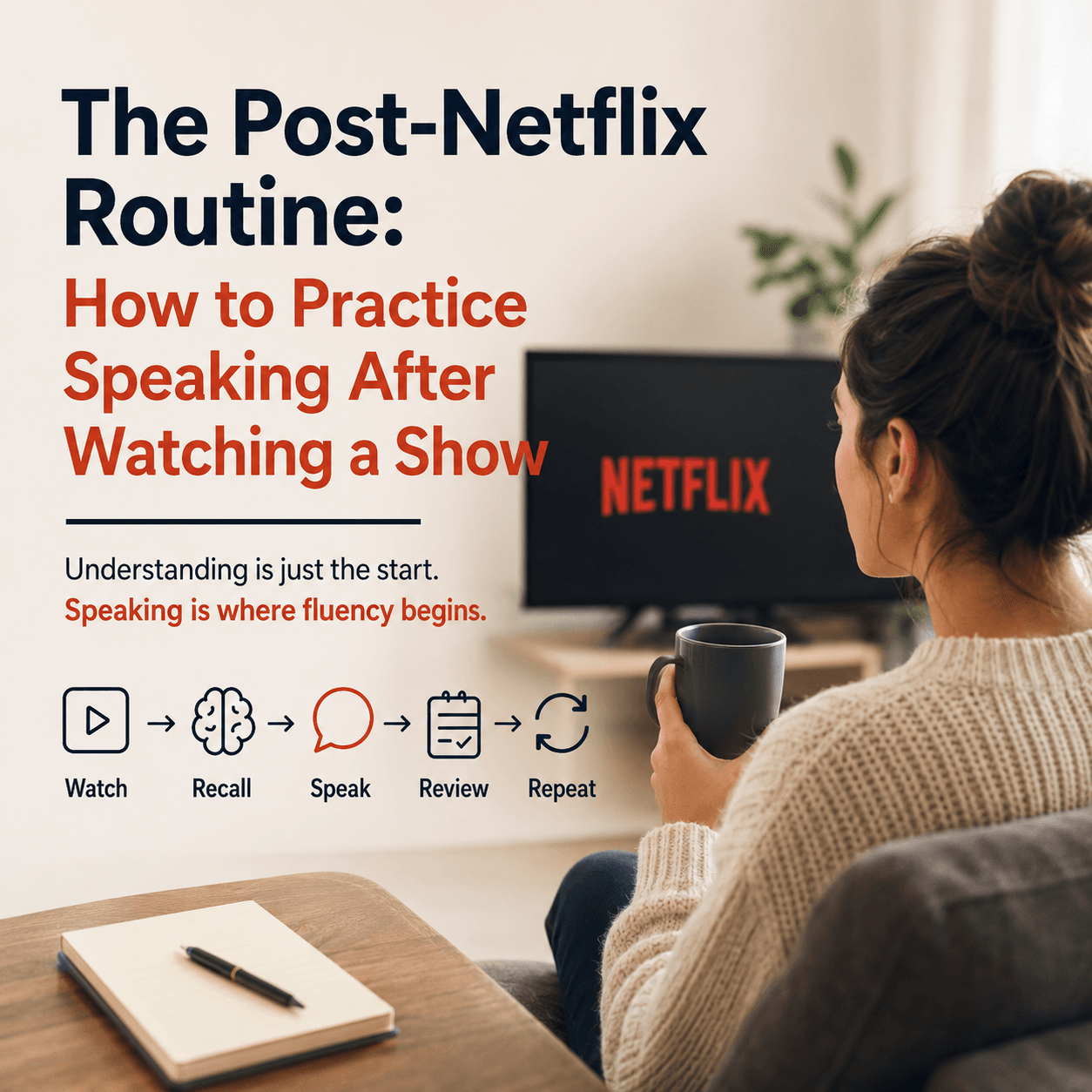
Yes! You can improve listening, vocabulary, and pronunciation with Netflix, but you will not become fluent by watching passively. Netflix works only when combined with structured strategies like rewatching, shadowing, and speaking practice.
Why Learners Feel Stuck With Netflix
Many adult learners already understand shows, podcasts, or YouTube, but they still can’t speak confidently. Common frustrations include:
- Understanding everything, but being unable to respond fast
- Knowing the words, but finding an inability to make sentences naturally
- Zero improvement in speaking despite watching hundreds of hours of Netflix
This frustration is especially common during the A2 to B1 transition, when comprehension feels high but independent speaking hasn’t developed yet.
This happens because Netflix provides input, not output, and speaking requires active retrieval and production.
How Does Netflix Actually Help Language Learning?
Netflix provides comprehensible input, which is language slightly above your level, supported by visual context. Linguistics research shows this input is essential for acquisition, but not sufficient for speaking fluency.
What Skills Netflix Improves vs. What It Doesn’t
| Skill | Netflix Helps? | Why |
| Listening comprehension | ✅ High | Real speech, accents, speed |
| Vocabulary (colloquial) | ✅ High | Repeated phrases in context |
| Pronunciation & intonation | ✅ Medium–High | Shadowing improves prosody |
| Grammar accuracy | ⚠️ Limited | No explicit rule learning |
| Speaking fluency | ❌ Low alone | Requires active production |
| Writing | ❌ Low | Passive input only |
How to Use Netflix to Actually Learn
Now that it’s clear what Netflix can and cannot do to help you on your learning journey, it’s time to use these methods to make the best of the streaming platform. To make Netflix effective, you need to move from passive exposure to active learning, where listening is paired with speaking and retrieval.
How Should You Use Subtitles?
Progression path:
- Target audio + native subtitles (beginner)
- Target audio + target subtitles (intermediate)
- Target audio only (advanced)
Remember that native subtitles block listening; but target subtitles reinforce parsing and spelling.
What Shows Are Best for Language Learning?
Easier for learners:
- Sitcoms (modern dialogue, repetition)
- Reality shows (natural speech, high frequency vocabulary)
- Animation (clear pronunciation)
Harder for learners:
- Legal/political dramas
- Historical shows
- Highly poetic or stylized scripts
As a rule, if you understand <20%, it’s too hard. If you understand >95%, it’s too easy. Adapt yourself accordingly.
Why Rewatching Matters More Than Watching New Episodes
If you’re in the group of people that values rewatching more than bingeing, we have good news.
First watch → gives you meaning.
Second watch → gives you language acquisition.
On rewatch, you:
- Notice repeated structures
- Extract phrase chunks
- Shadow dialogue
Remember that repetition creates neural automation, which is critical for speaking.
Why Does Shadowing Work?
Shadowing is simply repeating lines aloud with the speaker in real time.
It improves:
- Pronunciation
- Rhythm and stress
- Speech automaticity
Shadowing is a well-established technique in interpreter training and second language acquisition research, where it has been shown to improve both prosodic awareness and speech automaticity through active mimicry of native-speed input. The key is real-time repetition — not pausing and repeating, but speaking simultaneously with the speaker, which forces your mouth to keep pace with natural speech.
A Real Learner Example
Imagine this: You’re watching an episode of one of your favorite Netflix series in your target language, and the subtitle of the language you’re learning says:
“I didn’t mean to sound harsh.”
A typical learner reaction is:
- To look up the word “harsh”
- Understand the meaning
- Never using the phrase again
I see this pattern often with learners using Netflix: they understand phrases like ‘I didn’t mean to…’, but never practice producing them aloud.
The Jolii method is the following:
- Extract chunk: “I didn’t mean to…”
- Practice variations:
- I didn’t mean to interrupt.
- I didn’t mean to be rude.
This converts passive input into active speech patterns. You understand the meaning of the phrase in context, with synonyms, and phrases you would use normally.
The next time you find a similar hiccup, you’ll know how to navigate around it combining passive and active methods and learn your target language so much better!

Why Netflix Alone Doesn’t Make You Speak
Remember this: Understanding is recognition. Speaking is recall. Also, while recognition is passive; recall is active. Netflix trains recognition, but speaking requires retrieval practice. This is what’s known as the input–output gap, where learners understand language but struggle to produce it in real time.
What Is the Input–Output Gap in Language Learning?
The input–output gap is a phenomenon where learners comprehend language (input) but are unable to produce it (output). It helps to watch a show or a film and reading also benefits you, but when you speak or put things in writing, that’s active recall.
To bridge the gap, students need to repeat phrases back out loud, summarize episodes and practice new language in conversation. In other words, understanding doesn’t lead to fluency on its own: active production does the trick.
Understanding the Input–Output Gap
| Aspect | Input (Comprehension) | Output (Production) | Gap Explanation | How to Close the Gap |
| What it is | Receiving language through listening or reading | Actively speaking or writing in the language | Learners can understand but fail to use the language fluently | Practice repeating phrases, summarizing, and using new words in conversation |
| Skills trained | Listening, reading, vocabulary recognition | Speaking, writing, recall, sentence formation | Input strengthens recognition but not recall or sentence construction | Shadow dialogue, record yourself, explain scenes aloud |
| Example | Watching a Netflix episode and understanding the plot | Retelling the episode in your own words or using new phrases | You know what’s happening but hesitate when speaking | Pause, extract chunks, and produce them in conversation or writing |
| Learning outcome | Improved comprehension and passive vocabulary | Improved fluency and active vocabulary | Comprehension does not automatically translate into speaking ability | Combine Netflix with speaking drills and active output practice |
How to Convert Netflix Input Into Speaking?
Pair Netflix with:
- Speaking sessions (tutor, partner, AI roleplay)
- Oral summaries of episodes
- Recording yourself retelling scenes
- Micro-dialogue drills with extracted phrases
This closes the comprehension–production gap.
What Is the Best Weekly Netflix Learning Routine?
Use 30 to 45 minutes a day to train your brain with active and passive input/output.
- Day 1: Watch episode with target subtitles
- Day 2: Rewatch scenes + note phrases
- Day 3: Shadow selected dialogue
- Day 4: Watch without subtitles
- Day 5: Summarize aloud or write a recap
The key is consistency. Short, frequent speaking sessions matter more than binge-watching, especially when building fluency.
At Jolii.ai, we observe that learners who extract phrases from Netflix and immediately practice them in guided speaking scenario transition from understanding to speaking significantly faster. Tools that bridge input (shows, movies) with structured output practice are the missing link for most advanced learners.
FAQs
Can you really learn a language on Netflix?
Yes, for listening practice and vocabulary, but not for speaking without additional practice.
Is it better to watch Netflix with subtitles to learn a language?
Yes, especially with subtitles of the target language.
How to get started on using Netflix to help you learn a language as a beginner?
Begin by watching a show with native subtitles, then switch to the target-language subtitles, and ultimately go without.
Does shadowing really improve pronunciation?
Yes, shadowing trains rhythm, stress and articulation and is very common in interpreter training.
How many hours of Netflix should I watch daily to study a language?
Watching with active techniques for 20 to 45 minutes daily is more effective than binge-watching.
Remember: Netflix is not a magical language teacher.
It is a high-quality immersion engine that drives comprehension, vocabulary and pronunciation but only if it’s used actively.
To talk fluently, you need to take the Netflix input and turn it into structured output. That’s where genuine language acquisition happens— not in the watching, but in what you do immediately after.