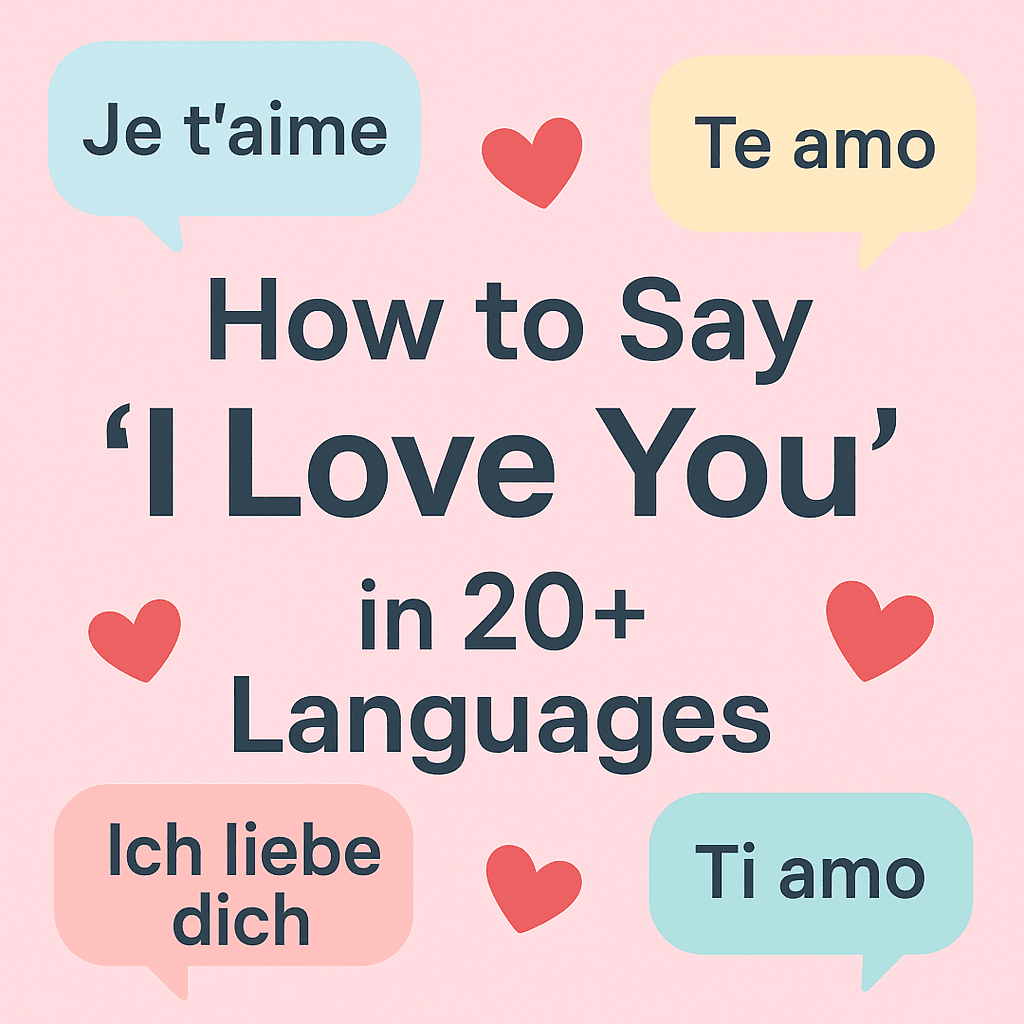
Saying I love you is one of the simplest, most powerful phrases in any language, but the way people express love varies widely across cultures. Some languages use poetic metaphors, others rely on subtlety, and some reserve the phrase for the most intimate relationships. Trust me, learning how to say I love you in different languages opens a window into how various cultures perceive affection and connection..
Learning to say “I love you” is easy. Learning when, how, and to whom is the harder part — and that’s where context matters more than vocabulary. Jolii is built around this exact gap: instead of memorizing a phrase in isolation, you encounter it inside real shows, songs, and conversations, where tone and relationship dictate which version actually fits.
How to Say “I Love You” in 20+ Languages

I Love You in French – Je t’aime
Pronunciation: zhuh tem
The French phrase is famously romantic and used both casually and seriously, depending on context.
Example: Je t’aime tellement. (I love you so much.)
Cultural note: In France, people are less likely to say Je t’aime early in a relationship compared to North America.
I Love You in Spanish – Te quiero / Te amo
Pronunciation: teh kyeh-roh / teh ah-mo
Te quiero literally means “I want you,” but is used widely among couples, family, and close friends. Te amo is stronger and more intimate way to say “I love you” in Spanish.
Example: Te amo con todo mi corazón.
Cultural note: Latin America uses te amo more readily than Spain.
Hear te quiero and te amo used differently across real Spanish-language shows and music in the Bad Bunny DTMF breakdown and Valle Salvaje analysis.
I Love You in Italian – Ti amo
Pronunciation: tee ah-mo
A passionate phrase traditionally reserved for romantic partners, used as a one way to say I love you in Italian.
Example: Ti amo da morire. (I love you to death.)
Cultural note: Italians may use affectionate nicknames instead of saying ti amo frequently.
I Love You in German – Ich liebe dich
Pronunciation: ikh lee-buh dikh
Direct and heartfelt.
Example: Ich liebe dich über alles. (I love you more than anything.)
Cultural note: Used sparingly; Germans may show love through acts rather than words.
I Love You in Portuguese – Eu te amo (Brazil) / Amo-te (Portugal)
Pronunciation: eh-oo chee ah-mo / ah-mo-te
Example: Eu te amo muito.
Cultural note: In Portugal, amo-te is more formal and serious.
I Love You in Dutch – Ik hou van jou
Pronunciation: ik how fan yau
Warm and sincere.
Example: Ik hou zo veel van jou.
Cultural note: Often used within families as well as couples.
I Love You in Swedish – Jag älskar dig
Pronunciation: yahg el-skar day
Example: Jag älskar dig så mycket.
Cultural note: Swedes tend to be emotionally reserved; actions often speak louder than words.
I Love You in Russian – Я тебя люблю (Ya tebya lyublyu)
Pronunciation: ya tee-BYA lyu-BLYU
Example: Я тебя очень люблю. (I love you very much.)
Cultural note: Russians also use affectionate diminutives like солнышко (little sun).
I Love You in Greek – Σ’ αγαπώ (S’agapó)
Pronunciation: sah-gah-POH
Example: Σ’ αγαπώ πάρα πολύ.
Cultural note: Strongly emotional and direct, common in both family and romantic contexts.
I Love You in Mandarin Chinese – 我爱你 (Wǒ ài nǐ)
Pronunciation: woh eye nee
Example: 我非常爱你。(Wǒ fēichánng ài nǐ.) (I love you very much.)
Cultural note: Saying “I love you” in Chinese openly is relatively modern; older generations traditionally express love through actions.
This phrase gets a full dedicated breakdown — pronunciation, meaning, and cultural nuance — in How to Say “I Love You” in Chinese.
I Love You in Japanese – 愛してる (Aishiteru) / 大好き (Daisuki)
Pronunciation: eye-shee-teh-roo / dai-ski
Example: 本当に愛してるよ。(I truly love you.)
Cultural note: Aishiteru is very intense and often reserved for deep romantic commitment. Daisuki (“I really like you”) is more common.
To hear aishiteru and daisuki used in real emotional context — including when neither would be said at all — see Learn Japanese Through Banshaku no Ryuugi.
I Love You in Korean – 사랑해 (Saranghae) / 사랑합니다 (Saranghamnida)
Pronunciation: sa-rang-heh / sa-rang-ham-ni-da
Example: 정말 사랑해. (I love you so much.)
Cultural note: Korean has levels of politeness. Saranghae is informal; saranghamnida is formal and respectful.
I Love You in Hindi – मैं तुमसे प्यार करता हूँ (Main tumse pyaar karta hoon)
(female speaker: करती हूँ / kartī hoon)
Pronunciation: meh tum-se pyar kar-ta hoon
Example: मैं तुमसे बहुत प्यार करता हूँ। (I love you very much.)
Cultural note: Hindi often uses full sentences rather than short phrases.
I Love You in Arabic – أحبك (Uḥibbuka for men / Uḥibbuki for women)
Pronunciation: oo-hib-booka / oo-hib-booki
Example: أحبك من كل قلبي. (I love you with all my heart.)
Cultural note: The phrase changes depending on the genders of the speaker and listener.
I Love You in Thai – ฉันรักคุณ (Chan rak khun)
Pronunciation: chan rak koon
Example: ฉันรักคุณมาก. – I love you very much.
Cultural note: Thai often softens or intensifies emotions with particles like na or ka.
I Love You in Tagalog (Philippines) – Mahal kita
Pronunciation: ma-hal kee-ta
Example: Mahal na mahal kita. – I love you very, very much.
Cultural note: Widely used for both family and partners.
I Love You in Vietnamese – Anh yêu em / Em yêu anh
Pronunciation: anh yew em / em yew anh
Example: Anh yêu em nhiều lắm.
Cultural note: The phrase changes depending on gender and relative age.
I Love You in Indonesian – Aku cinta kamu
Pronunciation: ah-koo chin-tah kah-moo
Example: Aku sangat cinta kamu.
Cultural note: Indonesians often use affectionate nicknames instead of repeating the phrase.
I Love You in English – I love you
Pronunciation: eye luhv you
Example: I love you more every day.
Cultural note: English-speaking cultures use the phrase frequently, not only in romantic relationships but also between family and close friends.
I Love You in Hawaiian – Aloha wau iā ‘oe
Pronunciation: ah-loh-hah vow ee-ah oh-eh
Example: Aloha nui loa wau iā ‘oe. (I love you very much.)
Cultural note: Aloha carries broad meanings: love, peace, compassion, connection.
I Love You in Guaraní (Paraguay) – Rojhayhu
Pronunciation: roh-zhai-hu
Example: Rojhayhu eterei. (I love you very much.)
Cultural note: Guaraní is widely spoken alongside Spanish; romantic phrases appear often in songs.
I Love You in Māori (New Zealand) – Aroha atu, aroha mai
Pronunciation: ah-roh-hah ah-too, ah-roh-hah mai
Example: Kei te aroha au ki a koe. (I love you.)
Cultural note: Aroha means love, compassion, and empathy, extending beyond romance.
I Love You in Samoan – Ou te alofa ia te oe
Pronunciation: oh-teh ah-loh-fah ee-ah teh oh-eh
Example: Ou te alofa tele ia te oe. (I love you very much.)
Cultural note: Family bonds are central; love is often shown through respect and service.
I Love You in Tahitian – Ua here vau ia ‘oe
Pronunciation: oo-ah heh-reh vow ee-ah oh-eh
Example: Ua here roa vau ia ‘oe.
Cultural note: Similar to Hawaiian, love is linked to harmony, nature, and spiritual connection.
I Love You in Hebrew – Ani ohev otach (m→f) / Ani ohevet otcha (f→m)
Pronunciation: ah-nee oh-hev oh-takh / ah-nee oh-heh-vet ot-kha
Example: Ani ohev otach me’od.
Cultural note: Hebrew, like Arabic, adjusts based on gender.
I Love You in Turkish – Seni seviyorum
Pronunciation: seh-nee seh-vee-yo-room
Example: Seni çok seviyorum. (I love you so much.)
Cultural note: Common in everyday romantic speech; Turks also use many affectionate terms like canım (my soul).
Beyond Words: How Different Cultures Express Love Without Saying “I Love You”

Around the world, love isn’t always verbal. In many cultures, saying “I love you” is less common than showing it. Understanding these expressions adds depth to your relationships and gives richer context to the phrase “I love you in different languages.” Here’s how cultures often express affection without words.
Acts of Service: Love Through Responsibility
In many societies, people show love by taking care of their partner or family, sometimes more than by speaking directly.
- Japan: preparing someone’s favorite meal or convenience-store treat
- India: making tea (chai) every morning
- Mexico: giving rides, fixing things at home
- Nordic countries: helping with daily tasks or giving personal space
These actions may seem small, but they carry emotional weight.
Gift-Giving: Love as Meaning, Not Material
Gifts are not about value, they’re symbolic.
- China: giving food or fruit (apples for peace, oranges for luck)
- West Africa: exchanging cloth, beads, or handcrafted items
In many cultures, a small personalized gift can express love more deeply than words..
Physical Affection: Touch as a Language
Touch is a universal expression of love, yet used differently around the world.
- Latin America: warm hugs, cheek kisses, hand-holding
- France: affectionate greetings among friends
How people touch reflects how they connect emotionally.
Quality Time: Love as Presence
Love can be expressed simply by being present (if only it were like that everywhere).
- Filipino culture: spending time with family, even in silence
- Mediterranean countries: long meals and late-night conversations
- Canadian culture: road trips, shared hobbies, staying connected despite distance
Time is love, especially in family-centered societies.
Words of Affirmation Beyond “I Love You”
Many languages use poetic or indirect expressions instead of the literal phrase.
Common affectionate alternatives include:
Love Idioms Around the World: When Language Gets Poetic
Love idioms reveal how cultures imagine romance, desire, and connection. Showing the metaphors people instinctively use to describe what love feels like.
French – “Avoir le coup de foudre”
Literal meaning: To have a lightning strike
Real meaning: To fall in love at first sight.
Cultural note: French often uses dramatic metaphors for romance, love as electricity, shock, or irresistible force.
Spanish – “Estar en la luna”
Literal meaning: To be on the moon
Real meaning: To be dreamy or lovestruck.
Use case: When someone is distracted because they’re thinking of their crush.
Italian – “Prendere una cotta”
Literal meaning: To take a cook/burn
Real meaning: To have a crush.
Cultural nuance: Italians are expressive; this idiom captures the heat and intensity of early attraction.
German – “Schmetterlinge im Bauch haben”
Literal meaning: To have butterflies in your stomach
Real meaning: Feeling nervous excitement around someone you love.
Fun fact: English adopted this idiom directly.
Japanese -.「縁がある」(En ga aru)
Literal meaning: There is a destined connection
Real meaning: Two people are meant to meet or be together.
Cultural nuance: Rooted in Buddhist ideas of fate and the “red string of destiny.”
English – “Head over heels in love”
Literal meaning: Being physically upside-down
Real meaning: Completely and overwhelmingly in love.
Note: One of the most globally recognized love idioms today.
Why Love Idioms Matter
Idioms show how a culture visualizes love:
- Destiny (Japan)
- Physical sensations (Germany, English)
- Metaphorical drama (French, Italian)
- Emotional support
They prove that love is universal, but each culture describes it in its own poetic language.
Romantic Traditions & Symbols of Love Around the World

Every culture has rituals and symbols that express love, gestures that communicate affection even without saying a word. Understanding these traditions enriches how you interpret love globally.
Japan – The Red String of Fate
A legendary belief says two people destined to be together are connected by an invisible red thread tied around their pinky fingers.
Symbolism: destiny, lifelong bonds, spiritual connection.
Modern use: appears in anime, weddings, couple photos.
China – The Qixi Festival (Chinese Valentine’s Day)
Celebrated on the 7th day of the 7th lunar month, inspired by the romantic tale of the cowherd and the weaver girl.
Tradition: couples make wishes for love and fidelity, and young women demonstrate traditional skills.
Symbol: magpies forming a bridge for the lovers.
India – Mehndi (Henna) for Brides
During weddings, intricate henna designs symbolize love, joy, and prosperity.
Fun detail: It’s said the darker the henna dries, the stronger the love between the couple.
Symbol: beauty, patience, devotion.
France – Love Locks (Pont des Arts)
Couples write their initials on a lock, attach it to a bridge, and throw the key away.
Meaning: eternal love, unbreakable bond.
Italy – La Festa degli Innamorati (Valentine’s Day)
Widely celebrated with chocolate, roses, handwritten notes (bigliettini d’amore).
Symbol of romance and sentimentality.
Germany – Liebe Schloss (Love Locks)
Popular across Germany, especially in Cologne (Hohenzollern Bridge).
Symbol of unbreakable bonds.
Spain – El Día de Sant Jordi (Catalonia)
On April 23rd, couples exchange a rose (for her) and a book (for him).
Symbol: beauty + knowledge intertwined in love.
Mexico – Serenatas
A classic romantic gesture: singing (or hiring musicians) outside a loved one’s window.
Symbol: courage, passion, traditional romance.
Often paired with mariachi music and roses.
New Zealand (Māori) – Carved Pounamu Pendants
Greenstone pendants carved into meaningful shapes, such as spirals or twists, symbolize unity and connection.
Symbol: eternal love, bond between two lives.
South Korea – 100-Day Celebrations
Couples celebrate not just anniversaries but milestone markers like 100 days together.
Tradition: gifts, photos, matching outfits.
Symbol: commitment and growing intimacy.
Polynesia – Flower Behind the Ear
Wearing a flower behind the left ear means you’re taken; behind the right, you’re available.
Symbol: openness, relationship status, natural beauty.
Why These Traditions Matter
These rituals show that love isn’t just verbal, it’s cultural, symbolic, and often deeply rooted in history. Learning them helps you appreciate:
- different ways couples bond
- how traditions shape modern romance
- how cultures express emotion without words
Summary, Takeaway & Mini FAQ
We explored how to say “I love you in different languages” across Europe, Asia, Africa, the Americas, and Oceania. Beyond words, we discovered:
- Cultural nuances and contexts for expressing love
- Romantic idioms that make each language poetic
- Traditions and symbols of love worldwide
- How non-verbal actions convey affection in daily life
- The practical benefits of learning love phrases for travel and cultural understanding
Whether it’s whispering Je t’aime in Paris, reciting Aishiteru in Tokyo, or understanding idioms in Spanish and German, expressing love opens doors to connection, empathy, and joy.
Once you know the phrase, the real learning happens in context — hearing te amo whispered in a telenovela, or aishiteru held back in a quiet Japanese drama scene. Jolii turns exactly that kind of content into structured practice, so the emotional weight of the phrase sticks along with the words.
Takeaway
Love is universal, but its expression is beautifully diverse. By learning in different languages and understanding cultural context, you don’t just speak words, you connect hearts across the world.
Mini FAQ
Q1: Is it rude to say “I love you” too early in some cultures?
Yes. In France, Germany, or Japan, saying it too soon may seem intense or insincere. Context matters.
Q2: Can I use idioms like “butterflies in my stomach” abroad?
Some idioms translate poorly. Learn the local equivalent for natural expression.
Q3: Do all countries have romantic traditions?
Not every country has codified customs. Some focus on gestures, poetry, or non-verbal affection instead.
This closes the guide on expressing love across languages and cultures. Your next adventure can start with a single, meaningful phrase.