First published: November 2025. Last updated: May 2026

Quick Answer:
The standard way to say “I love you” in Mandarin Chinese is 我爱你 (wǒ ài nǐ), pronounced with a falling-rising tone on 我 (wǒ), a sharp falling tone on 爱 (ài), and a falling-rising tone on 你 (nǐ).
Culturally, the phrase carries significant weight in China — it’s typically reserved for serious relationships, weddings, and heartfelt confessions rather than casual use. For everyday affection, 我喜欢你 (wǒ xǐhuān nǐ — I like you) or 我想你 (wǒ xiǎng nǐ — I miss you) are more natural choices.
1.Introduction – Why “I Love You” Means Something Different in China
Saying ‘I love you’ in English is straightforward — three words used casually or deeply depending on context. In China, however, the way of expressing love is often far more measured, and the phrase carries a different cultural weight entirely.
In Mandarin, words are shaped by tone and context. Saying “I love you” (我爱你, wǒ ài nǐ) seems direct, but in everyday life, many Chinese people rarely say it out loud, especially the older generations, as they are much more reserved. Historically, love in China is expressed through actions, not words. Cooking a favorite meal, offering chocolate, fixing something around the house, or lending a hand is often more meaningful and powerful than any phrase.
We’ll see that saying “I love you” in Chinese is not just about pronunciation; it’s primarily about understanding a deeper aspect of communication, where emotion, tone, and cultural respect blend harmoniously.
Throughout this article, clicking on any Chinese character will play the correct pronunciation. Use it alongside the tone notes to calibrate your ear before practising aloud.
2. How to Pronounce “I Love You” in Chinese (with Tone Breakdown)
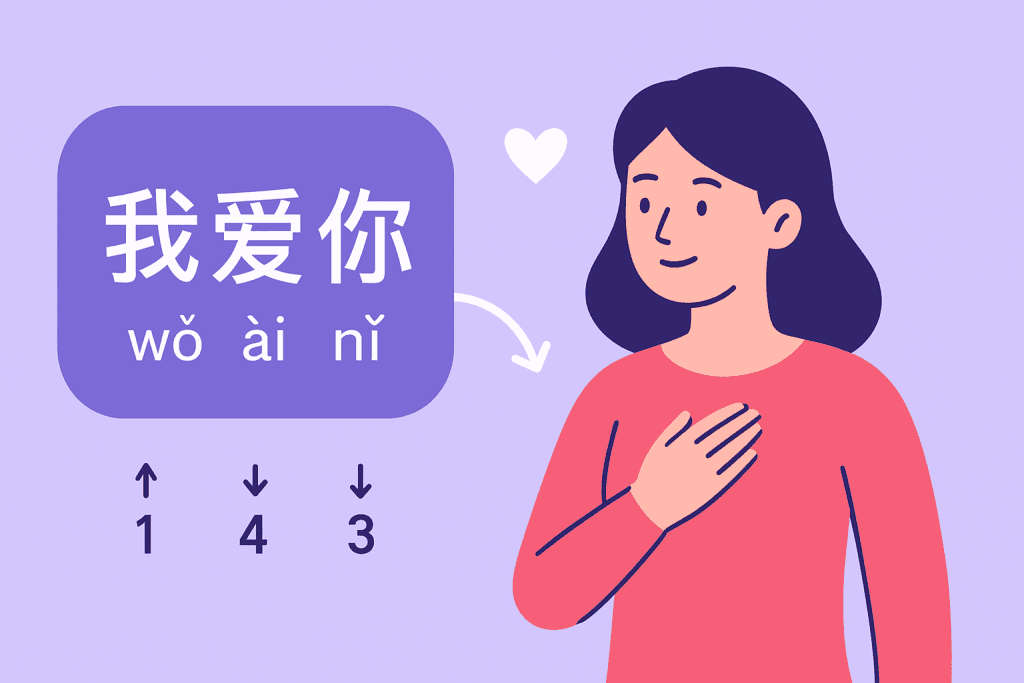
The most common way to say “I love you” in Mandarin Chinese is:
我爱你 (wǒ ài nǐ)
Let’s break it down:
- 我 (wǒ) – “I” or “me” – third tone (a falling-rising tone).
- 爱 (ài) – “love” – fourth tone (a sharp falling tone).
- 你 (nǐ) – “you” – third tone (falling-rising again).
When spoken naturally, the phrase has a soft rhythm: wǒ ài nǐ. Each word is distinct, but the tones flow smoothly together. The third tone gives the sound a kind of “dip,” and the fourth tone adds emphasis, so “ài” carries emotional weight when spoken clearly.
Try this pronunciation pattern:
- Start low with wǒ (your voice dips, then rises slightly)
- Drop sharply for ài (like a quick “no!” tone)
- Finish gently with nǐ (another smooth dip and rise)
You can listen to native speakers pronounce it accurately on resources such as:
- Forvo – community-recorded pronunciations.
- BBC Languages – Mandarin Chinese – short pronunciation guides.
Other Ways to Say “I Love You” in Chinese:
- 我喜欢你 (wǒ xǐhuān nǐ) – “I like you” (used more often among young people or when flirting).
- 我很想你 (wǒ hěn xiǎng nǐ) – “I miss you a lot.”
- 我对你有感觉 (wǒ duì nǐ yǒu gǎnjué) – “I have feelings for you.”
Each of these expressions can sound more natural in real-life situations, since 我爱你 is considered very strong in Mandarin. In Chinese culture, those words are often saved for special occasions, weddings, anniversaries, or heartfelt confessions.
A note on regional variation: 我爱你 is standard Mandarin. In Cantonese, spoken widely in Hong Kong and Guangdong province, “I love you” is 我愛你 (ngóh oi néih) — the characters are identical but the pronunciation differs significantly. If you’re learning Cantonese rather than Mandarin, the tonal system and pronunciation rules are different enough to treat as a separate language.
3. Love in Chinese Culture – Why Words Aren’t Always Spoken

The idea of love is often expressed through actions rather than words in Chinese culture. While Western cultures frequently use direct verbal affirmations like “I love you,” in China, emotional restraint is seen as a form of respect and maturity.
Historically, Confucian values have emphasized modesty, family duty, and harmony over emotional display. This means that instead of saying “我爱你 (wǒ ài nǐ)” often, people show affection by caring for each other silently, through small gestures, responsibility, or shared effort.
For example:
- Parents may never say “I love you” to their children, but they wake up early to prepare breakfast every morning.
- A partner might not express love explicitly in words but insists on walking you home in the rain.
- Grandparents quietly slip money into your pocket when you visit.
These are everyday expressions of ài (love) that speak volumes in Chinese life.
Modern Shifts in Expression
Younger generations, influenced by global media and pop culture, are more open to saying “我爱你.” Social media platforms like WeChat and Douyin (TikTok China) are filled with romantic messages and memes that playfully use the phrase. Valentine’s Day (情人节, Qíngrénjié) and the local Qixi Festival (七夕节) have also made it more acceptable to express feelings directly.
Still, most Chinese people reserve “我爱你” for serious relationships. Casual dating often involves phrases like “我喜欢你 (I like you)” or “我想你 (I miss you)” instead.
4. Common Mistakes & How to Use “I Love You” Naturally in Mandarin

When learning Mandarin, one of the most common beginner errors is using “我爱你 (wǒ ài nǐ)” too casually. While grammatically correct, it can sound overly intense or dramatic in everyday Chinese conversation. Here’s how to use it naturally, and what to avoid.
Common Mistakes
- Using “我爱你” too early in a relationship
In English, saying “I love you” after a few dates might feel romantic. In China, that level of expression often suggests deep commitment. It might surprise your partner or make things awkward.
Instead, say “我喜欢你 (wǒ xǐhuān nǐ)” – “I like you.” It’s softer and feels more genuine early on. - Overusing “爱” in casual contexts
Western learners sometimes apply “爱” to everything they enjoy – like “I love coffee” or “I love music.” In Chinese, it’s more natural to say:
- Ignoring tone precision
Mispronouncing the tones in “我爱你” can change the meaning or make it sound awkward. Mandarin is tonal, if you flatten the tones, you might be understood, but it won’t sound natural. Listening practice is key.
Using “我爱你” Naturally
In real Chinese conversation, tone and timing matter as much as words.
You might say “我爱你” during:
- A heartfelt confession (表白, biǎobái)
- A wedding vow (婚礼誓言, hūnlǐ shìyán)
- A phone call before saying goodbye to someone special
Mini-dialogue Example:
A: 你知道我最喜欢什么吗?
(Nǐ zhīdào wǒ zuì xǐhuān shénme ma?)
B: 什么?
(Shénme?)
A: 你。
(Nǐ.)
This short, poetic exchange translates to:
“Do you know what I like most?”
“What?”
“You.”
Sometimes, love in Chinese is expressed best through simplicity and subtlety, just a few words can say everything.
5. Quick Recap + How Jolii Helps You Master Mandarin

To briefly summarize one last time, learning how to say “I love you” in Chinese opens a small but meaningful window into Chinese culture, one where words and emotions intertwine carefully.
Learning 我爱你 opens a small but meaningful window into Chinese culture — one where words and emotions intertwine carefully. Pronunciation matters, but so does knowing when to speak and when to let actions carry the weight.
Let’s quickly review what we’ve covered:
- The phrase: 我爱你 (wǒ ài nǐ), pronounced with falling-rising, falling, and falling-rising tones.
- Cultural context: Chinese people often express love through actions, not declarations.
- Modern evolution: Younger generations are using “我爱你” more often, thanks to pop culture and digital media.
- Common mistakes: Avoid overusing “我爱你” or misplacing “爱” in casual sentences.
- Authentic alternatives: Phrases like 我喜欢你 (I like you) or 我想你 (I miss you) are often more natural and heartfelt.
Takeaway
To truly understand the Chinese language “I love you”, you need both pronunciation accuracy and cultural awareness. The Chinese way of expressing affection values subtlety, timing, and sincerity, qualities that make each word count. Got it?
Why Learn with Jolii?
If you want to go beyond vocabulary and develop the tonal accuracy and cultural instinct that makes Mandarin sound natural rather than textbook, Jolii offers AI-driven conversation practice built around real Mandarin content — pronunciation feedback, cultural context, and dialogue practice included.