When you’re learning, there’s always a moment where you want to say “I love you” in Spanish, and it seems pretty easy at first. But when you do begin to learn the language, you realize that it has nuance and emotion, subject to context. Another twist: you just can’t rely on a single word or phrase in Spanish to say “I love you.” Instead, it presents you with a choice, and every option carries its own weight. So how do you say “I love you” in Spanish without sounding stickier than a confection? And what’s the right time for each version? Let’s map it all out in a way that actually makes sense.
I love you in Spanish — Quick Answer
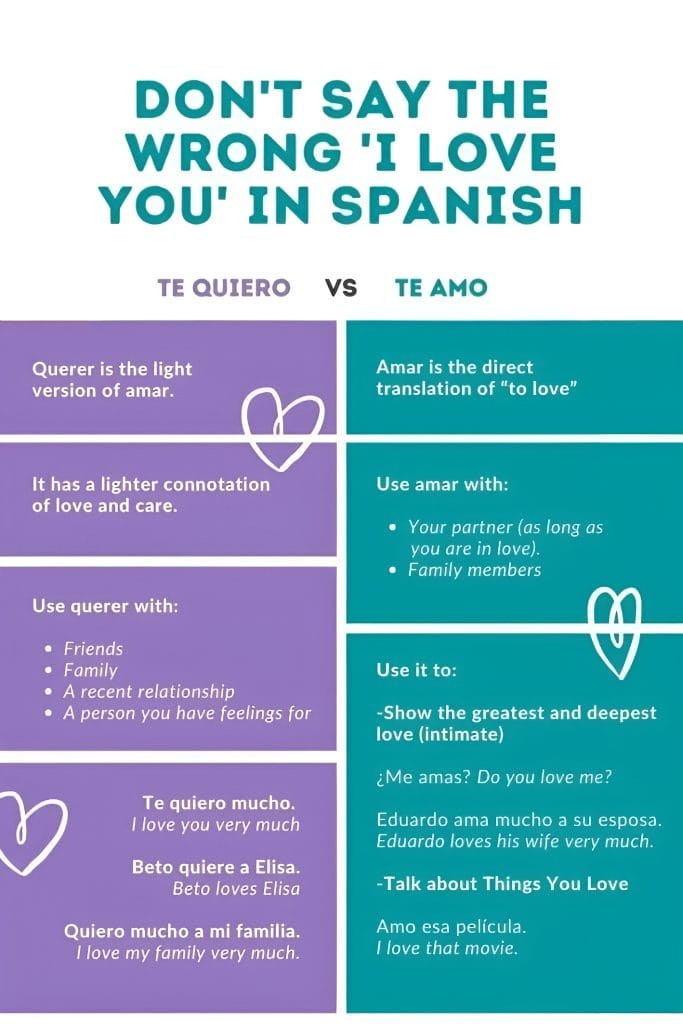
Saying “I love you” in Spanish depends on the type and intensity of love you want to express. Spanish has two main phrases — “te quiero” and “te amo” — and choosing the right one is essential to sound natural, emotionally accurate, and culturally aware. In short: te quiero is used for affection and everyday love, while te amo expresses deep, romantic, and serious love.
What you’ll learn in this guide:
- The difference between “te quiero” and “te amo”, and when to use each
- How Spanish speakers express love beyond direct translations
- Common contexts (romantic, family, friendships) for each phrase
- Why translating “I love you” word-for-word can sound unnatural in Spanish
- How tone, culture, and relationship depth affect meaning
I love you in Spanish: The Two Main Phrases You Need to Know
If you ask native speakers how to say “I love you” in Spanish, they are almost certainly going to tell you one of two things:
They both mean “I love you,” but in Spanish, they don’t mean quite the same thing. Knowing the distinction can help you steer clear of awkward encounters and express yourself without stress.
What Does “Te quiero” Mean and When Should You Use It?
“Te quiero” is warm, affectionate, and flexible. People use it all the time, and it’s fine in many cases. You can say “te quiero” to:
- A romantic partner
- A family member
- A close friend
- A child
It expresses love and care and emotional proximity without being too heavy. That’s why Spanish speakers frequently say it early in their relationships.
“Te quiero” feels like:
- “I care about you”
- “You mean a lot to me”
- “I love you, but gently”
Therefore, it’s usually the safest bet when you’re stuck.
I love you in Spanish: When to Say “Te amo”
Now let’s talk about “te amo”. This phrase carries emotional intensity. Spanish speakers reserve it for deep, committed love. Because of that, they do not use it lightly. You should say “te amo” when:
- You feel profound romantic love
- You are in a serious relationship
- You want to express emotional depth, not just affection
In many cultures, “te amo” feels closer to “I am in love with you” than a casual “I love you”. That is why timing matters. Saying it too early can feel overwhelming. On the other hand, saying it at the right moment can feel powerful and sincere.
“Te amo” vs. “Te quiero”: The Emotional Difference Explained
- “Te quiero” = affectionate, caring, everyday love
- “Te amo” = deep, intense, romantic love
English uses “I love you” for everything. Spanish does not. Instead, Spanish lets you fine-tune how strong your feelings are. Because of that, choosing the right phrase helps your Spanish sound natural, not translated.
I love you in Spanish: Common Phrases and Real Examples
Below is a basic cheat sheet with examples of how “te quiero” and “te amo” show up in everyday Spanish, along with an English definition that goes a little beyond simply meaning “I like you” and “I love you.” Both of these phrases, as you can see, are expressing love. But the mood feels different with each verb.
| Spanish Phrase | English Translation |
| “Te quiero mucho” | I love you a lot |
| “Te quiero con todo mi corazón” | I love you with all my heart |
| “Te amo profundamente” | I love you deeply |
| “Te amo más cada día” | I love you more every day |
| “Siempre te voy a querer” | I will always love you |
| “Te amo desde el primer día” | I have loved you since the first day |
I love you in Spanish in Different Countries
As we know, Spanish varies by region. Still, the meaning of “te amo” and “te quiero” stays mostly consistent across countries. That said:
- In Spain and Latin America, “te quiero” is far more common in daily speech.
- “Te amo” often sounds poetic or dramatic outside romantic contexts.
- Some couples use both, depending on mood and moment.
So, listening to native speakers helps you learn when each phrase feels right. Pay attention!
Why Learning Phrases Like I love you in Spanish Truly Matters
It’s not just about romance. Learning how to say “I love you” in Spanish increases your brain’s production of the language. We know from research from Cambridge University Press that words with emotional punch actually make it easier to remember, keep people hooked, and help language learners hang onto what they’ve learned much longer. On top of that, when a phrase packs some feeling, it just stays with you.
FAQs: I love you in Spanish
Is “te quiero” romantic or friendly?
It can be both. Context decides the meaning.
Is “te amo” too strong to say early?
Yes, in most cases. It signals deep emotional commitment.
Can I say “te amo” to my family?
Of course! But consider that in some cultures, many families prefer “te quiero”.
Which phrase should Spanish learners use first?
Start with “te quiero”. It is safe, warm, and widely accepted.
Learning how to say “I love you” in Spanish is not just about vocabulary. It is about emotion, timing, and connection. If you want help practicing real Spanish for real life, Jolii.ai makes it easier. With guided conversations, cultural context, and natural examples, you learn how Spanish truly sounds, not just how it translates. Start saying what you mean, the right way, with Jolii.ai.