It depends on how many meaningful exposure hours you accumulate — not how many months you’ve been studying.
Most adult learners need:
• 600–750 hours for conversational ability in closely related languages
• 2,000+ hours for structurally distant languages like Korean or Japanese.
Language learning time is determined by structured exposure and active use — not calendar time alone.

Why This Question Feels So Personal?
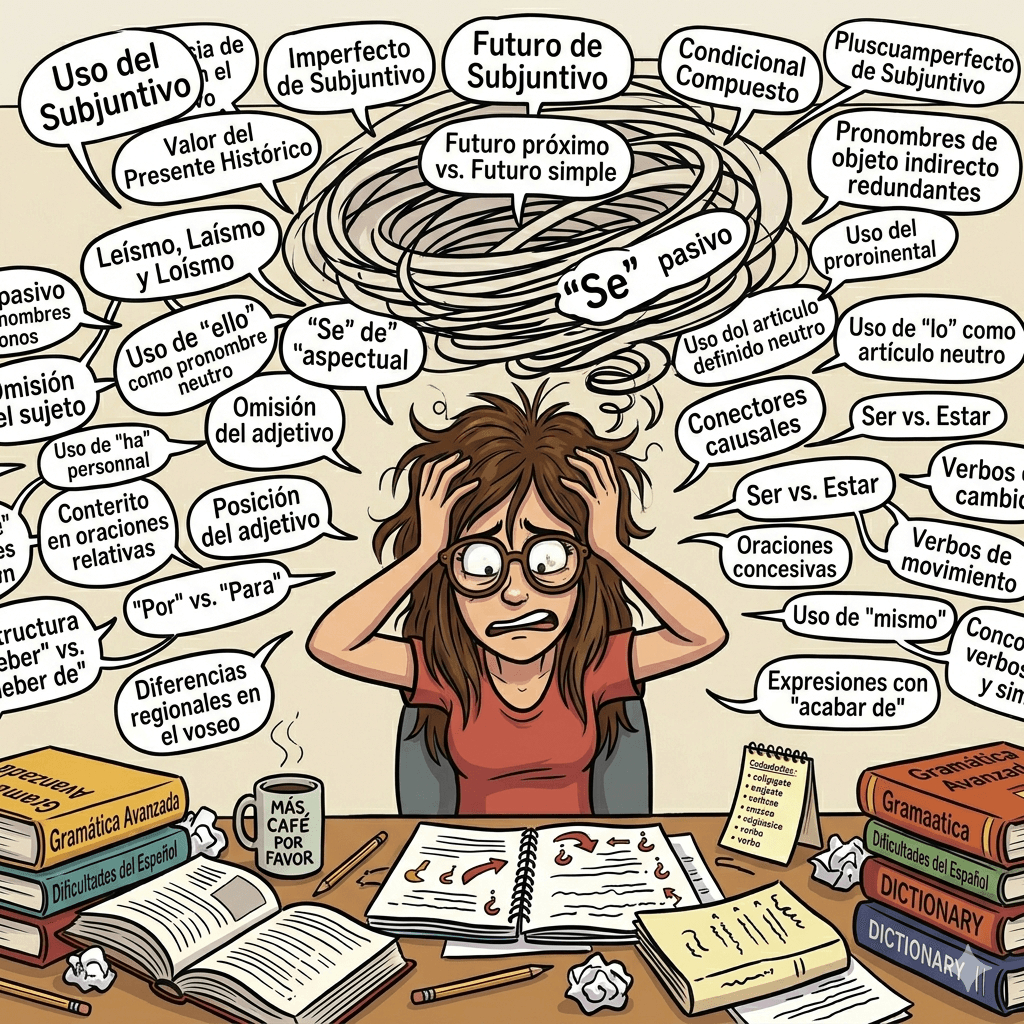
Most people don’t ask this question casually. They ask it after months of effort — when progress feels slower than expected.
You understand more than before.
You recognize vocabulary in shows.
You can follow conversations.
But when it’s your turn to speak, something freezes.
This happens because comprehension and production develop at different speeds. This gap is explored in depth in Is It Normal to Understand More Than You Speak? — which explains why the comprehension-production lag is a predictable stage, not a sign of failure.
Listening builds recognition. Speaking requires retrieval. Retrieval demands repetition before it feels automatic. So when speaking lags behind understanding, it creates the illusion that progress has stopped — even when it hasn’t.
Many learners interpret this gap as failure, even though it’s a predictable stage where you understand much more than you can say.
Why Does Understanding Improve Faster Than Speaking?
Comprehension is recognition. Speaking is retrieval.
When you listen or read, your brain matches patterns it has seen before. When you speak, your brain must retrieve vocabulary, apply grammar, organize structure, and produce sound — all in real time.
Recognition develops earlier.
Retrieval develops later.
Automaticity develops last.
Language learning time often feels long because speaking depends on automatic retrieval — and automatic retrieval requires repeated use.
I clearly remember understanding nearly everything in a 20-minute interview — and then freezing when asked a simple follow-up question. That was the moment I realized comprehension and speaking are not the same skill.
What Does “Learn a Language” Actually Mean?
Learning a language does not mean perfection. It means functional automaticity.
In practical terms, that usually means reaching one of these stages:
| Stage | What It Feels Like |
| Survival | Handle basic needs |
| Conversational | Sustain 10–15 minute discussions |
| Comfortable fluency | Express opinions naturally |
| Near-native | Think without translating |
Recognition alone does not equal fluency.
Production defines usable ability.
What Actually Determines Language Learning Time?
Three variables explain most differences in speed:
- Language distance
- Daily exposure intensity
- Input–output balance
Structured exposure builds automaticity.
Automaticity reduces cognitive load.
Reduced cognitive load increases fluency.
1. Language Distance
Languages that are structurally closer to your native language require fewer adaptation hours.
According to the U.S. Foreign Service Institute (FSI):
• Spanish or French (for English speakers): ~600–750 hours
• Korean or Japanese: ~2,200 hours
Greater structural differences mean:
• New grammar patterns
• New sound systems
• New writing systems
The greater the difference, the more exposure hours your brain needs to stabilize patterns.
Difficulty is not about intelligence.
It is about structural distance.
2. Daily Exposure (The Real Multiplier)
Fluency depends on accumulated exposure hours — not the number of months since you started.
For example:
• 30 minutes per day ≈ 180 hours per year
• 2 hours per day ≈ 730 hours per year
When I first calculated my own exposure hours, I was shocked. After six months, I had only accumulated around 140 focused hours — far less than the “six months” I thought I had invested.
Two learners may both say, “I’ve studied for one year.”
But their accumulated fluency hours can differ dramatically.
Calendar time does not equal learning time.
Exposure hours determine progress.
Consistency compounds.
Intensity multiplies.
3. Input vs Output Balance
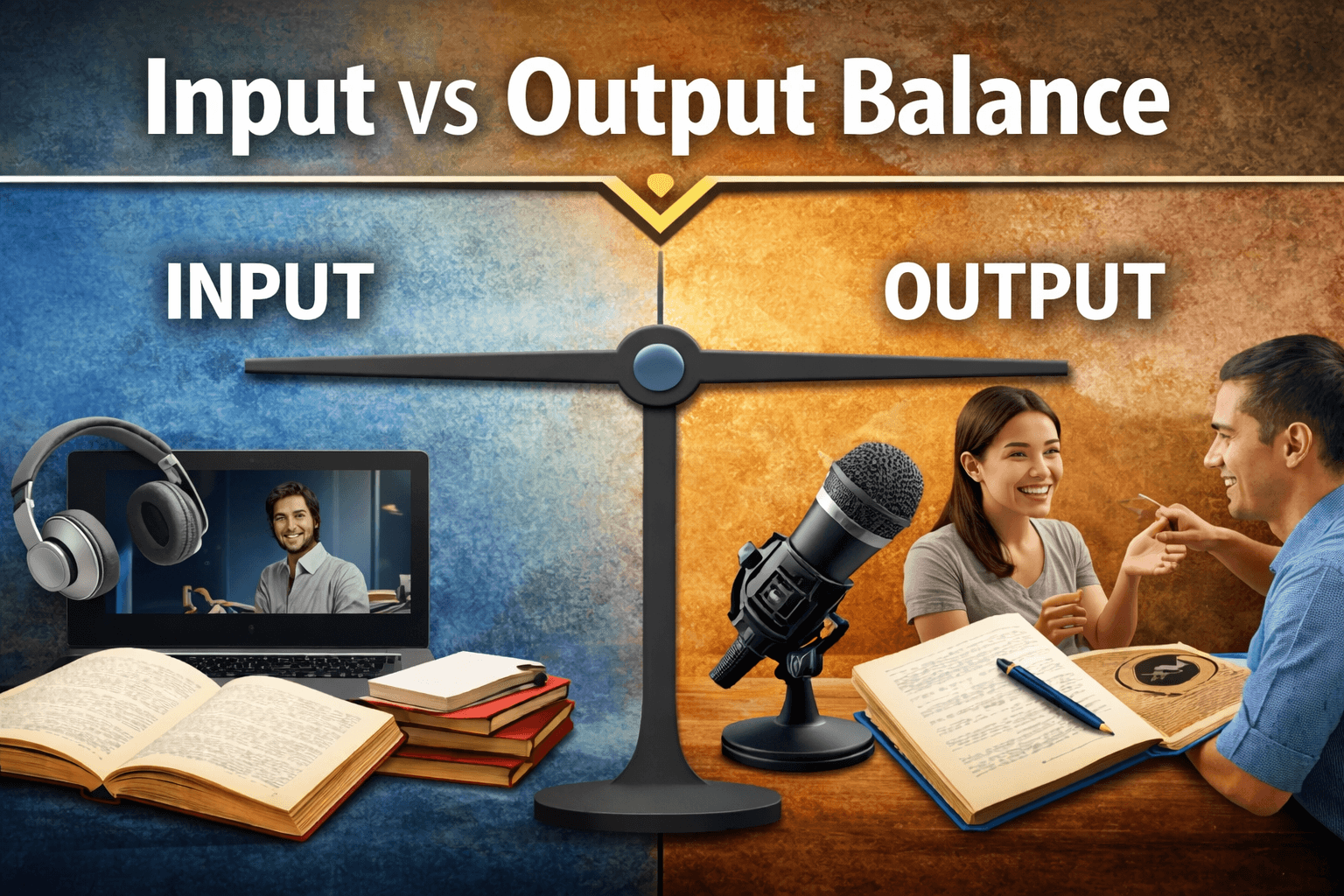
Fluency requires both comprehension (input) and production (output).
Input builds pattern recognition.
Output builds retrieval speed.
If input greatly exceeds output, you may:
• Understand conversations
• Recognize vocabulary
• Follow media content
But still hesitate when speaking.
Recognition develops first.
Retrieval strengthens through active use.
Active use creates automaticity.
The most common reason learners feel stuck is imbalance.
A More Honest Timeline for Adults
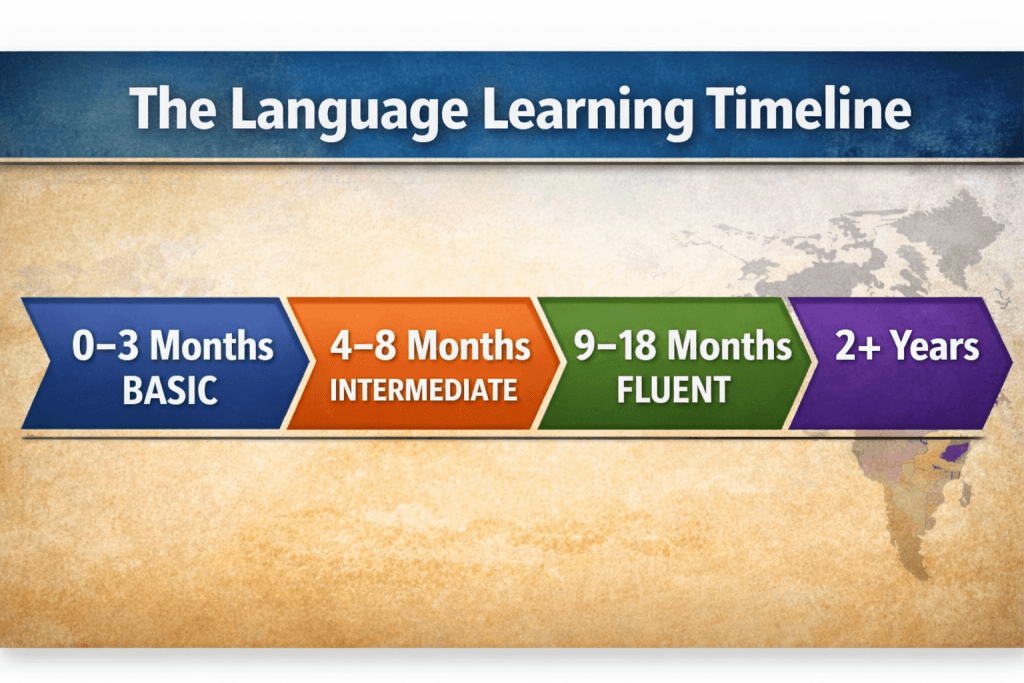
With 45–90 minutes of daily structured practice, progress often follows this pattern:
• 0–3 months → Basic decoding
• 4–8 months → Comprehension stronger than speaking
• 9–18 months → Increasing automatic responses
• 2+ years → Stable conversational fluency
The 6–12 month plateau is common. The A2 to B1 transition is one of the most common places this plateau appears — A1 to A2 Is Easy. A2 to B1 Is Where Most People Quit explains exactly what’s happening cognitively and how to move through it.
During this phase, your brain is reorganizing grammar patterns, sound systems, and retrieval pathways. Plateaus reflect consolidation — not failure.
Consolidation strengthens foundations before acceleration.
Around month seven, progress felt invisible. But looking back, that plateau was the phase where grammar stopped feeling theoretical and started becoming instinctive.
Why Can I Understand but Still Not Speak Fluently?
Because recognition develops before automatic retrieval.
You may understand an entire conversation but freeze when responding.
This gap is predictable.
Comprehension activates recognition networks.
Speaking requires fast retrieval.
Fast retrieval requires repeated output.
The solution is controlled active retrieval at manageable difficulty.
Does Age Slow Language Learning?
Age changes learning strategy — but it does not prevent fluency.
Adults tend to rely more on explicit learning, consciously analyzing grammar and structure. Children rely more on implicit learning, absorbing patterns through exposure.
The Critical Period Hypothesis suggests younger learners may develop more native-like pronunciation. However, total exposure hours remain the strongest predictor of fluency.
Age affects mechanism.
Exposure determines outcome.
What Speeds Progress Without Burnout?
Efficient structure speeds progress more than simply increasing study time.
Burnout usually happens when learners increase duration but not quality. What actually accelerates language learning time is focused, repeatable exposure that builds automaticity.
Effective strategies include:
• Daily exposure to real content – Real conversations, podcasts, or videos train your brain to process natural rhythm and structure.
• Active recall practice – Retrieving words from memory strengthens neural pathways more than rereading.
• Short shadowing sessions – Repeating phrases aloud improves pronunciation and processing speed.
• Vocabulary learned in context – Words learned inside sentences are retained longer than isolated lists.
Structured exposure reduces mental overload while steadily increasing fluency hours.
Automaticity grows from repetition, not exhaustion.
If You’re in the “I Understand but Can’t Speak” Phase
This phase means comprehension has improved, but speech retrieval is not yet automatic.
It typically happens when:
• Input hours are high
• Output practice is limited
You may understand conversations clearly, but hesitate when forming sentences. This gap occurs because recognition develops before real-time retrieval speed.
The solution is controlled active retrieval at manageable difficulty. That means practicing speaking or recalling phrases at a level slightly below your maximum comprehension.
Structured systems help reduce wasted exposure by matching content to your current level. Instead of consuming random material, you work within an optimal difficulty range.
Structured exposure shortens the gap between understanding and speaking by strengthening retrieval speed.
Quick Q&A: Language Learning Time
1. How many hours does it take to learn a language?
For most adults, conversational fluency typically requires:
• 600–750 hours for closely related languages
• 2,000+ hours for structurally distant languages
Fluency depends on accumulated structured exposure hours, not calendar months.
2. Can you learn a language in 6 months?
Yes — but only under high-intensity exposure.
If you study 2–3 hours daily with structured input and active speaking practice, you can reach early conversational ability in 6 months.
However, stable fluency usually requires closer to 12–24 months of consistent exposure.
3. Why do I understand but still can’t speak?
Because comprehension develops before automatic retrieval.
Listening builds recognition.
Speaking requires fast recall under time pressure.
If input greatly exceeds output practice, speaking will lag behind understanding. This is a normal developmental stage — not failure.
4. Does studying every day matter more than studying longer sessions?
Yes.
Consistency multiplies exposure hours.
30 minutes daily (≈180 hours/year) is more effective long-term than occasional 3-hour sessions with long breaks.
Frequency builds neural consolidation.
5. Is talent required to learn a language quickly?
No.
Research consistently shows that total exposure hours, retrieval practice, and structured repetition predict progress more strongly than “natural talent.”
What looks like talent is often accumulated exposure.
6. What is the biggest mistake learners make?
Relying too heavily on passive input.
Watching, reading, and listening build recognition — but without active recall and speaking, retrieval remains slow.
Fluency requires both input and output.
Final Thoughts
Language learning is measured in structured exposure hours, not calendar months.
Fluency emerges when retrieval becomes automatic — when sentences form without conscious translation.
Track your exposure hours.
Balance input and output.
Focus on consistent, structured repetition.
If progress feels slow, it often means your brain is consolidating patterns beneath the surface.
Consolidation is not stagnation.
It is preparation for fluency.
A Simple Next Step
If you want to shorten the gap between understanding and speaking, start by tracking your actual exposure hours and adding small, daily retrieval practice.
Even 20–30 minutes of structured, level-appropriate content each day can compound over time.
If you need a system that turns passive watching into active practice, tools like Jolii can help organize your exposure and make repetition more intentional.
Progress doesn’t come from doing more.
It comes from doing the right repetitions consistently.
Start small. Stay consistent. Let the hours compound.