Beginners progress fast because early language learning relies on recognition and memorization. Progress is slow in intermediate levels because learners have to come up with language on their own, using different cognitive capabilities and more regimented practice.
Why Do Beginners Feel Like They’re Progressing So Fast?
This feeling is familiar to anyone who’s ever started a new language: You pick up greetings, basic phrases and lists of the most commonly said words. All of a sudden, you’re comprehending basic sentences.
Then something changes. Progress slows. Motivation drops. Many learners quit.
This shift is normal. It happens because beginner progress and intermediate progress rely on different skills.
What Changes Between Beginner and Intermediate Language Learning?
At the beginner stage, learning focuses on recognition. At the intermediate stage, learning requires production.
That shift is the core reason for the language learning plateau.
Beginner vs. Intermediate: The Shift In Experience
| Stage | The Psychological State | Why it Feels This Way |
| Beginner | The “Explorer’s High” | Every new word feels like a massive victory. Your brain is simply collecting tools, which keeps dopamine levels high. |
| Intermediate | The “Performance Anxiety” | You’ve moved from collecting tools to trying to build a house. The mental effort required to coordinate grammar, vocab, and accent all at once creates a heavy “cognitive load.” |
| Beginner | Low Stakes | You expect to make mistakes, and so do others. There is no “internal critic” yet because you’re just happy to be understood. |
| Intermediate | The “Identity Gap” | You know enough to realize what you’re missing. You feel “boring” or “childish” because your speaking skills can’t yet express your actual personality. |
What Is the Language Learning Plateau?
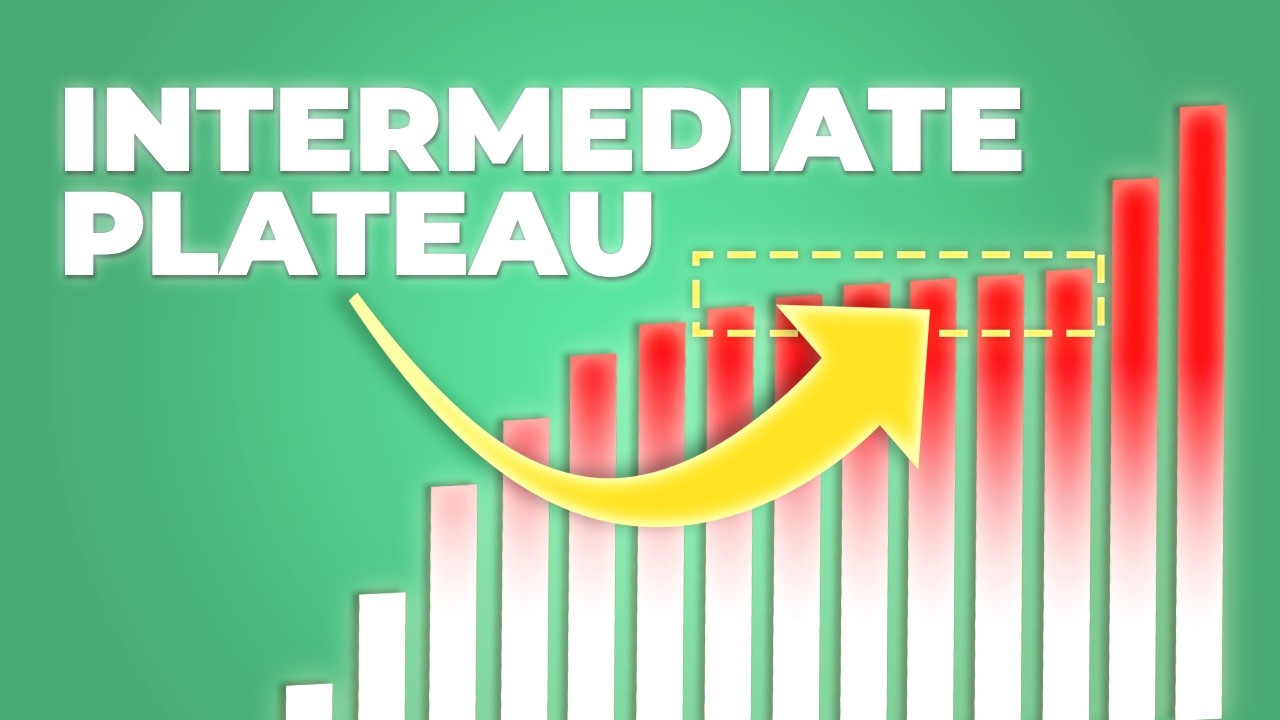
The language learning plateau is the stage where comprehension continues to improve, but speaking and writing lag behind. Learners feel stuck even though their knowledge is growing.
This happens because:
- Understanding language is passive
- Producing language is active
- Active skills require practice, feedback, and error correction
As a result, learners experience a gap between what they understand and what they can say. Many adults interpret this slowdown as failure, even though it is a normal phase in skill acquisition.
We break this transition down in detail in A1 to A2 Is Easy. A2 to B1 Is Where Most People Quit — including a structured activity table and real learner examples of what the shift actually looks like.
The Psychology of the Language Learning Plateau
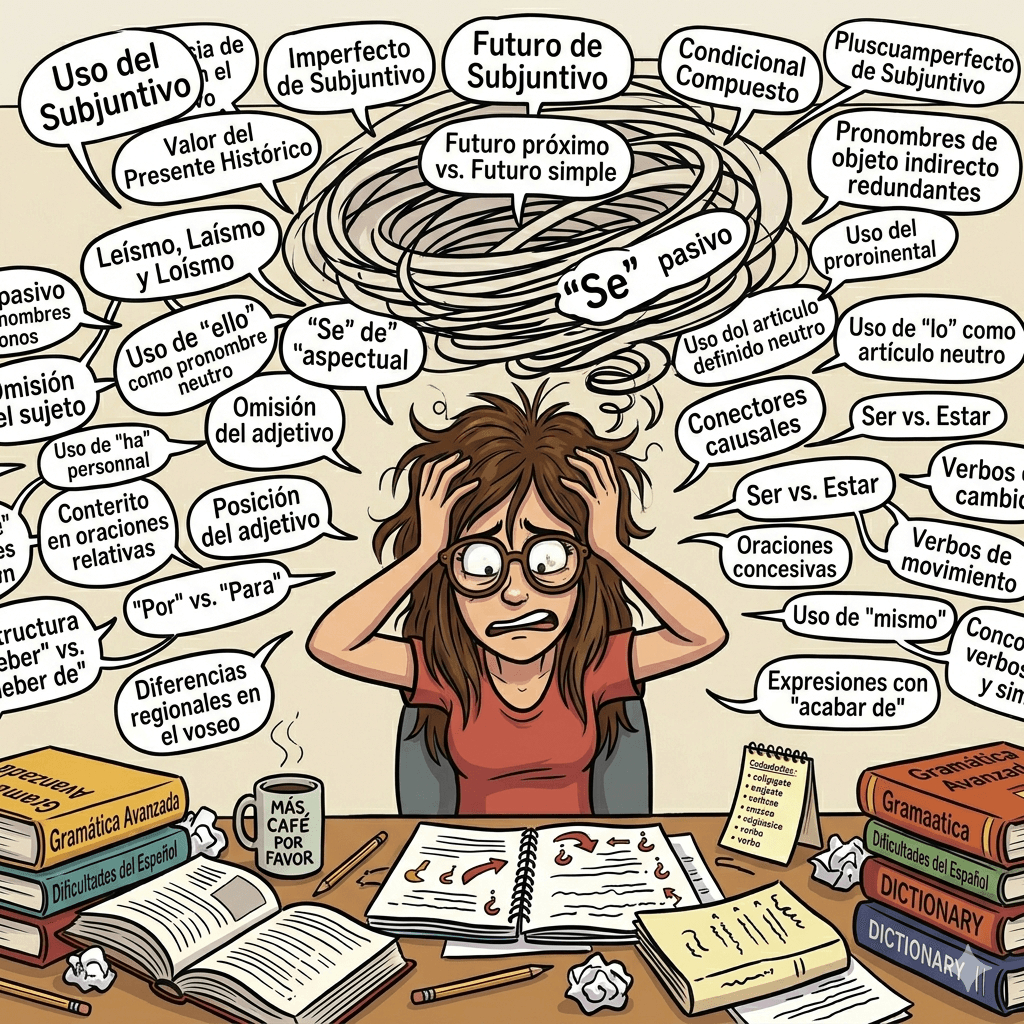
The plateau is rarely a lack of knowledge; it’s usually an overloaded internal monitor. As a beginner, you don’t know enough to be embarrassed. But as you hit the intermediate stage, your inner critic wakes up. You now know the rules well enough to realize you’re breaking them, which leads to a perfectionism paralysis.
This provokes a perfectionism feedback loop:
- Over-Monitoring: You analyze every verb tense before you say it
- Hesitation: The mental lag makes you lose the thread of the conversation
- Social Anxiety: You feel like you’re losing your adult identity because you can’t express complex thoughts
- Avoidance: You stop speaking to avoid the discomfort, which is exactly what keeps you stuck
Lowering the Stakes
The only way to silence the internal critic is to move grammar and vocabulary from your active thinking brain into your automatic brain, which handles procedural memory. This requires a high volume of mistakes in a safe environment.
This is where low-stakes speaking practice becomes essential. Jolii provides exactly that kind of environment — structured speaking prompts, pronunciation feedback, and guided output tasks built around real content you’ve already watched. The goal isn’t perfect speech. It’s enough repetition that grammar stops being something you think about and starts being something you just do.
Why Does Progress Feel Slow at the Intermediate Level?
- The Input–Output Gap Appears
Beginners consume language. Intermediate learners must produce it.
This is the same input-output gap explored in Why Passive Watching Doesn’t Build Speaking Skills — if you’ve been consuming content for months without improving your speaking, that article explains the cognitive reasons why.
It’s easier to understand than to speak because you recognize what you hear but need to recall, as well as use grammar and pronunciation on the fly.
According to linguist Stephen Krashen, comprehensible input is necessary but not sufficient for developing fluency — learners need to encounter language slightly above their current level, but exposure alone doesn’t guarantee they’ll be able to produce it. This is why Merrill Swain’s Output Hypothesis complements Krashen’s work: learners need opportunities to produce language, not just consume it, to close the gap between understanding and speaking.
- The Cognitive Load Increases
At beginner level, you memorize. At intermediate level, you compose.
You must:
- Select vocabulary
- Apply grammar
- Pronounce correctly
- Monitor errors
- Maintain conversation flow
This overload makes progress feel slower.
- Progress Becomes Less Visible
Beginner gains are visible: new words, phrases, and comprehension milestones.
Intermediate gains are subtle:
- More accurate grammar
- Faster processing
- Better pronunciation
These improvements feel invisible, even though they matter most.
Real Learner Example: How Sophie Achieved a Breakthrough
Sophie is a 34-year-old marketing director. Like many students, she hit the intermediate wall six months into her Spanish journey. On paper, she was awesome: she cleared every level on her beginner apps and could follow a podcast with ease. But emotionally, she felt like she was failing. Why? When she tried to join a group dinner with Spanish speakers, she found herself completely silent.
The worst? she didn’t know herself anymore. In English, Sophie was bright, witty and convincing. In Spanish, she felt stuck in a version of herself that could only do simple sentences and present-tense verbs. Of course, this set off a spiral: She was an impostor, and now she wanted to quit completely.
The Success of Practice
Sophie’s breakthrough came from changing how she practiced. She realized that she was in the middle of a psychological hurdle that required a transition.
So what did she do?
- Validated the struggle: She recognized that her lag was a sign of a high cognitive load, not a lack of intelligence
- Created a Safety Zone: Sophie started using Jolii.ai to bridge the gap. She practiced expressing her actual opinions and personality without the fear of looking foolish in front of a native speaker.
- Recovered Her Identity: By using guided speaking tasks on the platform, she automated the “boring” grammar and freed up her mental energy to focus on her tone, humor, and flow.
Within weeks, Sophie stopped translating in her head and learned how to be herself in Spanish.
Common Psychological “Fluency Killers”
| The Mental Trap | Why It Keeps You Stuck | The Fix |
| The Perfectionist’s Lean | You wait for the “perfect” sentence in your head before speaking, leading to long silences. | Embrace the “Ugly” Phase: Use solo drills to get comfortable with imperfect, high-speed output. |
| The Identity Crisis | You feel “childish” because you can’t express complex adult thoughts yet. | Rehearse Your Personality: Practice narrating your actual opinions and work tasks, not just “travel phrases.” |
| The Comparison Trap | Comparing your “Intermediate” messy speech to a native speaker’s effortless flow. | Track Production, Not Perfection: Measure success by how many minutes you spoke, not how many errors you made. |
| Over-Monitoring | Thinking so much about grammar rules that you forget the point of the conversation. | Automate via Repetition: Use Jolii.ai to turn grammar into a reflex so your brain can focus on the message. |
Breaking the Cycle
Language learning is a mental game as much as a linguistic one. When you feel your motivation dipping, it’s usually because you’ve lost the quick wins of the beginner stage.
Jolii.ai restores that momentum by providing a structured, private environment where you can rebuild your confidence. By focusing on low-stakes performance rather than high-stakes study, you bypass the anxiety that causes the plateau in the first place.
You don’t need a more expensive tutor or a harder textbook; you need a safe space to do the reps until your new language feels like a natural extension of who you are.
FAQs
Why do beginners learn languages fast?
Beginner progress feels fast because the brain is in acquisition mode — it is collecting new items (words, phrases, sounds) and storing them through recognition memory, which is one of the most efficient cognitive processes humans have. Every new word is a measurable, visible win. The brain also releases dopamine in response to novelty, which keeps motivation high. This is not a sign of exceptional talent; it is simply how the early stage of any skill acquisition works, from music to coding to sport.
What is the language learning plateau?
The language learning plateau is the point where a learner’s passive comprehension (reading, listening) continues to grow, but their active output (speaking, writing) lags noticeably behind. It typically appears around the A2–B1 transition. The frustrating part is that the plateau does not mean progress has stopped — it means progress has shifted to skills that are harder to measure. Learners who push through it almost always report that their fluency accelerates significantly on the other side.
Why is intermediate language learning harder?
At the intermediate stage, the brain can no longer rely on recognition alone. It must now retrieve words from memory under time pressure, apply grammar rules correctly, monitor pronunciation, and maintain the flow of a real conversation — all simultaneously. This is called cognitive load, and it is genuinely high. The difficulty is not a sign that the learner is doing something wrong; it is a sign that they have moved from collecting language to actually using it, which is a fundamentally different and more demanding cognitive task.
How do I break the language learning plateau?
The most effective approach is to shift the balance of your practice toward structured speaking output rather than more input. Concretely: set a minimum number of minutes per day where you speak aloud — even alone — without stopping to look things up. Use shadowing exercises to automate pronunciation. Seek low-stakes environments (language exchange apps, AI conversation tools, informal video calls) where making mistakes carries no social cost. The goal is to accumulate enough imperfect repetitions that grammar and vocabulary move from conscious recall into automatic, procedural memory.
How long does it take to reach intermediate fluency?
Most adults reach B1 level in 3–9 months with consistent, focused study — but that range depends heavily on the language distance from your native tongue and, more importantly, on how much of your study time involves active speaking rather than passive consumption. Learners who spend 80% of their time listening and reading and 20% speaking tend to plateau. Learners who invert that ratio — or at least reach 50/50 — typically break through the intermediate wall significantly faster.