Quick Answer (TL;DR)
Learning Spanish with music works best when you do more than just listen. Songs like Magnolias help you improve listening, vocabulary, pronunciation, and cultural understanding—but fluency comes when you actively speak, repeat, and reuse what you hear.
You love Spanish music. You recognize words, sing along, and feel connected to the language. But when it’s time to speak, nothing comes out.
That happens because listening creates recognition, but fluency requires active use.
This is why learning Spanish with music can be powerful when done correctly. Songs help you absorb pronunciation, rhythm, vocabulary, emotion, and culture in a way textbooks cannot. But if you only listen passively, progress stays limited.
Rosalía’s Magnolias is a perfect example. The song is rich in imagery, emotion, and natural Spanish expression, making it ideal for learners who want to improve comprehension while connecting with modern Spanish culture.
In this guide, we’ll break down the lyrics, explore the cultural meaning, and show you how to turn the song into real Spanish practice.
The Jolii Learning Loop: How to Learn Spanish with Music Faster
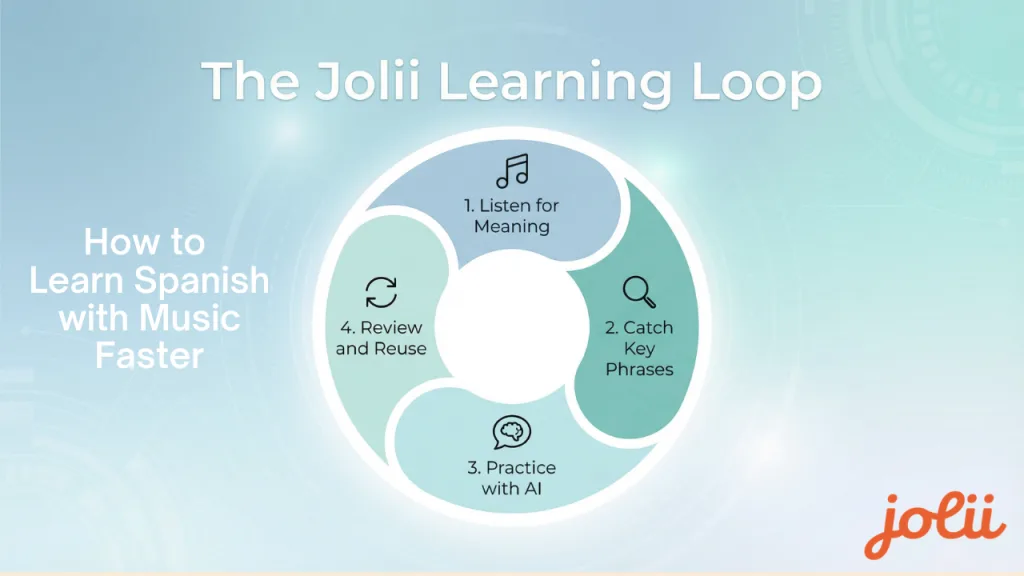
Listening once is enjoyable. Learning from it requires more structure. Jolii helps you turn songs into active Spanish practice with a simple loop:
1. Listen for Meaning
Play the song once without stopping. Focus on the mood, theme, and words you recognize.
2. Catch Key Phrases
Replay the song and notice useful expressions, repeated vocabulary, and pronunciation patterns.
3. Practice with AI
Repeat lines out loud with the singer to improve rhythm, pronunciation, and confidence, and practice relevant vocabulary and phrases with Jolii’s AI chatbot. That’s what turns passive listening into active learning.
4. Review and Reuse
Come back later to review saved words and expressions until they feel natural.
That’s the difference between enjoying music in Spanish and actually learning from it.
Decoding the Spanish Lyrics: Meaning, Language Notes & Cultural Insight
Before diving into individual verses, it helps to understand how “Magnolias” weaves language, symbolism, and emotion into a single narrative. Each section of the song carries layers of meaning — from spiritual references to everyday expressions you can easily add to your Spanish toolkit.
Verse 1: Opening the Door Between Life and Death
| Original Lyrics in Spanish | English Translation |
| Dicen que si vieras pasar a tu la’o la muerte / En la Mercedes la que es alargá’ / Te da buena suerte / Todos habéis venido / Hasta mis enemigos / Hoy lloran | They say that if you see Death passing by your side / In the long Mercedes / It brings you good luck / You all have come / Even my enemies / Today they cry |
Language Notes: “Dicen que…” is perfect for learners: a simple impersonal expression meaning they say / people say. “Habéis venido” uses the vosotros form (peninsular Spain), a good example of regional variation.
Cultural Analysis: This opening verse blends everyday superstition with the poetic image of death, represented by Rosalía’s hearse. In many Spanish-speaking cultures, death is not only feared; it is narrated, teased, and personified. Rosalía embraces that duality, imagining her funeral becoming a communal moment where even her enemies attend.
Verse 2: A Funeral That Becomes a Party
| Original Verse in Spanish | English Translation |
| Sobre mi ataúd KTMs quemando rueda / Lágrimas y goma se derriten en la madera / Gasolina y vino tinto, puros y chocolate / Bailando con amor encima de mi cadáver / Hoy se derrocha, burlando la suerte / Y lo que no hice en vida, lo hacéis en mi muerte | Over my coffin, KTMs burning rubber / Tears and tire rubber melting on the wood / Gasoline and red wine, cigars and chocolate / Dancing with love over my corpse / Today we indulge, mocking fate / And what I didn’t do in life, you do at my death |
Language Notes: Gerunds like “quemando” and “bailando” show ongoing action. “Lo que no hice en vida…” uses a useful relative pronoun (“lo que”) for expressing abstract ideas, and this verse includes modern vocabulary (gasolina, chocolate, vino tinto).
Cultural Analysis: This is where Rosalía fully flips the narrative of death. Instead of quiet mourning, she imagines motorcycle engines revving, tears mixing with tire marks, and people dancing over her coffin — not as disrespect, but as devotion. This draws from Spanish cultural tendencies to approach death as a cycle rather than an end.
Verse 3: Ascending, Returning, and Becoming Dust Again
| Original Verse in Spanish | English Translation |
| Dios desciende y yo asciendo / Nos encontramos en el medio | God descends and I ascend / We meet in the middle |
Language Notes: Short, simple verbs: desciende, asciendo, encontramos. Spanish present tense used symbolically rather than literally.
Cultural Analysis: This moment is mystical and serene. It reflects the influence of Anandamayi Ma, but also echoes mystical Spanish poetry (like Santa Teresa de Jesús or San Juan de la Cruz), where union with the divine happens through surrender. The “middle” becomes a threshold — neither life nor death, but transformation.
Verse 4: Gratitude for the Pain and the Journey
| Original Verse in Spanish | English Translation |
| Algún que otro navajazo me he llevado de la vida / Ella a mí me desarmó y yo le estoy agradecida / Y lanzará azúcar moreno sobre mi ataúd / Y quedaros despiertos hasta que vuelva otra vez la luz / Promete que me protegerás / A mí y a mi nombre en mi ausencia / Yo que vengo de las estrellas / Hoy me convierto en polvo / Pa’ volver con ellas | I’ve taken a stab wound or two from life / She disarmed me, and I’m grateful to her / And she will throw brown sugar over my coffin / And stay awake until the light returns again / Promise you will protect me / And my name in my absence / I, who come from the stars / Today become dust / To return to them |
Language Notes: The present perfect (“me he llevado”) is key for describing life experience. “Quedaros” again shows “vosotros”, useful for learners familiarizing themselves with Peninsular forms. We also have strong poetic verbs like “proteger”, “convertir”, and “volver”.
Cultural Analysis: Rosalía acknowledges life’s wounds but expresses gratitude for them — aligning with mystical traditions that frame suffering as a teacher. The imagery of brown sugar poured over the coffin is intimate and almost domestic, turning death into a warm ritual. When she says she becomes “polvo” to return to the stars, she echoes a universal idea: life begins and ends in the cosmos. It’s a soft, luminous farewell.

Complementary Spanish Learning Activities
- Create a Vocabulary Journal: Write down 10–15 words from the song, translate them, use each in an original sentence, and note whether it’s formal, poetic, or everyday slang.
- Record Yourself Reading a Verse Aloud: Choose your favorite verse and read it out loud, focusing on pronunciation, rhythm, and intonation, and compare your recording to Rosalía’s delivery.
- Write Your Own “Celebration of Life” Verse: Try writing 4 lines inspired by the theme of “Magnolias”, using one metaphor, one past tense verb. and one emotional adjective. This boosts creativity and grammar retention.
FAQs
Is “Magnolias” good for Spanish learners?
Yes — the song mixes poetic vocabulary with Spanish simple present and past tenses, making it ideal for intermediate learners.
Does listening to music in Spanish help you learn it?
Absolutely! Listening to music in Spanish strengthens your ear for pronunciation, rhythm, and natural phrasing while helping you internalize vocabulary and grammar patterns in a low-pressure, enjoyable way.
Should I try translating whole verses?
Absolutely. Verses teach rhythm, syntax, metaphor, and emotional nuance all at once.
What elements should I listen for in “Magnolias”?
Word stress, Andalusian influence in consonants, emotional pauses, and poetic metaphors.
Can music make you fluent in Spanish?
Not alone, but it can become one of the fastest ways to improve listening, pronunciation, and vocabulary when paired with speaking practice. Plus, it connects you to the language, making it a powerful way to increase motivation and joy in learning.
Just like Rosalía turns death into a celebration in “Magnolias”, you can transform your Spanish learning into a joyful, immersive experience. With Jolii.AI, you can explore songs, lyrics, and cultural insights while practicing vocabulary, grammar, and listening skills — all in a way that feels as engaging and inspiring as the music itself. Bring your lessons to life and let every song become a celebration of learning, so music becomes real progress.