Want to learn Spanish in a way that feels less like studying and more like discovering art? Spanish poetry might be your secret weapon.
The research is clear. A recent study shows that poetry engages multiple learning channels, auditory, visual, and emotional, creating what researchers call “cognitively rich and emotionally resonant” learning experience.
What’s more? Language learners who used poetry showed an improvement in communication skills and vocabulary retention.
Sounds like a win.
Unlike textbook exercises, short poems in Spanish capture the language in bite-sized pieces. They’re short enough to memorize during your morning coffee. They are beautiful enough to remember weeks later, and packed with vocabulary you’ll actually use in real conversations.
Why Learn Spanish Using Poems?

Spanish poetry has shaped the language for over 600 years. You know what this means? You’re tapping into centuries of linguistic evolution and cultural richness. They work because:
- Poetic repetition feels organic as the brain absorbs patterns through rhythm.
- A 12-line poem beats a page of prose any day. Have 30 minutes daily? You can read it multiple times.
- The metaphors, emotions, and cultural references are good for your vocabulary.
15 Short Spanish Poems with English Translations
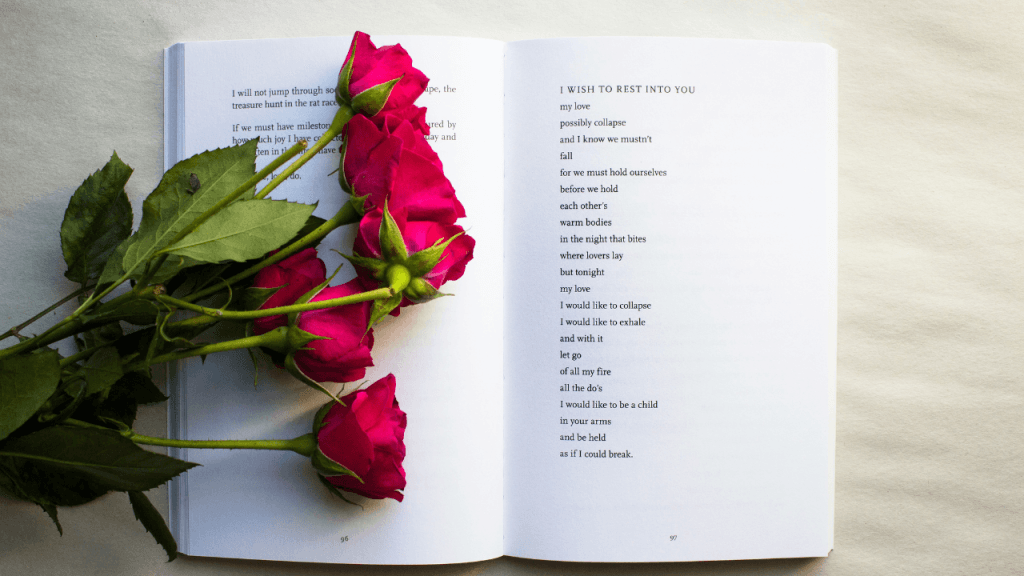
If you want to improve your Spanish skills, here are poems complete with English translations to get you started:
“Bajo la luna” by Douglas Wright
Six lines. That’s all it takes for Wright to capture a moonlit night where everything falls silent. With basic nouns and the phrase “todos callados”, this is probably one of the shortest poems on our list. It’s ideal for your very first Spanish poem. You can learn it in one sitting and practice those tricky Spanish vowel sounds.
“Cultivo una rosa blanca” by José Martí
Cuban hero José Martí wrote this powerful metaphor about cultivating a white rose for both friends and enemies. It’s one of those poems that sounds simple but hits you right in the chest. You’ll practice and learn emotional vocabulary like “sincero” and “corazón.”
Fun fact: These words became part of the Cuban patriotic song, “Guantanamera,” so you might already know the melody!
“El brillo de las estrellas” by Douglas Wright
Ever wonder how to say “fireworks” in Spanish? This four-line gem teaches you fuegos artificiales while comparing stars to artificial fires. You’ll also practice Spanish words that you can use for making comparisons. It’s short, philosophical, and surprisingly useful for everyday Spanish.
“Aquí te amo” by Pablo Neruda
From Neruda’s famous “Twenty Love Poems,” this passionate piece proves why he won the Nobel Prize. He expresses romantic love through nature imagery, using the wind, sea, and stars. What makes Neruda so learner-friendly? His emotional directness. He doesn’t hide behind complex metaphors. He tells you exactly what he feels in the poems.
“Bien tomados de la mano” by Douglas Wright
This poem about walking hand-in-hand through life uses the simple present tense and repeats “bien tomados de la mano” throughout. You’ll learn everyday words like caminar and cielo, vocabulary that appear in actual conversations.
The repetition makes it perfect for memorization. As a beginner, you’ll learn how to quickly recite this one by heart.
“La luna asoma” by Federico García Lorca
Lorca, one of Spain’s literary giants, creates this mysterious moonlit scene where bells fade. From the simple language to repeated phrases, this poem gives beginners a clear structure to follow.
“Caminante, no hay camino” by Antonio Machado
If you learn only one Spanish poem by heart, make it this one. Machado’s words appear everywhere in Spanish-speaking cultures. You’ll see them on murals, in songs, and in graduation speeches. One way to build your language skills.
Plus, quoting Machado at the right moment? That’s instant cultural credibility.
“Viento, agua, piedra” by Octavio Paz
Well, this might be a bit longer than the others. But this riddle-filled poem will teach you the Spanish verbs you need to know. This Mexican poet uses a repeating structure to help these new words stick. Read it three times and notice how the elements keep changing roles.
“Oda a los calcetines” by Pablo Neruda
Yes, Neruda wrote an entire ode to wool socks. He finds poetry in the everyday. The narrative structure makes it surprisingly easy to follow despite its length. You’ll learn clothing vocabulary and wild comparisons that every beginner can grasp.
“Rima XXI (¿Qué es poesía?)” by Gustavo Adolfo Bécquer
Four lines. That’s all Bécquer needs to deliver the perfect definition of poetry. This ultra-short poem uses question-and-answer format, teaching you “¿Qué es…?” (What is…?) It’s one of the most quoted Spanish poems. And what’s better? You can memorize it while waiting for your coffee to brew.
“Versos Sencillos I” by José Martí
“Yo soy un hombre sincero / De donde crece la palma…” Recognize these lines? They’re the lyrics to “Guantanamera.” Martí’s simple verses are the best for learning Spanish vocabulary and tenses.
“Soneto XVII” by Pablo Neruda
Neruda uses negative constructions to explain his unique kind of love. At the same time, he is teaching you how Spanish expresses complex emotions. The conversational tone makes it feel like he’s talking directly to you.
“La plaza tiene una torre” by Antonio Machado
Machado paints a peaceful Spanish town scene using the present tense. Travelling soon? This poem will teach you how to describe places in Spanish. The basic sentence structures can also work when describing anything from your neighborhood to your living room.
“Walking Around” by Pablo Neruda
Yet another Neruda classic. Although a bit longer, this piece walks through the routine feeling of being exhausted by modern life. He uses practical vocabulary with words such as “peluquerías” and “cines” for anyone learning basic Spanish words.
“Dame la mano” by Gabriela Mistral
Want to learn affectionate Spanish words to use in everyday conversations? This piece by the Chilean poet Mistral extensively covers human connection. The complex emotions feel simple and direct.
Final Takeaway
Nobody tells you this about learning Spanish. Flashcards and grammar drills will only get you so far. Real progress happens when you fall in love with the language.
Poems will do that for you.
And when you’re ready to practice speaking? Open your Jolii.ai app and discuss your favorite short poem with the AI tutor. Use the new vocabulary in conversation, and get real-time pronunciation feedback. It’s the bridge between reading poetry and actually speaking Spanish.
FAQs
Are short poems good for learning Spanish?
Yes. Short poems introduce vocabulary and rhythm in a few lines. They’re one of the easiest ways to practice Spanish without spending a lot of time.
What’s the best way to practice Spanish with poetry?
Always remember to read the poem aloud to practice your pronunciation. Learn one section at a time to build vocabulary, and repetition is your friend.