First published: November 2025 · Last updated: May 2026

Most people trying to learn Spanish faster are solving the wrong problem. They find more content, more vocabulary lists, more grammar explanations — and still plateau at the same level for months.
The real bottleneck isn’t input. It’s feedback. Traditional learning gives you Spanish to consume but rarely forces you to produce it — and when it does, feedback is slow, generic, or absent entirely. You write an essay and wait three days. Maybe you speak in class and get corrected once. You watch a show and understand most of it but couldn’t reproduce a single sentence an hour later.
AI changes the feedback loop, not just the delivery mechanism. Used deliberately, it gives you instant, personalised correction at the exact moment you need it — which compresses the gap between making a mistake and fixing it from days to seconds.
The FSI estimates 750 hours of study to reach Spanish fluency — a figure that puts off a lot of learners before they start. AI doesn’t change that number dramatically, but it changes the quality of those hours significantly. Deliberate practice with instant feedback compresses the learning curve in ways passive study never could.
If you’re looking for a broader framework for accelerating your Spanish learning, our guide on how to learn Spanish fast covers the full method. This article focuses specifically on how AI fits into that process.
What AI Actually Does Differently
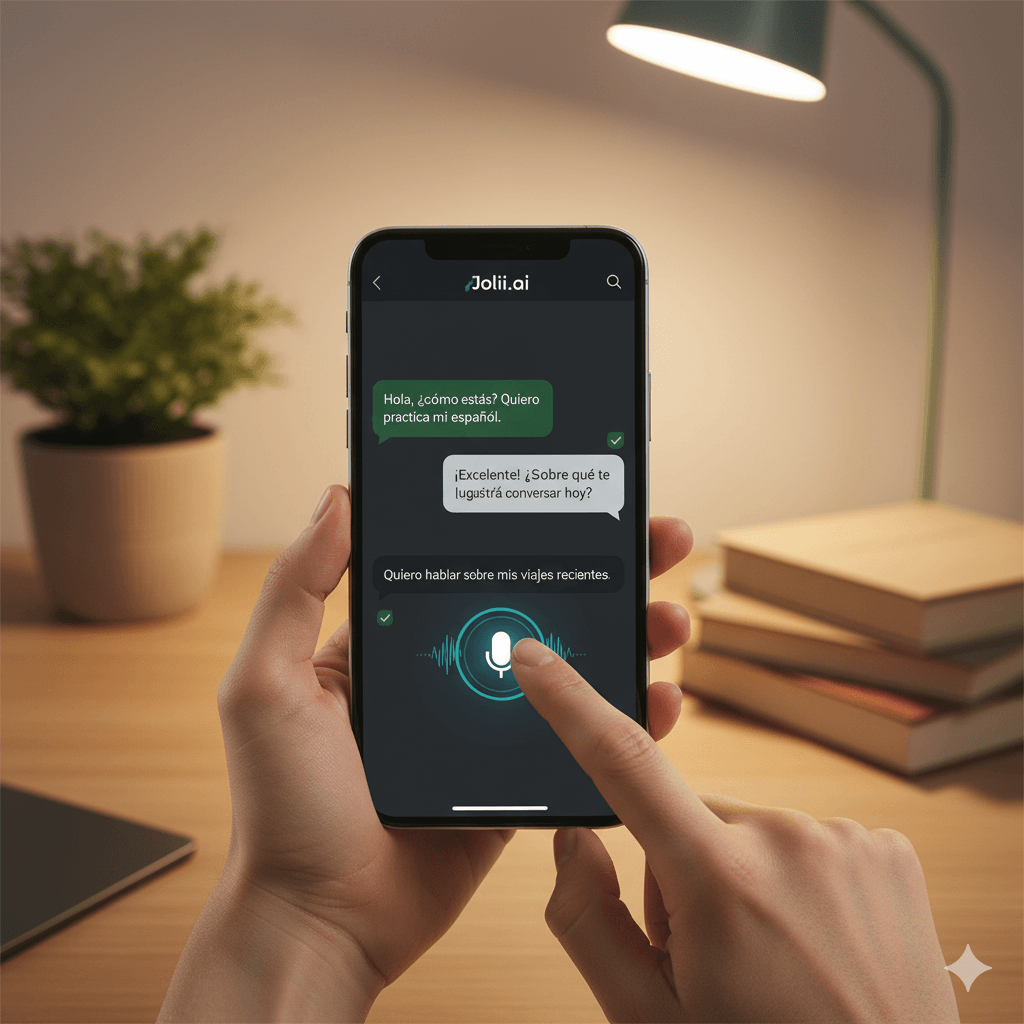
Before the methods, it’s worth being precise about what makes AI genuinely useful for language learning — because “use AI” is advice as vague as “use textbooks.”
The difference comes down to three things traditional methods struggle with:
Immediate feedback on output. When you speak or write, AI responds to what you actually produced — not a generic explanation of the rule you broke. That specificity is what makes correction stick.
Zero social anxiety. A consistent finding in second language acquisition research is that anxiety significantly slows speaking development. Learners freeze in front of native speakers, avoid making mistakes in class, and stay silent rather than risk embarrassment. AI removes that variable entirely. You can sound terrible and try again immediately with no social consequence.
Personalisation at scale. A human tutor adapts to you over weeks of sessions. AI adapts within a single conversation — and can be directed to focus on exactly the weakness you want to address rather than following a generic curriculum.
None of this replaces human interaction. But for the specific problem of getting more deliberate speaking practice with faster feedback, AI is genuinely the most efficient tool available right now.
For Beginners: Building the Foundation Faster
If you’re at A1–A2 level, the two biggest obstacles are pronunciation anxiety and vocabulary retention. These two methods target both.
Method 1 — Accent and Rhythm Training
Most beginners focus on whether they said the right word. Native speakers also notice whether you said it with the right stress and rhythm — and getting that wrong makes you harder to understand even when your vocabulary is correct.
The concept: rather than just checking word meanings, focus exclusively on syllable stress and sentence rhythm. The prompt below forces the AI to ignore everything else and zero in on how you’re producing sound, not just what you’re saying.
The prompt (use with any conversational AI tool):
“Act as my Spanish Phonology Coach. I will speak a sentence. Your ONLY job is to immediately identify which word had the wrong syllable stress and why. Then correct the sentence’s overall speaking rhythm and have me repeat it.”
In Jolii: use the speaking practice feature to apply the same focus — record yourself, get pronunciation feedback, and repeat until the rhythm feels automatic rather than constructed.
Best for: A1–A2 learners who understand words when written but lose them in fast speech.
Method 2 — Error Recycling
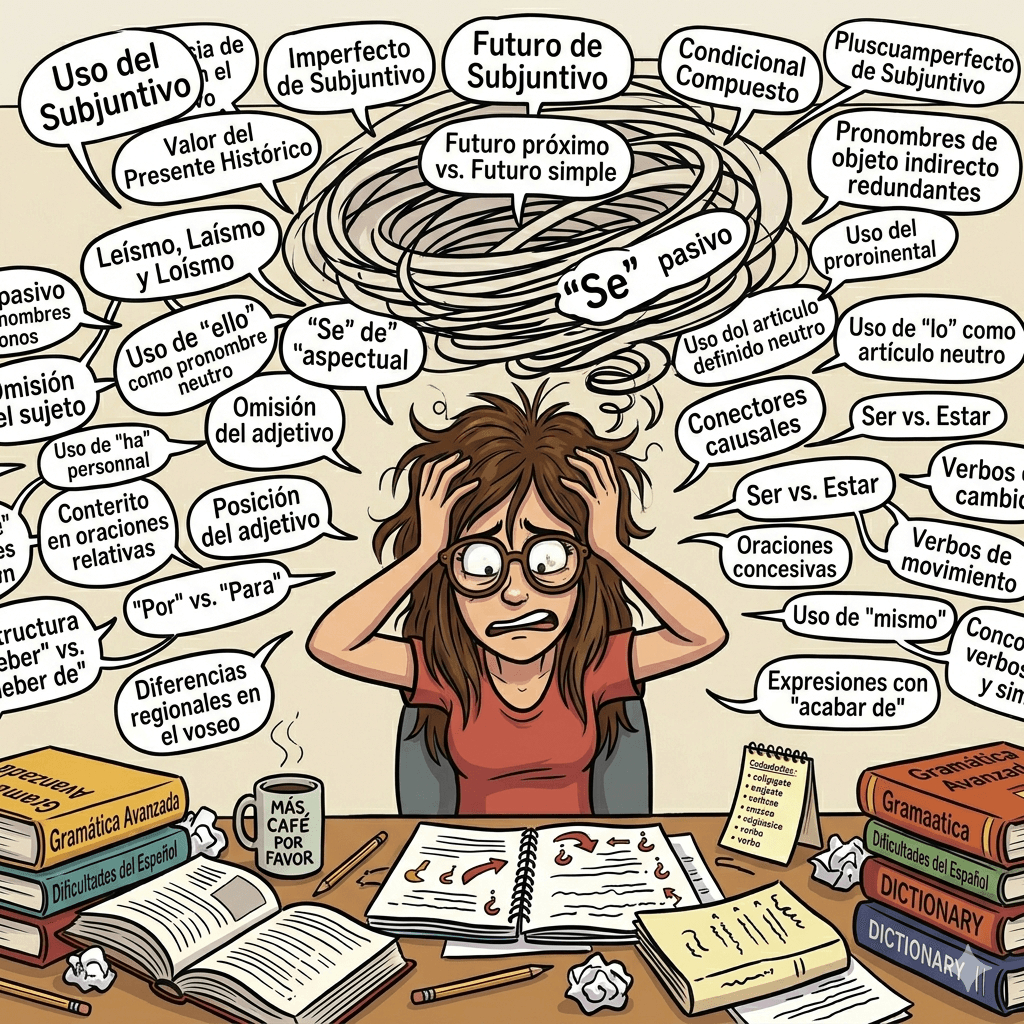
Most beginners make the same three or four mistakes repeatedly — ser vs. estar, gendered articles, verb conjugation in past tense. Generic grammar study covers all of these equally. Error recycling targets only yours.
The concept: after a speaking or writing session, identify your most frequent errors and generate new practice material built specifically around those patterns. Instead of working through a grammar chapter, you’re drilling the exact gaps in your own production.
The prompt (use with any conversational AI tool):
“I will speak a 1-minute Spanish monologue. As I speak, silently compile a list of my Top 3 recurring grammatical errors (e.g., ser vs. estar usage, incorrect subjunctive triggers). After I finish, generate five targeted sentences where the only mistake is one of my Top 3 errors, and have me correct them.”
In Jolii: the AI tutor tracks your output across a conversation and surfaces patterns in your errors — use those findings to direct your next session toward specific weaknesses rather than starting from scratch.
Best for: A2 learners stuck in a loop of making the same mistakes without knowing how to fix them systematically.
For Intermediate Learners: Breaking the Plateau
Intermediate learners typically understand a lot of Spanish but freeze when speaking, default to safe simple sentences, and sound noticeably non-native even when grammatically correct. These three methods target that gap specifically.
Method 3 — Dialect Customisation
If you’re learning Spanish for a specific region — Spain, Mexico, Colombia, Argentina — generic Spanish practice is working against you. Vocabulary, slang, verb forms, and pronunciation differ significantly across varieties, and intermediate learners often hit a wall when they encounter real regional speech after studying a neutral standard.
The concept: direct your AI conversations toward a specific regional variety. Request responses that use local slang, regional expressions, and the grammatical forms native to that area. When you use a word from a different variety, ask to be corrected with the regional alternative and an explanation of why.
The prompt (use with any conversational AI tool):
“Set your persona to a 35-year-old native from Buenos Aires, Argentina. You are a bartender. Only use local slang (Lunfardo where appropriate) and voseo verb forms. If I use a Peninsular Spanish word (like vosotros), you must correct it immediately and explain the Argentinian alternative.”
Adjust the region, persona, and context to match wherever you’re learning Spanish for. The same structure works for Mexican Spanish, Colombian Spanish, or Castilian — just change the details.
In Jolii: select content from your target Spanish-speaking region to get authentic regional input, then practise the vocabulary and expressions from that content with the AI tutor in the same session.
Best for: B1 learners who have solid general Spanish but struggle with regional variation in real conversations.
Method 4 — Active Listening Into Production
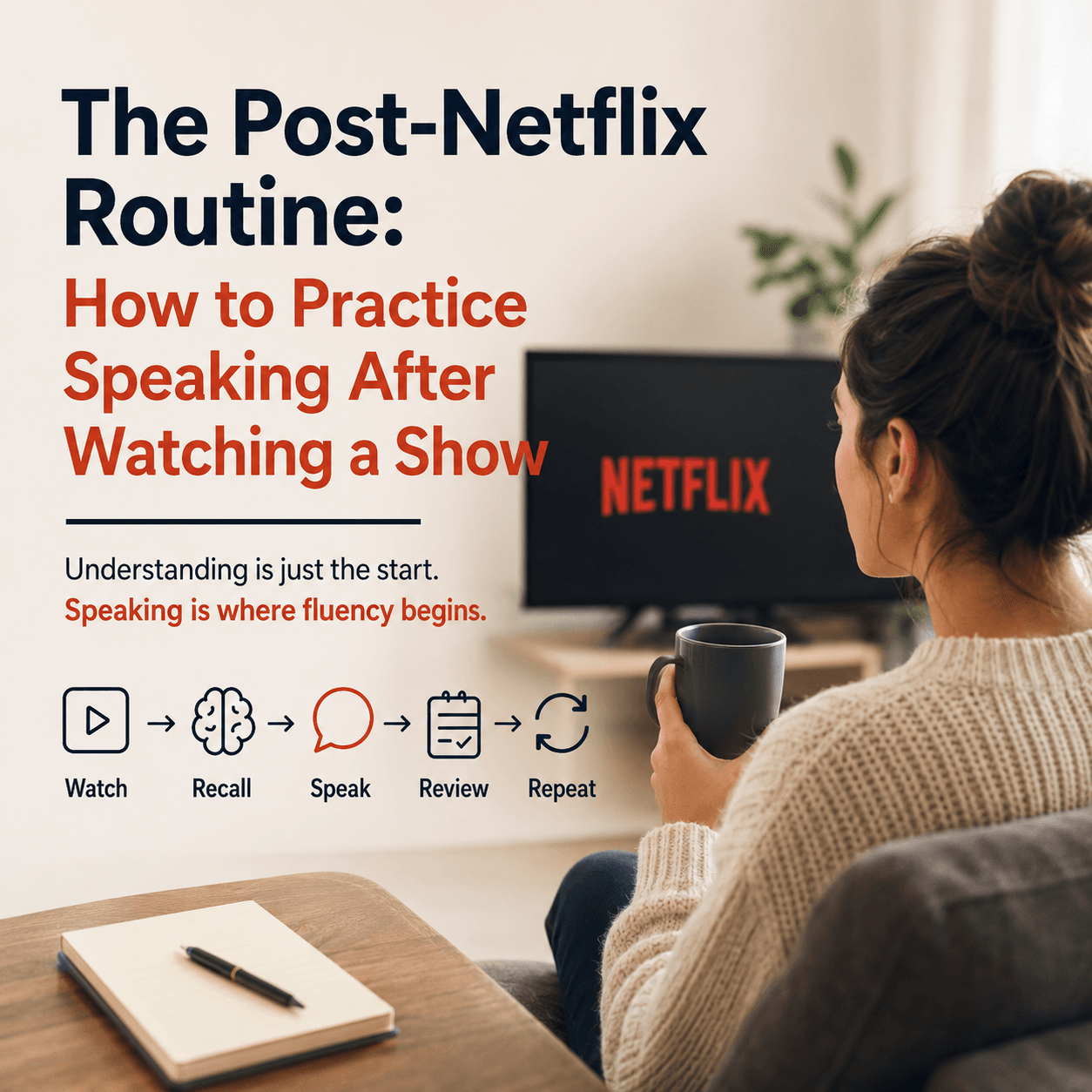
Passive listening — podcasts, Netflix, YouTube — builds comprehension. It rarely builds speaking ability, because recognition and production are different cognitive skills. This method forces the conversion.
The concept: listen to a short piece of authentic Spanish audio, then immediately attempt to summarise what you heard in Spanish without replaying it. The gap between what you understood and what you could reproduce is exactly where the learning happens.
The prompt (use with any conversational AI tool):
“Find a 30-second Spanish audio clip at a B1–B2 level (a short story or news snippet works well). Play the clip once. I will then attempt to summarise the content entirely in Spanish. Correct my summary for both the accuracy of the information and my grammatical usage. If I succeed, increase the complexity of the next clip.”
In Jolii: this process is built into the video-based learning flow — watch a short clip, then respond to it in Spanish with the AI tutor, which corrects both your comprehension accuracy and your grammatical output in the same session.
Best for: B1 learners with strong listening comprehension who still struggle to produce language spontaneously.
Method 5 — Fluency and Filler Training
Grammatically correct Spanish that sounds unnatural usually comes down to two things: unnatural pausing and English filler words carried into Spanish. “Um,” “like,” and “so” don’t exist in Spanish the way they do in English — native speakers use “pues,” “entonces,” “a ver,” and “bueno” to fill the same space. Using English fillers marks you as a non-native speaker regardless of how accurate your grammar is.
The concept: during AI conversations, flag every English filler word you use and replace it immediately with its natural Spanish equivalent. Over several sessions, track which fillers you default to and drill the Spanish alternatives until they surface automatically under conversational pressure.
The prompt (use with any conversational AI tool):
“We are going to have a 60-second debate on any topic I choose. During our conversation, track every time I use an English filler word (um, like, so, you know). Immediately replace it with the most natural Spanish equivalent (pues, entonces, a ver, bueno). After 60 seconds, list the fillers I used and drill me on the Spanish alternatives until they feel automatic.”
In Jolii: the speaking practice sessions create enough conversational pressure to surface these habits naturally — use the AI tutor’s feedback to identify which fillers you default to, then target them directly in your next session.
Best for: B1–B2 learners who speak accurately but don’t yet sound natural at conversational speed.
How to Use These Methods Together
These five methods work best in combination rather than in isolation. A practical weekly structure for intermediate learners might look like:
- Monday / Wednesday / Friday — Active listening into production (Method 4) using a short Jolii video clip, followed by error recycling on whatever mistakes surfaced (Method 2)
- Tuesday / Thursday — Dialect-specific conversation practice (Method 3) with filler training running in the background (Method 5)
- Weekend — Pronunciation and rhythm focus (Method 1) on expressions from the week’s sessions
That’s roughly 30–45 minutes a day structured around output and feedback rather than passive consumption — which is where AI accelerates learning most effectively.
FAQs
Can AI really help me learn Spanish faster than a tutor? For specific aspects of learning — pronunciation feedback, error correction, speaking practice without anxiety — AI is faster and more accessible than most tutoring arrangements. For nuanced cultural guidance, accountability, and the experience of real human conversation, a tutor still has advantages. The most effective approach combines both: AI for daily practice and drilling, human interaction for the conversations that matter.
What level do I need to be to use these methods? Methods 1 and 2 work from A1 upward. Methods 3, 4, and 5 are most effective from B1, when you have enough Spanish to produce output that’s worth analysing. Beginners attempting the advanced methods will spend more time constructing sentences than practising the target skill.
How long before I notice results? Feedback-based practice produces noticeable changes in speaking confidence within two to three weeks of daily use — faster than passive input methods because you’re correcting mistakes at the moment they happen rather than hoping they self-correct through exposure. Fluency in the broader sense takes longer regardless of method.
Does this work with any AI tool or only Jolii? The concepts behind each method work with any AI tool that supports conversation. Jolii integrates these approaches into a structured language learning flow — video input, speaking practice, and AI feedback in the same session — which makes the active listening and error recycling methods particularly streamlined. For the dialect and filler methods, any conversational AI works well once you know what to direct it toward.
What to Do Next
Pick one method that matches your current level and use it in your next Jolii session. Don’t try all five at once — each one builds a specific habit, and building one habit properly is worth more than five started and abandoned.
If you’re not sure where to start, Method 2 (error recycling) works at any level and gives you the clearest picture of exactly where your Spanish needs the most work. Everything else follows from knowing that.