First published: December 2024. Last updated: May 2026
A Dutch woman tries to explain a proverb in German to a teenager running an illegal online drug business. She gets one word wrong. That one word — the difference between trinken (to drink) and ertrinken (to drown) — turns a motivational saying into something considerably more threatening.
That scene from “How to Sell Drugs Online (Fast)” is one of the most memorable grammar lessons available on Netflix. It demonstrates something textbooks rarely show: how a single prefix can completely change the meaning of a German verb — and why getting it wrong matters.
Netflix is full of moments like this. Shows like “How to Sell Drugs Online (Fast)” are particularly valuable for German learners because they use contemporary, conversational German — slang, informal register, Gen Z vocabulary — that formal courses rarely cover. The language is fast, natural, and specific to how young Germans actually speak.

This article uses one scene from the show to demonstrate a method you can apply to any German content on Netflix: find a moment where language does something surprising, break it down, and let the grammar reveal itself through context rather than a textbook explanation.
Why “How to Sell Drugs Online (Fast)” Works for German Learners
Before the scene analysis, it’s worth understanding why this show is worth your time as a German learner specifically.
Contemporary language. Most German dramas available on Netflix use either historical German (period pieces like Babylon Berlin) or formal register (crime procedurals). How to Sell Drugs Online (Fast) uses the language of German teenagers in 2024 — slang, abbreviations, informal constructions, and the kind of casual speech that native speakers actually use with each other.
Conversational pace. The dialogue is fast but not incomprehensible. Characters speak naturally rather than theatrically, which makes it excellent for training your ear to real speech patterns rather than performed speech.
Cultural specificity. The show is set in a German gymnasium — the academic secondary school that feeds into university — which means it’s full of cultural references specific to German youth culture, university life, and the particular social dynamics of that environment.
Accessible plot. The story is simple enough to follow even with limited German — which reduces the cognitive load of trying to understand the narrative while simultaneously analysing the language.
The show is available on Netflix with both German audio and German subtitles — watch with German subtitles rather than your native language wherever possible.
Watch the Dutch Horse Proverb Scene:

What Happens
Moritz, the main character, is negotiating with three Dutch drug suppliers. One of the Dutch women tries to encourage him with a proverb — translated into German. She says:
“Man kann das Pferd zum Wasser ziehen, aber nicht zum Ertrinken zwingen.“ (You can lead a horse to water, but you can’t make it drown.)
Her colleague immediately corrects her:
“Nicht ertrinken! Trinken!“ (Not drown! Drink!)
One prefix. Completely different meaning. The scene is funny precisely because the error is so logical — ertrinken sounds like a natural extension of trinken, and in a sense it is. That’s exactly what makes German prefixes both fascinating and dangerous.
Why This Scene Is Worth Studying
The joke works because German verb prefixes genuinely do transform meaning in ways that can be startling. The Dutch woman’s error isn’t random — it follows a logical pattern that any learner might make. Understanding why the mistake happened is more valuable than just knowing the correct version.
German Verb Prefixes: The Full Lesson
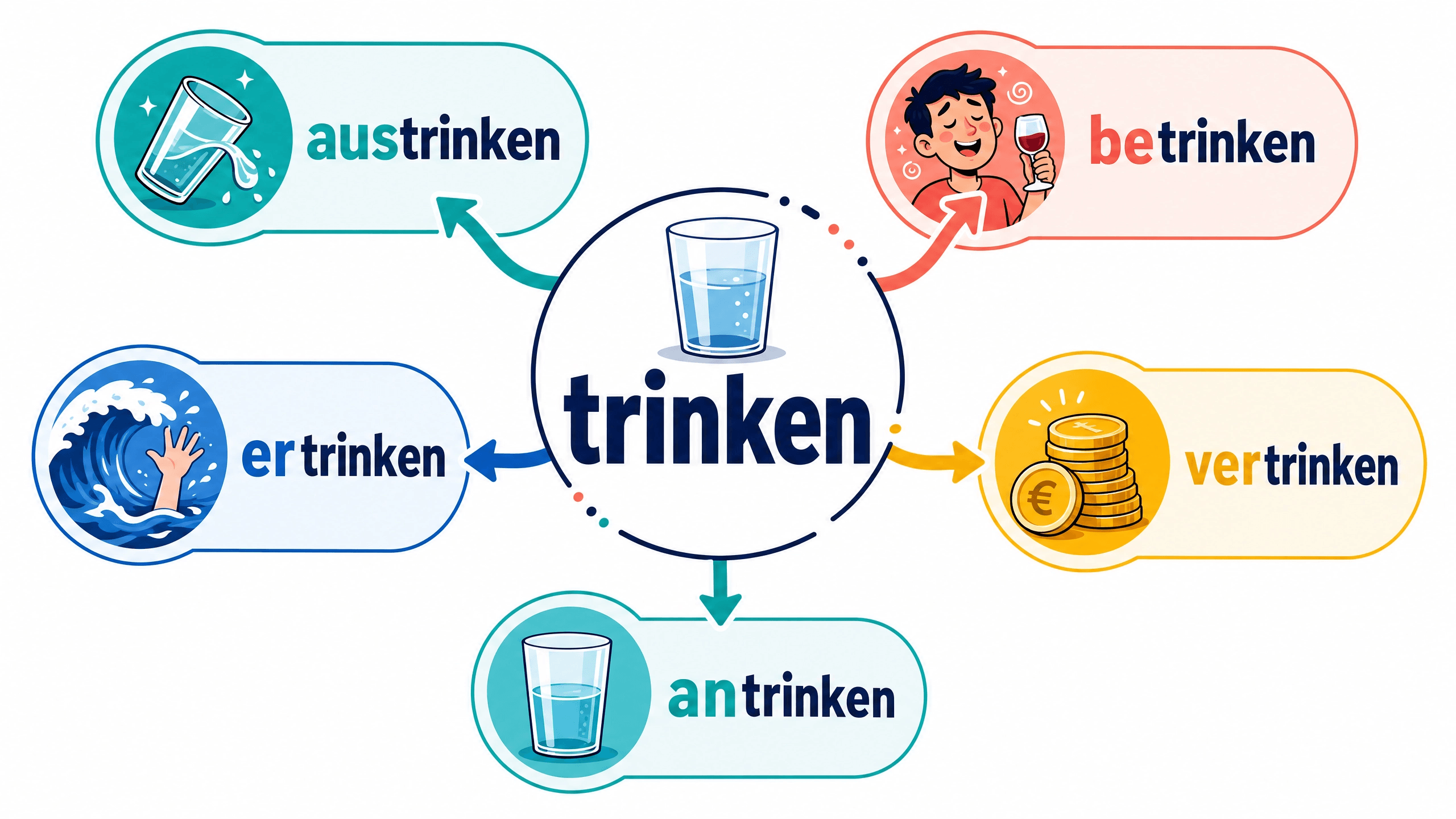
The scene introduces one of the most important structural features of German — separable and inseparable verb prefixes. A prefix attached to a base verb doesn’t just modify meaning slightly. It can reverse it, intensify it, or create something entirely new.
Trinken — to drink — is the base verb. Here’s what happens when you add prefixes:
| Verb | Meaning | Example | Translation |
|---|---|---|---|
| trinken | to drink | Ich trinke Wasser. | I drink water. |
| antrinken | to start drinking | Wir haben die Flasche nur angetrunken. | We only started on the bottle. |
| austrinken | to drink up / finish | Trink dein Glas aus! | Finish your drink! |
| betrinken | to get drunk | Er hat sich betrunken. | He got drunk. |
| ertrinken | to drown | Das Kind fast ertrank im See. | The child almost drowned in the lake. |
| vertrinken | to drink away / squander money on alcohol | Er hat sein Gehalt vertrunken. | He drank away his salary. |
Notice the pattern: the prefix carries the additional meaning while the base verb provides the core action. An- suggests something started but incomplete. Aus- suggests completion. Be- makes the action reflexive or intensive. Er- often suggests a final, irreversible outcome. Ver- frequently implies waste or doing something wrong.
These patterns apply across hundreds of German verbs — not just trinken. Once you internalise the prefix logic, you can often guess the meaning of an unfamiliar verb from its components.
Three more base verbs with the same prefix patterns:
| Prefix | With kaufen (to buy) | With schreiben (to write) | With laufen (to run) |
| an- | ankaufen (to acquire) | anschreiben (to write to someone) | anlaufen (to start up) |
| aus- | auskaufen (to buy out) | ausschreiben (to write out / advertise) | auslaufen (to run out / expire) |
| be- | bekaufen — not standard | beschreiben (to describe) | belaufen (to amount to) |
| er- | erkaufen (to buy at a price) | erschreiben — not standard | erlaufen (to earn by running) |
| ver- | verkaufen (to sell), the opposite of kaufen | verschreiben (to prescribe / misspell) | verlaufen (to get lost) |
The table shows both how productive these prefixes are and where the system breaks down — not every prefix works with every verb, which is why exposure through authentic content like this scene is more effective than memorising rules in isolation.
The Deeper Lesson: Fressen and Saufen
The scene has a second linguistic layer that most viewers miss. The Dutch woman’s corrected version — “Man kann das Pferd zum Wasser ziehen, aber nicht zum Trinken zwingen” — is actually still not quite right.
In German, trinken (to drink) and essen (to eat) are reserved for human beings. For animals, German uses different verbs entirely:
- Fressen — to eat (for animals)
- Saufen — to drink (for animals)
A more accurate translation of the Dutch proverb would be:
“Man kann das Pferd zum Wasser ziehen, aber nicht zum Saufen zwingen.”
This distinction matters because it reveals something about how German categorises the world — human actions and animal actions are linguistically separated in a way English doesn’t replicate.
Slang Usage of Fressen and Saufen
In everyday German slang, both verbs are used humorously to describe exaggerated or uncontrolled human behaviour — the implication being that the person is acting like an animal.
| Verb | Formal Meaning | Slang Usage | Example |
|---|---|---|---|
| fressen | to eat (animals) | to eat greedily or messily | Er hat den Kuchen wie ein Schwein gefressen! |
| saufen | to drink (animals) | to drink heavily, especially alcohol | Er hat gestern wieder den ganzen Abend gesoffen. |
Using fressen or saufen about a person in slang is deliberately crude — it reduces them to animal behaviour. Understanding when and why native speakers reach for these words is exactly the kind of cultural nuance that formal study never covers.
Cultural Insights from the Show
Language and culture are inseparable in How to Sell Drugs Online (Fast). The show is set in a German gymnasium and university environment, which means it’s full of cultural references specific to German academic and youth culture.
Watch the following video, to discover 9 typical German facts you can learn from the show.

Klopfen statt Klatschen — Knocking instead of applauding
In Germany, especially in university lecture halls, students don’t applaud at the end of a lecture. Instead they knock on their desks. This custom — Klopfen instead of Klatschen — is so ingrained that applauding would feel jarring and foreign to a German audience. The show references this and other small rituals of German academic life that are invisible to outsiders but immediately recognisable to native viewers.
Du vs Sie — Informal and formal register
The show demonstrates the du/Sie distinction in action across different social contexts — how Moritz speaks to his friends versus how he speaks to adults, teachers, or business contacts. Watching these register shifts in a dramatic context makes them far more intuitive than learning the rule from a textbook.
Directness in German communication
German communication culture values directness in ways that can read as blunt to English speakers. The show’s dialogue reflects this — characters say what they mean without the hedging and softening that English conversation typically employs. Exposure to this register through entertainment is one of the fastest ways to internalise it.

How to Use Jolii with This Content
The prefix lesson from the Dutch horse proverb scene is one example of what’s available in every episode of this show. The challenge with learning from authentic content is identifying those moments, pausing on them, and converting passive recognition into active knowledge.
Jolii is built specifically for this workflow. Import any episode of How to Sell Drugs Online (Fast) from Netflix directly into Jolii, and the platform generates interactive exercises around the vocabulary and grammar structures in that episode — including prefix patterns, slang expressions, and register distinctions. Rather than pausing manually and looking up words one by one, the learning layer is built into the watching experience.
The prefix table in this article is a starting point. Jolii turns it into a practice session — drilling the distinctions between austrinken and vertrinken, between fressen and essen, until they move from recognition into something you can actually produce in conversation.
Practice: Gap-Fill Exercise
Time to apply what you’ve learned. Fill in the blanks with the correct verb:
Antrinken – austrinken – betrinken – ertrinken – saufen – vertrinken.
- Jugendliche, die sich regelmäßig __________, riskieren ihre Gesundheit.
- Sie mussten ihr Getränk schnell ________, bevor der Zug kam.
- Es ist wichtig, im Meer vorsichtig zu sein, um nicht zu ___________ .
- Beim Glücksspiel riskiert er, sein ganzes Geld zu ___________ .
- Die Kühe gehen zum Fluss, um Wasser zu ___________.
- Ich möchte nur ein wenig vom Bier ___________.
Would you like to practice more? Download Jolii today and keep learning German!
Answer Key:
- Betrinken
- Austrinken
- Ertrinken
- Vertrinken
- Saufen
- Antrinken
FAQs
What level of German do I need to watch How to Sell Drugs Online (Fast)? The show works from A2 upward with German subtitles enabled. Complete beginners will find the pace challenging but can still benefit from visual context and repeated exposure to natural speech patterns. From B1 onward you’ll catch enough dialogue to use the show actively — pausing on unfamiliar expressions, rewatching scenes, and analysing specific moments the way this article does.
Is the German in this show representative of how Germans actually speak? Yes — more so than most German content on Netflix. The show uses contemporary youth language, Gen Z slang, and the informal register of German teenagers rather than the performed or historical German of many other productions. Some expressions will be specific to that demographic, but the core vocabulary and grammar are authentic and transferable.
Are German verb prefixes really that important? Yes — they’re one of the most productive systems in the language. Once you understand the logic of separable and inseparable prefixes, you can decode the meaning of hundreds of unfamiliar verbs from their components. The trinken family alone — antrinken, austrinken, betrinken, ertrinken, vertrinken — demonstrates how much meaning a single syllable can carry.
What’s the difference between fressen and essen in everyday conversation? In formal German, fressen is for animals and essen is for humans — using fressen about a person is deliberately insulting or humorous. In casual slang among friends, fressen is used affectionately or comically to describe someone eating enthusiastically or messily. Context and tone determine whether it’s rude or funny — which is exactly why hearing it in authentic dialogue is more instructive than reading a grammar rule about it.
Can I learn German just by watching Netflix? Watching alone builds comprehension but not production. You can watch for months and improve your listening significantly without improving your speaking at all — because recognition and production are different cognitive skills. Netflix works best as input that you actively analyse and then practise producing. The scene analysis method in this article — find a moment, break it down, drill the pattern — is what converts passive watching into actual learning.
Conclusion
One scene. Two verbs. One prefix. And a grammar lesson that’s genuinely impossible to forget because it arrived as a joke rather than a rule.
That’s the method: find the moment in authentic German content where something surprising happens with the language, stop, and understand why. The Dutch horse proverb scene works because the error is logical — which means understanding it teaches you something about how German actually works, not just what the correct version is.
How to Sell Drugs Online (Fast) is full of moments like this. Contemporary slang, prefix transformations, register shifts between du and Sie, cultural references specific to German academic life — all of it available in thirty-minute episodes on Netflix.
The prefix system introduced in this article applies across hundreds of German verbs. Start with the trinken family, then find a scene in the show that surprises you and apply the same analysis. That gap between what you expected and what actually happened is where your German improves.
Jolii turns this method into a structured practice session — import any Netflix episode and get interactive exercises built around the specific language in that content. The scene analysis starts here. The practice continues there.