TL;DR
Language apps use gamification to drive engagement. Features like streaks and points are designed for daily logins. While these build a habit, they don’t actually improve speaking skills. True fluency requires real-world context and the difficult work of speaking. Most app designs try to avoid this struggle to keep the experience easy and addictive.
Key Takeaways
- Gamified apps produce passive recognition, not active production.
- Roughly 80–90% of language app users drop off within 30 days.
- Streaks tie learning to rewards, not meaning.
- Fluency is linked to discomfort, mistakes, and real conversation.
- Apps are best used as a scaffold, not a destination.
The Learner Problem
You’ve hit a 200-day streak. Badges have been earned. XP has piled up. Then a native speaker says something in the target language, and nothing comes out.
This gap is felt by millions of learners. Understanding is assumed to grow with practice, but the practice inside most apps is shaped by game mechanics, not language science.
What feels like progress is often just engagement dressed up as learning.
What Is Gamification in Language Learning?
Gamification means putting game-like features into apps that aren’t games.
Language apps do this by using points and daily streaks. They also use leaderboards and digital badges to keep users coming back. The goal is to improve user retention.
The psychology is borrowed from slot machines and mobile games.
Dopamine is released whenever someone gets a win, whereas loss aversion is activated whenever a streak is threatened. Both mechanisms work very strongly.
This is also one reason why language learning apps like Rosetta Stone and Memrise have such an addictive feel to them.
Why Gamification Feels Addictive?
Rewards are delivered on variable schedules, a concept traced back to B.F. Skinner’s work on operant conditioning. Unpredictable rewards are known to drive the most persistent behavior. Each login is tied to anticipation, and the streak becomes the point.
Habit-building and skill-building are not the same thing. One is measured in days logged in. The other is measured in sentences spoken under pressure.
Why Gamification Works at First?
For beginners, gamified apps are genuinely useful. Fear is reduced. A daily routine is built. The first hundred words are picked up without stress. This is where gamification earns its place.
The affective filter, a concept introduced by linguist Stephen Krashen, is lowered when anxiety is low. Beginners benefit from this. Confidence is built before the hard work begins. This psychological mechanism is explored in depth in The Affective Filter, helpful for understanding why low-pressure environments help beginners, and why that same comfort eventually becomes the ceiling.
Gamified apps are excellent for beginners, habit building, and early vocabulary. Their weakness is not how they start, it is where they often stop.
Why Gamification Fails Long-Term Language Learners?
Apps focus on how many people use them every day rather than how well they speak.
Some language apps have reported daily active users in the tens of millions, with continued growth expected. These statistics only track how often people log in. They do not measure how many people can actually hold a conversation.
A critical mismatch is created here. The product is optimized for frequency. Fluency is built through depth. The two rarely overlap.
What the Metrics Actually Measure
| Gamified Metric | What It Rewards | What It Does Not Measure |
| Daily streak | Logging in once per day | Speaking ability |
| XP / points | Task completion | Comprehension under pressure |
| Badges | Milestone reinforcement | Real conversation skill |
| Leaderboards | Social comparison | CEFR level progression |
| Hearts/lives | Error avoidance | Risk-taking in speech |
No published study maps XP totals to CEFR levels. Standardized tests like IELTS and TOEIC have validated CEFR mappings. App XP does not.
The Context Problem: Sentences Without Meaning
Gamified apps often teach through decontextualized sentences.
Phrases like “The bee is on the man” or “The green owl eats a suitcase” are grammatically correct but communicatively useless.
No real situation or emotion is attached. No one would ever say these things. The brain stores such input as weak, fragmented memory with nothing to anchor it to.
Real language is situational. It is shaped by who is speaking, where they are, and what they want. These layers are stripped out in most gamified drills.
The Output Gap: Recognition Is Not Production
Tapping the correct answer and speaking the correct answer are processed by different parts of the brain. Recognition pulls from familiarity. Production pulls from retrieval.
Gamified apps lean heavily on recognition. Tasks like multiple choice, word matching, and tile tapping are easy to score and easy to repeat, which is why they dominate.
But fluency is built through output under uncertainty. Speaking with mistakes. Writing without prompts. Being misunderstood and recovering. None of this is rewarded by a streak.
How the Two Modes Compare
| Learning Mode | Example | Cognitive Load | Fluency Transfer |
| Recognition | Tap the correct translation | Low | Weak |
| Production | Speak the answer without cues | High | Strong |
| Shallow engagement | Streak maintenance | Minimal | Near zero |
| Deep engagement | 10-minute conversation | Heavy | High |
The Motivation Crash
Language learning apps see drop-off rates that are unusually steep even by mobile app standards — most users stop within 30 days, a pattern consistent with broader trends across habit-based apps generally.
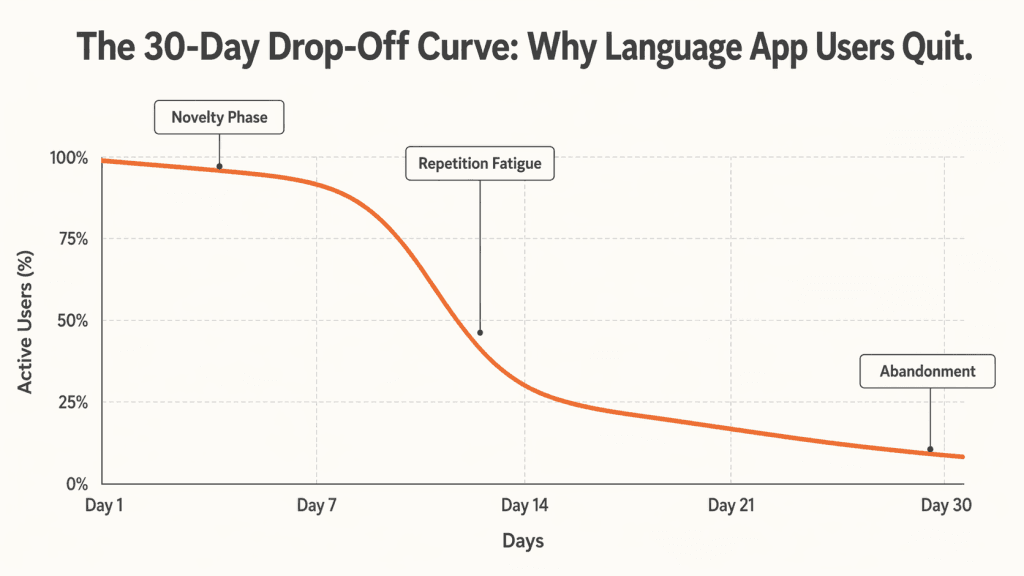
Here is why the crash happens. Early use is driven by novelty. Streaks extend the habit.
But once the game feels repetitive, and once real conversations expose the gap, motivation collapses.
This is sometimes called streak anxiety. The streak is protected, but the learning is abandoned. Guilt replaces curiosity. The app is opened just to save the number.
Real-World Fluency Requires Discomfort
Memory is strengthened by effort, not ease. This principle is called desirable difficulty, introduced by psychologist Robert Bjork.
Tasks that feel harder in the moment produce stronger long-term retention.
Gamified apps are built to avoid this. Difficulty is kept low so users don’t quit. But the cost of that comfort is skill.
Fluency is built in messy environments. Interruptions happen. Slang is thrown in. Sentences are left unfinished. None of this is simulated by a tap-to-answer quiz.
A Real Example
A learner finishes the Duolingo Spanish tree. They can recognize “¿Dónde está la biblioteca?” instantly. Then a taxi driver in Mexico City says, “¿A dónde vas, jefe?“
Nothing matches. “Jefe” wasn’t in the course. The speed was different. The context was different. This is the gap between app fluency and real fluency, and no amount of XP closes it.
As a teacher, I see this often. Learners can repeat phrases and complete drills, but they often lack that real-life adaptability which is essential for communication and ultimately for mastering the language.
What Works Better Than Gamification
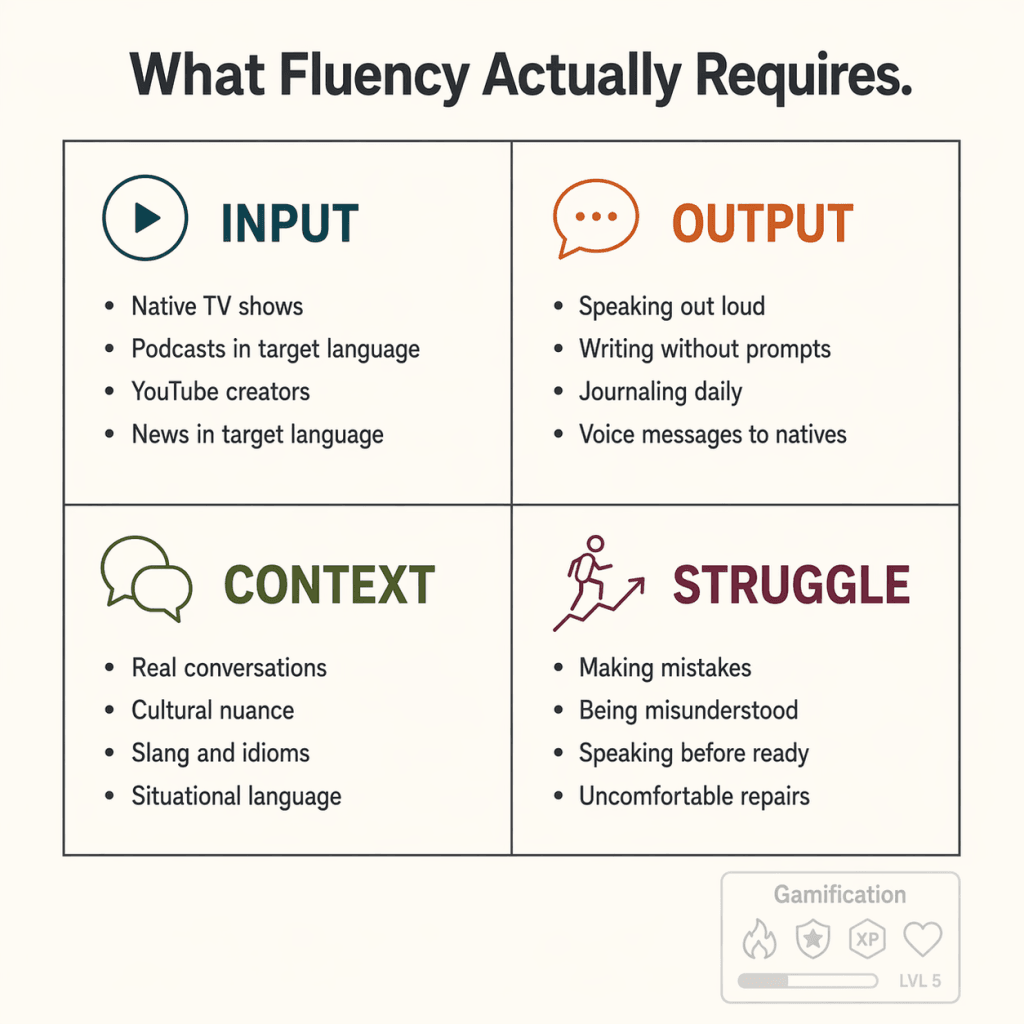
Fluency is built when input is combined with forced output in varied contexts. The following approaches are backed by second language acquisition research:
- Comprehensible input through real media. Native shows, podcasts, and YouTube videos are used instead of scripted drills.
- Language exchange. Platforms like Tandem, HelloTalk, and Preply connect learners with native speakers for live practice.
- Shadowing. Audio is repeated out loud to train prosody, rhythm, and pronunciation.
- Spaced retrieval. Tools like Anki force active recall rather than passive recognition.
- Real-life constraints. Target-language-only hours, labeled household items, and journaling are used to build daily usage.
Gamification can still play a role. It is best used as a warm-up layer, not the main system.
2026 Trends and Future Predictions
Gamification is not disappearing. It is being rebuilt.
Through 2026, the market is being pushed toward hybrid models.
Streak mechanics are being paired with mandatory output tasks. AI conversation partners are being integrated into apps that previously relied on multiple-choice.
The global language learning market is estimated at around $101.5 billion for 2026, and competition is being driven by fluency claims, not engagement numbers.
Two shifts are already underway:
- adaptive AI roleplay is replacing static drills, with real-time dialogue increasingly tied to practical, can-do language goals rather than abstract points.
- output-mandatory systems are emerging — designed to require actual speaking or writing before rewarding progress, rather than rewarding logins alone.
The shift is from reward optimization to performance simulation. Apps that fail to adapt will lose the serious learner segment, even if casual users stay.
FAQs
Why does gamification feel effective at first?
Quick rewards are delivered before real effort is required. Dopamine is released with each small win, and visible progress is shown through streaks and levels. This feels like learning, but engagement is being measured, not skill.
Can gamification ever lead to fluency?
Gamification only works when combined with constant talking and active use. Study alone usually stalls at a basic intermediate level.
Relying on drills limits your progress to a low B1 ceiling. True fluency requires moving beyond passive study into real production.
What is missing from gamification-based apps?
Fluency develops by practicing speaking and handling unpredictable conversations. Facing cultural nuances and the struggle to be understood is where growth happens.
Real progress occurs when you are challenged by these difficult conditions. You gain mastery by navigating actual speech rather than controlled drills.
Should gamification apps be quit entirely?
No. They are useful for building a daily habit and reducing beginner anxiety. But they should be treated as a starter layer, not a replacement for real practice.
How is the transition beyond gamification made?
Conversation is added early. Media in the target language is consumed daily. Mistakes are treated as progress, not failures. Output is practiced even when it feels awkward.
Does XP correlate with CEFR proficiency?
No published validation exists between app XP and CEFR levels. Standardized tests like IELTS and TOEIC have mapped CEFR scores. App gamification metrics have not.
Final Word
Gamification can aid in developing the habit, but that’s not where it ends. Streaks ensure your presence, but communication creates fluency.
True speaking skills are only developed through the act of speaking. The focus remains on using the language rather than just staying in the app.
How Jolii Can Help?
Unlike other gamification apps, Jolii employs artificial intelligence to ensure that interaction takes precedence over playing games.
Language skills such as vocabulary can be learned via videos on Netflix and YouTube. The AI tutor is available 24/7 and provides pronunciation guidance
Learning is more about output rather than keeping up with the streak. By engaging yourself in conversations, you overcome the understanding stage.