Quick Answer (TL;DR)
Adult learners can develop fluency faster—not despite their age, but because of how they process language.
They are better at noticing patterns, connecting meaning to context, and reflecting on how language is used.
However, fluency only develops when that awareness is paired with real exposure and active use.
That’s where context and immersion make the difference.
What Children Do Differently (And Why It Matters)
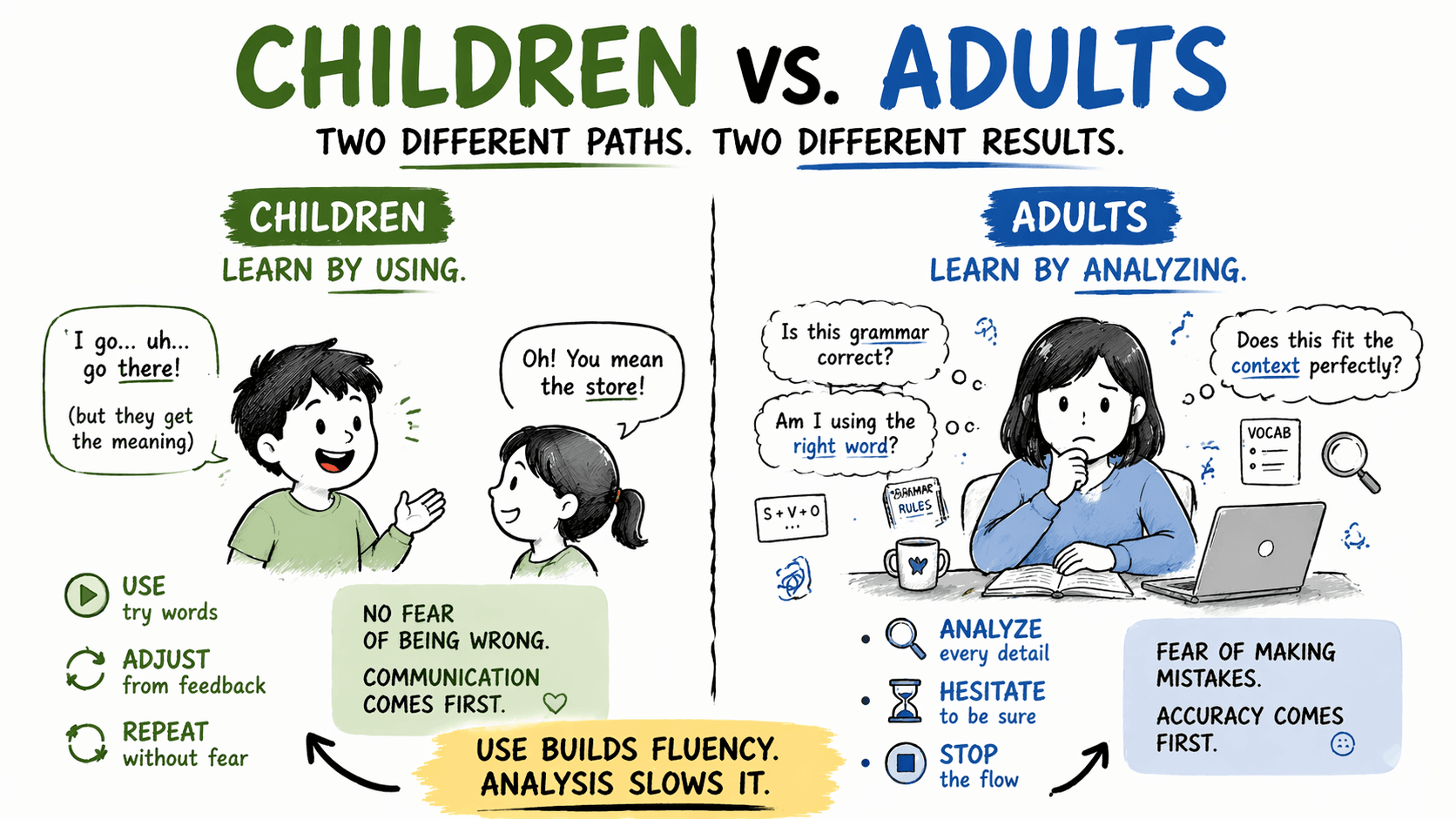
If you observe how children learn a new language, something becomes obvious.
They don’t treat it like a system to master.
They treat it like something to use.
There are no internal questions like:
- “Is this grammar correct?”
- “Am I using the right word here?”
- “Does this fit the context perfectly?”
Instead of analyzing every detail, they work with what they already have.
Words come out even if they’re incomplete.
Sounds get repeated, sometimes imperfectly.
Meaning is adjusted in real time, based on how others respond.
And most importantly, there is no hesitation around being wrong.
If the other person doesn’t understand,
they simply try again.
For them, communication comes first.
Accuracy comes later.
Why Adults Often Feel Slower (But Aren’t)
And this is exactly where the difference begins.
That shift—from using language to analyzing it—
changes how learning feels.
Many adult learners feel like they are at a disadvantage.
Children seem to absorb language effortlessly.
At the same time, they pick up sounds quickly, and they adapt without thinking too much.
So it’s easy to assume:
👉 Adults learn slower
However, that assumption is misleading.
Because adults are not worse at learning.
They are just using a different system.
The Cognitive Insight: Why Adults Learn Differently
The real difference is not speed.
It is how the brain processes language.
1. Awareness vs Automatic Absorption
Children learn through exposure and interaction.
They pick things up by repeating what they hear,
adjusting based on feedback,
and gradually shaping their language through use.
Adults take a different route.
Instead of simply absorbing, they tend to analyze.
Patterns become visible, while structures get compared.
Meanwhile, meaning is reflected upon rather than just experienced.
That awareness is powerful.
But if it replaces usage instead of supporting it,
it becomes a barrier.
2. Knowledge vs Usability
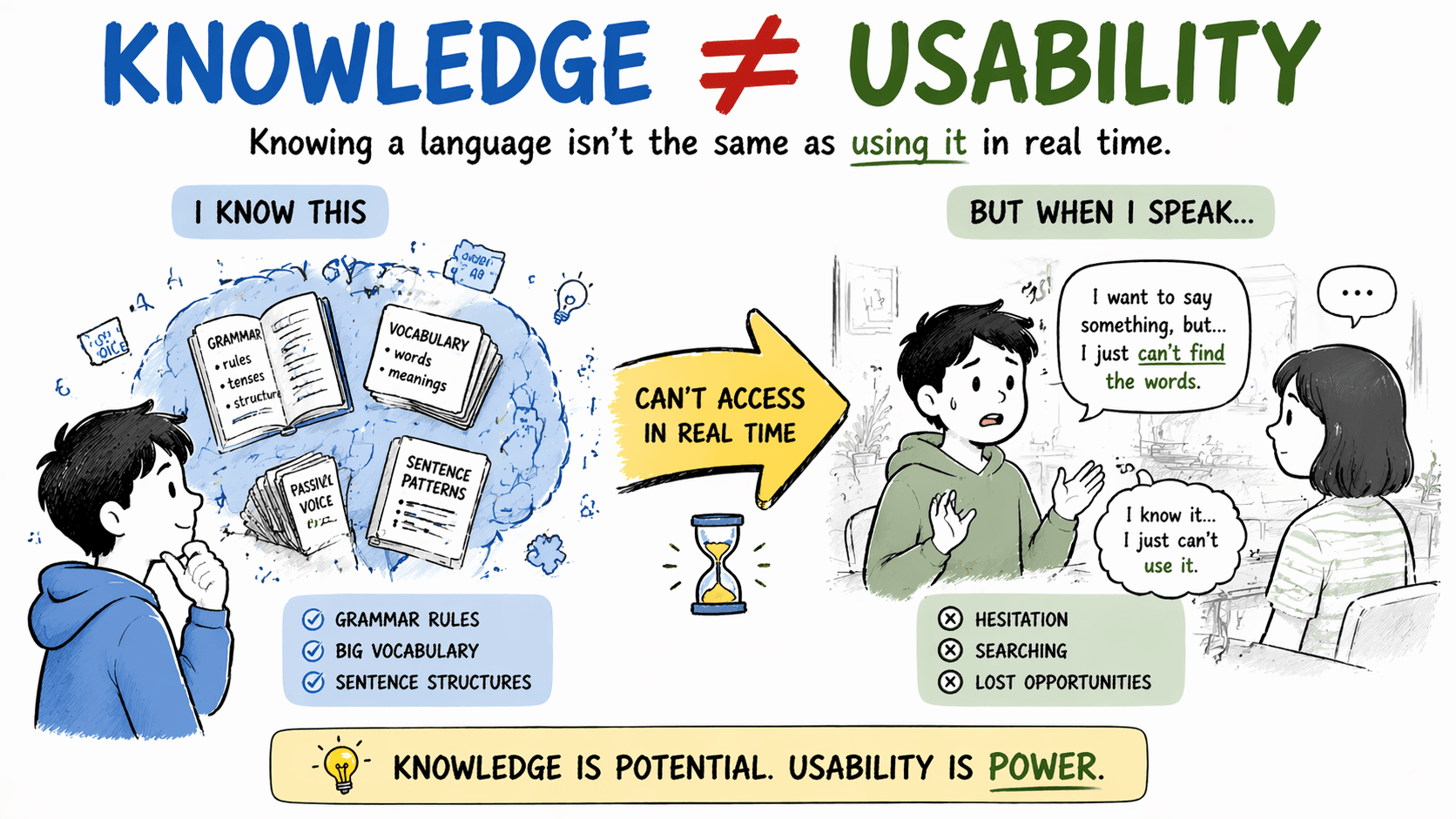
Adults often understand more than they can use.
They know grammar rules, vocabulary, and sentence structures.
Yet, when it’s time to speak, something slows down.
But when it’s time to speak, something slows down.
Because knowledge is not the same as access.
And fluency depends on access.
And that’s why knowing more often feels like progress—
until you actually need to speak.
3. Efficiency vs Engagement
Adults tend to optimize.
They look for:
- shortcuts
- explanations
- clear systems
That makes learning feel efficient.
However, efficiency changes how you engage with language.
When everything is optimized,
there is less room for struggle.
And without that struggle:
- memory weakens
- patterns don’t stabilize
- language stays abstract
Because what feels efficient in the moment
often becomes friction later.
4. Control vs Experience
Adults try to control learning.
They want:
- correct sentences
- clear understanding
- minimal mistakes
But language is not built through control.
It is built through experience.
And experience is messy.
It includes:
- uncertainty
- repetition
- incomplete understanding
Without that, fluency doesn’t develop.
Research Support
Research shows that adult learners benefit from meaningful, context-rich input because it allows them to connect language with real situations and prior knowledge.
At the same time, studies on immersion-based learning highlight that repeated exposure to language in context improves both comprehension and the ability to use language spontaneously.
In simple terms:
👉 Adults don’t need more explanation.
👉 They need better exposure.
A Moment I Noticed This Myself
There was a time when I focused heavily on understanding everything.
Whenever I encountered something new, I stopped.
I started by looking it up carefully.
Then, I analyzed what I had found.
Finally, I worked to fully understand it before moving forward.
At first, it felt like progress.
Because everything became clearer.
But over time, something didn’t match.
Even though I understood more,
I wasn’t speaking more.
In real conversations, I still hesitated.
Not because I didn’t know the words.
But because I hadn’t used them enough.
That’s when I changed something.
Instead of stopping to understand everything,
I started staying inside the situation.
I let some things remain unclear.
I focused more on:
- what was happening
- how people reacted
- when certain phrases appeared
And gradually, something shifted.
It stopped being something I understood.
And started becoming something I could actually use.
Adult Learning vs Child Learning
| Aspect | Children | Adults |
| Learning Style | Absorption | Awareness |
| Strength | Imitation | Pattern recognition |
| Weakness | Lack of structure | Overthinking |
| What Builds Fluency | Repetition | Context + usage |
So What Actually Builds Fluency for Adults?
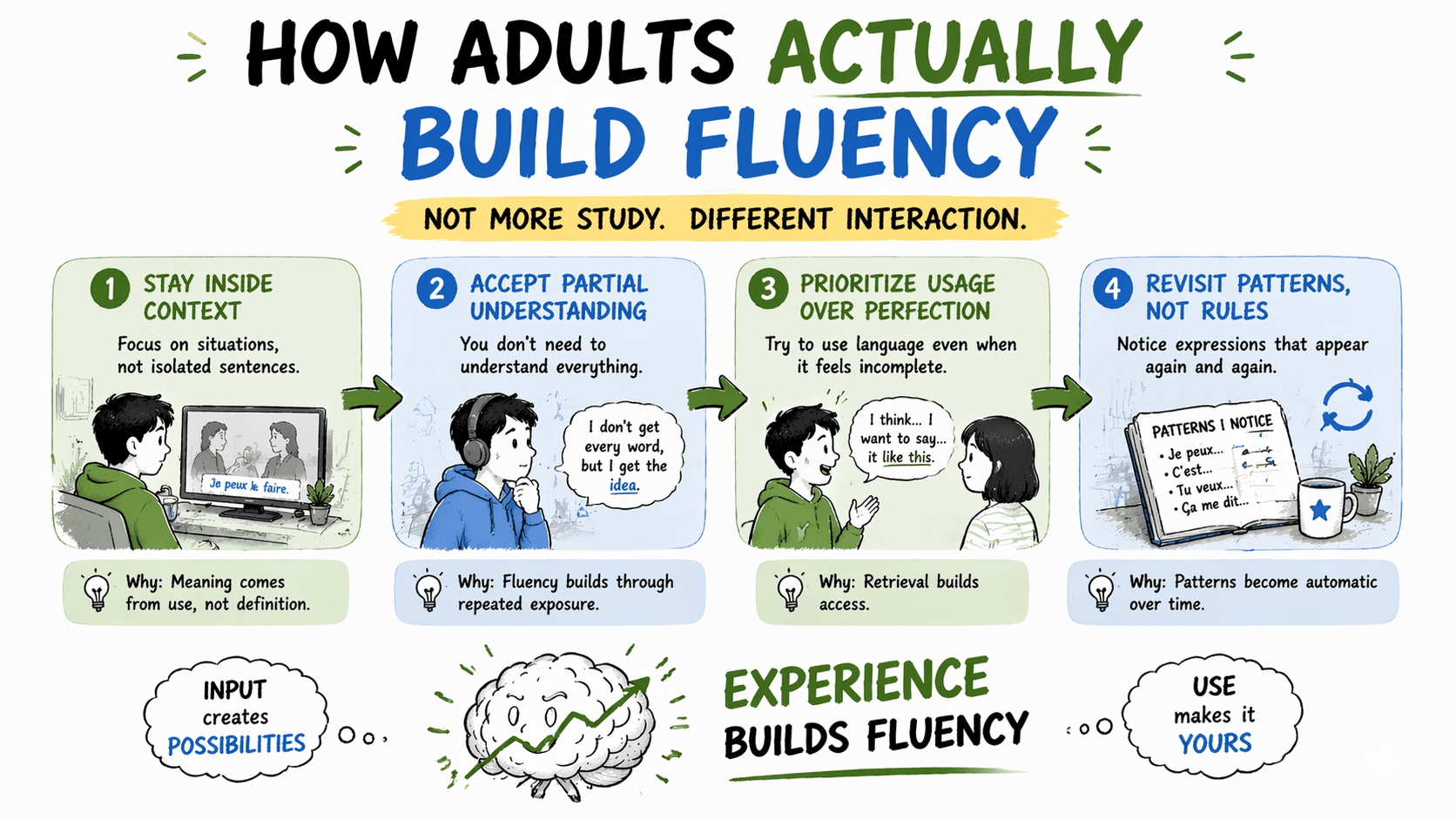
The answer is not more study—
it’s a different way of interacting with language.
1️⃣ Stay Inside Context
Focus on situations, not isolated sentences.
👉 Why: meaning comes from use, not definition
2️⃣ Accept Partial Understanding
You don’t need to understand everything.
👉 Why: fluency builds through repeated exposure
3️⃣ Prioritize Usage Over Perfection
Try to use language even when it feels incomplete.
👉 Why: retrieval builds access
4️⃣ Revisit Patterns, Not Rules
Notice expressions that appear again and again.
👉 Why: patterns become automatic over time
Why This Connects to Linguistic Identity
At some point, learning stops being about correctness.
It becomes about expression.
The way you choose words gradually shapes your expression.
Meanwhile, meaning starts to take form through context.
And over time, your responses in real situations become more natural.
This shift is explained more deeply here:
👉 The Future of Linguistic Identity: How AI is Reshaping Our Relationship with Language
Because fluency is not just about using language.
It is about owning it.
FAQs
1. Can adults really learn faster than children?
Yes—if they use context and active engagement effectively.
2. Why do I understand but can’t speak?
Because understanding does not automatically become usable language.
3. Do I need immersion to become fluent?
You need consistent exposure to meaningful context, which immersion provides.
A Simple Way to Make This Work (Jolii Approach)
The problem is not age.
It is how learning is structured.
Jolii helps you:
- stay inside real contexts
- notice patterns naturally
- revisit key moments
So instead of overthinking language,
you start experiencing it.
And that is what allows fluency to develop.
Final Thoughts
Adults are not at a disadvantage.
They just need a different approach.
Because fluency is not built through explanation.
It is built through experience.
And once you shift from:
👉 Understanding language
to
👉 Using language
everything changes.