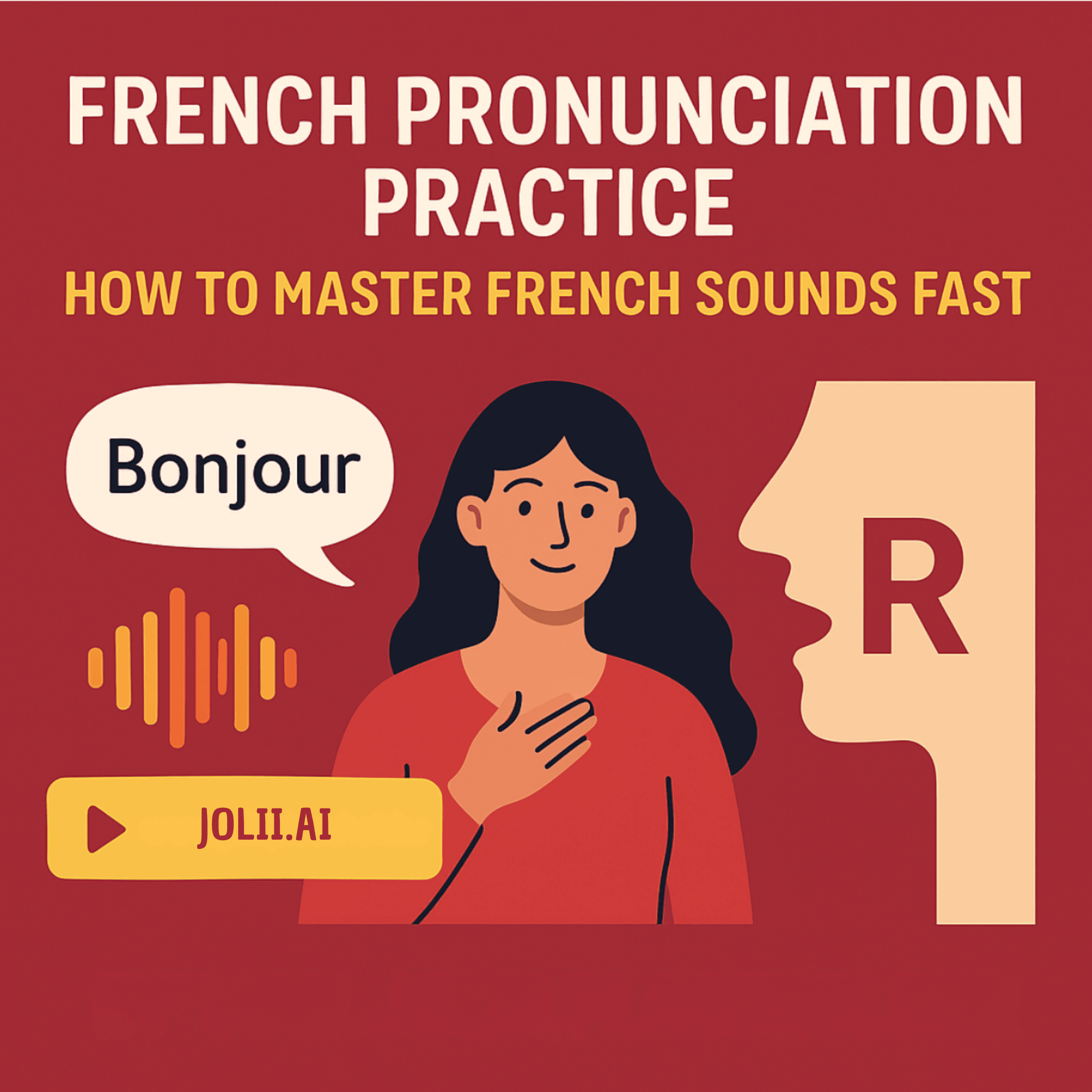
French can seem difficult (and it really is, no doubt about it) when you’re just starting out: nasal sounds, closed vowels, a unique rhythm, silent letters… Yet with the right method, it’s absolutely possible to progress very quickly. This humble and complete guide to French pronunciation practice shows you how to master the essential French sounds, understand the most common learner mistakes, and adopt the right habits from day one.
Unlike English or Spanish, French has a very consistent sound system, but one that relies on subtle nuances. By working on the sounds one by one, and especially by listening to them in real, natural contexts, you can improve your accent in just a few days (piece of cake).
The Essential Foundations of French Pronunciation (Rhythm, Vowels, Key Consonants)

Before diving into real French pronunciation practice, it’s essential to understand the three pillars that make French sound unique: rhythm, vowels, and key consonants. These elements, combined, give French its auditory identity. Once you grasp these foundations, everything becomes more logical, and much easier to reproduce.
1. French rhythm: uniformity above all else
French is not a “stress-timed” language like English. It is syllable-timed.
Each syllable has almost the same duration, weight, and importance. This creates the fluid, continuous quality that English speakers often perceive as “flat” or “even.”
Example:
- Je ne sais pas → every syllable is regular
Unlike English, where certain syllables are strongly stressed, French has only one main accent, placed lightly at the end of a group of words, not on individual words.
To instantly improve your accent, read sentences in rhythmic blocks, not word by word. This is something most beginners never do, but it transforms your pronunciation right away.
2. French vowels: tiny nuances, major results
French vowels are one of the first real challenges for learners because:
- there are many of them
- several are very close to one another
- small differences completely change the meaning
a) Closed vs open vowels
French distinguishes several vowel pairs, such as:
- é (closed) vs è (open)
- closed o vs open ɔ
Examples:
These differences barely exist in English, but they are fundamental in French.
b) The famous nasal vowels
They are part of what gives French its characteristic sound:
- an / en
- on
- in / un (depending on the accent)
Examples:
These vowels are pronounced by letting air pass through the nose, a very unusual gesture at first, but absolutely essential.
French speakers almost never close their mouths completely when pronouncing vowels. An overly “English” or rigid mouth shape automatically produces a foreign-sounding accent.
3. Key consonants: the traps and the essentials
Some consonants cause repeated difficulties for beginners:
a) The guttural French R (ʁ)
This R is produced at the back of the throat with a slight friction, nothing like the English or Spanish R.
Examples:
Quick tip: imagine a very soft, controlled gargling sound, not a tongue roll.
b) The clear French L
It’s a bright, front-of-the-tongue L (unlike the English “dark L”).
Examples:
c) Final consonants that almost always disappear
In French, most final consonants are silent.
Examples:
- petit → the “t” disappears
- grand → the “d” disappears
- vous parlez → the “z” is silent
If you’re hesitating, don’t pronounce the final consonant. In 90% of cases, you’ll be correct, and you’ll immediately sound more natural.
The Most Difficult French Sounds and How to Master Them (with audio)

French sounds are notoriously challenging for beginners because they don’t exist in many learners’ native languages. Focuses on the sounds that cause the most confusion, why they are difficult, and exactly how to train them efficiently with real French pronunciation practice.
1. The French “U” vs “OU” – the unbeatable beginner trap
These two sounds are extremely important because mixing them can completely change the meaning of words.
- u → pronounced with tightly rounded lips, tongue high and forward
Example: lune - ou → a deeper, back-of-the-mouth sound
Example: loup
Tip to master them:
Push your lips forward as if whistling for u, and pull them slightly back for ou. For most learners, this contrast becomes clear after a few minutes of focused practice.
Many beginners think the difference is in the tongue, but in reality, it’s 80% lips, 20% tongue. Adjusting the lip position instantly boosts accuracy.
2. The French R (ʁ) – harsh for the throat, soft in practice
The French R might feel intimidating, but it’s simply a soft friction produced at the back of the throat.
How to train it:
- Relax the throat
- Exhale gently
- Create a light vibration, not a gargle, not a rolled R
- Start with “hhhrrr” to find the airflow
This R is one of the sounds that most clearly signals “French accent,” so practicing it regularly pays off quickly.
3. Nasal vowels – the French signature sounds
Nasal vowels (an/en, on, in/un) often feel unnatural at first because the airflow must go through the nose.
Examples:
Technique to master them:
- Pronounce the vowel normally (oral)
- Then lower your soft palate so air flows through your nose
- Keep your lips slightly open, never closed
Nasal vowels are not nasal consonants (like N or M). They are pure vowels, but “colored” by nasal airflow. Understanding this removes 50% of the confusion for learners.
4. The French “é” vs “è” – subtle but essential
These two vowels look similar but sound very different:
Quick training hack:
Smile slightly for é (it tightens the vowel).
Relax your jaw for è (it opens the sound).
Learners who skip this distinction often sound monotone or unclear in French.
5. The “liquid” French L – simpler than you think
The L is pronounced at the front of the mouth, with the tongue touching just behind the teeth.
It is much lighter than the English “dark L,” making it easier to produce once you adjust your tongue placement.
6. Silent letters – the invisible difficulty
Often forgotten in pronunciation guides, silent letters dramatically impact how natural you sound.
Examples:
- petit → no “t”
- vous parlez → the “z” disappears
- grand → the “d” is silent
A simple rule dramatically boosts clarity:
If you’re unsure… don’t pronounce the final consonant.
You’ll be right the majority of the time.
How to Practice French Pronunciation Effectively (Beginner-Friendly Methods)

Mastering French sounds it’s about training your ear, your mouth, and your rhythm in a consistent, efficient way. Let’s see how.
1. Train your ear before your mouth (listening-first approach)
French is a language where small sound differences create big meaning differences. That’s why ear training is the foundation of all French pronunciation practice.
Practical exercises:
- Listen to short audio clips and repeat immediately
- Compare minimal pairs (ex: beau vs bol, du vs dou)
- Shadow native speakers for 10-20 seconds at a time
This method helps you recognize patterns your brain doesn’t yet perceive, making pronunciation easier afterward.
2. Use “shadowing” to copy native rhythm and melody
Shadowing means listening to a native recording and repeating simultaneously, like an echo.
Benefits:
- Improves rhythm
- Increases fluency
- Builds natural pronunciation reflexes
Choose slow-paced French audio at first, then gradually increase speed. It’s one of the most powerful techniques to reduce your accent quickly.
3. Record yourself
Most learners believe they sound better than they actually do… until they record themselves.
What to do:
- Read a short text aloud
- Record it
- Compare to a native speaker
- Adjust and repeat
This simple loop leads to rapid improvement, especially with nasal vowels and the French R.
4. Break difficult sounds into micro-exercises
Complex sounds become easy when you isolate them.
Examples:
- Practice the French R using just “hrrr” airflow
- Repeat u in a series (tu, su, lu, vu)
- Alternate nasal vowels (on / an / in)
Short, focused drills are more effective than long sessions.
5. Surround yourself with everyday French sounds
Pronunciation improves automatically when your brain becomes familiar with the music of the language.
What to add to your routine:
- French YouTube channels
- Podcasts for beginners
- Series or movies with subtitles
- French songs focusing on clear vocals
Exposure makes pronunciation feel natural instead of forced.
6. Use AI-based pronunciation tools (like Jolii)
Apps with speech recognition help beginners correct mistakes instantly. With Jolii AI, you can:
- Listen to native pronunciation
- Practice the same sounds
- Get immediate feedback
- Train daily for a few minutes
This recreates the experience of speaking with a native tutor, accessible anytime.
Conclusion
Let’s be honest, French pronunciation is complex, no point pretending otherwise. But it becomes much easier once you understand how its sounds, rhythm, and articulatory mechanics work. By practicing regularly, listening to native speakers, and working on vowels, nasal sounds, and the French R, you can improve your accent much faster than you think.
The most common mistakes can be corrected with a simple combination: listening + repetition + micro-exercises + immediate correction. By adopting this routine now, you lay the foundation for a solid accent throughout your learning journey.
Takeway
Here’s the essential to remember:
- French pronunciation practice relies above all on listening: your ear must be trained before your mouth.
- French is a sound-based and regular language, but very nuanced, precision makes all the difference.
- Difficult sounds (nasals, u, R) become easy with targeted exercises of just a few minutes.
- Consistency beats duration: 5 minutes a day is enough to see real progress.
- AI tools like Jolii allow you to correct your mistakes instantly and accelerate your learning.
If you master these principles, your French accent will naturally become clearer, smoother, and much closer to that of a native speaker.
Jolii Language Learning App
If you want to pronounce French sounds like a native, here is how Jolii AI can help you:
- listen to native pronunciation for all essential French sounds
- practice each sound with AI and get instant feedback
- correct your accent step by step
- improve your fluency in just a few minutes a day
- access exercises adapted to your level
- learn real cultural vocabulary used by native French speakers
Discover Jolii AI and learn French fast by turning your French pronunciation into a natural, precise, and motivating skill.