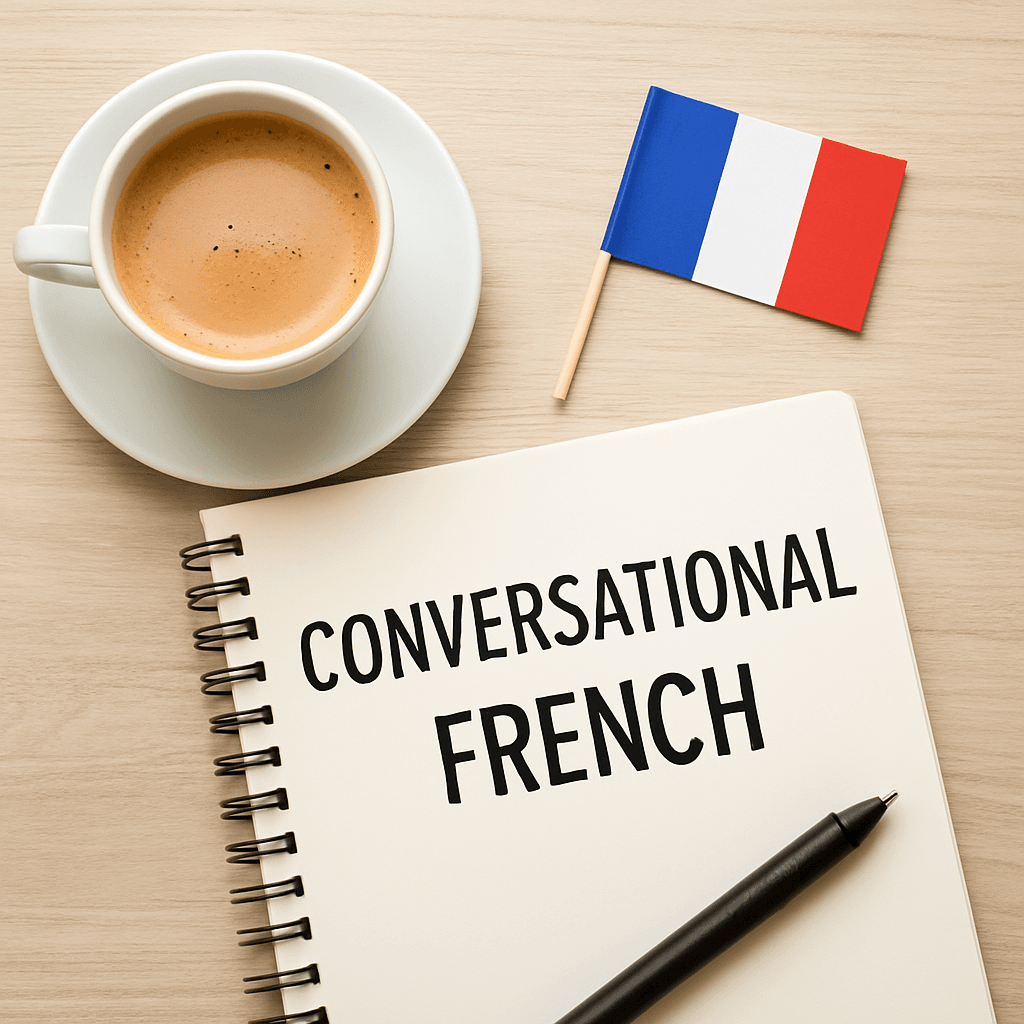
Many beginners understand grammar or vocabulary but freeze when it’s time to actually converse. That is why conversational French focuses on real-life, natural communication rather than theory.
Simple French Conversations for Beginners – Quick Answer
Conversational French for beginners means learning to speak French through short dialogues, common phrases, and real-life situations instead of grammar drills alone.
This method focuses on:
– High-frequency spoken phrases
– Natural sentence patterns
– Everyday dialogues (cafés, greetings, directions)
– Pronunciation shortcuts native speakers use
It helps beginners start speaking faster and with more confidence than textbook-only learning.
Why Conversational French Matters for Beginners

In my beginner French classes, I see the same pattern repeatedly: students who know vocabulary and grammar still freeze when asked a simple question like “Ça va ?”. Those who practice short, conversational exchanges from day one usually start responding naturally within a few weeks, while students who focus only on grammar often understand everything but struggle to speak.
Beginners often focus on grammar tables, verb conjugations, or long vocabulary lists. While these elements are important, they don’t always translate into real communication. What they actually need is the ability to use French naturally in everyday situations, which is exactly what conversational french provides.
Conversational French emphasizes:
- Speaking in short, natural sentences
- Understanding common expressions
- Listening to real-life dialogue
- Building confidence through repetition
- Learning phrases you actually use in daily life
This approach mirrors how children learn their first language: by hearing, repeating, and using language in context rather than memorizing abstract rules.
Why beginners benefit from conversational learning
- Faster confidence boost – Start speaking earlier, which reduces anxiety.
- Better retention – Phrases learned in context stick longer.
- More motivation – Feel progress because you can actually communicate.
- Cultural understanding – Conversations reflect real French culture, not textbook language.
- Practicality – Learn what you need for travel, socializing, or work.
Example
Instead of memorizing the sentence “Je voudrais un café,” (I want a coffee) beginners learn the conversational version:
“Un café, s’il vous plaît.” (A coffee, please)
This is shorter, more natural, and exactly how people speak in cafés across France.
Conversational French is therefore the most efficient path for beginners who want to communicate first and refine grammar later.
Core Elements of Conversational French

To speak conversational french confidently, understand a few essential building blocks. These elements form the foundation of natural dialogue and help learners sound more fluid and authentic.
1. Common Everyday Expressions
Conversational French relies heavily on short, frequently used expressions. These phrases appear in casual conversations, cafés, workplaces, and social gatherings.
Examples:
- Ça va ? – How are you?
- Pas de souci. – No problem.
- À tout à l’heure ! – See you later!
- C’est génial. – That’s great.
2. Informal vs. Formal Speech
French has clear distinctions between:
Beginners often struggle with this, but conversational French teaches you when to use which form:
- Use tu with friends, family, or people your age.
- Use vous in professional or unfamiliar contexts.
3. Question Structures
In conversational French, questions are usually shorter and more relaxed than in textbooks.
Formal:
Conversational:
- Ça va ?
- Tu vas bien ?
Shorter questions make conversations smoother and more natural.
4. Fillers and Natural Pauses
Native speakers use fillers constantly. Learning them helps you sound more fluent.
Examples:
5. Linking Words
Conversational French uses many connectors to keep conversations fluid.
Common connectors:
6. Pronunciation Patterns
Conversational French often links words together:
- Tu as → “t’vas”
- Je ne sais pas → “j’sais pas”
- Il y a → “y’a”
Spoken shortcuts are essential for listening comprehension.
The 3-Step Conversational French Method for Beginners
Over time, I’ve found that beginners progress fastest when they follow a simple, repeatable structure. This is the 3-Step Conversational French Method, designed specifically for early speaking confidence.
Step 1 – Recognize
Listen to short, real conversations until you recognize common phrases and rhythm, even if you don’t understand every word.
Step 2 – Reuse
Reuse ready-made phrases (greetings, requests, reactions) in multiple contexts instead of building sentences from scratch.
Step 3 – React
Practice reacting naturally with short responses (“Oui”, “D’accord”, “Pourquoi pas”, “Ça marche”) to keep conversations flowing without pressure.
Beginners who focus on recognition, reuse, and reaction tend to speak sooner and with less anxiety than those who wait for grammatical perfection.
Simple French Dialogues for Beginners

Practical dialogues are one of the best ways to learn conversational french, because they show how real people speak in everyday situations.
Dialogue 1 – Greeting a Friend
French
A: Salut ! Ça va ?
B: Ça va bien, merci. Et toi ?
A: Ça va. Quoi de neuf ?
B: Pas grand-chose, et toi ?
English
A: Hi! How are you?
B: I’m good, thanks. And you?
A: I’m good. What’s new?
B: Not much, and you?
Notes:
- Ça va ? is the most common greeting in conversational French.
- Quoi de neuf ? is equivalent to “What’s new?”
- Short, casual sentences mirror natural spoken French.
Dialogue 2 – Asking for Something in a Café
English
A: Hello, I’d like a croissant, please.
B: Of course. With a coffee?
A: Yes, thanks.
B: Here you go!
Notes:
- Je voudrais… = “I would like…” (polite but still common)
- Voilà ! = “Here you go!”
- This dialogue represents everyday café conversations in France.
Dialogue 3 – Planning to Meet
English
A: Do you want to grab a drink tonight?
B: Yeah, why not!
A: Shall we meet at 7 pm?
B: Perfect. See you tonight!
Notes:
- Pourquoi pas ! = “Why not!”
- Very casual, friendly tone, typical of conversational French.
Dialogue 4 – Getting Directions
English
A: Excuse me, where is the train station?
B: The station is to the left, then straight ahead.
A: Thank you very much!
B: You’re welcome.
Notes:
- Excusez-moi uses the formal “vous,” used with strangers.
- De rien = “You’re welcome,” very common in everyday speech.
By practicing dialogues, beginners internalize conversational patterns faster than with grammar alone.
Cultural Context in Conversational French

1. Greetings Are Important
French conversations often start with a polite greeting, even in informal settings. Skipping greetings can come across as rude, especially in shops or cafés. Even a quick Bonjour ! helps create a positive interaction.
Common greetings:
2. Politeness Is Embedded in Speech
French speakers frequently use polite expressions:
- S’il vous plaît – Please
- Merci beaucoup – Thank you very much
- Je vous en prie – You’re welcome (formal)
- Pardon – Sorry / Excuse me
3. Conversation Style: More Formal Than English
Even casual conversations can sound slightly more structured compared to English.
People often:
- Speak in complete sentences
- Avoid overly direct statements
- Use more polite forms
For beginners, this means learning when to use vous instead of tu, especially with strangers.
4. Cultural Expressions and Humor
French conversations include expressions that don’t translate directly but appear often in everyday speech and slang.
Examples:
- C’est pas grave. – It’s no big deal.
- Ça marche. – Okay / Works for me.
- On y va ! – Let’s go!
- Ça me dit. – I’m interested / Sounds good.
5. Body Language Matters
During conversations:
- People maintain eye contact
- Gestures are expressive
- A handshake is common in formal settings
- Friends may greet with la bise (cheek kisses), usually 1-2 kisses
Understanding these gestures helps beginners navigate social interactions more confidently.
Tips to Improve Your Conversational French
1. Practice Daily, At least 5 Minutes
Try:
- Saying a dialogue aloud
- Repeating common phrases
- Listening to a short audio clip
- Speaking to yourself in French
Consistency builds muscle memory.
2. Focus on High-Frequency Phrases
Instead of memorizing rare vocabulary, learn phrases you hear every day.
Examples:
- Ça marche – Okay
- Pas de problème – No problem
- Je ne sais pas – I don’t know
- On y va – Let’s go
3. Listen Before You Speak
Use:
- Podcasts
- Simple videos
- Dialogues
- Songs
Listening helps you internalize patterns used in conversational French. Listening is essential, but waiting too long to speak can slow progress — especially if you’re unsure how much listening is actually enough before speaking.
4. Repeat and Shadow Native Speakers
Shadowing means listening to a speaker and repeating immediately after them.
Benefits:
- Improves accent
- Builds flow
- Helps with contractions (e.g., “j’sais pas”)
- Increases confidence
5. Speak With Other Learners or Native Speakers
Conversation partners reduce hesitation and make learning fun. Speaking regularly helps you overcome fear and improve speed.
6. Review Mistakes, But Don’t Obsess
Mistakes are normal and helpful.
Focus on:
- Correcting pronunciation
- Understanding meaning
- Improving clarity
Perfection comes later.
Common Mistakes in Conversational French (and How to Avoid Them)

Beginners of conversational french often make similar mistakes. From experience, most beginner mistakes in conversational French come from hesitation and overthinking, not from a lack of vocabulary. Confidence really makes a different when it comes to speaking a language.
1. Using “vous” and “tu” Incorrectly
Many learners overuse vous because it feels safer.
- Tu → friends, family, informal
- Vous → strangers, older people, formal settings
Using tu too early can sound disrespectful, while vous in casual settings sounds stiff.
2. Speaking Too Slowly or Too Clearly
Beginners tend to:
- Enunciate every syllable
- Avoid contractions
- Speak in a rigid rhythm
Native speakers contract words naturally:
- Je ne sais pas → j’sais pas
- Il y a → y’a
- Tu as → t’as
3. Direct Translation From English
Learners often translate sentences word-for-word.
Example (incorrect):
Je suis très faim.
Correct:
J’ai très faim. (I’m very hungry.)
French uses avoir (to have), not être (to be), for hunger.
4. Overloading Sentences With Grammar
Beginners try to use complicated structures too early.
Instead of:
“Bien que je sois fatigué, je vais travailler.”
Say:
Je suis fatigué, mais je vais travailler.
Simple sentences sound more natural in conversational French.
5. Ignoring Liaison and Linking
French speech often links words together.
Examples:
- Les amis → lézami
- Vous avez → vouzavé
- C’est intéressant → sé-tère-san
Ignoring liaison makes you sound “textbook-like.”
6. Being Afraid of Making Mistakes
Mistakes are part of learning. Native speakers expect errors from learners and rarely judge them.
Summary
Instead of focusing solely on grammar charts or vocabulary memorization, beginners discover that real progress happens when they immerse themselves in natural dialogue, cultural nuance, and everyday expressions. Through simple conversations, learners begin to hear patterns, internalize rhythm, and develop confidence in their ability to communicate. Over time, phrases that once felt foreign become familiar, and communication feels less like an academic exercise and more like a natural flow.
The dialogues, cultural explanations, practice strategies, and common pitfalls explored in this article all point toward a single goal: helping beginners speak French in a way that feels authentic, intuitive, and enjoyable. Conversational French thrives on simplicity, clarity, and connection, and it encourages learners to speak early rather than wait until they feel “perfect.” In this approach, mistakes become stepping stones rather than obstacles, and every conversation strengthens both comprehension and confidence.
Takeaways
The key insight from this exploration is that fluency begins with simplicity. Natural speech relies on short sentences, common expressions, and the ability to listen and mimic rather than overanalyze. Beginners benefit when they allow themselves to speak early, focus on high-frequency phrases, and absorb the cultural context that shapes communication.
If you want to continue this journey with a tool designed specifically to develop real conversational skills, Jolii AI offers an immersive environment where you can practice speaking freely, receive immediate feedback, and experience dialogue that mirrors everyday French.