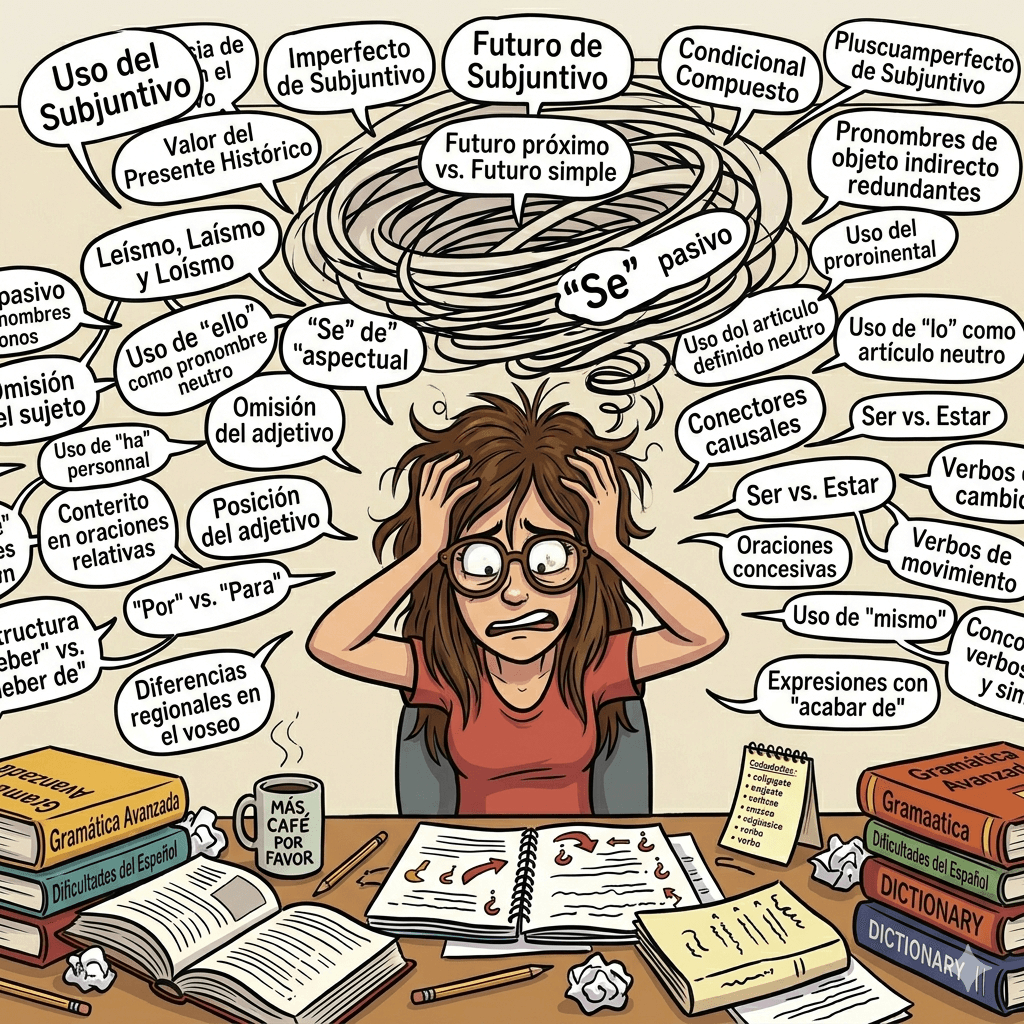
Have you ever stumbled over an English word? Or read one of your texts and something sounded off? Not to worry, you are not alone.
Whether you embarked on learning English to improve your global communication, to advance your career or for academic pursuits, you probably didn’t know that English is not as simple as it seems.
You will have challenges in your journey. English is wide and quite a complicated language. Also, as a learner, you will probably have little time to learn and get fluent, when in reality, you need more time. However, this is not to say that you can’t learn and be fluent. We just have to make sure you know what challenges you will run into and what mistakes you are bound to make. It is said, “To be forewarned, is to be forearmed”. Knowing what to expect will help you either avoid them or solve them. And we will also provide possible solutions to each of the mistakes.
And without further ado, let’s jump in!
1. Subject-Verb Agreement
That just sounded like rocket science. We know. However, it is not as difficult as it sounds. What this means is the subject (Who or what the sentence is about) must agree in number with the verb (state of being or the action). So, if the subject is singular, the verb must also be singular, and vice versa.
Verbs typically end with -s or -es when in the singular but when in plural terms the suffix is not used, as in “they play” or “they jump”.
Let’s apply this rule in a sentence:
Incorrect: She bake bread.
Correct: She bakes bread.
The above are set in the singular. Let’s look at what they would be in the plural.
Incorrect: They bakes bread.
Correct: They bake bread.
This rule is important for speaking fluently and mastering it quickly is needed. Understanding this rule will make you sound more fluent.
2. Word Order for Questions
In English, asking questions involves rearranging the order of words. It is not just adding a question mark at the end.
Learners, especially the beginner ones do not know this.
It is most common for questions to start with questioning words such as who, where, or why. Afterward, an auxiliary verb is placed, such as do, does, did, are, is, etc. The subject of the sentence follows the auxiliary verb. Subjects may look like she, he, you, it, etc. Then, you place the main verb after the subject. This main verb is usually in its base form. Let’s look at an example:
Incorrect: She is going to church?
Correct: Is she going to church?
Knowing how to ask English questions is a great skill and will go a long way in helping you sound more fluent and communicate better.
3. Countable and Uncountable Nouns
English learners often make the mistake of mixing up countable and uncountable nouns. It is good to know which nouns are countable because this affects which quantifiers and verb forms you use.
Countable nouns are words that can be counted and have a singular and plural form. For example, a pen is countable and becomes pens in plural.
Uncountable nouns have no distinguishable way of counting them. As such they may look the same in both singular or plural forms. For example, furniture which can’t be counted as one or many. We can look at this concept in a sentence.
Countable Nouns:
Incorrect: I have two pen.
Correct: I have two pens.
Uncountable nouns:
Incorrect: We need new furnitures at the house.
Correct: We need new furniture at the house.
4. Use of Articles
Articles. Do you have any idea how troublesome these are? Yet, they are so important. These “a”, “an”, and “the” are quite capable of tripping you up.
“A” and “an” are indefinite verbs used before a sentence when referring to something for the first time or when referring to a general item and not a specific one.
“The” is a definite verb used to refer to an item that is known to the listener or a unique word such as, “the sun”.
To know when to use “a” or “an”, you look at the following subject. For instance, if it starts with a consonant such as a table, you say “a table”. If it starts with a vowel such as “umbrella”, you say “an umbrella”. There are exceptions to this rule such as words that start with a “You” sound, you use “a”. For example, the word “unique”. Let’s consider an example:
Incorrect: I saw the pot in kitchen.
Correct: I saw a pot in the kitchen.
5. Incorrect Plural Nouns
There is nothing as common as this mistake. Confusing between singular and plural forms of a word.
While it seems correct enough, using the correct form of a word is important to communicate better, especially in business where accuracy is important.
For example, saying, “We have ten table” is incorrect as we are talking about more than one table. The correct way is, “We have ten tables”.
Well, in English there exists irregular nouns. Where you simply can’t add an “s”. For instance, “child” in the singular form will be “children” in the plural form.
Knowing which is regular and which is irregular will help you know how to change their forms when needed. And no, you don’t need to cram the entire English dictionary to know which is which, trust that in time they will get easier to know.
6. Using Prepositions
Another tiny word with big implications. Choosing the correct preposition that correctly conveys the relationship with other words is an important aspect of learning English and now as a learner, you might be struggling with this.
Prepositions like “in”, “at”, “on”, and “by” are used to show different relationships as to time, location, and method. To use them correctly, consider the specificity of the sentence, such as “at 3 PM” or “At the station”. “In” denotes enclosed spaces such as “In the house” or “In the afternoon”. “On” shows surfaces or specific days such as “on the table, on Tuesday”. And finally, “by” shows a method or proximity such as “by car, by the tree”. Let’s consider how the wrong preposition may confuse:
Incorrect: She should be on the station in Tuesday.
Correct: She should be at the station on Tuesday.
Great, now you have an idea of what could go wrong and what it should look like. But how do you get good with these details? How do you move from struggling to practiced? Well, let’s look at how you can do that.
How To Fix English Language Problems
· Practice, practice, practice
You can only get better if you practice how to use your newly learned language. Consider going over your notes and speaking out loud. Having a language learning routine is of key importance.
It might also be a good idea to join a community of other language learners. They might come in handy in helping you get over these pesky grammar rules.
· Use Language Apps and Tools
We assume you are learning English using traditional methods or maybe you have an online tutor. To add more variety to your practice and learning materials, you may consider using AI English language learning apps. Most offer you the ability to learn words and phrases using flashcards and other advanced features such as AI-powered chatbots.
· Seek Feedback
Whichever way you are learning English, you probably have access to a native speaker as your tutor or a community of native speakers. Use this valuable resource to give you feedback on your progress.
· Learn from Context
Often, you find that most grammar mistakes come from ignoring context. Every sentence is a combination of words put together to make sense. If a preposition is not meant to specify something, or show proximity, then it shouldn’t be in the sentence.
Wrapping Up
Learning English is much more complicated than it might seem. Most people who have learned English as a second language, have spent a long time to perfect it.
And we have tried to show you a few mistakes that you will no doubt make along the way. You will find that your subject and verb may not agree, or you will be using the wrong articles in a sentence. You may also make errors with prepositions such as do you say, “On time or in time”? Or you may also use the wrong singular or plural forms of a word.
And so that we are not just pointing out errors, we have also given you a few tips on how you can ensure you don’t stay too long making mistakes. You will realize that by following these tips and keeping watch over how you construct your sentences, you will be more fluent with time.
Well, we hope that this does not discourage you from learning English. It seems hard, but it is simpler when you try to learn them. And whether you are a beginner or a seasoned learner, may you continue unraveling the mysteries of the English language.