Babbel is an online, self-paced language learning program designed for people who want to learn a new language. It has gone through a different rebranding process to serve learners better. It is more challenging than most other AI language learning apps, but the exercise can be tedious. Babbel is best for people who are good at learning languages or those who already speak a language similar to what they want to learn. The app has different free and premium plans. It offers all kinds of languages to help users reach a conversational level quickly.
How Babbel Works
Babbel is the perfect app for busy users where lessons are 10–15-minute chunks. The app focuses on picking up language skills for “right-now” applicable (daily conversations). Courses are divided by themes (such as travel and business), and they teach you vocabulary, grammar, and sentence structure while incorporating speaking, listening, reading, and writing exercises. Babbel also includes speech recognition to ensure learners practice correct pronunciation.
Key features
Babbel is designed to deliver to learners of all levels, from beginner to advanced, and to concentrate on practical, real-world conversations. Below are the key features that make Babbel unique:
Organize Lesson: Babbel organizes his content into different courses that entail different aspects of language learning, such as grammar, speaking, vocabulary, pronunciation, and sentence structure. It offers short app lessons, making it easy for learners to work at their own pace through a series of lessons. Babbel also included dialogue, allowing learners to practice their comprehension skills and familiarize themselves with authentic conversational patterns.
Incorporation of Grammar and Vocabulary: While focusing on practical skills, Babbel also recognizes the importance of grammar rules and vocabulary in language learning in a way that’s easy to understand. The app introduces grammar points and vocabulary into the curriculum. Learners are exposed to grammatical structures and rules within relevant contexts, making understanding and applying them in practical situations easier. Vocabulary is introduced in such a way that it ensures learners build a solid foundation of words and phrases.
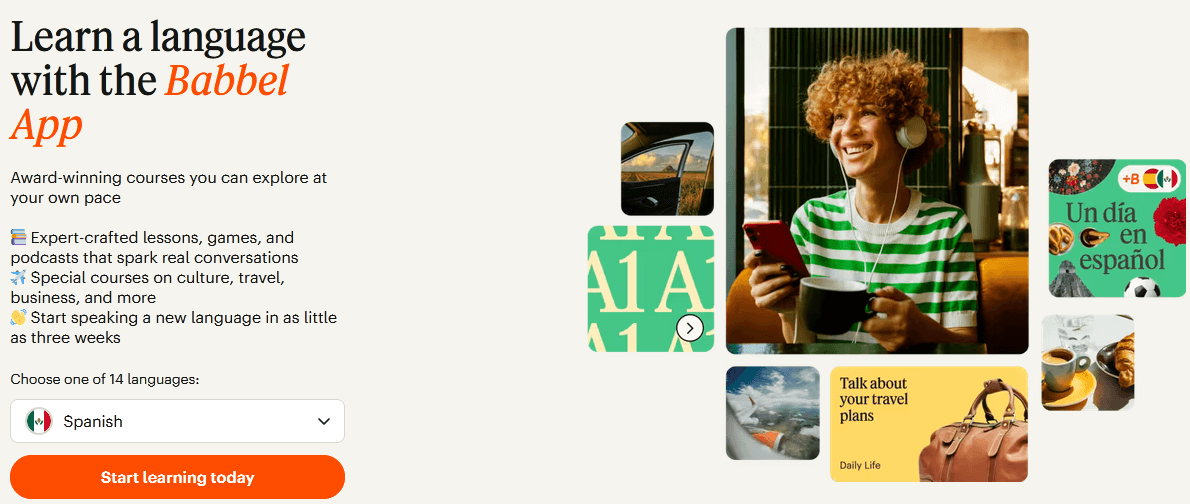
Diverse of languages: Babbel offers a choice of 14 languages to learn, helping you improve your foreign language skills or start from scratch. These popular languages include English, French, Spanish, Italian, Brazilian Portuguese, and Turkish. Courses are designed for various learning goals and skill levels, from beginners to advanced learners.
Accessible to multiple devices: Babble permits learning from different devices you prefer, such as laptops or mobile devices like Androids, for a better and easier way of learning anytime, anywhere, and even offline.
Subscription Bundles: Babbel is a subscription-based service with monthly and yearly plans. The subscription gives you access to all the languages in Babbel courses and includes online classes with teachers. The premium version unlocks all courses and allows learners to engage fully with the app’s content.
Celebration of achievement with Certification: This app appreciates achievement reaching a new level in language learning. Anytime a level is completed, an official Babbel certificate is given as proof of language skills.
Babbel is designed to get you speaking quickly by making learning fun, interesting, and relevant to your needs. Speech recognition is considered a key to learning a new language effectively.
The strength of Babbel
Babbel has gained popularity among language learners due to his unique approach to teaching and its range of practical features. Some of his strengths are:
Time-independent and location: One of the biggest strengths of Babbel’s online language learning courses and applications is that you can study a language wherever and whenever you want. All you need is a device connected to the internet.
Live classes: Babbel offers live classes for those who prefer to learn by getting lessons from certified language teachers or native speakers. Babbel lessons can be taken alongside other students at any level, whether to join the advanced class, start with beginner courses or just some practice sessions.
14 Different languages: Babbel offers language courses in Spanish, French, Italian, German, Russian, Portuguese, Dutch, Swedish, Polish, Norwegian, Indonesian, and Danish. Its language learning app covers the major European languages.
Variety of plans: Babbel’s strength is its ability to offer flexibility and affordability for different users with different needs. It allows learners to choose between monthly, quarterly, or yearly plans, making it accessible for various budgets and learning timelines. It offers a free plan, allowing users to explore the app before committing financially.
The Limitation of Babbel
While Babbel has a lot of strength factors, there are also some limitations that users may encounter:
Lack of Asian languages: It is disappointing that Babbel does not offer many Asian languages, even after signing up for the first time to get unlimited access to all languages. It leans heavily towards European languages, which might not meet the needs of learners interested in these regions.
Lack of real-time instruction: Unlike some competitors, Babbel does not offer real-time instruction from a language teacher. Though it has digital tools that can mimic some of the affordances of having an actual instructor, these tools are not as effective or efficient as a real instructor.
High Initial Cost: The upfront cost of Babbel Lifetime can be relatively high compared to monthly subscriptions.
Competition: Many alternative language learning apps, like Duolingo and Rosetta Stone, offer lower lifetime subscription prices and access to more languages, making them a competitive choice.
Plus vs. Free Version
Babbel Plus: The paid version offers full course access, personalized learning features, and flexibility, significantly enhancing the learning experience. Babbel Plus is worth the investment for serious language learners, providing more tools, structure, and long-term support than the limited free version. On the other hand, Babbel Plus provides a more immersive and structured experience that allows learners to progress more effectively. The subscription plans are reasonably priced, especially for those committed to long-term language learning.
Babbel free version: The Babbel free version is useful for understanding Babbel’s interface and methodology; it needs to offer more depth and continuity for serious learners.
The free Babbel version gives users a glimpse into the platform. However, the Babbel Plus subscription is necessary to unlock its true potential. The paid version offers full course access, personalized learning features, and flexibility, significantly enhancing the learning experience. Babbel Plus is worth the investment for serious language learners, providing more tools, structure, and long-term support than the limited free version.
Tips for Maximizing Babbel
Below are tips that refer to plans or best practices that learners can use to get the most out of their experience with the Babbel language learning app. Which are:
Application: Use new vocabulary and phrases in real-life situations to reinforce learning.
Constant practices: Plan constant study sessions to build and reinforce your language skills over time.
Community Engagement: Connect with other learners of the same goals to practice speaking and share tips.
Setting the Goals
Babbel allows individuals to define their goals, i.e., what they want to achieve, such as conversational fluency and travel vocabulary, to fit their learning experience.
Comparison with Other Apps
The main difference between Babbel and another learning app like Duolingo is that it focuses on a more robust and traditional form of teaching a foreign language through comprehensive lessons; Babbel uses a more diverse set of drills, emphasizing visuals while employing more game-like features.
Other learning apps like Rosetta Stone emphasize immersive learning with no translations. Rosetta Stone is much simpler. It’s designed for the simplest goals: tourist level of the language. The lessons are static, and you know precisely what you’ll get. Babbel, on the other hand, is more responsive to answers. It keeps bringing things up and up until you gets it.
Similar language learning apps like LanguaTalk, Babbel, Duolingo, and Rosetta Stone, offer different learning styles regarding content, teaching methodology, and pricing.
Babbel is ideal for learners who prefer a structured, in-depth method focused on grammar and real-life conversation. Its spaced repetition system (SRS) ensures long-term retention and offline access, which adds flexibility, making it great for those aiming for fluency.
Duolingo’s gamified system provides a fun, casual way to learn, perfect for beginners. It focuses on over 30 languages, basic vocabulary, and bite-sized lessons but needs deep grammar instruction.
Rosetta Stone delivers a fully immersive experience, using images, audio, and text in the target language without translations. Its speech recognition helps improve pronunciation, though its gradual, intuitive pace may not suit everyone. Babbel is best for structured learning, Duolingo for a fun start, and Rosetta Stone for those seeking immersion.
In short, Babbel is for structured learners, Duolingo is for beginners wanting fun, and Rosetta Stone is for immersive, intuitive learning.
Conclusion
In conclusion, Babbel is best suited for learners seeking a structured, thorough approach emphasizing grammar and real-world application. At the same time, Duolingo’s gamified system is ideal for beginners looking for a fun introduction to a new language. Rosetta Stone is a good option for immersive, context-based learning. Ultimately, Babbel stands out for its ability to combine structured lessons with practical conversation skills, making it a strong contender for learners who want to gain real-life language fluency.
Babbel provides a structured learning experience and engaging exercises; introducing additional features, challenges, or milestones to sustain motivation throughout the learning journey could be beneficial.
Furthermore, Babbel is the way to go. It teaches the basics of grammar, including special vowels and consonants and their correct pronunciations, before moving on to conversational scenarios in common settings.it is worth noting that the content within Babbel may not be equally extensive for all the languages offered. Babbel learning app covers a wide selection of languages; some languages may have a more limited range of lessons or advanced materials than others. Expanding the content to ensure consistent depth and coverage across all languages would enhance the overall user experience.