In today’s digital age, language learning has become more accessible than ever, thanks to technological advancements. Two of the most popular AI language learning apps on the market are Duolingo and Babbel. Both platforms offer a range of features designed to help users learn new languages, but they cater to different needs and preferences. This article will delve into a comprehensive comparison of Duolingo and Babbel, analyzing user reviews, overall effectiveness, and how well each app meets the needs of beginner language learners. It will explore some critical insights regarding Duolingo’s “free” model and Babbel’s approach to marketing and content.
User Reviews: A Balanced View
Indeed, real users’ feedback is helpful when determining the pros and cons of apps for language learning. As it has been indicated, Duolingo and Babbel have attracted general public attention and received various comments from users from different parts of the world.

Duolingo
My favorite is Duolingo, famous for its gaming approach to teaching languages. Users like the app’s interface. It is stimulating and includes various features that connect the game, such as streaks, points, and URLs to the leaderboards. Due to its design, using the app feels like playing, which could encourage learners at their initial stages of learning.
Pros
- Gamification: Some enjoy the game components as language learning gets enjoyable and not monotonous.
- Free Access: However, Duolingo has a trove of content available for free, making it a good tool for users willing to try out language but not ready to spend cash on it.
- Variety of Languages: It covers many languages, including those that are not very popular for learning, enhancing its use.
Cons
- Surface-Level Learning: Some users have said that with Duolingo, a tree is complete in two ways; one needs to understand grammar or all the details of language fully.
- Repetitive Exercises: Some customers have complained that exercises may seem monotonous after a while and cause them to lose interest.
- Limited Speaking Practice: Yes, Duolingo provides speaking practice, but many participants state that more is needed to improve students’ speaking skills.
Babbel
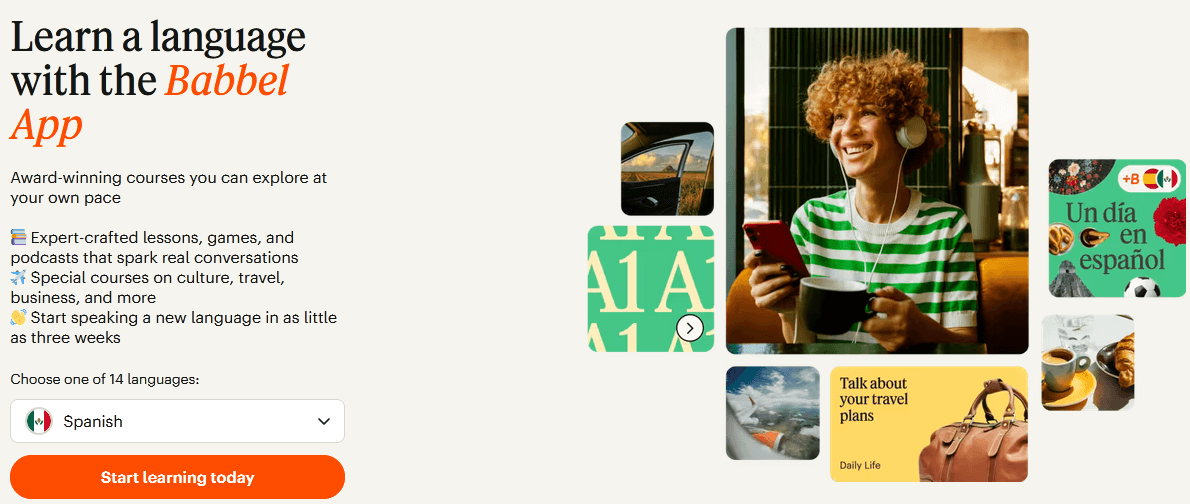
Babbel‘s learning process is relatively structured, and its main priorities are practical language use and grammar. Customer satisfaction is evident from the applause most users have showered Babbel with due to its good arrangement of lessons and explanatory lessons.
Pros
- Structured Learning Path: Babbel’s lessons are equally arranged progressively, meaning that they are different from Reddit’s approach of randomly arranged lessons that one has to guess and explore.
- Grammar Focus: The app also focuses heavily on grammar, which is favorable to users who want to learn more than just the vocabularies.
- Practical Conversations: Babbel’s lessons are designed to reflect realistic scenarios and thus prepare the users with common phrases and words.
Cons
- Subscription Cost: While Duolingo has no fees and is free to use, Babbel, however, is partly free, with a paid subscription feature being an essence.
- Limited Free Content: Babbel’s primary disadvantage is that it offers restricted data for users and does not allow a trial, so it is difficult for users to determine the app’s efficiency if they have to spend money on it.
- Less Game-like: Babbel still covers all these principles, even though it still needs gamification, which appeals to some users in Duolingo.
- Overall Effectiveness: A Comparative Analysis of Customer Experience Portrait based on Demographic and Behavioral Data of Customers.
In order to conclude how effective both Duolingo and Babbel are, one has to consider to what extent each app assists in achieving the ultimate goal.
The Hidden Costs of Duolingo vs. Babbel: Unveiling the True Price of Language Learning Apps
When comparing AI language learning apps, the distinction between Duolingo and Babbel often boils down to cost: one claims to be “free,” while the other requires a subscription. Unsurprisingly, Many opt for Duolingo’s seemingly no-cost approach, especially when Babbel’s subscription fees might appear less appealing. But is Duolingo genuinely free, or is there more to the story?
The Price of “Free”: Duolingo’s Hidden Costs
In particular, Duolingo positions itself as an application that does not require any payment from the users, even though it is optional. However, this model has the loophole of hidden costs. Although you may not be paying in dollars, you’re giving your data in another form. Every exercise you finish on Duolingo is not only practice but a goldmine of information. The answers you provide are used for the translation tasks and sold to large companies. This data is helpful for companies, especially for those who want to improve their product or service. Duolingo’s business model, based on crowd translation, is very strategic.
In addition to Duolingo, the founder, Luis von Ahn, is best known for developing CAPTCHA, which utilizes users’ input for both identification and data collection. Similarly, Duolingo uses a translation feature where users develop translations to help the company make its revenues. Thus, although many people might not mind these tricks as they get free language lessons in the spirit of receiving ‘Work for the English’ in return, they become involved in translation activities, and ethical issues are worthy of discussion. It’s reminiscent of what you see with Google and Facebook — companies that use people’s information for their gain without being completely transparent about it.
The Infantilization of UI: Duolingo’s Design Philosophy
I found Duolingo’s user interface (UI) to be unique. The app’s design is based on the childhood realm, as it has bright illustrations, cartoon-like shapes, and favorable colors to keep children’s attention. To an ever-growing extent, this process of ‘infantilization’ is being applied in practice and, in particular, in developing applications for education. However, the design of Duolingo could be more mature, attracting young users or those searching for more entertaining ways of learning. Still, it brings concern about the efficiency of such an approach for adults.
By the way, Babbel opts for a rather business-like and sophomoric interface look, which aligns with the platform’s promise of serious language acquisition. This difference in design philosophy underlines a larger discussion on the use of gamified, low-fidelity interfaces in learning applications designed for grown-ups.
Babbel: A Marketing Success but Mediocre in Content
Nevertheless, websites like Babbel, which are quite popular and successfully advertised, are famous for their mediocre quality. Babbel successfully advertised the brand on Google, social media, and even TV, although the platform itself may not be very exciting. Most of Babbel’s categories for language learning are superficial, and the fact that Babbel has been advertising so aggressively means that it has been attracting many learners, but this does not say much about the content quality.
The app has become famous not by featuring unique and educative content but by extensive advertisement. On the same note as Michel Thomas’s language learning courses, which did not gain popularity based on their effectiveness, Babbel gained popularity based on its advertising campaign.
Comparing Duolingo and Babbel: What’s the Verdict?
Like anything in life, both tools provide certain benefits and limitations in language learning. Some strengths of Duolingo include the presence of many languages and the game-based approach, while the weaknesses are primarily related to the company’s data mining practices. Babbel is not a free application, but it is developed with levity by language tutors, which gives it a more organized and professional approach to teaching languages.
If one has to opt for one, Babbel might be the better one. It offers, therefore, structured lessons that have likely been professionally developed and taught, and I don’t have to worry about the ethical string that comes with data use. Still, Duolingo is also a worthy contender for people needing colorful interfaces and games every time they learn languages, despite its hidden costs.
As with any software, there are many options in the context of language learning applications. What will be important here is matching it with each user’s stated preferences and ethical inclinations. Do you have any ideas about the pros and cons of Duolingo vs. Babbel?
Language Testing
In Duolingo, free placement tests are available for every language when you start the course. If the course is too easy, you can use the “Jump Here” option to test into more advanced levels. These tests assess the language skills covered in the lessons.
In Babbel, free placement tests are available for Spanish, French, German, Italian, and Portuguese. However, these tests consist of questions requiring you to self-assess your abilities, with questions in English. Therefore, they serve as a rough guide rather than a formal language assessment.
App User Experience
Duolingo
- Apple iTunes:
4.7/5 stars with 87.5K reviews
- Google Play:
4.4/5 with 15M reviews
Babbel
- Apple iTunes:
4.6/5 with 995 reviews
- Google Play:
4.6/5 with 877K reviews
I am not a fan of the tricks used in-game mechanics for the sake of game mechanics. Duolingo is trying pretty hard to be a severe language-learning application while keeping it entertaining with the ridiculous strings they use. Of course – seeing a sentence like ‘The fox drinks milk with the bear,’ I sometimes want to yawn, but it does instruct some possible grammatical patterns and valuable words and complies with CEFR. In my view of learning as a hobby and mainly focused on conversational uses, it is an excellent way to be introduced to a new language.
To sum up, there is no clear winner in the Babbel vs. Duolingo battle as everyone has his/her needs and purposes for learning. Both apps have been finely tested, and many users of these apps have achieved impressive results in mastering the language.
Thus, are you ready to start your language-learning journey? While Duolingo is a fun app that helps users engage through its gamification, Babbel is an adaptive application that effectively teaches new words by guiding you through the process. Either way, both apps are tools that work miracles when it comes to eliminating barriers to speaking fluently!