Whenever you want to learn a new language, you have a choice of several apps and sites all of which promise to teach you a language. One app that has stood the test of time is Rosetta Stone.
Admittedly, this app is older than most including Duolingo. That also says this app has all the experience of teaching learners various new languages. The app has undergone several updates and evolutions to become a serious contender for apps to use.
In this article, we will explore how this app can help you achieve your language-learning dreams. We will tell you what you get, and what you miss out on, by using the Rosetta Stone app. But first, what languages does Rosetta Stone offer you?
Languages Covered by Rosetta Stone
Being that Rosetta Stone has been in the language learning industry for a long time, they have more languages to offer.
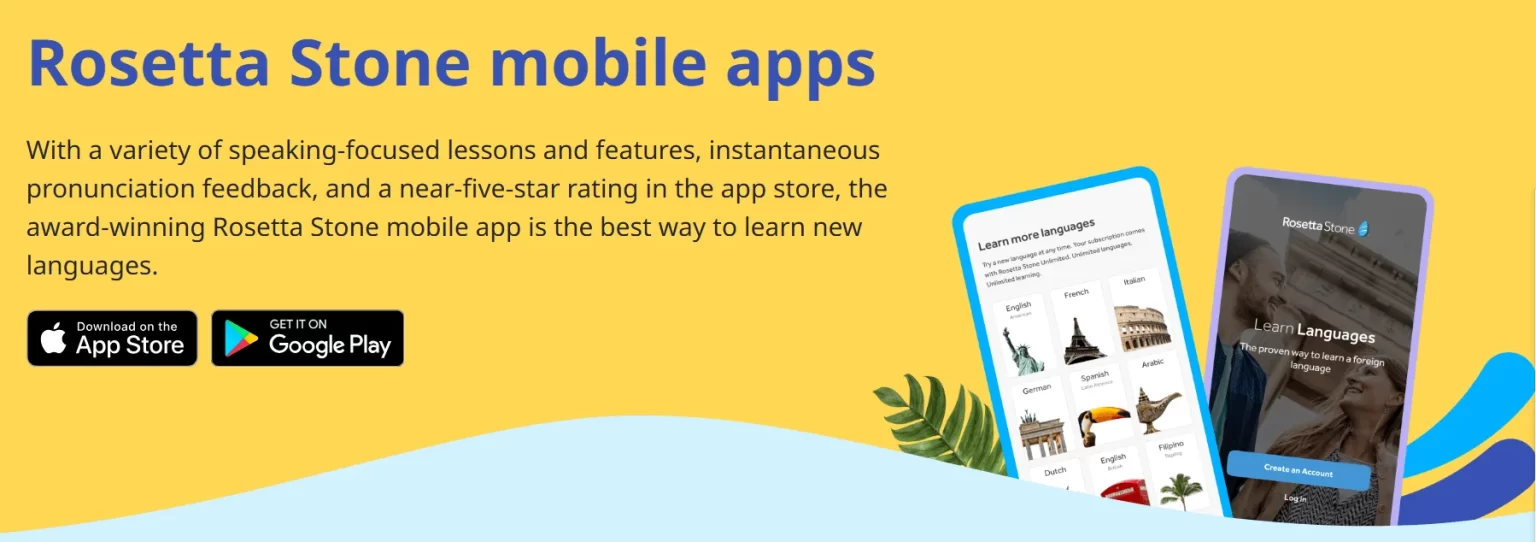
Rosetta currently offers 25 languages at various levels. Rosetta Stone has languages offered in level 5, level 3, and some endangered languages. We will discuss these levels in a later section of this article. For now, you get access to these languages offered by Rosetta Stone:
Level 5 Languages
- American English
- British English
- Chinese Mandarin
- French
- Spanish
- German
- Italian
- Russian
- Spanish (Latin America)
- Spanish (Spain)
Level 3 Languages
- Modern Arabic
- Dutch
- Persian (Farsi)
- Modern Greek
- Hebrew
- Hindi
- Irish
- Japanese
- Korean Latin
- Polish
- Brazilian Portuguese
- Swedish
- Filipino Tagalog
- Turkish
- Vietnamese
Endangered languages
- Kanien’kéha (Mohawk)
- Sitimaxa (Chitimacha)
- Iñupiaq (Coastal) and Iñupiaq (Kobuk/Selawik)
- Iñupiaq (North Slope)
- Diné Bizaad (Navajo)
- Inuktitut
- Objiwe
Now that we are all caught up on the languages you can learn with Rosetta Stone, we can explore how Rosetta Stone.
The Rosetta Stone Method: How Does It Work?
Rosetta Stone has structured every course into levels, up to 5. Although some are at level 3. A 5- level course has 20 units, and each unit has 4 chapters. Each chapter has modules on pronunciation, listening, reading, and speaking. Writing modules are optional to the learners. Each chapter ends with a milestone, which is some sort of conversation simulation.
Each module is composed of about 5 – 30-chapter exercises. Each exercise page has 2-8 boxes with a word or phrase with audio, text, and visual exercises. You may expect the following types of exercises:
- Fill in the gap
- Repeating exercise
- Multiple choice
- Optional writing exercises
The vocabulary and grammar you learn will be built upon the last module you learned. By completing a 5-level course, you should be at least at level A1- A2. You should not expect that the grammar will follow a textbook pattern, nor will you be learning the alphabet. If your target language has a different alphabet, we recommend learning that before you take a course.
Rosetta Stone prides itself on its immersion teaching practices. This means you don’t get immediate translations. In this way, they emulate how we learn our first languages. You are exposed to an image describing the item, word, or phrase. You will not be learning by memorization or translations.
But in the new version, you can tap on a tap and hold to get a translation.
Key Features of Rosetta Stone
Rosetta is a language app that has been teaching people language for decades. These features are what make it stand out from the other apps.
- Immersion teaching – unlike many other apps that will use translation to teach you, you will learn language by being fully immersed in your target language from the get-go on Rosetta Stone.
- Stories – This is a novel feature. Stories help you put your learning into context. These stories are written and narrated by native speakers to help you practice the language. Plus, they are fun.
- Phrasebook – Phrasebooks help you practice your speaking in regular, everyday activities like dining out, taking a taxi, or health and safety.
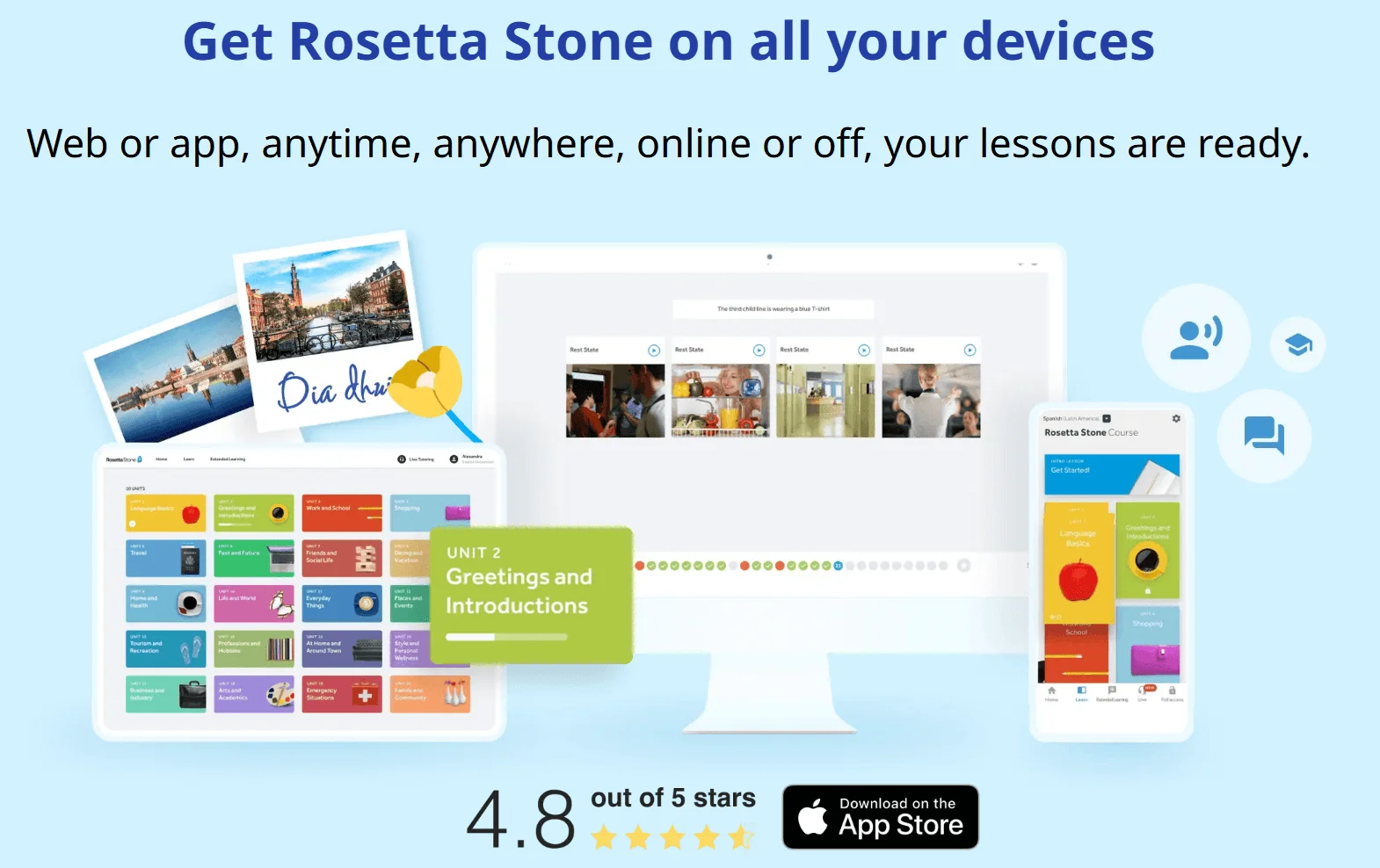
- Audio companion and downloadable lessons – Rosetta Stone offers you audio help that will allow you to download lessons that align with Rosetta Stone’s lessons. Practice your words, phrases, and pronunciation even offline.
- Live lessons – with a Rosetta Stone tutor, you get to have conversations with native speakers to practice your speaking.
- Tutoring – An important aspect of learning a language is to speak with other people. With tutoring, you can interact with native speakers in either small groups or individually.
These are by far the unique features you get from Rosetta Stone. Now, let’s proceed to the Strengths of using Rosetta Stone.
The Strengths of Rosetta Stone
Every language-learning app has its advantages. And Rosetta Stone is not to be left behind. Let’s see what those are:
- Rosetta Stone is constant, predictable, and reliable. When you start learning, you can expect the lessons to look the same regardless of the language you are taking.
- The interface is simple. When you sign in, you are asked to define your level of learning, that is beginner, intermediate, or advanced.
- Rosetta Stone has addressed the lack of cultural context by adding additional material. You will find videos and stories.
Limitations of Rosetta Stone
And like many other apps, Rosetta Stone still has a few limitations to using it.
- You do not get a tutor who steps in to correct and teach further. You will get pre-recorded videos. Tutoring lessons are purchased separately.
- Rosetta Stone is a little basic. You won’t necessarily take you to fluent. You might need additional materials or resources for that.
With these, you know what you get with Rosetta Stone and what you don’t get. Rosetta stone will ultimately help you get the basics down and from there, you can progress further.
Does Rosetta Stone Have a Free Version?
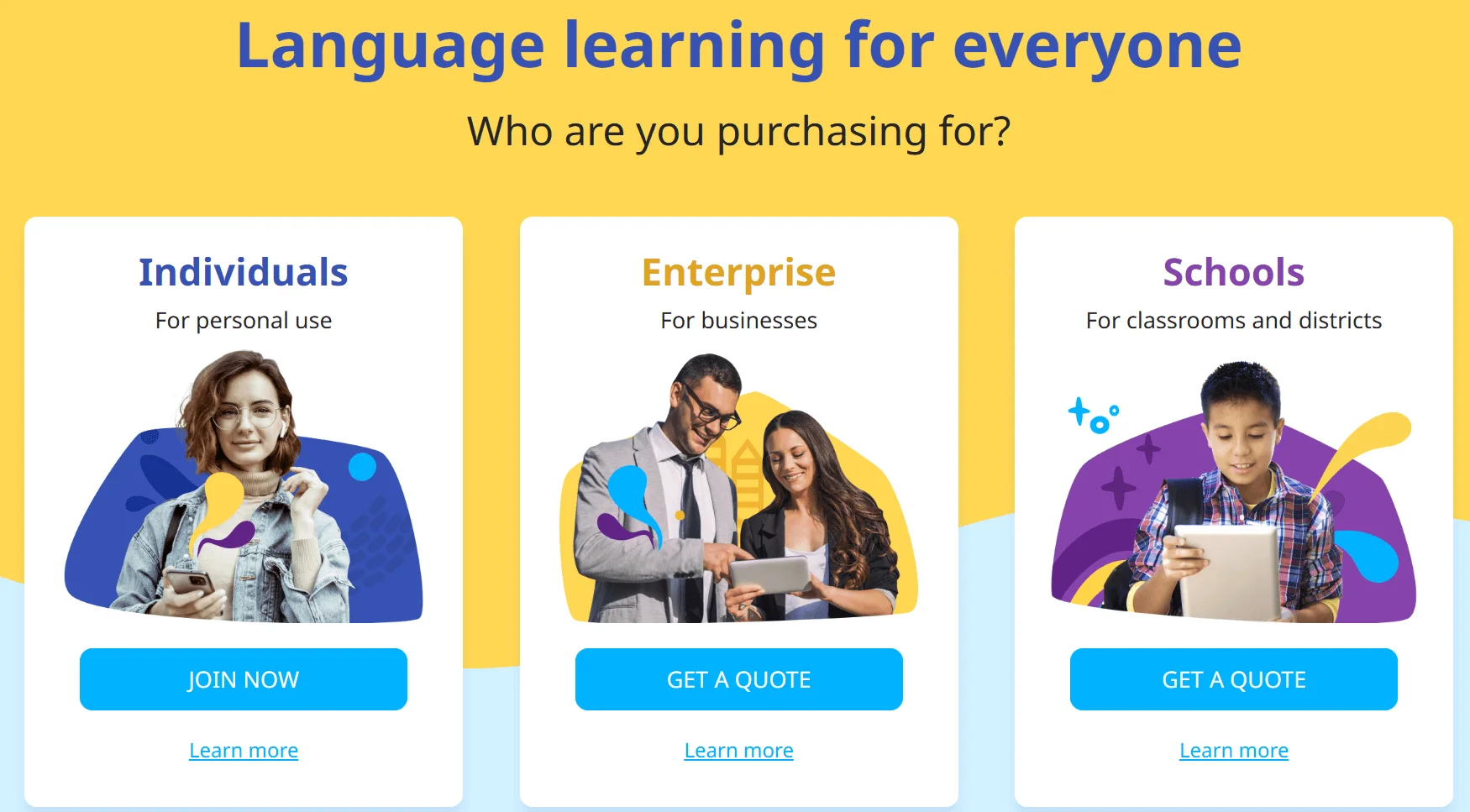
Let’s start by mentioning that Rosetta Stone does not have a free version. When you sign up, you will have to pick a payment plan. These are as follows:
- 3- month package – $ 15.99 per month (Billed $47.97 one-time payment)
- 12-month package – $ 10.50 per month (Billed $ 126 for a one-time payment)
- Lifetime package – $ 199 one-time payment
The first package will make you very tired as you will need to cram all your lessons in this limited time. Unless you want to just learn the basic words, and then let off.
The 12-month package is a little better at cost saving and giving you time to fully learn all the content on Rosetta Stone without burning yourself out. However, these two packages are only applicable to one language, whichever you choose.
The lifetime package makes more sense cost-wise. And you get access to all the languages. It is great for people who intend to learn more than one language.
Now that you have this information, you can make the best decision based on your needs and budget.
Tips For Maximizing Rosetta Stone
Any language learning app will promise fluency. However, you are responsible for your progress. Use these tips to get the most out of Rosetta Stone:
- Rosetta Stone offers downloadable lessons. Use them to get a little learning in your free times
- Have a regular schedule of learning. Preferably daily.
- Keep note of words you need to learn better. You can research them later or practice using them to get better.
Comparing Rosetta Stone with Other Apps
Duolingo – Unlike Rosetta Stone, it is free. However, it is a flashcard app, so this is not a big deal. You can learn a lot of vocabulary with the app.
Rocket languages – This app features a conversational approach to teaching language. And uses English to explain grammar points. All price packages are for one language with the lifetime package costing $ 89.95 which is usually the sale price.
Innovative languages – This app offers several free resources for your chosen language. They also have a long list of packages you can pay for depending on your specific needs. The premium package for one year and one language comes to about $ 180 which also comes with added features such as a vocab bank, quizzes, and audio dictionaries.
Wrapping Up
So, we have, all the points you might use to consider if Rosetta Stone is the right fit for you. We promised information, and we have given it. We have highlighted the key features, strengths, weaknesses, pricing, and comparison with other apps in the industry. All these works show you what the deal is with Rosetta Stone.
Learning a language is a journey. And Rosetta Stone works to take you from a complete novice to holding a basic conversation or ordering a taxi in Spain. The app offers flexible subscription plans created to match individual needs. It also features beautiful pictures and audio to help you familiarise yourself with your target language. It also offers a wide range of languages for you to pick and learn.
So, you can consider using Rosetta Stone if you are a very beginner, or you are using it in addition to your other learning material and combined towards mastery of your target language. Based on your needs, Rosetta Stone may be a good choice.