First published: August 2025 · Last updated: May 2026
We spent 30 days testing 5 AI English learning apps — with both a native speaker and a learner. Here’s what actually worked, what didn’t, and which one we’d recommend depending on your goal.
In 2026, AI-powered English learning apps have become far more advanced, but choosing the right one still depends on whether you want to improve speaking, pronunciation, fluency, or exam performance.
Quick Answer:
There is no single best AI app to learn English in 2026. Apps like ELSA Speak are best for pronunciation, Fluently and TalkPal for conversation, LanguaTalk for structure, and Jolii AI for video-based, real-world learning. Which one is best, depends on your goals and learning style.
If you’re trying to move from understanding English to actually speaking it, see our guide on why learners understand more than they can speak.
Best AI Apps to Learn English: Updated 2026 Guide to the Top Tools for Speaking, Pronunciation, Grammar & Exam Prep
Speaking and pronunciation are the initial factors that help you align your English language learning goals. When you search for the best AI apps that can help you learn English faster, you will come across many tools that can assist you in using the correct pronunciation and aid in conversations.
Grammar and writing fall later than speaking and English pronunciation. Whatever your needs are, the following guide can help you well in improving your spoken and grammatical English.
Why AI Is Changing English Learning
The core problem with traditional English learning has always been feedback — specifically, the lack of it. You read a textbook, complete an exercise, or watch a video, and nothing tells you whether you’re producing the language correctly. Mistakes go unnoticed and become habits.
AI changes that by making feedback immediate and specific. When you speak into an app like ELSA Speak or Jolii, you don’t wait for a teacher to review your pronunciation at the next session. You hear what went wrong and why, at the moment it happened — which is when correction is most likely to stick.
Beyond feedback, AI makes personalisation practical. A human tutor adapts to your level over weeks of sessions. AI adapts within minutes — identifying which sounds you consistently mispronounce, which grammar patterns trip you up, and adjusting the difficulty of practice material accordingly.
The result is that the barrier between passive study and active practice gets lower. You’re not just consuming English — you’re producing it, getting corrected, and producing it again. That cycle, repeated daily, is what builds fluency.
How AI English Learning Apps Work
Understanding what’s happening under the hood helps you use these tools more effectively.
Speech recognition is what allows apps like ELSA Speak and Jolii to hear your pronunciation and identify specific errors — not just whether you said the right word, but whether your vowel sounds, consonant clusters, and sentence stress match native-speaker patterns. The quality of this technology varies significantly between apps, which is why two apps can both claim “pronunciation feedback” but deliver very different results.
Personalisation is driven by the same large language models that power tools like ChatGPT. This is what allows apps to generate contextually appropriate responses in conversation practice, adapt difficulty based on your errors, and remember what you’ve struggled with across sessions.
Spaced repetition — used by Anki and Memrise — is a scheduling algorithm that resurfaces vocabulary at the optimal moment before you forget it, compressing the time needed to move words from short-term to long-term memory.
The most effective apps combine all three: speech recognition for output correction, LLM-driven conversation for realistic practice, and spaced repetition for vocabulary retention. No single app currently does all three equally well — which is why the skill-based recommendations below matter.
How We Evaluated Apps (methodology)
As of 2026, most AI English apps use large language models and speech recognition, but their effectiveness still varies widely depending on feedback quality and how actively learners are encouraged to speak.
We tested the apps individually to evaluate them. For each app, we ensured we had both an English learner and a native-English speaker trying them. This way, we got feedback from both sides and were able to judge the Apps better. Having a native English speaker test them served as a ‘control’ to judge the accuracy of the corrections and how realistic the overall conversational experience was.
We evaluate each AI English learning app based on:
- Real-time correction
- Multi-modal support (for both audio and text)
- Personalization/adaptive paths
- Pricing
- Accuracy of feedback
The Best AI Apps To Learn English
TalkPal: : Best for Casual Conversational Practice with AI
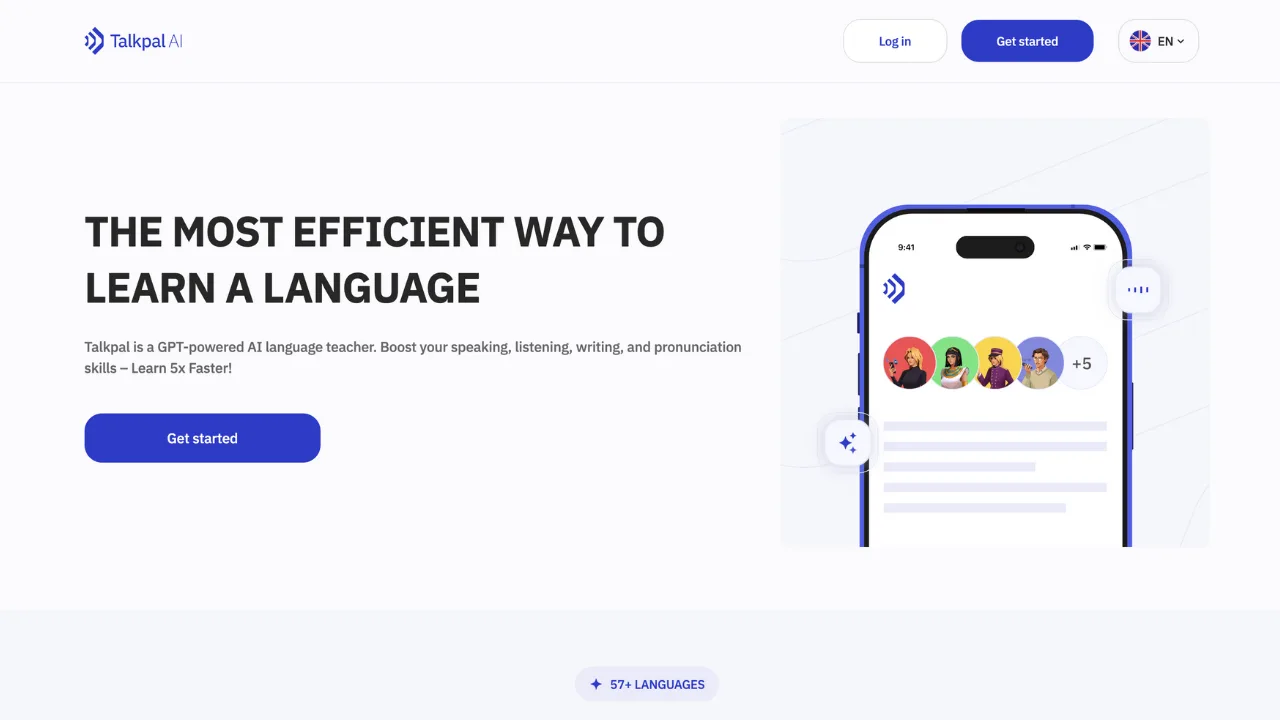
Talkpal AI presents itself as the most efficient way to learn a language, but is it really? It surely has entertaining conversations on different topics.
Best for: Casual learners looking for flexible conversation practice.
Top features:
- GPT-powered chat
- Role-play scenarios and different characters
- “Call Mode” for audio-only interactions
Free tier / Pricing: Free trial available. 10 minutes daily limit in the free version, which only has basic features. Premium plans at approx. $14/month.
Verdict: A dynamic, affordable app for realistic AI conversation, though pronunciation feedback could be refined.
ELSA SPEAK: AI Pronunciation & Exam Prep Specialist

Elsa Speak is probably the best alternative if you are looking for an app that can help with test preparation, as it includes exam-ready modules.
Best for: Pronunciation and test prep (IELTS, TOEFL, etc.)
Top features:
Free tier / Pricing: Free version with limited content; Pro plan starts ~$19/month, billed for a minimum commitment of 3 months.
Verdict: A powerful AI pronunciation tutor perfect for serious learners, though the robotic sound of their AI tutor is worth noting.
Fluently: Best AI App for Natural, Chat-Style English Practice with Feedback

Fluently is a way to practice English in a natural way, and receive feedback on different points: pronunciation, grammar, vocabulary, and fluency.
Best for: Learners who want natural, chat-style practice with detailed corrections
Top features:
- AI tutor chats with real-time feedback
- Conversation history to review mistakes
- Roleplay scenarios
Free tier / Pricing: No free trial after initial assessment $9.99/week or $32/month.
One-line verdict: A strong choice for frequent conversational practice, but pricey compared to alternatives.
LanguaTalk: Best AI App for Structured Conversations with Human Tutor Support

LanguaTalk claims that its AI tutor sounds human. But are they really? We tried them and they are actually pretty good, but human tutors sound different.
Best for: Structured conversational learning and adult learners seeking human support
Top features:
- Empathic AI chat with follow-up prompts
- Call mode for hands-free chats
- Human tutor options for a hybrid approach
Free tier / Pricing: Trial periods available; full subscriptions are around $24/month for limited use of 30 minutes/day or $37/month for unlimited.
Verdict: Feels like a real conversation partner, great for confidence-building, but pricier than other alternatives.
Jolii AI: Best AI App for Learning English with YouTube & Netflix Videos
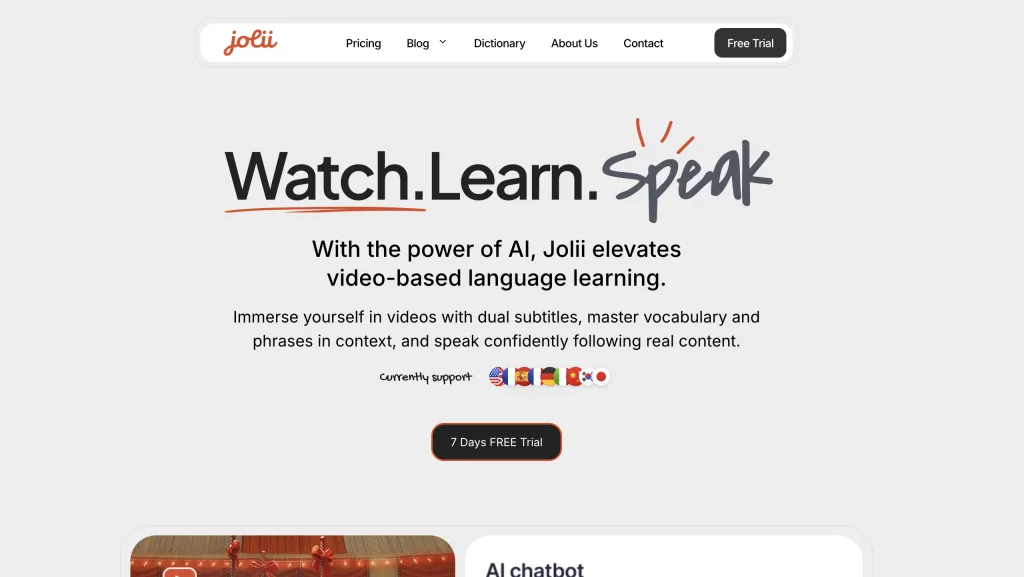
Jolii differs from other best AI apps to learn English as it offers a different approach to language learning. With Jolii, you can convert any YouTube video into a language lesson and actively practice with it. As of April 2026, Jolii AI has also introduced the ability to watch Netflix directly within the iOS app, making it even easier to learn English through your favorite shows and movies.
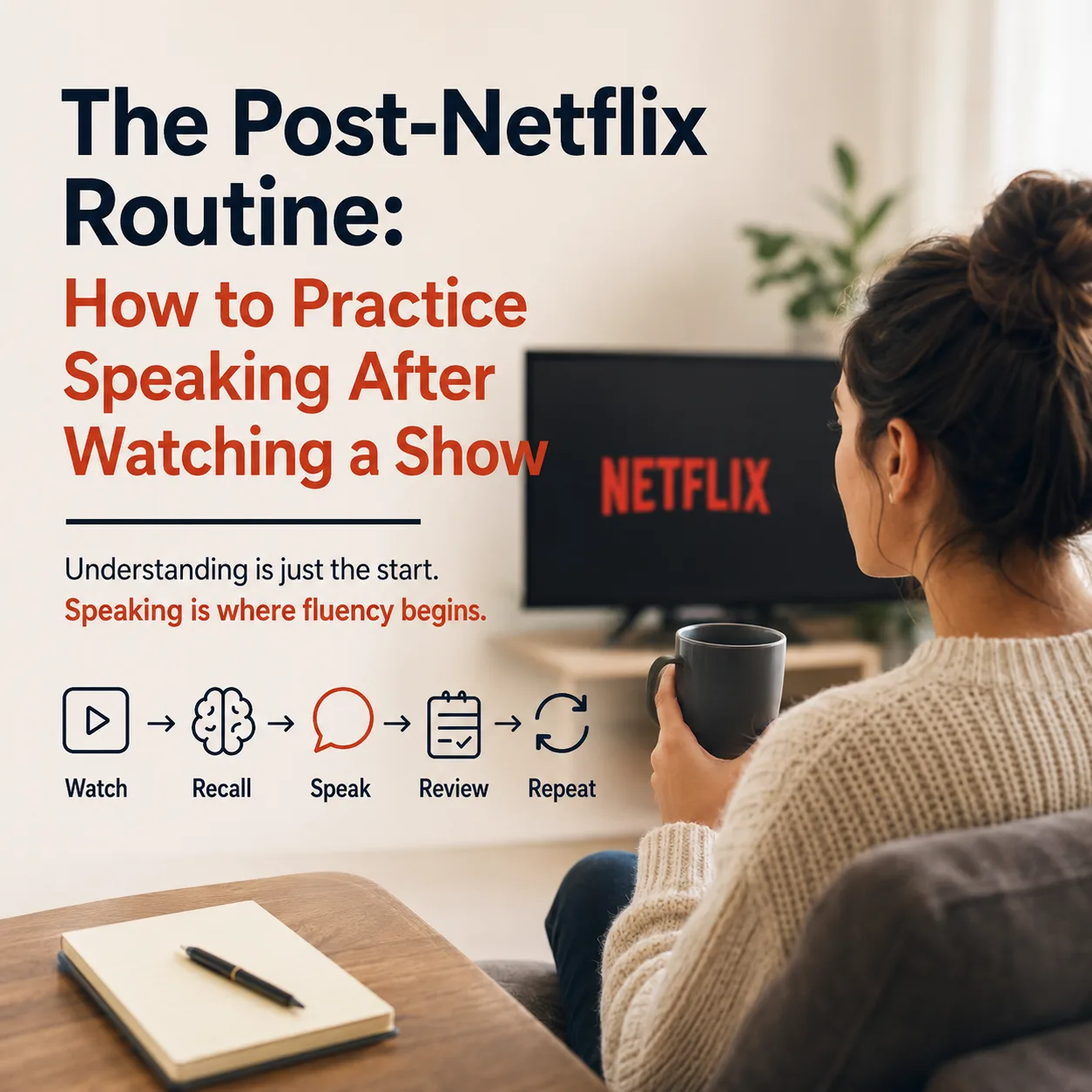
Many learners already watch Netflix or YouTube in English but don’t actually improve their speaking. This usually happens because passive watching doesn’t turn input into active use. Jolii helps you turn real videos into speaking and vocabulary practice instead of background entertainment.
Best for: Learners who prefer real media (YouTube/Netflix) combined with structured study
Top features:
- AI video matching: Finds authentic YouTube/Netflix clips suited to your level, engaging but not overwhelming
- AI tutor for conversation practice: Provides instant feedback on your pronunciation.
- Interactive dual subtitles: Tap any word for instant translation and meaning
- Active reinforcement: Practice with transcripts, quizzes, and follow-up exercises
Free tier / Pricing: Free trial available. Subscription for$9.99/month, or as low as $7.40/month with annual subscription.
Verdict: A video-first, fun way to learn English, ideal for learners who find traditional drills boring and want more than just conversation.
Language Learning Apps – Comparison Table
| App | Best for | Speech Recognition | Real-time Feedback | Writing/Grammar | Exam Prep | Price Tier |
| TalkPal | Casual conversation practice | Yes | Limited | No | No | Free / $14 per month |
| ELSA Speak | Pronunciation, test prep (IELTS, TOEFL) | Yes | Yes | Limited | Yes | Free / $19 per month |
| Fluently | Natural conversations with detailed corrections | Yes | Yes | Yes | No | $9.99/week or $32 per month |
| LanguaTalk | Structured lessons, human support | Limited | Yes | Yes | No | Trial / $24–37 per month |
| Jolii AI | Video-based learning, real practice, personalised vocab & grammar | Yes — via AI tutor | Yes | Yes | No | Free trial / $9.99 per month |
Note: Speech recognition quality varies by feature within each app. Jolii’s pronunciation feedback is delivered through its AI tutor conversation feature rather than standalone speech analysis.
Our Pick: For most learners who want to improve real-world speaking rather than pass a specific exam, Jolii AI offered the most practical and engaging experience in our testing — particularly for intermediate learners who already watch English content and want to turn that habit into active practice. If pronunciation or exam prep is your primary goal, ELSA Speak is the stronger choice.”
Best Apps By Skills
Best AI Apps for English Pronunciation & Accent Training
Top Picks: ELSA Speak, Boldvoice, TalkPal
Why:
ELSA Speak: Gold standard for pronunciation feedback, focusing on identifying and correcting specific sound issues. Good for test prep since all you need is to focus on the listening portion.
Boldvoice: Concentrates on accent reduction specific to those who want American English. Provides specific video exercises.
TalkPal: Offers conversational practice in a wide range of accents, which allows a beginner to be exposed when speaking with different people from different ethnic backgrounds.
If pronunciation and accent are your main blocker, our breakdown of English pronunciation explains how you can improve without sounding fake.
Best AI Apps for English Conversation Practice & Fluency
Top Picks: Fluently, TalkPal, Naitly (formerly SpeakingAI)
Why:
Fluently: Excellent at mimicking conversational styles. Great if you feel there is realism to learning to speak in AI.
Talkpal: It uses real people’s dialogue so it does generate realism as you speak with most people on the planet.
Naitly: Great with providing context of lessons and allowing more human-like learning thanks to adaptive intelligence.
How often should you acutally practice speaking (whether it is with apps, teachers, or native speakers) to see real progress? This is exactly what we explain in our guide on how much speaking practice you actually need to become fluent.
Best AI Apps for English Grammar & Writing Support
Top Picks: Grammarly, Jolii AI, Fluently
Why:
Grammarly: If you need help from AI, this is the platform to use, as it integrates with about any web tool. This is great for copying data from anywhere.
Jolii AI: Provides specific video recommendations suited for personalized learning, and allows you to extract from its learning and give specific instructions.
Fluently: This gives a real-time correction and allows for feedback in a well-conversational manner.
Best AI Apps for Vocabulary & Spaced Repetition
Top Picks: Anki, Memrise
Why:
Anki: A strong open AI to choose from. Great way to create a powerful tool for creating flashcard practices.
Memrise: Great for spaced repetition exercises, and creates video exercises with a combination of native speakers.
Best AI Apps for IELTS & TOEFL Exam Preparation
Top Picks: ELSA Speak, Magoosh
Why:
ELSA Speak: Includes dedicated IELTS and TOEFL modules with targeted pronunciation and vocabulary practice. The real-time feedback on speaking sections is particularly useful for exam candidates who need consistent scoring on spoken English.
Magoosh: A dedicated exam prep platform with structured IELTS and TOEFL courses, practice tests, and video lessons from experienced tutors. Better suited for comprehensive exam preparation than conversational practice.
Best Gamified AI Apps for Learning English Consistently
Top Picks: Duolingo, Babbel
Why:
Duolingo: Great for building consistency thanks to its reminder and pushing you to achieve daily goals.
Babbel: If you love courses crafted from multiple backgrounds, it is great to have the course created by professional instructors.
Pros & Cons: Can AI Replace A Human Tutor?
The rise of AI is changing our world and raising the question: Will it replace human teachers?
We don’t think it is the case, as when it comes to interactive speaking or understanding grammar, and especially cultural understanding, AI just can’t have that “human touch”. We believe that the ultimate goal for language learners will still remain speaking with people and not with robots, so human teachers will probably continue to exist, but their role will be redefined.
AI tutors can be a very helpful tool to enrich your language learning experience, as they provide instant feedback and are available 24/7 for conversation practice. All in all, we recommend a hybrid approach. Combining human tutors and AI tutors might be the potential solution to get the best of both methods. With Apps like LanguaTalk’s you can find them both in just one app.
Pros of AI Tutors
- Availability 24/7
- Instant Feedback
- Cost-Effectiveness
- Methodology in Teaching
Cons of AI Tutors
- Lack of Human Touch
- No Cultural and Contextual Understanding
- Limited Interactive Speaking Practice
How To Choose the Right App for You
Start with your biggest blocker — not your overall goal.
If you can’t be understood when you speak, pronunciation is the blocker. Start with ELSA Speak.
If you understand English well but freeze in conversation, speaking practice is the blocker. Start with TalkPal or Fluently.
If you’re preparing for a specific exam, exam prep is the blocker. Start with ELSA Speak or Magoosh.
If you learn best through content you enjoy rather than drills, video-based learning is your format. Start with Jolii.
Getting faster results: Use one app consistently for at least 30 days before switching — most learners change apps too quickly and never build the habit that produces results. Combine your chosen app with occasional sessions with a human tutor for feedback that AI can’t yet replicate: cultural nuance, emotional register, and the accountability of a real conversation partner.
FAQs
What are the best AI apps to learn English in 2026? It depends on your goal. ELSA Speak leads for pronunciation and exam prep. TalkPal and Fluently are strongest for conversational practice. Jolii is the best option for learners who want to improve through real YouTube and Netflix content rather than scripted drills. Anki and Memrise remain the most effective for vocabulary retention through spaced repetition.
Can AI apps replace human tutors? Not fully — and probably not soon. AI delivers instant feedback, unlimited practice, and consistent availability at a fraction of the cost of a tutor. What it can’t replicate is cultural nuance, emotional intelligence, and the unpredictability of real human conversation. The most effective approach combines both: AI for daily practice volume, a human tutor for periodic feedback on the things AI misses.
Can AI apps help prepare for TOEFL or IELTS? Yes — particularly for the speaking and pronunciation components, where immediate feedback is most valuable. ELSA Speak is the strongest dedicated option. For full exam preparation including reading, writing, and listening sections, Magoosh offers a more comprehensive structured course. Neither replaces full practice tests under timed conditions.
Are there free AI English learning apps worth using? Yes. TalkPal and ELSA Speak both have free tiers that are genuinely useful for getting started — though daily limits apply. Jolii offers a free trial. Anki is entirely free. The free versions are worth trying before committing to a subscription, but most serious learners will hit the limits of free tiers within a few weeks.
How long before I see results from using an AI app? Most learners notice improvement in pronunciation accuracy within two to four weeks of daily practice with an app like ELSA Speak. Conversational fluency takes longer — expect three to six months of consistent daily practice before conversations feel significantly more natural. The key variable is output: learners who speak actively every session improve faster than those who complete exercises passively.
Do app prices change frequently? Yes — pricing for all apps listed was accurate as of April 2026 but may have changed since. Always check the app’s current pricing page before subscribing. Free trials are available for most apps listed and are worth using before committing.
Conclusion: Finding Your Best AI English App in 2026
The best AI apps each do something different. If you need pronunciation help or exam prep, ELSA Speak is a solid choice. For real conversations and fluency, TalkPal and Fluently work well. If you want structure and tutors, LanguaTalk is reliable. If you like learning with videos, Jolii AI is a good fit.
AI won’t replace teachers. But it makes practice faster and feedback instant. The best way forward is to mix both: use AI every day for practice, and meet teachers for real-life guidance. Next step: Try one free trial. See which app feels natural, then stick with it.