Wondering which apps are best for learning Italian in 2025? You’re in the right place. Come along and I will show you the most popular apps for learning Italian in 2025..
But before that, let me ask you a quick question.
Do you know you already speak a little Italian?
Think about it: pizza, spaghetti, mozzarella, zucchini, cappuccino. Recognize those? Of course you do.
Congratulations! You know some Italian! Italian has found its way into daily life around the world, especially through food. And it doesn’t stop there. Words like bravo, opera, maestro, ciao, amore, adagio, arrivederci, and allegro are also internationally recognized.
Even if you’re just getting started with the language, you already know more than you think. That’s part of what makes Italian such an enjoyable language to learn.
Why Learn Italian
Italian may not be as widely studied as English, but its charm is undeniable. Why? Because Italian is the language of beauty, art, music, design, fashion, lifestyle, and delicious food. But there’s something even more special – passion. Italians live with passion, and most people learn Italian out of love for the culture, not obligation. This makes learning the language a true pleasure.
In this article, we will guide you through your choice of the best app for learning Italian in 2025, keeping in mind that learning Italian – and any language – must be an enjoyable experience. Andiamo!
Why learn Italian with an App
The quicker you get exposed to native conversations, real-life scenarios, and cultural nuances, the faster you’ll learn. Apps offer interactive and engaging lessons that gradually build your skills, making the transition to native-level content smoother.
Read more: The Best AI-Language Learning Apps for Children.
Pros and Cons of Learning Italian with an App
Nothing is perfect in this imperfect world; the same goes for language learning methods. We need to figure out what works best for us in learning a language.
Language learning apps are a good invention for learning Italian, especially in the year 2025, when AI is at its peak.
Still, you have to face some real troubles. If you feel the cons are greater than the pros of learning Italian with the app, then you can use other methods.
Read more: Learn Italian With ‘Odio il Natale’ (I Hate Christmas) Netflix Show.
Here is a comparison of the pros and cons of learning a language for instance Italian with an app.
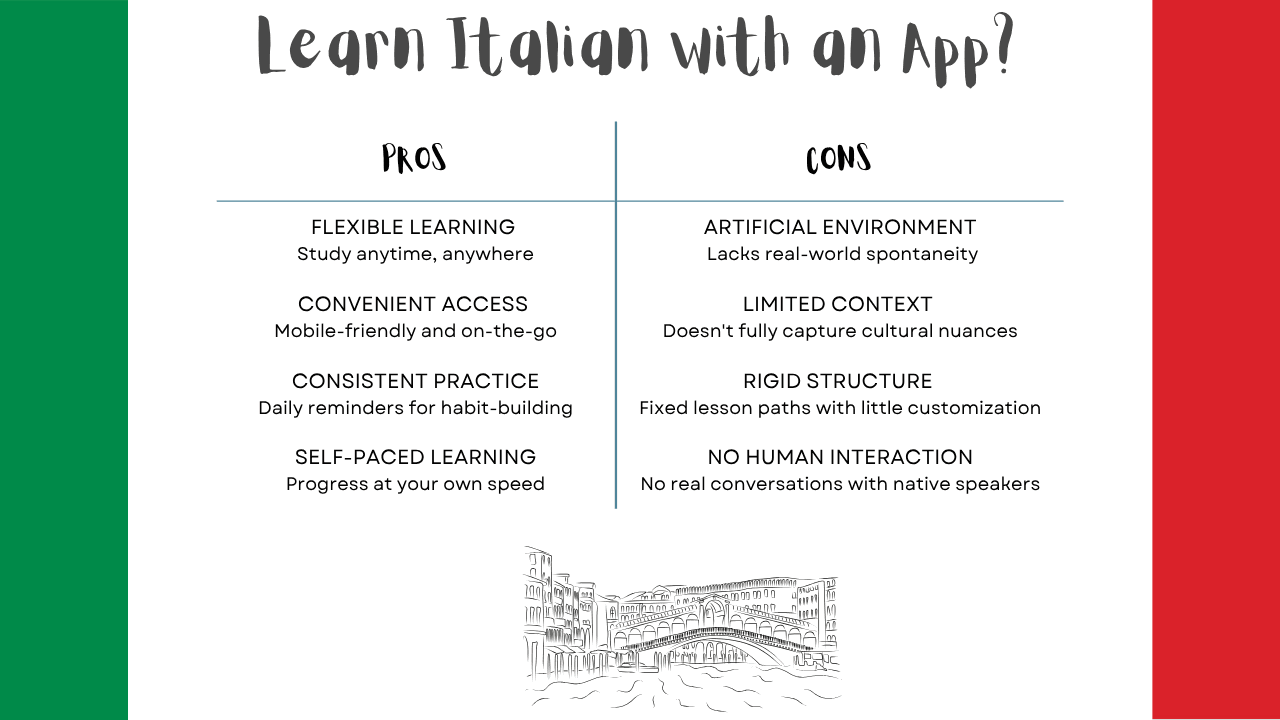
| Pros | Cons |
| Flexible Learning: Study anytime, anywhere | Artificial Environment: Lacks real-world spontaneity |
| Convenient Access: Mobile-friendly and on-the-go | Limited Context: Doesn’t fully capture cultural nuances |
| Consistent Practice: Daily reminders for habit-building | Rigid Structure: Fixed lesson paths with little customization |
| Self-Paced Learning: Progress at your own speed | No Human Interaction: No real conversations with native speakers |
Best App to Learn Italian Vocabulary In 2025
1. Duolingo
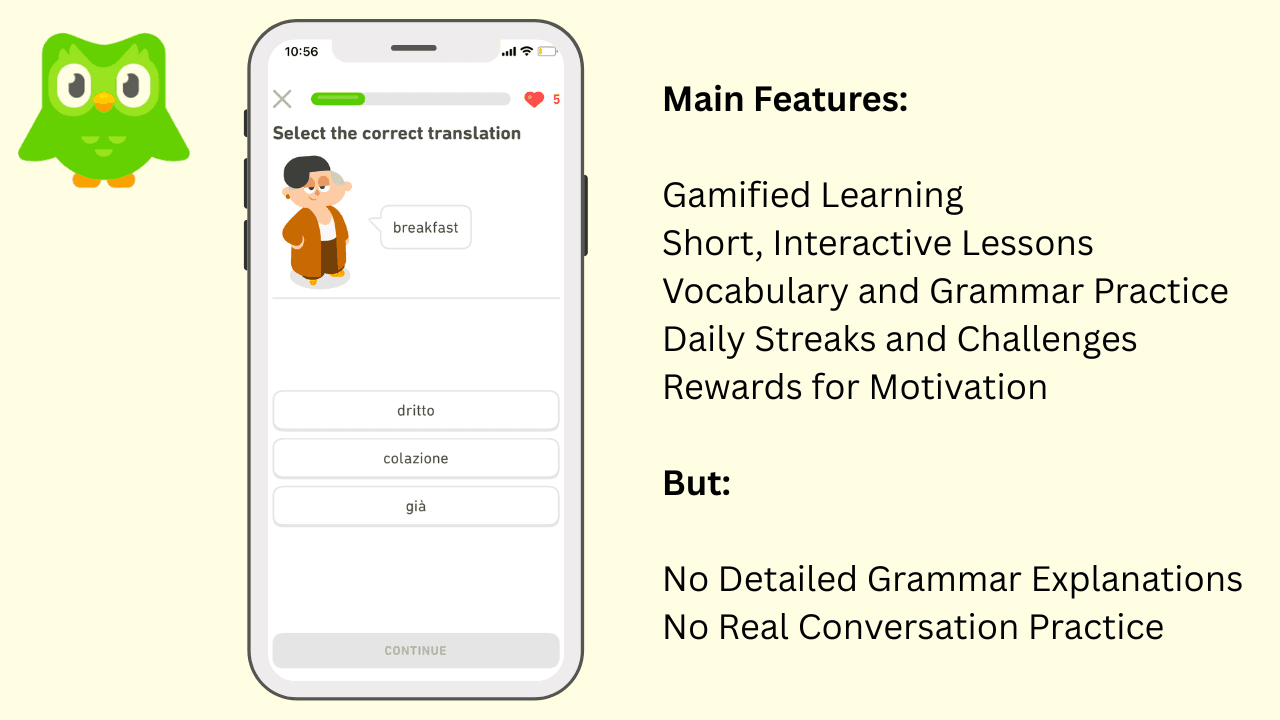
 | Main Features: Gamified Learning Short, Interactive Lessons Vocabulary and Grammar Practice Daily Streaks and Challenges Rewards for Motivation But: No Detailed Grammar Explanations No Real Conversation Practice |
Duolingo is by far the most popular language App out there. But what makes it so popular? It excels at gamification. Its short, interactive language lessons keep learners engaged and motivated, making language practice feel more like play than study.
Why You Can’t Rely On Duolingo
It is a great way to get started in Italian and pick up some basic vocabulary. However, don’t rely solely on Duolingo, as it lacks detailed grammar explanations and doesn’t provide opportunities for real conversations.
2. Memrise
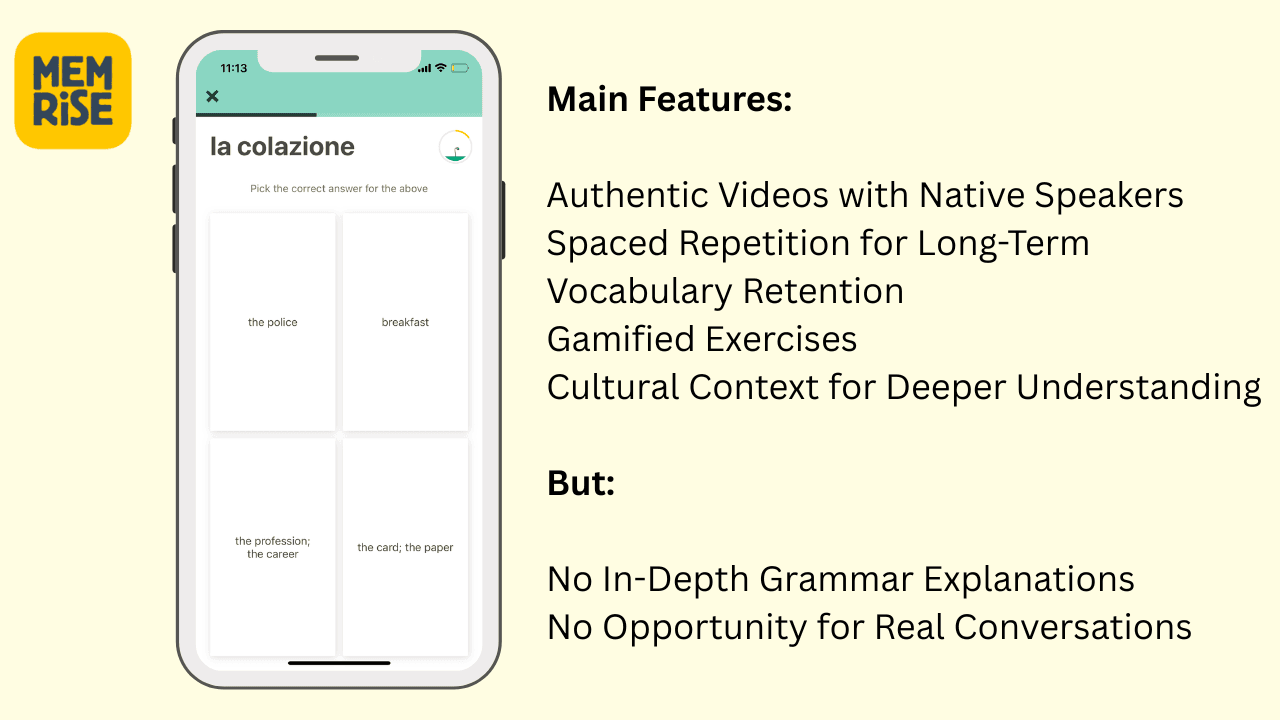
 | Main Features: Authentic Videos with Native Speakers Spaced Repetition for Long-Term Vocabulary Retention Gamified Exercises Cultural Context for Deeper Understanding But: No In-Depth Grammar Explanations No Opportunity for Real Conversations |
Memrise is also a great tool for getting started with Italian vocabulary. It uses short videos with native speakers to help you learn vocabulary and phrases.
It also helps you memorize through spaced repetition and gamified exercises. Similar to Duolingo, you won’t find much grammar in Memrise, but it is good to improve vocabulary (a similar app you might want to check is Drops). At some point, you might want to integrate it with other apps to learn grammar and practice Italian conversation.
Best App to Learn Italian Grammar
3. Busuu
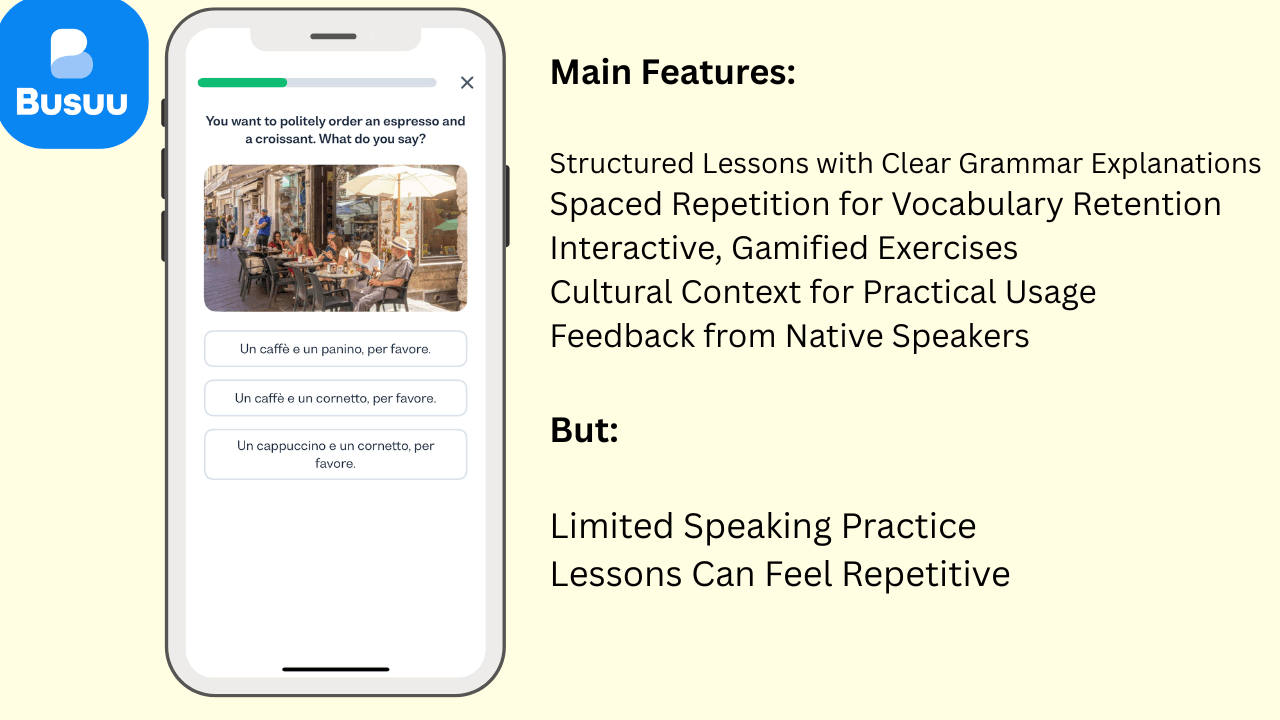
 | Main Features: Structured Lessons with Clear Grammar Explanations Spaced Repetition for Vocabulary Retention Interactive, Gamified Exercises Cultural Context for Practical Usage Feedback from Native Speakers But: Limited Speaking Practice Lessons Can Feel Repetitive |
When it comes to learning Italian grammar, Busuu stands out because of its well-structured lessons with clear explanations. It breaks down complex grammar rules into small lessons, making grammar accessible even for beginners. However, the lessons can be quite repetitive, which may feel boring and less motivating over time.
4. Babbel
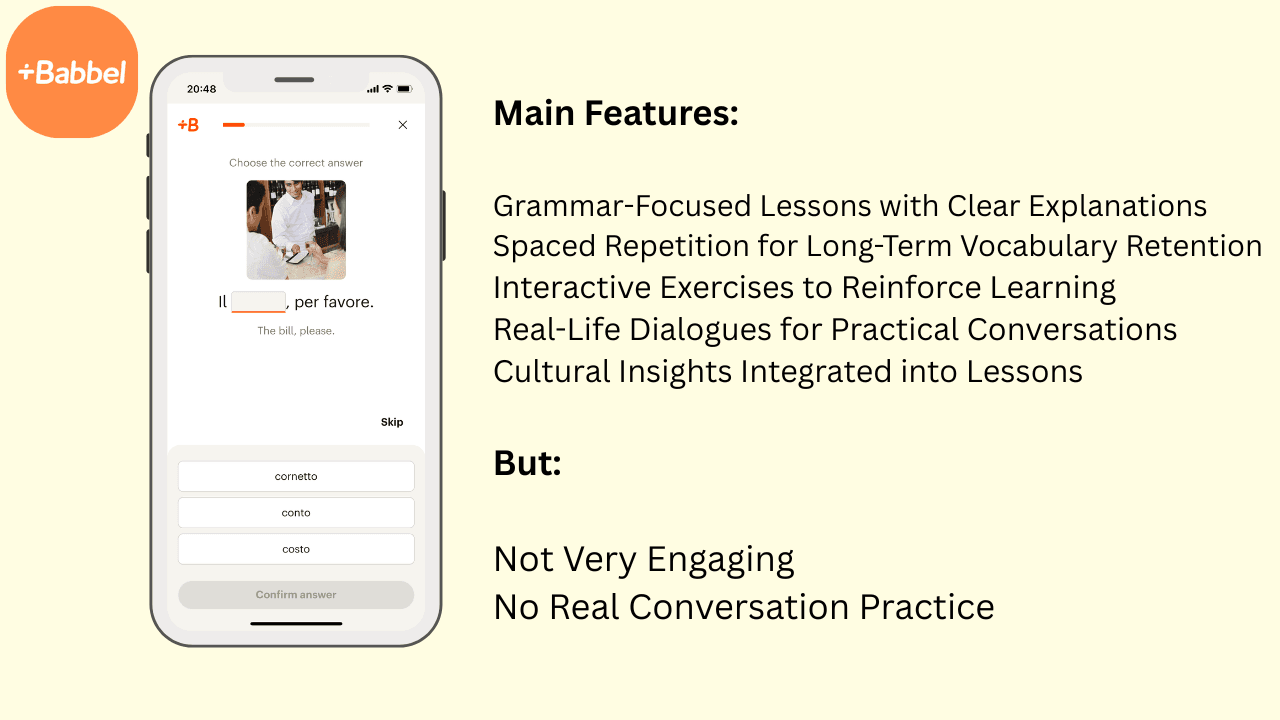
 | Main Features: Grammar-Focused Lessons with Clear Explanations Spaced Repetition for Long-Term Vocabulary Retention Interactive Exercises to Reinforce Learning Real-Life Dialogues for Practical Conversations Cultural Insights Integrated into Lessons But: Not Very Engaging No Real Conversation Practice |
Another big player in the best language-learning apps for learning Italian is Babbel. Its structured lessons with clear grammar explanations are useful for learning Italian.
Babbel also uses dialogues and cultural insights to make learning more relevant and engaging. However, speaking practice is limited, and many users report that the lessons are not as fun in other language-learning apps like Duolingo.
Best App to Learn Italian Pronunciation
5. FluentU
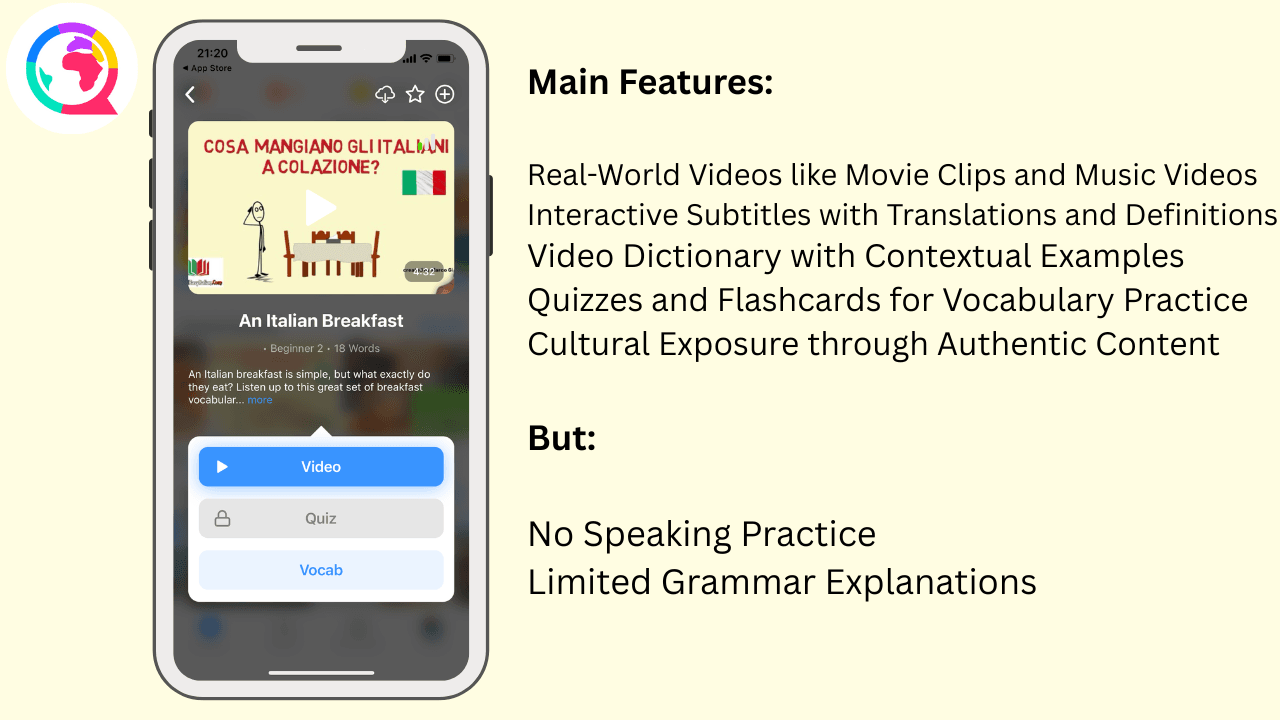
 | Main Features: Real-World Videos like Movie Clips and Music Videos Interactive Subtitles with Translations and Definitions Video Dictionary with Contextual Examples Quizzes and Flashcards for Vocabulary Practice Cultural Exposure through Authentic Content But: No Speaking Practice Limited Grammar Explanations |
FluentU is great for improving your pronunciation and listening skills because it uses real-world videos like movie clips, music videos, and news segments to teach you Italian. This way, you can learn from authentic content and get used to how Italian is spoken in real-life situations. Songs and short videos make it easier to acquire new vocabulary. However, FluentU doesn’t offer grammar explanations and speaking practice, making it a great supplementary tool for improving listening and pronunciation but not a comprehensive language learning solution.
6. Coffee Break Italian
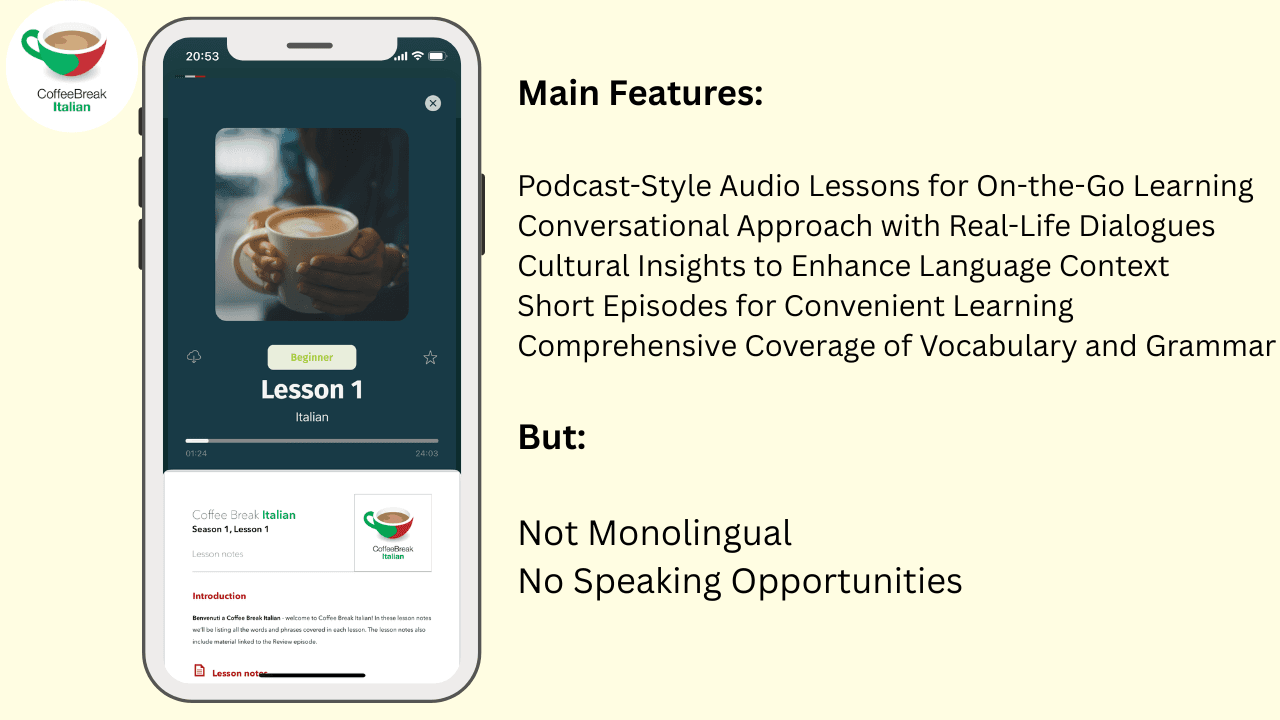
 | Main Features: Podcast-Style Audio Lessons for On-the-Go Learning Conversational Approach with Real-Life Dialogues Cultural Insights to Enhance Language Context Short Episodes for Convenient Learning Comprehensive Coverage of Vocabulary and Grammar But: Not Monolingual No Speaking Opportunities |
CoffeeBreak Italian teaches you Italian through podcast-style audio lessons. Each lesson comes with lesson notes, where you can also read explanations and practice reading in Italian. It is a great way to get a sense of the language, and you can easily fit it into your daily routine, for instance while walking or commuting to work. However, it makes extensive use of English even at advanced levels, which means you cannot truly immerse yourself in the language. The speakers switch frequently, so you don’t get Italian-only content.
7. News in Slow Italian
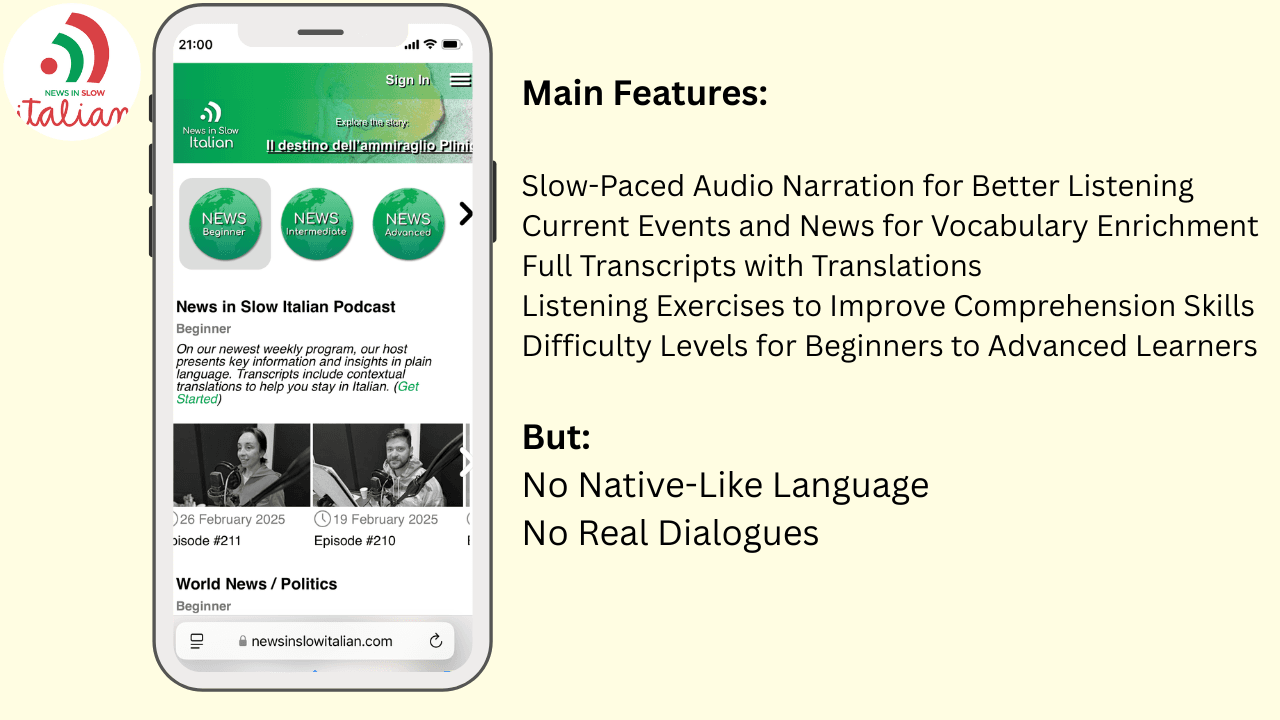
 | Main Features: Slow-Paced Audio Narration for Better Listening Comprehension Current Events and News for Vocabulary Enrichment Full Transcripts with Translations Listening Exercises to Improve Comprehension Skills Difficulty Levels for Beginners to Advanced Learners But: No Native-Like Language No Real Dialogues |
As the name suggests, News in Slow Italian provides you with an opportunity to listen and read the news in a simplified way. The App features three different difficulty levels (beginner, intermediate, and advanced), and the articles are divided by themes, such as World Politics, Technology, Art, and Grammar. You can also read the transcript, and the most challenging words and expressions are highlighted and translated. This App is especially useful to enrich your vocabulary, especially if you are into global and Italian news. However, if you are a beginner looking to learn Italian for your next trip, this App might not be the right choice, as you won’t find any real dialogue and speaking situations are limited.
Best App to Practice Italian Conversation
8. Italki
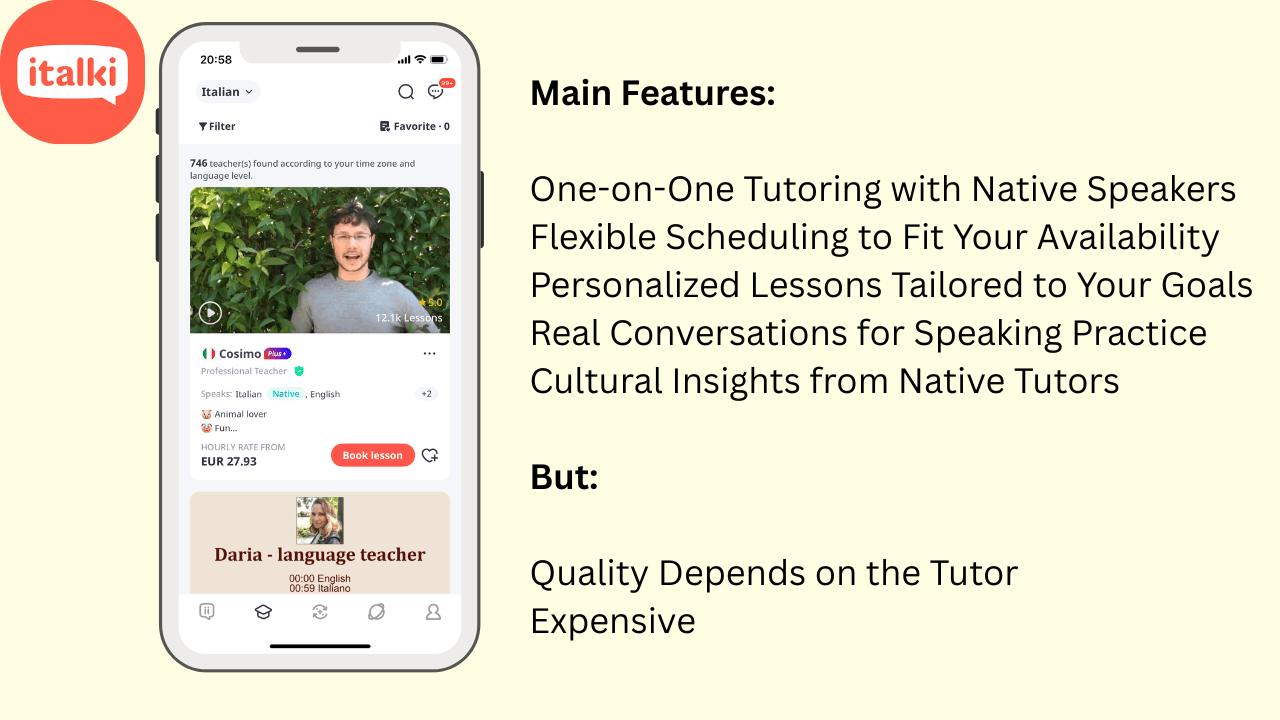
 | Main Features: One-on-One Tutoring with Native Speakers Flexible Scheduling to Fit Your Availability Personalized Lessons Tailored to Your Goals Real Conversations for Speaking Practice Cultural Insights from Native Tutors But: Quality Depends on the Tutor Expensive |
Italki differs from the other Apps we have covered so far because it offers one-on-one tutoring with real native speakers. Once you download the App, you will be able to browse and choose among thousands of tutors and schedule a class.
It’s great to have a tutor who can tailor the lessons to your needs and goals, make corrections, and provide feedback. This way, you can progress faster and interact with a native speaker with flexible scheduling. However, having a private tutor can be expensive, and the quality of the lessons ultimately depends on the tutor, with no real guarantee for results.
9. Tandem
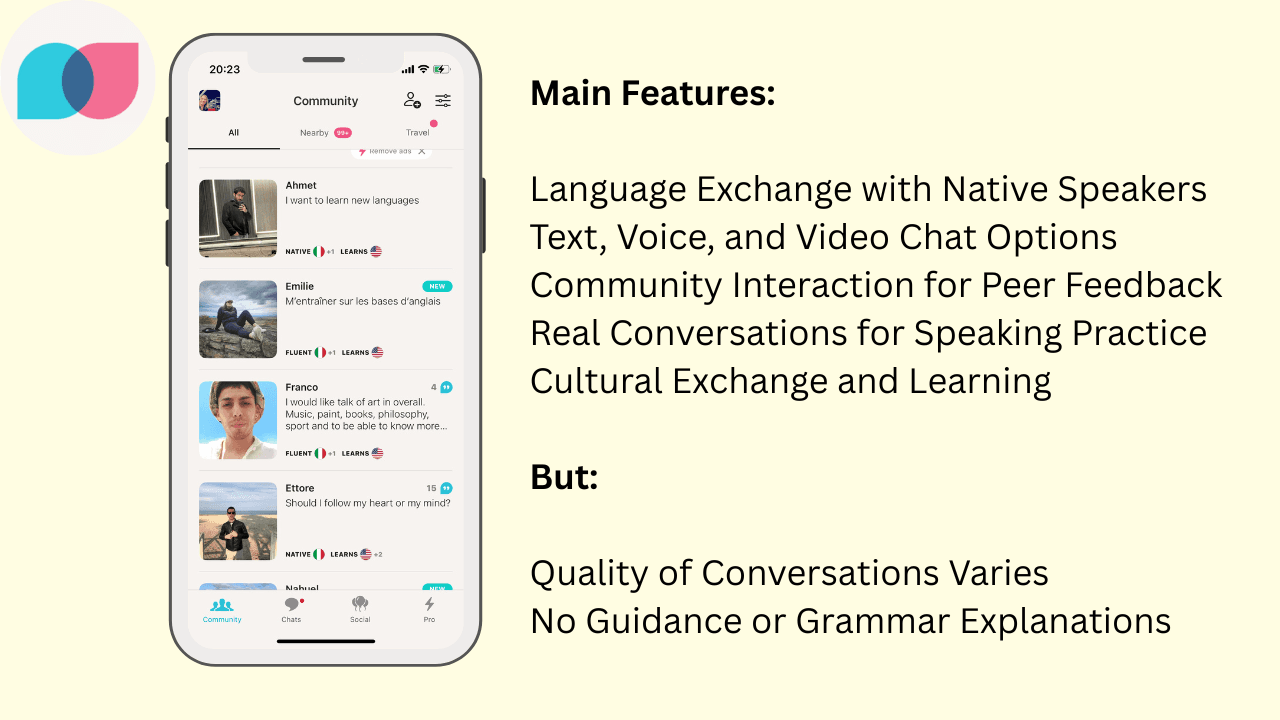
 | Main Features: Language Exchange with Native Speakers Text, Voice, and Video Chat Options Community Interaction for Peer Feedback Real Conversations for Speaking Practice Cultural Exchange and Learning But: Quality of Conversations Varies No Guidance or Grammar Explanations. |
Like Italki, Tandem offers the possibility to interact with native speakers, but this time they are not tutors – they are people who are learning your language. With Tandem, you can match with native speakers and do a language exchange with them. The first contact is usually by chat, but you can also send voice messages or do video calls.
We recommend trying tandem once you have reached an intermediate level because otherwise, it might be difficult to interact. As you can expect, the quality of conversation varies and although you might get some corrections, you will rarely get grammar explanations and tips on how to improve.
Best App to Immerse Yourself in the Italian Language
10. Jolii
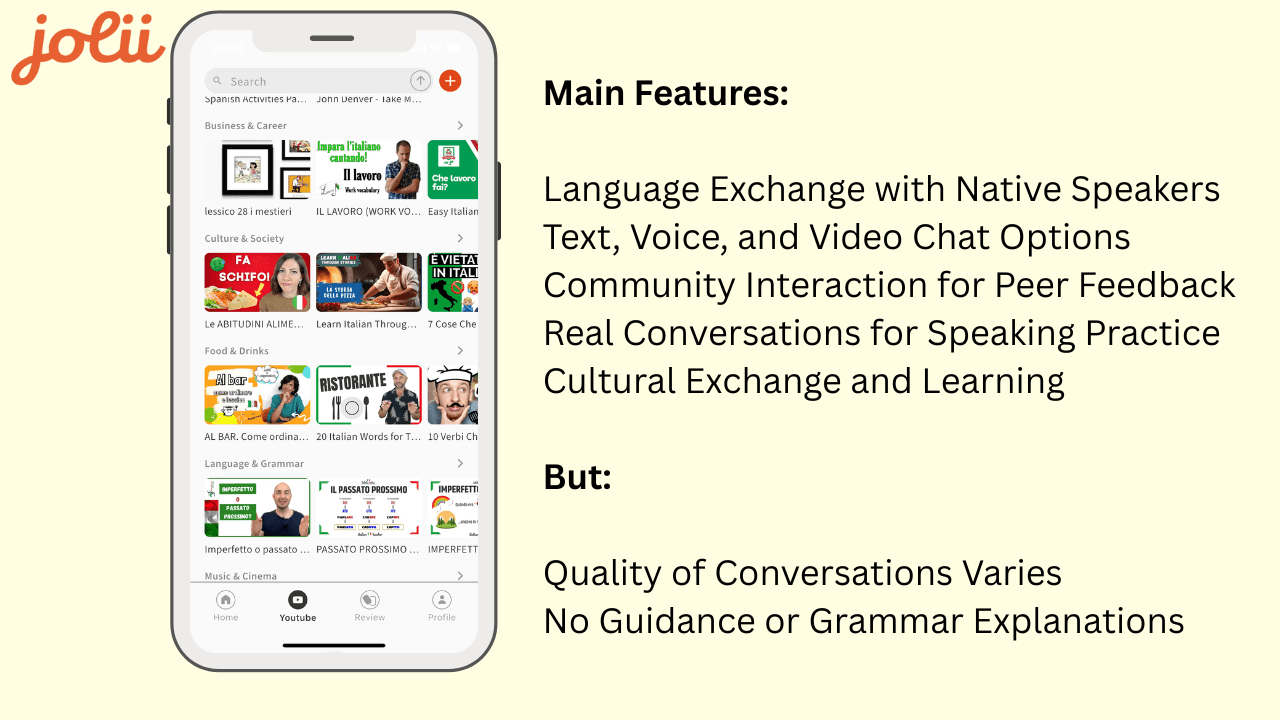
Jolii helps you immerse yourself in the Italian language and learn from authentic video content. The app adapts to your level and creates interactive lessons from YouTube and Netflix videos. You can save words and phrases and practice with quizzes to test your understanding. You can also import any video you like and the app analyzes and transforms it into a language lesson.
We recommend Jolii to all levels, but especially to intermediate and advanced learners who want to enrich their vocabulary and improve their listening skills naturally. Even though you cannot engage with native speakers directly on Jolii, you can practice speaking with its chatbot, making it a fun way to learn from authentic content that is actually meaningful to you.
 | Main Features: Interactive Lessons from YouTube and Netflix Videos Contextual Learning with Real-Life Scenarios Customizable Exercises Tailored to Your Level and Goals Immersive Experience for Natural Language Acquisition Fun and Engaging Way to Learn Vocabulary and Grammar But: No Live Conversation Practice |
Conclusion
Whether you are learning to prepare for your next trip to Italy, because you want to reconnect to your origins, for work, or even just for fun, learning Italian can be an engaging and rewarding experience if you have the right tools! As we have seen in this article, there is no perfect solution. Some apps can be useful for getting started, like Duolingo, while later on you might want to challenge yourself with other apps like Tandem or News in Slow Italian. Combining different apps may be the best solution. If you are looking for a way to learn from authentic content and immerse yourself in the Italian language, you can try Jolii today and learn Italian the fun way! Buon divertimento! (have fun!)
FAQs
Can I learn Italian fluently using just an app?
You can definitely reach a high level of Italian using a combination of different apps. No single app will make you fluent, but using the ones we describe in our article can help you improve faster.
How to improve my Italian listening skills?
Listening to podcasts and music regularly and watching movies in Italian can improve your listening skills. You could start with a song like L’Italiano by Toto Cutugno, which is slow and easy to understand. Make sure the level of what you watch or listen to is right for you, meaning that you should be able to follow along and understand the story at least partially.
Which App is best for intermediate Italian?
As an intermediate Italian learner, you can use an app like Tandem to engage with native speakers or use Jolii if you want to improve your vocabulary and listening skills.
Can I learn Italian on Duolingo?
You can definitely learn the basics of Italian on Duolingo, but the app lacks conversation practice and in-depth grammar explanations.