First published: March 2026. Last updated: June 2026
Feeling fluent and being fluent are not the same thing.
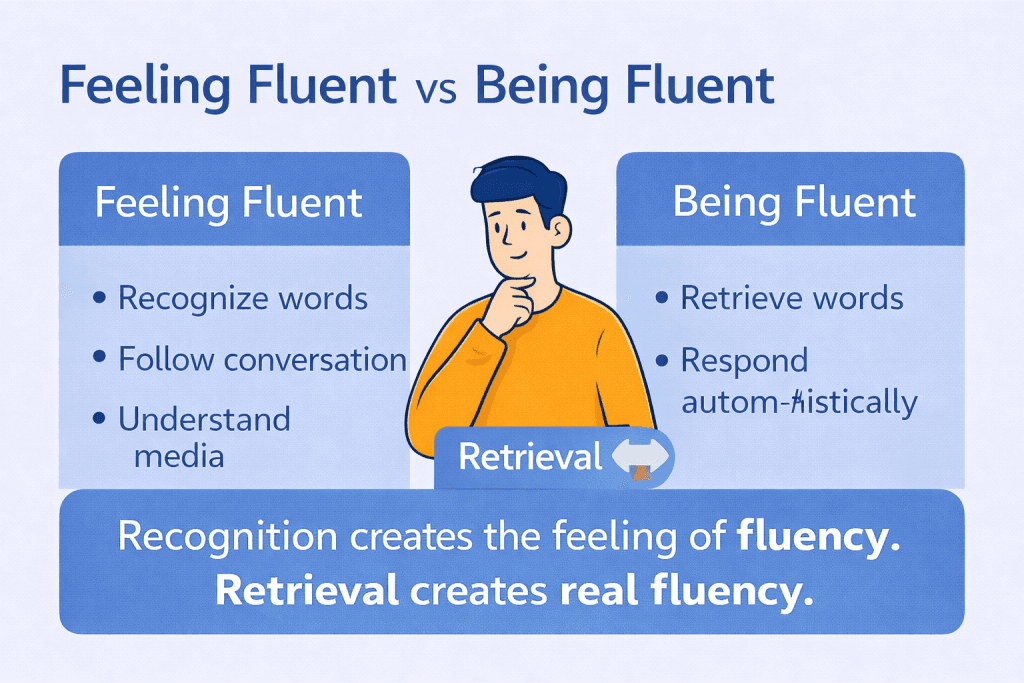
Many language learners feel fluent when they can recognize vocabulary, follow conversations, or understand media in their target language.
However, real fluency requires something deeper: automatic retrieval and flexible communication.
In simple terms, recognition creates the feeling of fluency, but retrieval creates real fluency.
Understanding a language and responding effortlessly are two different stages of learning.
Why Learners Often Feel Fluent Too Early
At certain stages of learning, comprehension improves faster than speaking.
You may be able to:
- Understand videos easily
- Follow conversations
- Recognize grammar patterns
- Read articles comfortably
This creates a strong psychological signal of fluency.
Many learners believe they are fluent because they can follow Netflix shows with subtitles, but the moment they must answer a question themselves, the gap becomes visible.
If you can understand most of what you hear or read, it feels like you already “know” the language.
But recognition is not the same as production.
Your brain can recognize thousands of words long before it can retrieve them instantly in conversation.
This gap is one of the most common illusions in language learning.
In addition, fluency is often topic-dependent. A learner might feel fluent when discussing familiar subjects — such as work, travel, or hobbies — because the vocabulary and sentence patterns are well practiced. However, when the conversation suddenly shifts to a new topic like politics, technology, or health, hesitation often appears again.. and then they panic. True fluency develops when learners can retrieve language flexibly across many different topics, not only within the situations they have practiced.
The Cognitive Difference: Recognition vs Retrieval
Cognitive science distinguishes between two types of memory access.
| Recognition | Retrieval |
| Your brain identifies information when it sees or hears it. | Your brain produces information without external cues. |
Language learners usually develop recognition first.
Retrieval takes longer because it requires automatic recall under time pressure.
Research in cognitive psychology shows that actively recalling information strengthens long-term retention much more effectively than passive review.
This is why reading and listening often improve faster than speaking.
Your brain is recognizing patterns — but retrieval still needs practice.
Why Repeating One Pattern Can Create a False Sense of Fluency
One reason learners feel fluent too early is something called blocked practice.
Blocked practice happens when you repeat the same sentence pattern many times in the same situation.
For example:
“I think so.”
“I think so.”
“I think so.”
After enough repetitions, the sentence feels automatic.
But the moment the situation changes, the brain may hesitate.
For example:
“I think it might work.”
“I think we should try.”
“I think that’s possible.”
This happens because the brain has learned the pattern only in one context.
Learning science describes this difference as blocked practice vs interleaving.

Blocked practice repeats the same skill repeatedly in a single context. It can create the illusion of mastery because performance improves quickly during practice.
However, research shows that interleaving — mixing variations of a skill across different contexts — leads to stronger long-term learning and better transfer of knowledge.
Instead of memorizing one fixed sentence, the brain learns to adapt a structure across many situations.
This flexibility is what real fluency requires.
A Real Moment When I Noticed the Difference
I remember watching a Korean interview and understanding almost everything.
The conversation felt natural, and for a moment I thought:
“Maybe I’m finally fluent.”
Then a friend asked me a simple question in Korean.
I paused.
I knew the words.
I understood the grammar.
But forming the answer took several seconds longer than it should have.
That moment made something very clear.
Understanding a language and responding automatically are not the same skill.
Signs You Feel Fluent But Aren’t Yet
Many learners experience this stage.
Common signals include:
• understanding conversations easily
• recognizing vocabulary quickly
• reading comfortably
But still experiencing:
- Hesitation when speaking
- Difficulty forming sentences quickly
- Translating internally before responding
This stage does not mean learning has stopped.
It simply means recognition has developed faster than retrieval.
Recognition vs Retrieval in Fluency Development
| Skill Type | What It Feels Like | What It Actually Means |
| Recognition | “I understand everything.” | Comprehension is strong |
| Retrieval | “I can respond quickly.” | Speaking ability is developing |
| Automaticity | Speech feels effortless | Real fluency |
Recognition builds confidence. Retrieval builds fluency.
Why Retrieval Takes Longer
Producing language requires multiple cognitive processes happening almost simultaneously:
- Retrieving vocabulary
- Selecting grammar structures
- Organizing sentence order
- Producing speech in real time
Each of these processes must become automatic.
Automaticity develops only through repeated retrieval across many situations.
This is why speaking often lags behind listening and reading.
How to Move From “Feeling Fluent” to Real Fluency
Instead of focusing only on comprehension, learners need to train retrieval.
Three strategies help close the gap.
1. Practice Active Recall
Instead of rereading sentences, try producing them yourself. Read a question, pause, then answer aloud. Active recall forces the brain to retrieve language rather than simply recognise it.
2. Introduce Retrieval Under Light Pressure
Real conversations happen quickly. Practicing short responses with mild time pressure helps simulate real communication. Examples include answering simple questions, describing images quickly, or reacting to short prompts. These exercises strengthen retrieval speed.
3. Practice the Same Ideas in Different Contexts
A sentence pattern becomes truly useful only when it appears in multiple situations. For example: “I think so.” / “I think it’s possible.” / “I think we should try.” Practicing variation prevents language from becoming tied to a single context — and this flexibility is what allows learners to respond naturally in real conversations.
FAQs
1. Is understanding a language the same as fluency?
No. Understanding shows strong recognition ability, but fluency requires fast retrieval and automatic speech production.
2. Why can I understand but still struggle to speak?
Because comprehension develops earlier than retrieval. Speaking requires the brain to produce language quickly without external cues.
3. How long does it take to become truly fluent?
It depends on exposure hours and practice structure. Most learners gradually develop fluency as retrieval becomes faster and more automatic.
A Simple Way to Practice Retrieval Consistently
One reason many learners feel fluent but struggle to speak is that most study methods focus heavily on passive input.
Jolii bridges this gap directly — video input combined with active exercises that force retrieval rather than passive recognition. The structured interaction moves language from comprehension into production, which is exactly what closes the gap between feeling fluent and being fluent.
If you want to understand how exposure hours influence language learning progress, you may also enjoy this article: “How Long Does It Really Take to Learn a Language?”
It explains how cognitive restructuring and accumulated exposure hours shape the language learning timeline.
Final Thoughts
Feeling fluent is actually a positive stage in language learning.
It means your comprehension system is becoming strong.
But real fluency appears when retrieval becomes automatic.
The gap between these two stages can sometimes feel frustrating.
Yet it is also one of the clearest signs that real language ability is developing.
Recognition builds confidence.
Retrieval builds fluency.
And with enough varied practice, the two eventually become the same skill.