Quick Answer (TL;DR)
Watching Netflix in your target language often feels productive.
However, in many cases, that feeling is misleading.
Instead of building real fluency, what often develops is a sense of familiarity with the language.
As a result, progress appears visible, even though your ability to actively use the language remains limited.
This phenomenon can be described as a comprehension illusion.
It happens when understanding input creates the impression of learning, while actual language production remains underdeveloped.
And this gap is where many learners unknowingly slow down their progress.
Why Netflix Feels Like Progress
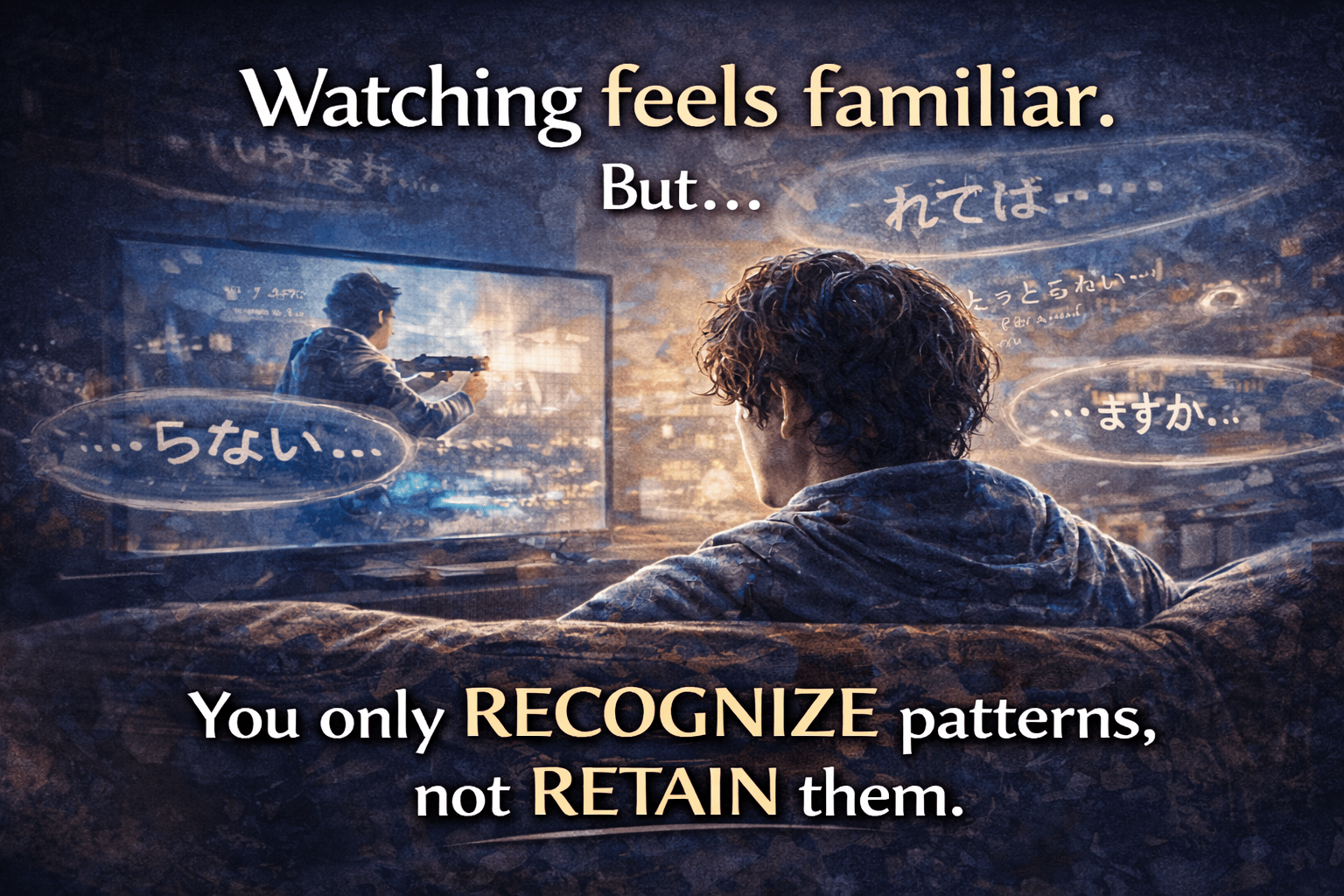
At the beginning, the experience is encouraging.
You start noticing recurring patterns, picking up frequently used expressions, and following conversations with less effort.
Because of that, the content becomes easier to process over time.
Naturally, your brain interprets this increasing ease as improvement.
However, this interpretation is incomplete.
What improves is your ability to recognize, not necessarily your ability to use.
And that distinction is crucial.
The Core Illusion: Recognition vs Retrieval
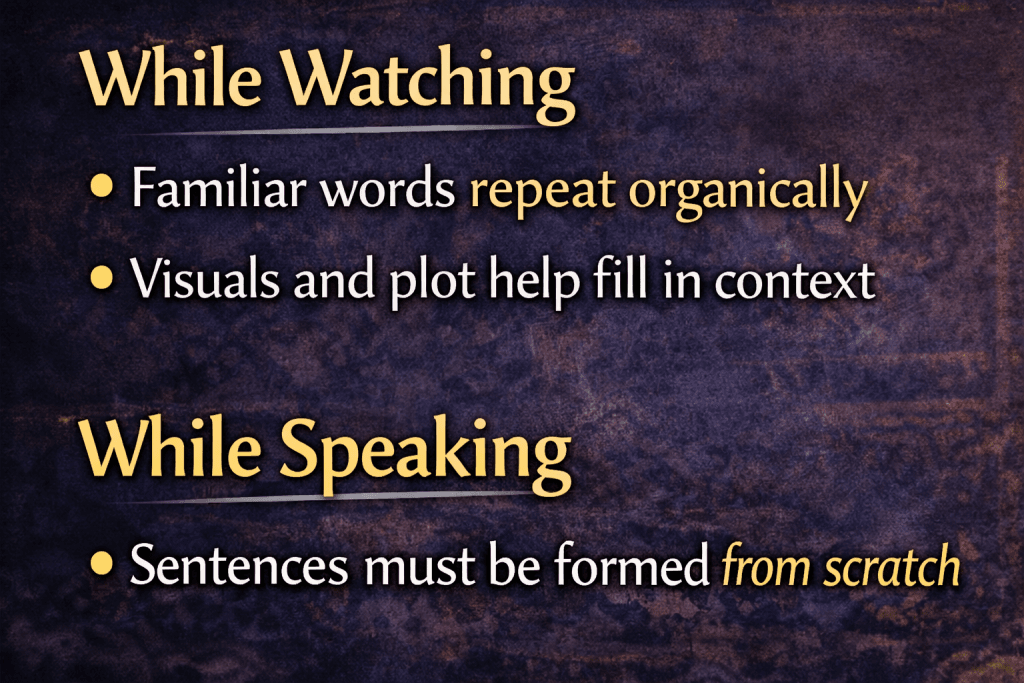
To understand what is happening, it helps to separate two different cognitive processes.
1. Recognition
While watching Netflix, your brain benefits from multiple layers of support.
- Words appear repeatedly in familiar situations, making them easier to notice
- Tone, facial expressions, and visual context help clarify meaning
- The overall scene allows missing information to be inferred naturally
Because of these factors, understanding feels smooth and intuitive.
However, this type of understanding depends heavily on external support.
2. Retrieval
In contrast, real communication requires something entirely different.
To speak, you need to:
- Access vocabulary without prompts
- Construct sentences under time pressure
- Respond without relying on visual context
This process is called retrieval.
And unlike recognition, it requires internal effort.
This is exactly where many learners struggle..
Why This Illusion Feels So Real
The reason this illusion is so convincing lies in how the brain interprets ease.
1. Context Reduces Effort
Scenes provide emotional and visual guidance.
Even when language is only partially understood, the situation fills in the gaps.
Therefore, comprehension feels higher than it actually is.
2. Engagement Creates False Signals
Because you are focused and emotionally involved, the experience feels active.
However, the brain is not performing the type of effort required for language production.
There is no pressure to:
- Recall words independently
- Formulate responses
- Make linguistic decisions
Without these steps, learning remains incomplete.
3. Familiarity Feels Like Mastery
As exposure increases, patterns begin to repeat.
Because of that, the content becomes predictable.
Expressions seem recognizable, and conversations feel easier to follow.
Over time, this familiarity is misinterpreted as actual skill.
A Moment You Might Recognize
After finishing a series, something shifts.
There is a noticeable sense of ease with the language.
You feel more relaxed while listening, and the content no longer feels overwhelming.
However, when you try to speak, a different experience emerges.
Instead of responding smoothly, hesitation appears.
Words take longer to access, and ideas become simplified.
This contrast can feel confusing.
Because despite understanding the language in context,
you may not have developed the ability to use it independently.
The Deeper Cognitive Insight
Learning is not a single process.
It involves at least two distinct mechanisms.
| Process | What Happens | Result |
| Recognition | Input is understood with support | Familiarity |
| Retrieval | Language is produced independently | Usable fluency |
Netflix strengthens recognition effectively.
However, fluency depends on retrieval.
Without retrieval, progress feels real—but remains incomplete.
Research on memory shows that repetition over time strengthens long-term retention, especially when learning is spaced rather than repeated in a single session.
At the same time, cognitive research highlights that recognition and recall are fundamentally different processes, meaning that recognizing information does not guarantee the ability to retrieve or use it independently.
In other words:
👉 Repetition builds familiarity, but only retrieval turns it into usable language.
A Moment I Realized This Myself

There was a period when I watched Netflix almost every day in my target language.
It felt productive.
Following the storyline became easier, and understanding conversations required less effort than before.
At some point, I even started anticipating certain lines before they were spoken.
Because of that, it seemed like real progress.
However, that assumption changed in a real conversation.
When I needed to respond spontaneously, something unexpected happened.
The ideas were clear in my mind.
But the words did not come out as easily as expected.
There was a pause.
Not because of confusion, but because the language was not readily available.
That moment revealed something important.
Understanding had improved.
But the ability to retrieve language had not developed at the same pace.
From that point on, the difference became clear.
Recognition creates comfort.
Retrieval creates fluency.
Why Some Shows Make This Worse
Not all Netflix content contributes equally to learning.
Some shows:
Move too quickly for processing
Use exaggerated or unnatural dialogue
Provide little meaningful repetition
As a result, they increase exposure but reduce learning efficiency.
This is explained in more detail here:
👉 Why Some Netflix Shows Are Terrible for Language Learning
Because content directly affects how your brain engages with language.
So What Actually Builds Fluency?
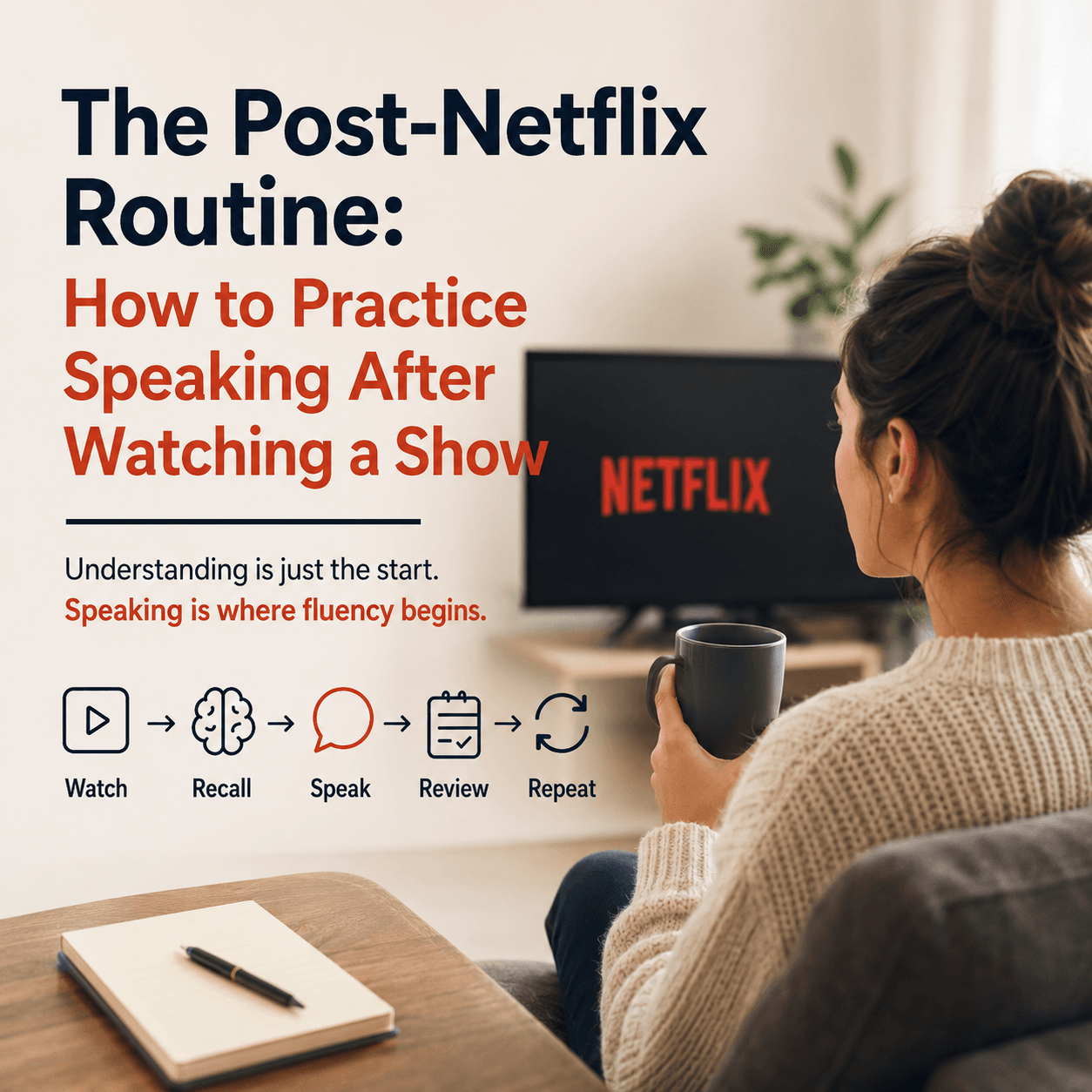
The solution is not to stop watching Netflix.
Instead, it is to change how you interact with it.
1️⃣ Turn Recognition Into Retrieval
Pause and actively repeat key lines.
👉 Why: recall strengthens memory
2️⃣ Focus on Meaningful Patterns
Pay attention to expressions that appear in important moments.
👉 Why: patterns become reusable
3️⃣ Rewatch With Purpose
Return to the same scenes with a clear focus.
👉 Why: repetition reinforces retrieval
4️⃣ Simulate Responses
After hearing a line, consider how you would respond in that situation.
👉 Why: production builds fluency
FAQs
Can Netflix alone make me fluent?
No. It improves exposure, but not active usage.
Why does it feel effective?
Because recognition improves faster than production.
Should I stop watching?
No. However, you should engage with content more actively.
A Different Way to Use Netflix (Jolii Approach)
The issue is not Netflix itself.
It is the lack of structure.
Jolii transforms passive watching into guided learning.
Instead of random content, you get:
- Curated scenes selected for learning value
- Dual subtitles for real-time comparison
- Highlighted expressions matched to your level
Because of that, attention shifts toward what actually matters.
Instead of passively following the story,
you begin to recognize patterns, notice repetition, and understand which expressions are usable in real situations.
This makes the experience not just engaging—but effective.
Final Thoughts
The biggest challenge in language learning is not effort.
It is interpretation.
Netflix makes progress feel real.
And to some extent, it is.
However, unless recognition is supported by retrieval,
fluency will remain limited.
Because in the end,
language is not defined by what you understand.
It is defined by what you can use.