If you just want the quick answer — you say hello in Japanese by saying “こんにちは (konnichiwa)”, the most common and polite daytime greeting.
Okay, let’s be honest—if you’ve ever typed how to say hello in Japanese into a search bar, you probably hoped for one neat, catch-all answer. Just one word. Like “hello” in English. Simple, clean, dependable.
But, um… no. It’s not quite that easy.
When I started learning Japanese, I was convinced there had to be a universal go-to phrase. Something you could toss out confidently no matter who you were talking to. But Japanese doesn’t play by that rule. Turns out, learning how to say hello in Japanese is more like choosing what kind of shoes to wear. If you’re new to the language, you might want to start with learning hiragana, the basic Japanese alphabet — it lays the groundwork for everything else, including how greetings are written.
Sure, sneakers might work most days. But try showing up to a wedding in them—or a rainy day hike—and suddenly things feel a little off. Same deal here. You could technically use the same phrase all the time… but it won’t always feel right.
This article’s here to save you some of the awkward moments I stumbled into. I’ll walk you through ten common greetings, give you a peek at how they’re really used (not just what textbooks say), and sprinkle in a few “uh-oh” memories from my own learning curve—so hopefully, you won’t repeat them.
Why Learning Hello in Japanese Feels Different Than in English
You know, one thing that kind of crept up on me as I kept learning was this: Japanese greetings? They’re not really about the words themselves.
I mean, sure, the phrases matter—but the real heart of it is how you recognize someone’s presence. It’s less about “starting a chat” and more about quietly placing each person in the right social bubble.
In English, a quick “hi” usually kicks things off. It’s casual, it’s light, it’s… just there. But in Japanese, knowing how to say hello in Japanese isn’t just a friendly gesture—it’s a subtle way of measuring the space between two people.
Like:
- Are we close… or keeping it professional?
- Is this formal, casual, somewhere in between?
- Am I talking to someone higher up, or is this a peer-to-peer thing?
Once I started noticing these unspoken signals, the greetings I’d memorized finally started making sense. It didn’t magically make everything easier—but it did feel a lot less random.
1. When and Where to Use Hello in Japanese
If you’ve ever tried to figure out how to say hello in Japanese, you’ve probably realized it’s not just about the word — it’s about when, where, and who.
Japanese greetings, or aisatsu, are tiny social signals. They’re not simply “hello” or “good morning” — they’re more like a way of tuning yourself into the moment.
Some examples (trust me, context is everything):
- First meeting: Hajimemashite (nice to meet you). A bow, a smile. Respect sealed.
- Morning at work: Ohayō gozaimasu (good morning in Japanese) — even if it’s 1 PM. (Yes, that confused me too.)
- Evening: Konbanwa (good evening). Calm, measured, polite.
- Friends and casual chats: Yā or Genki? if you’re close enough.
- On the phone: Moshi moshi. Only there. Never face-to-face.
In Japan, greetings are like keys — each one fits a different door.
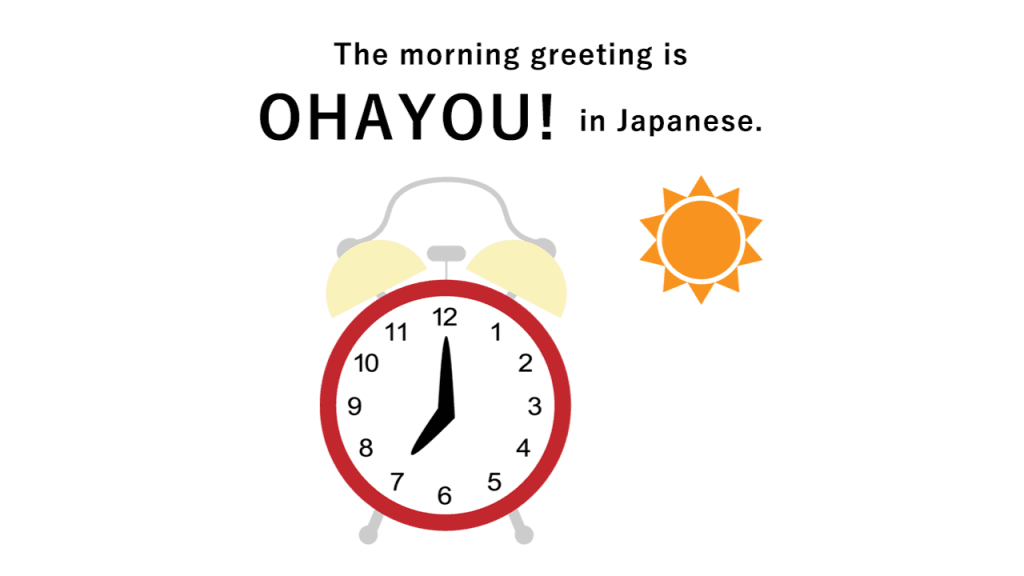
🌞 10 Everyday Japanese Greetings (and When They Actually Work)
| Greeting | Meaning | When to Use |
| おはようございます (Ohayō gozaimasu) | Good morning (formal) | With coworkers, teachers, or strangers |
| おはよう (Ohayō) | Morning (casual) | With friends, family |
| こんにちは (Konnichiwa) | Hello / Good afternoon | Late morning to early evening |
| こんばんは (Konbanwa) | Good evening | After sunset, polite tone |
| はじめまして (Hajimemashite) | Nice to meet you | First-time meetings |
| もしもし (Moshi moshi) | Hello (on the phone) | Phone calls only |
| お疲れ様です (Otsukaresama desu) | Hello / good work | Common in workplaces |
| さようなら (Sayōnara) | Goodbye | More formal or long-term partings |
If you’re also curious about how Japanese honorifics like san, kun, or sama fit into greetings, check out our full guide on Japanese honorifics — they play a big part in how you address someone properly.
2. Cultural Nuances Behind Say Hello in Japanese
The more I learned how to say hello in Japanese, the more I realized — the words aren’t the main point.
- Konnichiwa sounds fine, but use it at 8 a.m. and people might blink twice.
- Ohayō gozaimasu isn’t really “good morning,” it’s more “our first hello today.”
- Hajimemashite isn’t just “nice to meet you” — it marks the exact moment two paths cross.
And the silence? Oh, it speaks volumes.
A nod. A bow. Even a glance. Sometimes that’s all the greeting you need.
Japanese greetings are less about saying and more about showing — respect, awareness, and timing.
3. The Hello Mistakes Every Beginner Makes (Yes, I Made Them Too)
Here’s the good news: everyone messes up.
The bad news? You’ll remember each mistake vividly.
Some classics:
- Saying konnichiwa first thing in the morning. (Nope.)
- Using hajimemashite with someone you’ve already met. (Awkward silence included.)
- Greeting your boss with genki? (Just… don’t.)
- Forgetting to bow — or bowing too deeply to the vending machine. (It happens.)
How to fix it:
- When unsure, go polite. Always.
- Watch what locals do — mimic, don’t memorize.
- Accept that tiny awkward moments are part of learning how to say hello in Japanese.
Those small stumbles are actually the rhythm of progress.
💡 Pro Insight: What Real Japanese Greetings Actually Feel Like
Real greetings in Japan? They’re quiet — almost invisible.
Sometimes just a soft ohayō, a nod, or even… silence.
At first, I thought I’d done something wrong.
But then I realized — in Japan, greetings don’t shout. They breathe.
- Small = sincere. Subtlety is warmth disguised as restraint.
- Timing > words. The same phrase can feel completely different depending on when it’s said.
- Respect lives in tone. A soft hello can speak louder than a cheerful one.
It’s funny — once I stopped trying so hard, conversations flowed better.
How to say hello in Japanese stopped being about vocabulary, and started feeling like music — soft, rhythmic, human.
4. Practice Japanese Greetings Without Overthinking
Overthinking? Yeah, been there.
The trick isn’t to study greetings — it’s to absorb them.
Try this:
- Listen more. Watch how people greet each other — the nods, the pauses, the tone.
- Practice timing. Not every moment needs a word.
- Keep it simple. The more natural, the better.
- Learn through rhythm. Greetings are part of daily flow, not isolated phrases.
At some point, you’ll stop asking, Am I saying it right?
and start thinking, That felt right.
That’s when you’re really learning how to say hello in Japanese.

5. Learning How to Say Hello in Japanese Is a Process
Every learner hits that phase — overthinking, second-guessing, getting flustered.
But that’s the point.
Language isn’t a checklist; it’s a heartbeat.
You’ll misstep, mumble, maybe even bow to the wrong person — and still, somehow, you’ll get better.
Eventually, you’ll realize it’s not about the perfect konnichiwa or the right degree of bow.
It’s about connection. Awareness. That small moment of recognition that says, “I see you.”
And maybe that’s what all greetings really are — not words, but bridges.
✨ Quick Recap:
| Situation | Best Greeting | Tone |
| First meeting | Hajimemashite | Formal, respectful |
| Morning at work | Ohayō gozaimasu | Polite, warm |
| Afternoon | Konnichiwa | Neutral, friendly |
| Evening | Konbanwa | Calm, polite |
| With friends | Ohayō, Yā, Genki? | Casual |
| On the phone | Moshi moshi | Only by phone |
| At work (throughout the day) | Otsukaresama desu | Respectful, collegial |
| Saying goodbye | Sayōnara / Jā ne | Depends on context |
Final Note: Why Greetings in Japanese Are More Than Words
If you remember nothing else, remember this: how to say hello in Japanese isn’t just a phrase — it’s a way of being present.
It’s the quiet art of meeting someone halfway, in language, in spirit, in kindness.
And if you’re still second‑guessing yourself — replaying a greeting in your head, wondering if it landed the way you meant — that’s normal. I did that a lot. Probably still do, actually.
Having something like Jolii app around can help for how to learn Japanese fast. Not to drill you, not to correct every little thing, but to keep these everyday greetings close enough that they start to feel familiar. Less effort. Less thinking. Just… more natural over time.