Quick Answer:
“Good morning” in Japanese is ohayou gozaimasu (おはようございます) in formal settings and ohayou (おはよう) in casual contexts. The version you choose depends on your relationship and the level of politeness required.
Most “good morning in Japanese” guides give you the two phrases and stop there. This one goes further — explaining why Japanese greetings carry social and emotional weight that English greetings don’t, and what that means for how you actually use them in real situations.
Good Morning in Japanese — sounds simple on the surface, right? But oh boy, when you start learning it, there’s suddenly a whole web of nuance that hangs off something that seems as everyday as “Good morning.”
I vividly remember my first week in Japan. I was still half asleep, and someone cheerfully said Ohayou gozaimasu to me with this bright smile. And I just froze — stuck between “Did they just say hello?” and “Why so many syllables for morning?”
It felt like someone handed me a handshake I didn’t know how to return.
But here’s the thing — Good morning in Japanese isn’t just about saying hello. It’s a kind of social acknowledgement. The way you say it can subtly communicate your status relative to the other person, how polite you want to sound, or even how close you feel with them.
1. The Most Polite Good Morning in Japanese:
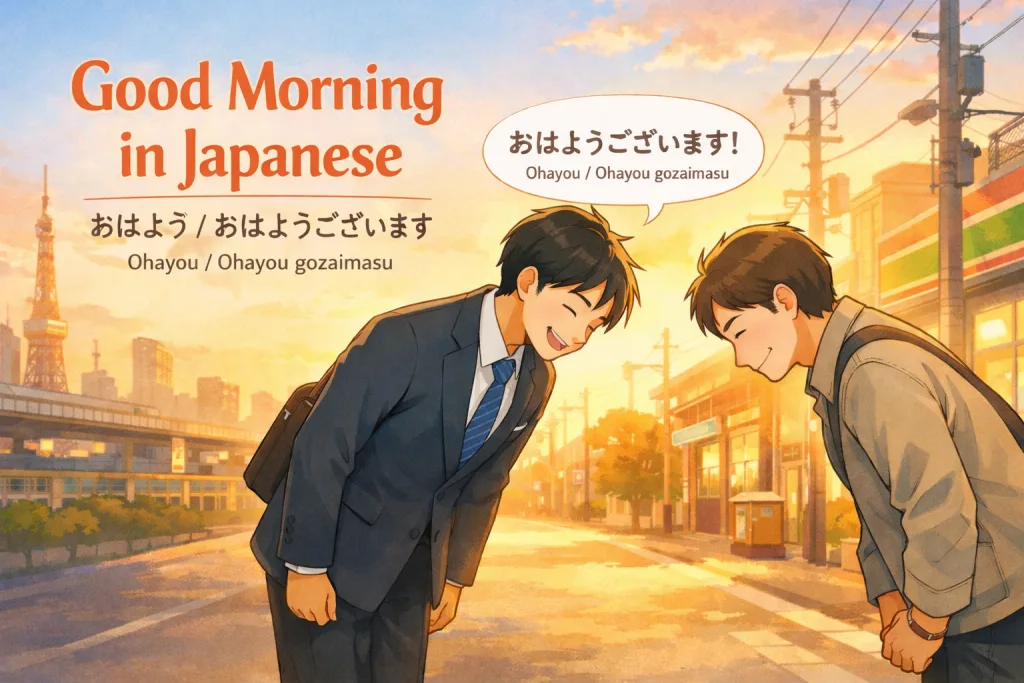
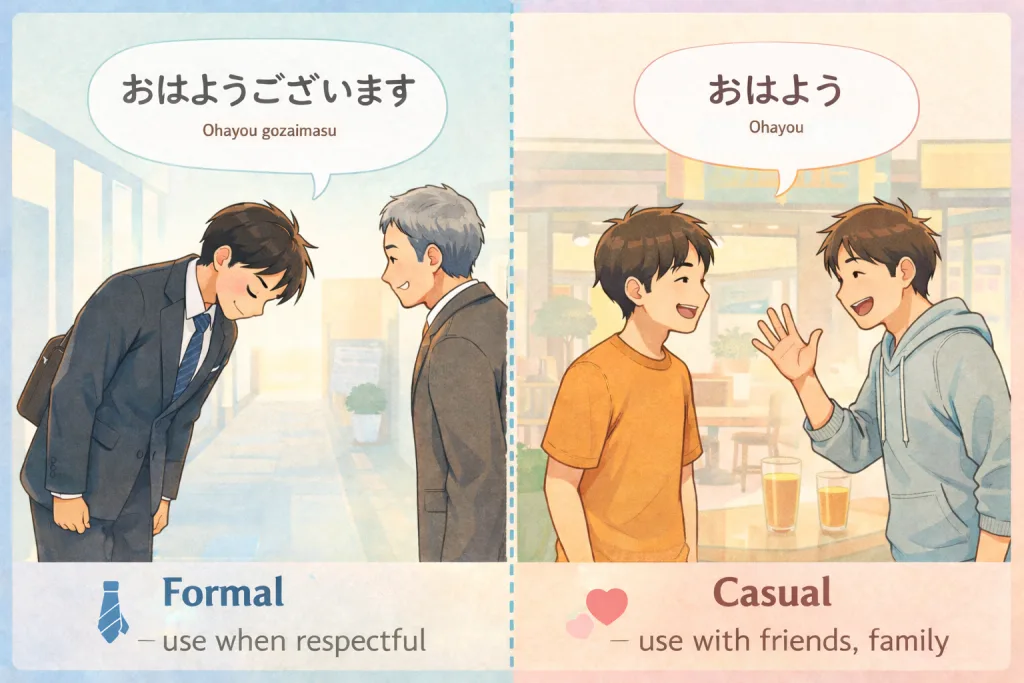
This is the version you’ll hear in offices, schools, and early mornings in shops and workplaces. Ohayou gozaimasu is the formal, polite way to greet someone, and you use it when you don’t know the person well or when the situation calls for respect. In other words, when you’re saying good morning in Japanese in a formal setting, this is your default.
Think of it as the equivalent of “Good morning, everyone,” but with an extra layer of cultural courtesy woven into it. When you start your day saying Ohayou gozaimasu, it’s almost like you’re telling the other person, “I see you. I respect you. Let’s start this day on good terms.”
Example:
- Ohayou gozaimasu, Tanaka-san! (おはようございます、田中さん!) – Good morning, Mr./Ms. Tanaka!
If you’re wondering why it’s Tanaka-san (and not just Tanaka), here’s Japanese Honorifics Explained. This phrase shows up so often in daily Japanese life that if you miss it, people might notice — not because they’re strict, but because it’s just part of the rhythm of polite morning interaction in Japan.
2. The Casual Good Morning in Japanese
Now, the casual version — Ohayou — is more like saying “Morning!” in English. You’ll use it with friends, family, or people around your own age when formality isn’t necessary. It’s direct, friendly, and doesn’t carry that “business attire” feeling that gozaimasu does. This is how good morning in Japanese sounds when the vibe feels relaxed.
Example:
- Ohayou, Yuki! (おはよう、ゆき!) – Morning, Yuki!
I remember using this with a friend once and feeling like, suddenly, I was part of the group. It was like dropping the polite mask and just being… human. It feels warmer, and dare I say, a bit more honest most of the time.
3. Other Nuances of “Good Morning in Japanese”
3.1 Timing Matters Too
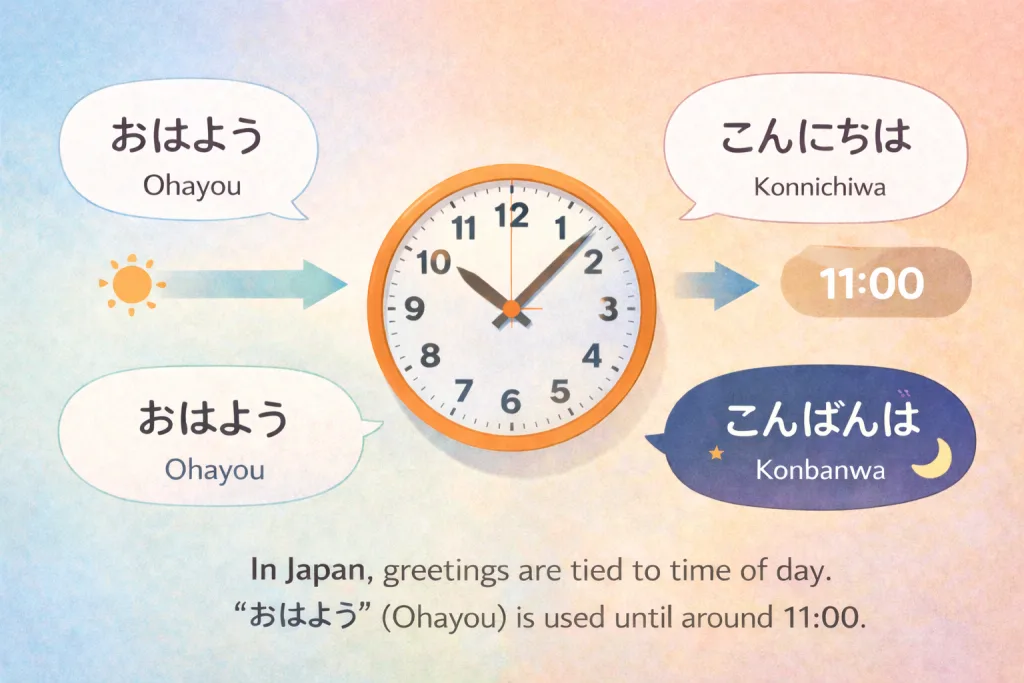
In Japan, people often tie greetings to the time of day. (Ohayou is typically used until around 11:00 a.m.*).
If you’re greeting someone later in the day, you’d usually switch to Konnichiwa (“Hello/Good afternoon”) or Konbanwa (“Good evening”).
This tiny shift shows you something about how Japanese people think about greetings: they anchor them in context, not just words.
3.2 Good Morning in Japanese as a “Phatic Expression”
Linguists describe greetings — like Ohayou — as phatic expressions. They don’t convey literal meaning; instead, they maintain social ties and smooth interaction.
It’s like Japanese way of saying, “Hey, I acknowledge you — let’s be friendly today.”
4. How to Use “Good Morning” Naturally
So when do you use Ohayou (おはよう) versus Ohayou gozaimasu (おはようございます)?
- Formal or respectful settings: Work, school when talking to seniors or clients → Ohayou gozaimasu (おはようございます)
- Casual, friendly settings: Close friends, roommates → Ohayou (おはよう)
And yes — sometimes you might hear something in between, like Ohayou (おはよう) with a comfy tone when you’ve been living with someone for a while. Language adapts to relationship, not just dictionary rules.
Real Example: The Morning I Learned “Good Morning” Isn’t Neutral
I still remember the first time I had to say good morning in Japanese, Ohayou gozaimasu (おはようございます), in a real setting — not in a textbook, not in a role-play, but in that quiet, awkward moment where everyone’s already moving and you’re trying not to stick out.
I walked into a workplace hallway, saw someone I didn’t know well, and my brain did that classic second-language panic: Do I go casual or formal? Smile — or bow? And before I could overthink it, I heard it from the other side first — a crisp, effortless Ohayou gozaimasu (おはようございます) — like it was the official “we’re starting the day together” button.
Here’s what surprised me: it didn’t feel like small talk. It felt like permission. Like the greeting wasn’t just “good morning,” but “we’re on the same page,” “I acknowledge you,” “we’re going to get through today smoothly.” And the little gozaimasu (ございます) at the end? That was the difference between sounding like a friend… and sounding like someone who understands where they are.
A few weeks later, something else happened. I started hearing Ohayou (おはよう) in smaller, softer spaces — with people I’d grown close to, or in those relaxed moments before work truly began. And the first time someone said it to me casually, I felt it in my chest like a tiny upgrade: Oh. We’re here now. Same meaning on paper. Totally different feeling in real life.
That’s when it clicked: getting greetings “right” isn’t about memorising the phrase. It’s about training your mouth and your instincts to match the room — until Ohayou and Ohayou gozaimasu stop being “Japanese words” and start becoming the natural way you move through a morning.
Summary:
- Formal: Ohayou gozaimasu
- Casual: Ohayou
- Used until around 11am
- Reflects relationship and hierarchy
5. FAQs About Saying “Good Morning in Japanese”
Do I always need to be polite?
Not always. With close friends or family, simple Ohayou feels natural. Use gozaimasu when the situation requires respect or a formal tone.
Is “Good morning” in Japanese just a time greeting?
Mostly, yes — but in Japan it also reflects social expectations and respect culture more strongly than just a time-based phrase in English.
Can I skip greeting someone in the morning?
Skipping a greeting once in a while won’t ruin your life, but daily greetings are part of the culture of mutual acknowledgment in Japan — people pay attention to them.
For more on how Japanese language changes depending on context and relationship, Banshaku no Ryuugi breaks down exactly how tone, formality, and social hierarchy shape everyday Japanese speech through a real Netflix drama.
6. A Simple Goodbye to “Good Morning” — And a Better Way to Practice It
In Japanese, Good morning — whether Ohayou or Ohayou gozaimasu — is more than just brush-off culture. It’s a cultural custom, a signal of respect, and often the first opportunity to set a harmonious tone for the day. Learning it isn’t just about reciting a phrase — it’s about understanding how Japanese people connect with each other at the start of a day.
Still unsure about Good morning in Japanese? It’s okay — these little phrases pack a lot more meaning than they first seem! With Jolii AI language app, you can practice real-life greetings in context so they feel natural, not awkward. Start using them confidently and watch your Japanese interactions become smoother and more genuine.