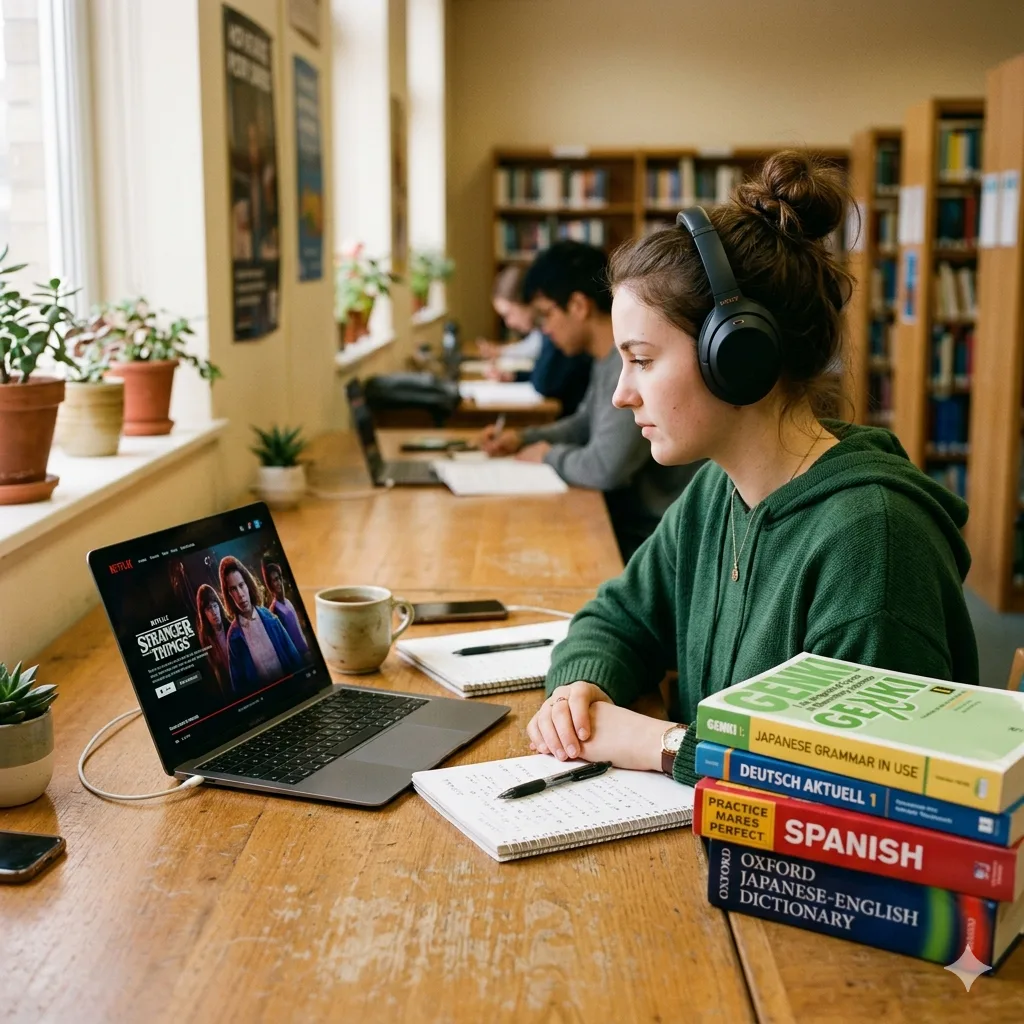
Textbooks and Netflix-style immersion don’t cut it as standalone approaches. Textbooks provide structure, but lack authenticity. Immersion gives you real language, but is intimidating. How do you learn best? With a mix of the two; textbooks to isolate things clearly, and immersion to hit those fluency goals.
The Real Debate: Classroom Language vs. Living Language
Textbooks and Netflix represent two completely different versions of a language.
Textbooks give you:
- Clean sentences
- Predictable grammar
- Controlled vocabulary
- Interruptions
- Slang and tone shifts
- Speed and unpredictability
Both are real in their own way, but only one reflects what happens when someone actually speaks to you.
Textbooks vs. Netflix (What They Actually Teach You)
Textbooks and Netflix can both teach you a language, of course. They are very different, though. One turns language into rules you can learn, and the other shows you what it really sounds like in practice, but lacks structure.
| Feature | Textbooks | Netflix / Immersion |
| Grammar clarity | ✅ High | ❌ Low (implicit) |
| Real-life usage | ❌ Limited | ✅ High |
| Listening training | ❌ Minimal | ✅ Strong |
| Predictability | ✅ High | ❌ Low |
| Speaking readiness | ⚠️ Limited | ✅ Stronger over time |
Textbooks vs. Immersion
While textbooks will give a grasp of grammar and structure, immersion through tools like Netflix will assist a learner with listening and speaking practice. Both require complete, full language fluency.
Why Textbooks Alone Don’t Get You There
Textbooks are optimized for clarity. They break language down into manageable pieces so you can understand how it works.
That’s useful. But it also creates a controlled environment that doesn’t exist outside the page.
In real conversations, language behaves differently:
- People don’t finish sentences
- They change direction mid-thought
- They rely on tone as much as words
So the limitation isn’t just lack of “real language.” It’s that textbooks don’t train you to make decisions under pressure.
When you speak, you don’t have time to recall a rule, check it, and apply it. You need to respond instantly, often with incomplete information.
That’s the gap:
→ Knowing how the language works
→ vs. being able to use it in motion
This is why learners often hit a wall: “I know the rules… but I don’t know how to respond.”
This aligns with research in second language acquisition showing that language doesn’t come from consciously applying rules in real time, but from repeated exposure to meaningful input.

Why Netflix Alone Isn’t Enough Either
Immersion flips the problem. Instead of too much control, you get too much variability.
You’re exposed to:
- Overlapping voices
- Unclear pronunciation
- Unfamiliar structures
At first, this feels like “real learning.” But without a framework, your brain has no way to organize what it’s hearing. So, instead of building patterns, you start:
- Guessing meaning from context
- Relying heavily on subtitles
- Recognizing phrases without understanding them
The issue isn’t difficulty. It’s lack of anchoring. When everything is new, nothing sticks.
If the content is overly complex or unstructured, your brain can get overloaded with information and it will be very difficult to even process what you have just heard.
The Two Plateau Problem
At some point, most learners hit a wall. Not because they’ve stopped learning, but because their method stops developing both sides of the skill.This is where two very different plateaus emerge:
| Path | What happens | Result |
| Only textbooks | You understand structure but hesitate in real time | “I know it, but I can’t use it” |
| Only Netflix | You recognize language but can’t break it down | “I hear it, but I don’t get it” |
Both feel like progress. But eventually, both methods stall.
Textbooks vs. Netflix (What They Actually Teach You)
Textbooks and Netflix can both teach you a language, of course. They are very different, though. One turns language into rules you can learn, and the other shows you what it really sounds like in practice.
| Feature | Textbooks | Netflix / Immersion |
| Grammar clarity | ✅ High | ❌ Low (implicit) |
| Real-life usage | ❌ Limited | ✅ High |
| Listening training | ❌ Minimal | ✅ Strong |
| Predictability | ✅ High | ❌ Low |
| Speaking readiness | ⚠️ Limited | ✅ Stronger over time |
Why Context + Structure Works Better
Learning becomes effective when input is both understood and experienced.
Structure gives you something to hold onto:
→ Categories, patterns, expectations
Context puts those structures under stress:
→ Speed, variation, unpredictability
That interaction is what creates usable knowledge.
Instead of memorizing rules or guessing meaning, you start to:
- Recognize patterns faster
- Adapt when things aren’t clear
- Respond without overanalyzing
That’s the shift from learning about the language to actually handling it.
What Actually Changes When You Combine Both
When learners integrate both approaches, three things typically improve:
- Processing speed: You stop translating and start recognizing chunks.
- Confidence under uncertainty: You don’t freeze when you miss something.
- Flexible recall: You can use what you know in different situations, not just the ones you studied.
Most learners reach a plateau sooner or later. Not because they have stopped learning, but because it narrows the two sides down to one side of the skill.
This is where two very different kinds of plateau start to appear, depending on whether you’re relying on textbooks or immersion.
| Path | What happens | Result |
| Only textbooks | Strong understanding, weak fluency | “I know it, but I can’t use it” |
| Only Netflix | Strong exposure, weak structure | “I hear it, but I don’t get it” |
Real Case: When Switching Didn’t Solve the Problem
Genevieve, a 21-year-old exchange student, tried both extremes… just not at the same time.
First, she went all-in on textbooks:
- Structured lessons
- Grammar drills
- Vocabulary lists
She improved quickly… on paper. Then, out of frustration, she switched completely to Netflix. No more studying. Just immersion.
At first, it felt like progress. But after a few weeks:
- She relied heavily on subtitles
- She missed key details
- She felt lost without support
That’s when it clicked: Neither approach was wrong. But using them in isolation was.
The shift
She changed her routine:
- Short textbook sessions (to understand structure)
- Then watched content to see it in action
- Rewatched scenes to connect both
After that, something changed. Grammar stopped feeling abstract and listening stopped feeling chaotic. For the first time, both sides started reinforcing each other and fluency started kicking in.
Why Context + Structure Works Better
Learning science supports this combination.
- Structured learning helps build mental models
- Contextual exposure helps apply them in real situations
When both are present:
- Retention improves
- Recall becomes faster
- Language becomes usable, not just understandable
In other words:
→ Structure gives you the pieces
→ Context shows you how they fit
What “Balanced Learning” Actually Looks Like
This is where most learners go wrong, because they think balance means equal time, when in reality, it doesn’t. It means different roles.
A Practical Split
| Activity | Purpose | Example |
| Textbook / structured learning | Understand rules | Grammar, exercises |
| Netflix / immersion | Apply and recognize | Shows, videos |
| Active practice | Convert to output | Speaking, reacting |
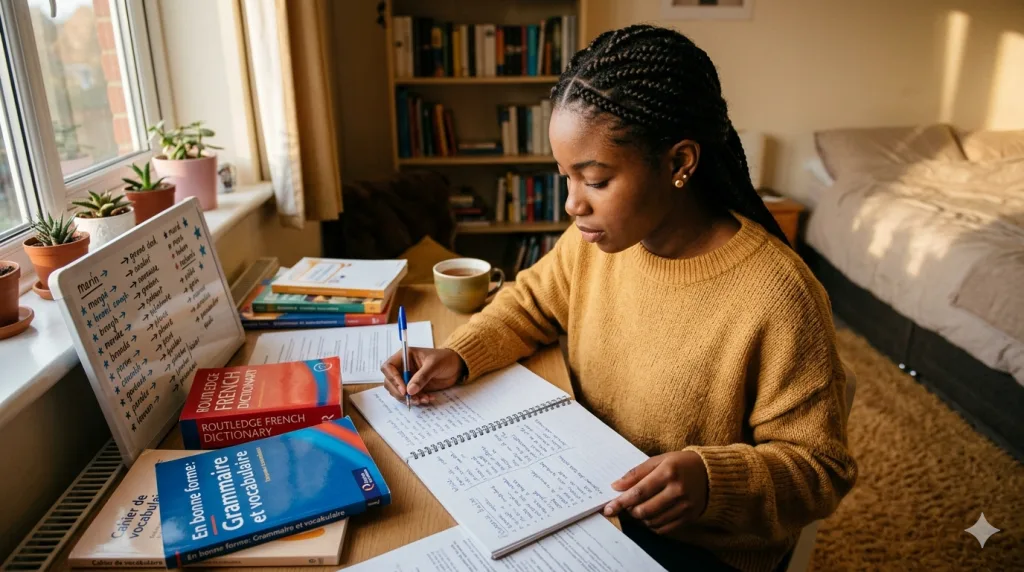
How To Combine Textbooks and Immersion?
Textbooks and immersion are a good pairing option because you do need structure to learn grammar and vocab, as well as training on how natives use these concepts before forcing yourself to only use real language (whether it be shows, conversations, or auditory/visual mediums.)
A More Practical Way
If you’ve been caught between studying and “just watching,” you should not have to choose sides: You need to unite them.
Jolii.ai can help bridge the divide of comprehension and usage so what you learn does not stay abstract or stagnant.
At this point, it is not a case of choosing your textbook or Netflix, is to make sure both will actually get you talking.
FAQs
Is Netflix enough to learn a language?
No. It gives the same level of exposure, but without a solid base, it will be chaos and it will take longer to break through.
Are textbooks necessary?
They are especially useful and handy in the early phases. They give you a picture of how the language works.
Which is better: textbooks or immersion?
Neither is better alone. The best solution is a mixture of them both.
Why do I feel stuck using only one method?
Each method develops different skills. Your learning is incomplete without the other.