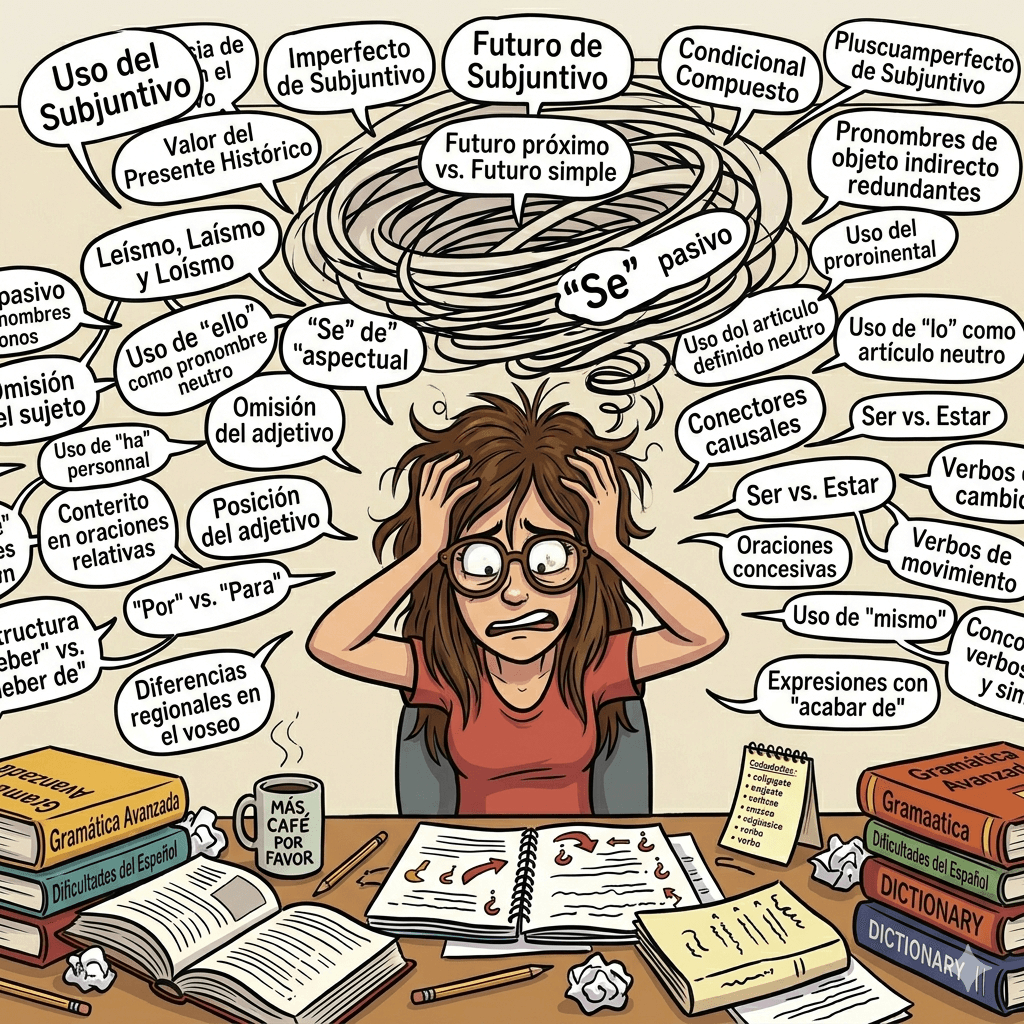
“WEIRDO”
Felt demeaning?
But it should not be.
If I say, it will help you understand the difference between indicative vs. subjunctive mood.
Wishes
Emotions
Impersonal expressions
Recommendations
Doubts
Ojalá
These make up the acronym WEIRDO, which helps identify when to use the subjunctive mood.
When you learn the acronym, you will find out how it covers 90% of the subjunctive verbs.
If you want to improve your fluency in Spanish, mastering the difference between the subjunctive and indicative moods is essential.
Let’s learn how!
What Is the Indicative Mood?
The indicative mood is used to talk about things that are objective or certain. This includes facts, descriptions, and real conditions. Let’s look at the following text.

| Spanish Text | English Translation |
| María siempre llega temprano al trabajo porque vive cerca de la oficina. Su jefe sabe que ella es responsable y siempre cumple con sus tareas. Todos en la empresa piensan que ella trabaja muy bien y creen que merece un ascenso. | Maria always arrives early to work because she lives near the office. Her boss knows that she is responsible and always fulfills her tasks. Everyone in the company thinks that she works very well and believes she deserves a promotion. |
In this example, the indicative is used because the sentences express certain facts and objective descriptions of Maria’s performance at work. The underlined triggers sabe que, piensan que and creen que introduce clauses that state actual information, therefore, the indicative mood is used.
What Is the Subjunctive Mood?
The subjunctive mood is used to talk about things that are subjective or possible but uncertain. This includes doubts, wishes, uncertainty, and hypothetical conditions. Let’s look at a similar text now, but in which the subjunctive mood is used.

| Spanish Text | English Translation |
| Es posible que María llegue tarde al trabajo si hay tráfico. Su jefe duda que ella siempre sea puntual, aunque espera que cumpla con sus tareas. Algunos en la empresa no creen que trabaje tan bien como dicen. Algunos desean que reciba un ascenso pronto. | It is possible that Maria arrives late to work if there is traffic. Her boss doubts that she is always punctual, although he hopes that she completes her tasks. Some in the company do not believe that she works as well as they say. Some wish that she receives a promotion soon. |
In this second example, the sentences express uncertainty and subjective opinions about María’s performance at work, therefore, they are in the subjunctive mood. The underlined triggers es posible que, duda que, espera que, no creen que, and desean que introduce clauses where the information is something uncertain or desired.
Key Differences Between Spanish Subjunctive and Indicative Mood
Subjunctive and indicative are grammatical moods. But what is a mood and how does it differs from a tense? Let’s find out. And if you want a full overview of Spanish tenses and moods, check our article.
Mood vs. Tense: Understanding the difference.
A tense tells us about the time of an action, whether it takes place in the present, past, or future.
Present: María trabaja en una tienda. (Maria works in a store.)
Past: Ayer vendió muchos productos. (Yesterday, she sold many products.)
Future: Mañana tendrá un día ocupado. (Tomorrow, she will have a busy day.)
The mood, instead reflects the attitude of the speaker, and in Spanish there exist three different moods: indicative, subjunctive, and imperative.
The Indicative Mood → Expresses facts and certainty.
- María trabaja mucho. (Maria works a lot.)
- Su jefe sabe que es puntual. (Her boss knows she is punctual.)
The Subjunctive Mood → Expresses doubt, emotions, wishes, or hypothetical situations.
- Dudo que María llegue tarde. (I doubt that Maria is late.)
- Su jefe quiere que ella descanse más. (Her boss wants her to rest more.)
The Imperative Mood → Gives commands or requests.
- Ven aquí. (Come here.)
- No llegues tarde. (Don’t be late.)
The subjunctive mood is mostly used in dependent clauses, often introduced by triggers like:
- ojalá (hopefully)
- es posible que (it’s possible that)
- dudo que (I doubt that)
- quiero que (I want that)
- no creo que (I don’t think that)

| Indicative vs Subjunctive | |
| Certainty Creo que él viene.(I think he is coming.) | Doubt Dudo que él venga. (I doubt that he is coming.) |
| Reality Tú siempre vienes a tiempo. (You always come on time.) | Wish Quiero que vengas temprano. (I want you to come early.) |
| Truth Es cierto que debes estudiar. (It is true that you must study.) | Necessity Es importante que estudies. (It’s important that you study.) |
| Real Condition Si hace sol, vamos a la playa. (If it’s sunny, we go to the beach.) | Hypothetical Condition Si tuviera dinero, viajaría más. (If I had money, I would travel more.) |
| Habitual Action Cuando llega, siempre me llama. (When he arrives, he always calls me.) | Uncertain Future Cuando llegue, te avisaré. (When he arrives, I will let you know.) |

| Category | Example in Spanish | Translation in English |
| Wishes (Deseos) | Quiero que vengas a mi fiesta. | I want you to come to my party. |
| Emotions (Emociones) | Me alegra que estés aquí. | I’m glad that you are here. |
| Impersonal Expressions (Expresiones impersonales) | Es importante que estudies para el examen. | It’s important that you study for the exam. |
| Recommendations (Recomendaciones) | Te sugiero que pruebes ese restaurante. | I suggest that you try that restaurant. |
| Doubts (Dudas) | Dudo que ella llegue a tiempo. | I doubt that she will arrive on time. |
| Ojalá (Hope) | Ojalá que no llueva mañana. | I hope it doesn’t rain tomorrow. |
Conclusion
Mastering the differences between subjunctive and indicative needs patience. With the WEIRDO you can start finding patterns in no time. Learning the right way to use subjunctive vs. indicative makes you fluent in Spanish faster.
The Jolii app lets you learn the differences in patterns following real languages spoken by characters in Netflix and YouTube videos. Easily upload the video you like in the easy-to-use Jolii interface and learn a language in an immersive way.
FAQs
Q: When should I use the subjunctive instead of the indicative?
A: Use the subjunctive when expressing doubt, emotion, uncertainty, wishes, or hypothetical situations. When expressing facts and certainty, use the indicative instead.
Q: Can a sentence have both subjunctive and indicative?
A: Yes, if it has multiple parts with different levels of certainty.
Q: What are the most common mistakes Spanish learners make?
A: When they start learning the subjunctive, they tend to overuse it and often confuse its conjugation with the indicative. This is one of the most common mistakes of Spanish learners.