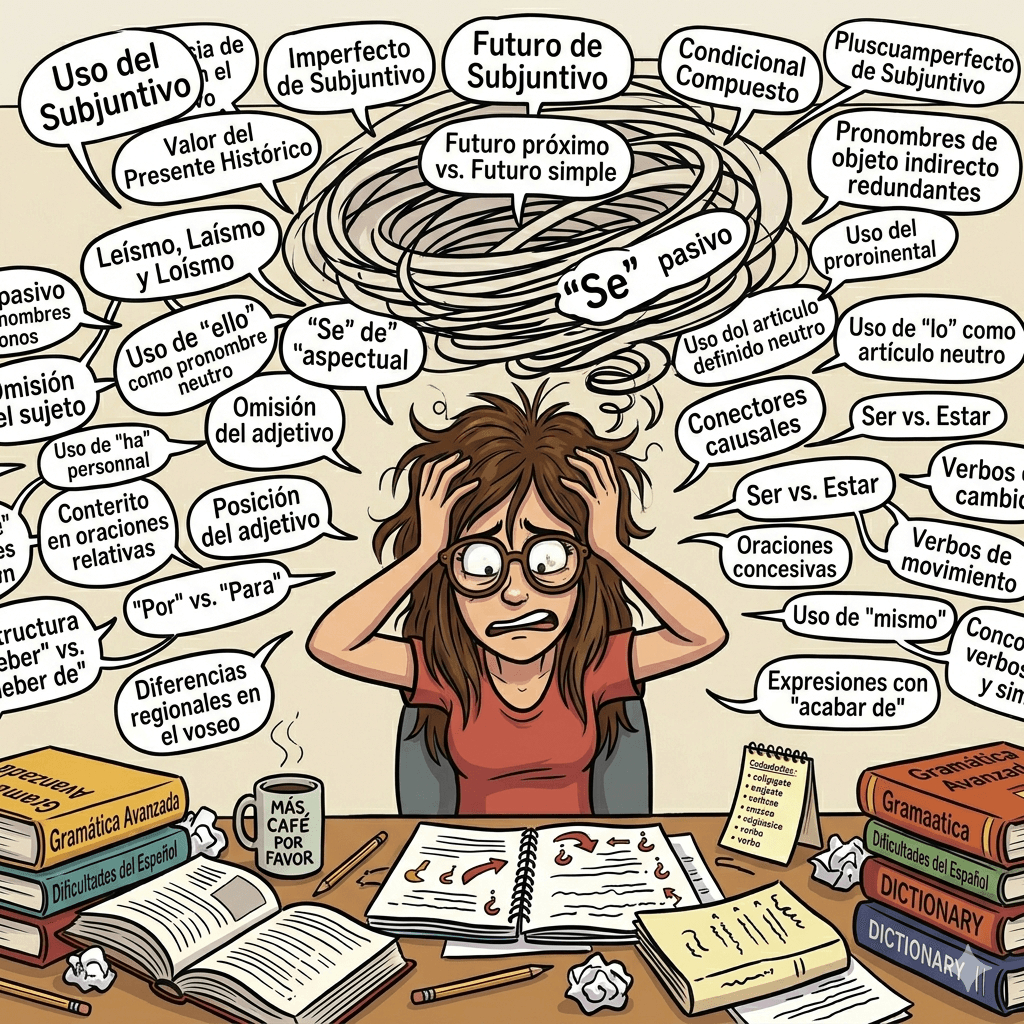
Have you ever been confused by future tense conjugations and grammar rules in your Spanish learning journey? I know, as a fellow learner living in Latin America, I sure do.
There are three forms of the Spanish future tense; each is important, but they are not always used equally in spoken and written Spanish.
Let’s look at each form. I will explain the differences between them and, more importantly, talk about when natives use them and when they don’t. All examples include an audio link so you can listen to the pronunciation.
The 3 tenses that express “future” in Spanish
Spanish has three main ways to talk about something that will happen in the future.
They are the simple future, near/immediate future and future present.
Simple future:
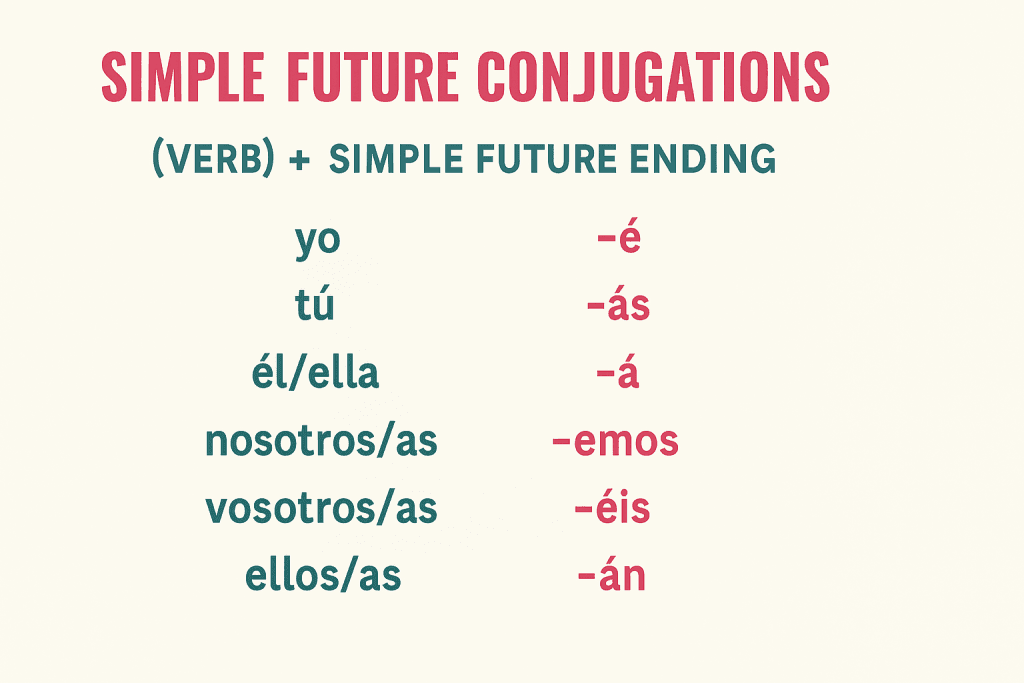
- Infinitive + endings: -é, -ás, -á, -emos, -éis, -án.
- For example: Hablaré, comerás, viviremos…. I will talk, you will eat, we will live
- In speech, the simple future can be used to express probabilities (e.g. Ella estará en el colegio – she’s probably at school).
- It is the preferred way to express a future action in written, formal Spanish.
- Most Spanish verbs are regular, meaning they are very easy to conjugate as they follow the same rules and patterns (like the table above).
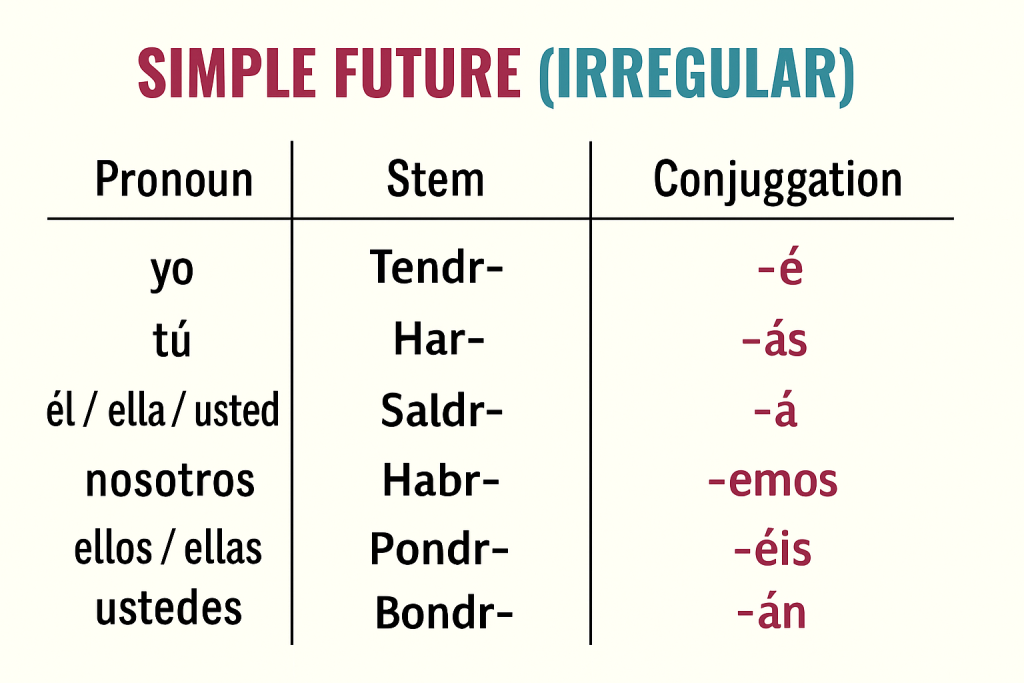
- However, there are 11 irregular verbs to look out for – See the infographic below.
Near/Immediate future (also known as the periphrastic future):
- ir + a + infinitive
- This is like using “I’m going to…” in English
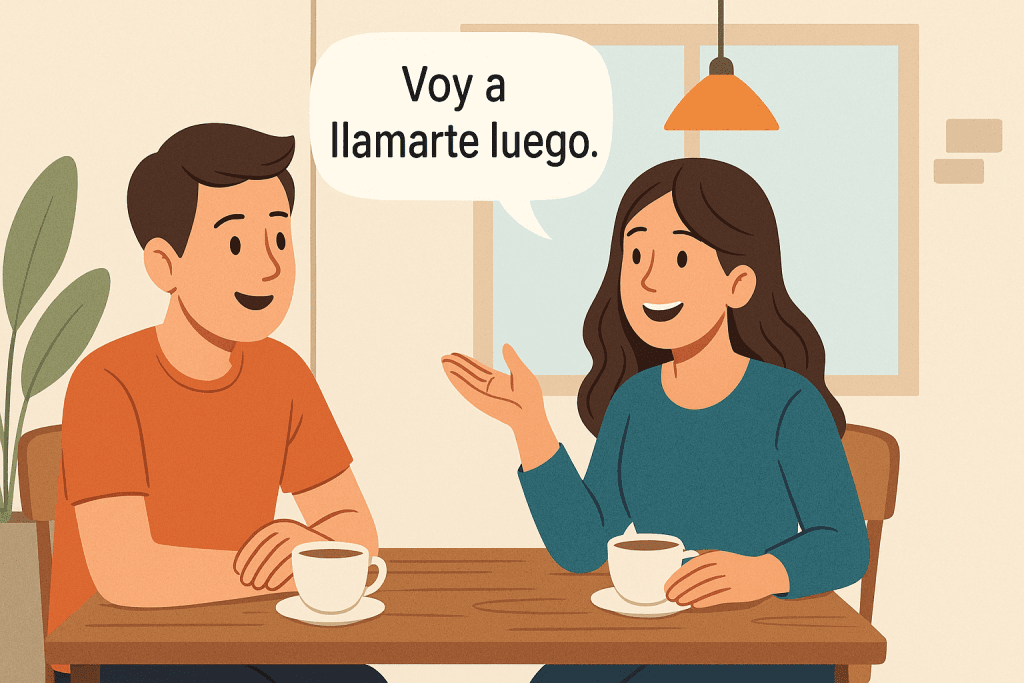
- For example: voy a comer, vamos a viajar – I’m going to eat, we are going to travel
Future present (also known as perfect future)
- This is a compound tense, which means that you will need two verbs to form this tense: the auxiliary verb haber(to have)and a Spanish past participle.
- For example; ¡Mañana, habré visitado la dentista tres veces en solo dos semanas! – Tomorrow, I will have visited the dentist three times in only two weeks
These are the 3 future tense forms you need to know to understand Spanish grammar. Although in actual native usage, they don’t compete equally.
Then how do native speakers use future tenses in daily conversation?
Linguists studying the use of Spanish in Mexico (the country with the largest Spanish-speaking population) found that ~77% of future tense verbs spoken are near future (ir a + infinitive) vs 23% in the simple future.
This study concluded that the near future has taken over the temporal “will do” job, while the simple future is now used mainly with modal (probability) meaning. In other words, the near future is the preferred way to describe future actions. In the past, in spoken Spanish, this wasn’t always the case, with the simple perfect being the preferred way to express future actions.
For example, native speakers prefer to say:
- “Voy a llamar” (“I’m going to call”) rather than “Llamaré” (“I will call”).
The shift away from the simple future towards the near future tense has been observed across dialects spoken in Latin America. So, if you want to speak the future tense more like a native, I strongly recommend that you use it.
Not only will you sound more like a native speaker, but some learners also find it a lot easier to speak using the near future tense rather than the simple future tense. This is because the simple future requires the use of future verb conjugations or endings to use them.
However, you should still learn the simple future verb endings so that you can become truly fluent (describe probabilities and understand written Spanish).
Do natives still use the simple future?
The simple future is still very important and used every day by native Spanish speakers, but mostly it expresses probability or guessing, rather than describing a future action.
For example:
- “Estará en casa”. (“He’s probably at home.”)
It can also be used to make a prediction.
For example:
- “Este cambio transformará la economía” (This change will transform the economy)
Usually, it is the preferred future tense in written Spanish because in the written context, it is more formal and polite than the near future form.
When do native speakers use the present future tense?
The present future is the least used of the future tenses. It is used to express that an action will be completed before a specific point in the future.
- For example: “Para mañana, ya habré terminado el informe.”- By tomorrow, I will have already finished the report.
- Or: “Cuando vuelvas, ellos ya habrán salido.” – When you return, they will have already left.
Final Thoughts
The Spanish future tense becomes much easier once you understand how native speakers truly use it. In spoken Spanish, the near future (ir a + infinitive) is the most natural and most common way to talk about upcoming actions. The simple future is still important, but it appears more in predictions, probabilities, and formal writing than in everyday conversation. Meanwhile, the future perfect is used less often but is essential when describing actions that will be completed before a specific time.
By prioritising the near future in speech, learning the simple future endings, and recognising when to use the future perfect, you’ll sound more fluent, more accurate, and more like a native Spanish speaker. This understanding will strengthen your grammar, improve your listening skills, and help you express the future in Spanish with confidence.