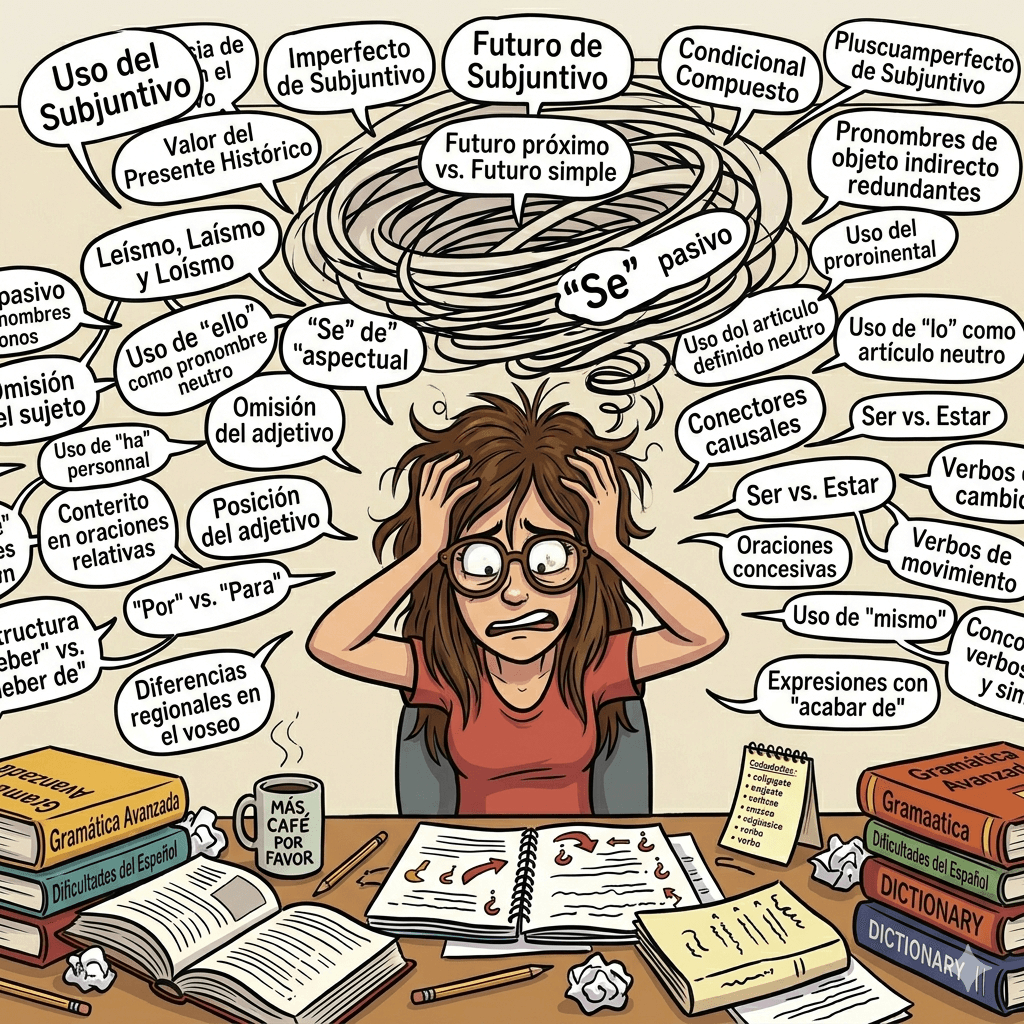
Let’s be real. You can read a language. You can type it.
But the moment a native speaker opens their mouth at full speed? Boom—brain crash.
“How to improve listening comprehension” is easily the #1 pain point for language learners worldwide.
Because it’s the only skill where you can’t hit “pause” in real life.
The good news for you is that we’re going to break down how your brain actually processes speech, why it fails, and how to train it like a pro!
Why Listening Comprehension Is Harder Than You Think
Native speakers talk like they’re getting paid per syllable.
English averages 150–170 words per minute, Spanish pushes 200–260, and your brain? It’s still buffering.
Here’s the kicker: You read roughly twice as fast as you listen, which means listening feels like decoding Morse code underwater.
Add slang, accents, filler words (“like,” “you know,” “ehhh”), and your working memory starts waving a white flag.
That’s “brain lag”. It’s the 1–2 second delay between hearing and understanding.
Science says:
- Learners process only 25–100 words/minute, far below native speed.
- Around 50% of learners fail listening tests at least once.
- Over 60% of real-world meaning comes from tone and body language
Moral of the story? You’re not bad at languages. You’re just battling brain physics, neurology, and bad input.
How to Choose the Right Content for Your Level?
Leveling up starts with choosing input that matches your current ability, not your fantasy fluency.
Get the content right and everything else moves faster.
The i+1 Principle (Krashen’s Reality Check)
You learn fastest when most of the input makes sense, and a small slice still forces your brain to work. That tiny “+1” is the friction zone where progress happens.
If you understand around 90 percent, the remaining 10 percent keeps you alert without burning you out. That’s the optimal load.
“Comprehensible input is not about perfection. It’s about momentum.” — Leonardo English, 2025
Pro-Insight: Adaptive AI apps like Jolii now handles the i+1 balance for you, adjusting difficulty in real time.
Balance Challenge + Comfort
Too easy? Zero progress.
Too hard? Full shutdown.
Stick to content you can follow without pausing often. Use slowed audio, transcripts, or simple podcasts.
Enjoyment Is a Learning Multiplier
Dopamine isn’t about feeling good. It’s about locking memories in. Neuroscience (2024–2025) shows enjoyable content boosts recall by 30–40%.
Check out whatever lights you up: music, gaming videos, true crime docs, or anything else.
And, keep your mind buzzing with it.
How Jolii Helps
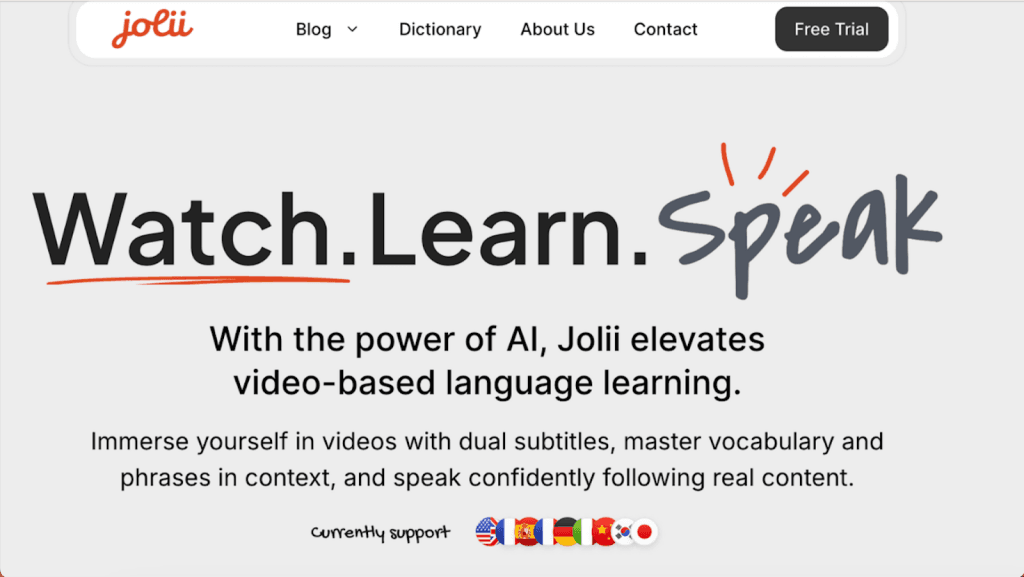
Jolii app analyzes your listening level and feeds you media with calibrated difficulty, updating dynamically as you improve.
No guesswork. Just progressive comprehension.
Best Methods That Actually Work
If your study routine feels like a treadmill, you’re not alone. Most students use methods that don’t work well.
This guide shares the best learning techniques. They help you take in information faster, remember it longer, and truly master any subject.
Active Listening vs Passive Listening
Active listening is focused work with transcripts and zero distractions. Passive listening is background exposure while you go about your day.
Active builds accuracy. Passive builds familiarity. Use both active and passive for real progress.
Use Subtitled Content Strategically
Start with L1 subtitles, move to L2, then drop them entirely. Watch once for the gist and once for details. Most learners transition within 6 to 12 weeks.
Bonus: Jolii supports dual subtitles for frictionless switching.
Transcription and Correction
Write what you hear, then compare it to the transcript. This trains phoneme-level attention, fixes “I know the word but missed it,” and hardens recognition.
Use Shadowing to Imitate Native Speech
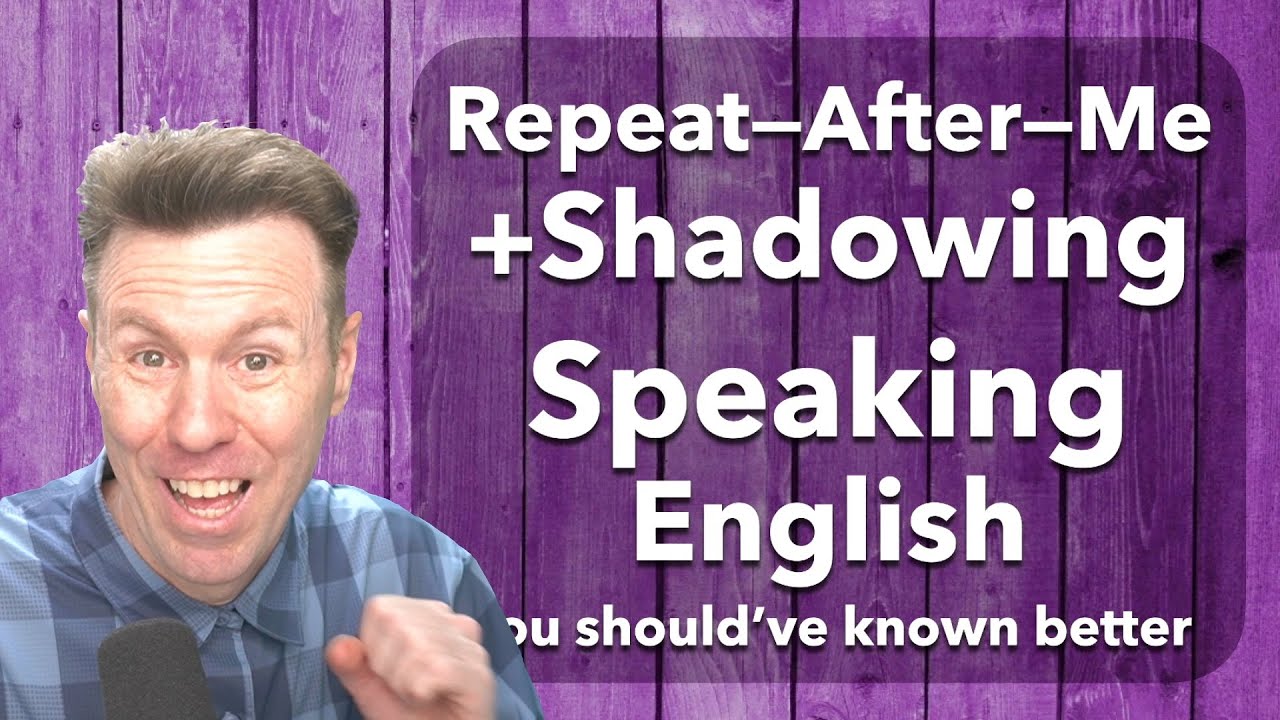
Shadow in real time to sync timing, stress, and prosody. Evidence shows faster improvements in fluency and listening accuracy than delayed repetition.
Use repetition for micro-chunks; shadow for full sentences.
Choosing the right input also answers a bigger question many learners struggle with: how much listening you need before you should start speaking — and why waiting too long can slow progress.
How to Create a Listening Immersion Environment
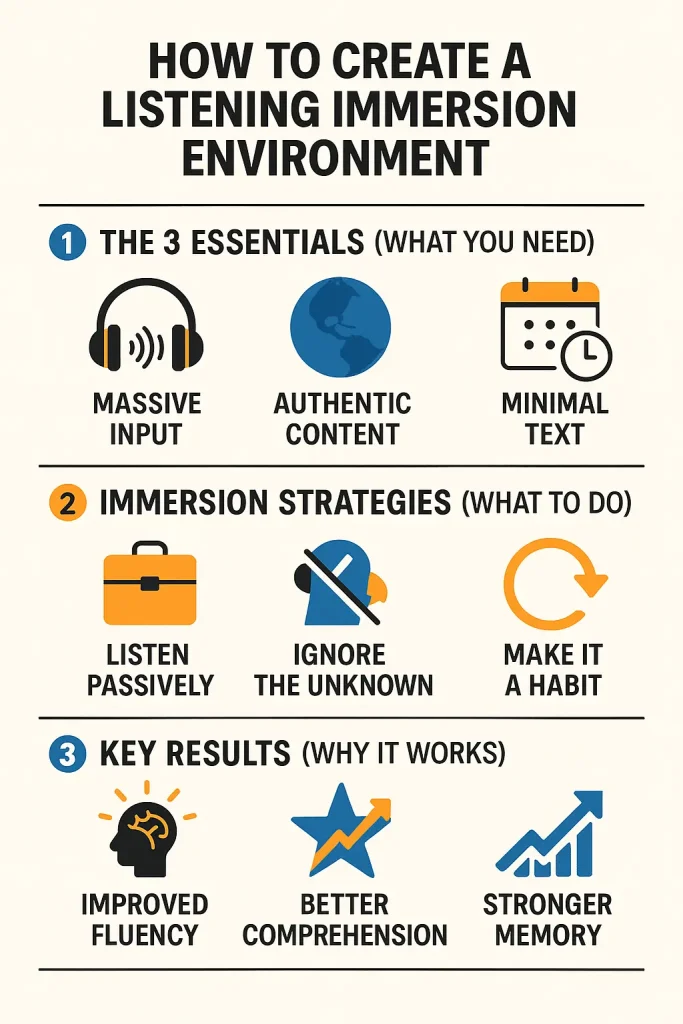
- Change phone language
- Stream podcasts, YouTube, and radio
- Follow native social accounts
- Think in the language when hearing it
Best Types of Audio to Practice Listening
Match content to processing capacity. That keeps motivation intact and accuracy trending up.
- Beginner: Slow podcasts, audio courses
- Intermediate: YouTubers, news, audiobooks
- Advanced: Comedy, debates, documentaries
What NOT to Do
- Don’t chase “perfect understanding.” You’ll never hit 100%.
- Don’t jump to advanced podcasts if you can’t follow beginner ones.
- Don’t multitask during active listening—your brain can’t split focus.
- Don’t study with content you hate. If it’s boring, you won’t remember it.
The New Dawn: Building Acoustic Tolerance:
Researchers are now tracking “Acoustic Tolerance”, which is your brain’s ability to stay calm under fast, messy, real-world speech.
In 2025 trials, learners who mixed multiple accents (2 to 3 per day) increased their tolerance by 40 percent and became far better at decoding unfamiliar voices.
The twist? Variety beats difficulty. Switching between accents, speeds, and styles builds flexible listening skills. It creates more than just practice.
FAQs
Q. What’s the fastest way to improve listening comprehension?
A: Mix daily listening with shadowing and spaced repetition. Focus on doing it often, not for long periods.
Q. How long does it take to see improvement?
A: Usually 6–12 weeks with steady practice.
Q. Should I listen to content I don’t understand?
A: Slightly beyond your comfort zone = yes. Total gibberish = no.
Q. Do I need to understand every word?
A: Not even close. Focus on gist, tone, and recurring patterns.
Final Thoughts
Listening is a muscle. Ignore it and it shrinks. Train it daily, and it becomes automatic.
Build your mix:
- 40% focused sessions, 60% exposure
- Spaced repetition. Shadowing. The 3-1-1 method. AI that adapts.
Forget “study harder.” Study smarter and enjoy the damn process.
Stop wasting time on guesswork! Sharpen your listening skills quickly with Jolii.ai.