To be or not to be, that is the question. Or in the case of Spanish, ¿Estar o ser, esa es la pregunta? (Sometimes this gets a chuckle of laughter from my students, depending on their age.)
But if you’re learning Spanish, this question is no laughing matter because one of the first big challenges learners face is understanding the difference between ser and estar.
Both verbs mean “to be,” but they’re used in different situations, and choosing the wrong one can completely change your meaning. The good news? Once you know the core rules and see real-life examples, the difference becomes much clearer. So read on if you want to learn the differences between ser and estar in Spanish with real-life examples.
Ser vs Estar: The Simple Rule
Simply put: Ser describes what something is. Estar describes how something is.
In other words:
Ser = essence (identity, character, things that define a person or thing)
Estar = state (temporary conditions, emotions, locations)
Common misconception: Teachers often express that the difference is simply temporary (estar) vs permanent (ser). This is partly true and works in many cases, but the Royal Spanish Academy notes that it’s less about “permanent vs temporary” and more about how the speaker views the situation.
The Nueva Gramática explains that ser expresses essence, while estar expresses states or conditions.
When should you use ser?
Ser can be used to answer questions like: What is it? Who is it? What’s it like?
Remember, ser is used to express essence.
1. Identity
Soy José. (I’m José.)
2. Profession
Soy profesor. (I’m a teacher.)
3. Origin / Nationality
Soy de Panamá. (I’m from Panama.)
4. Characteristics
José es simpático. (José is friendly.)
El clima es frío. (The climate is cold in general.)
5. Time & Dates
Hoy es lunes. (Today is Monday.)
Son las 8. (It’s 8.)
6. Material
La mesa es de madera. (The table is made of wood.)
7. Possession
El coche es de mi hermano. (The car belongs to my brother.)
When should you use estar?
When should you use estar?
Use estar for things that answer questions like: How is it? Where is it?
Remember: estar is used to express your state (emotions).
1. Location
This sometimes confuses learners, but remember you are only in a place for a temporary amount of time, so to describe where something or someone is located, use estar.
Estoy en casa. (I’m at home.)
Madrid está en España. (Madrid is in Spain.)
✔ Even permanent locations use estar.
2. Emotions / Feelings
Estoy cansado. (I’m tired.)
Ella está feliz. (She’s happy right now.)
3. Temporary Conditions
Remember: when you use estar in this context, you are implying that the subject is in a temporary state which will change in future.
El café está frío. (The coffee is cold.)
El niño está enfermo. (The child is sick.)
4. Physical Position
Estoy sentado. (I’m seated.)
5. Progressive Tenses
Estoy estudiando. (I’m studying.)
6. Result of an Action
La ventana está abierta. (The window is open.)
La comida está preparada. (The food is prepared.)
How do meanings change with ser vs estar?
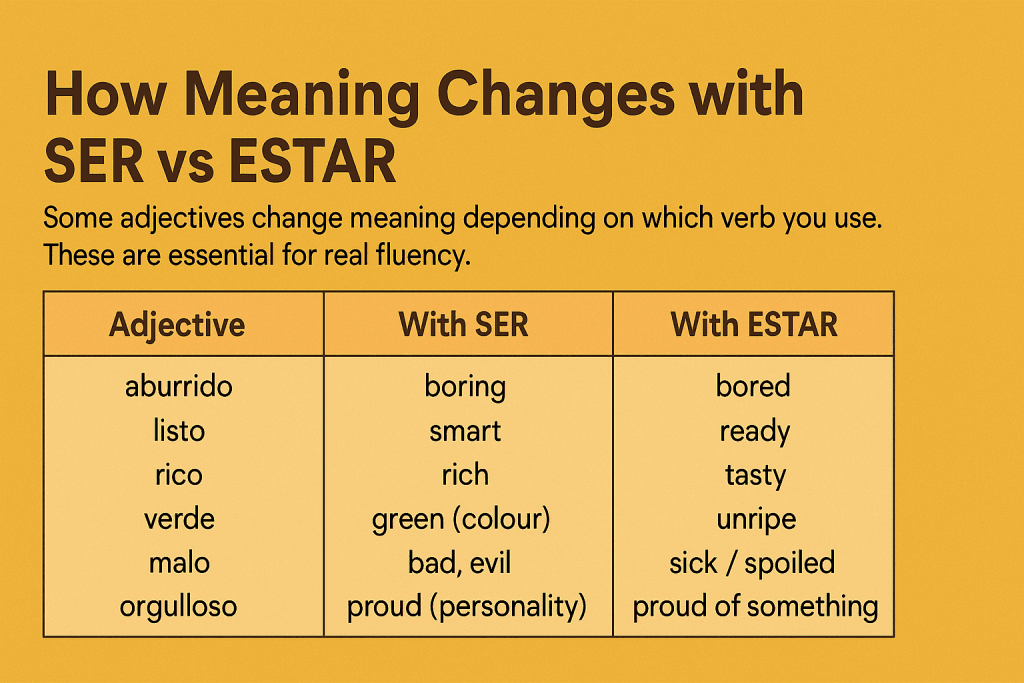
Examples:
El niño es aburrido. → The child is boring.
El niño está aburrido. → The child is bored.
La sopa está rica. → The soup is tasty.
Él es rico. → He is rich.
Common Mistakes English Speakers Make
1. Using ser for moods
Incorrect: Soy feliz hoy. We describe emotions using estar because they are temporary
Correct: Estoy feliz hoy.
2. Using ser for location
Incorrect: El baño es aquí.
Correct: El baño está aquí.
3. Using estar for profession
Incorrect: Estoy profesor.
Correct: Soy profesor.
4. Confusing adjective meanings
Incorrect: Estoy aburrido = “I’m boring.”
Correct: It means I’m bored.
Easy Memory Tricks: DOCTOR + PLACE
This common acronym is used to memorise the differences between ser and estar. Although this technique is useful for beginners, native speakers inherently know which version of to be to use based on meaning. However, if you like acronyms, this trick can help you get there
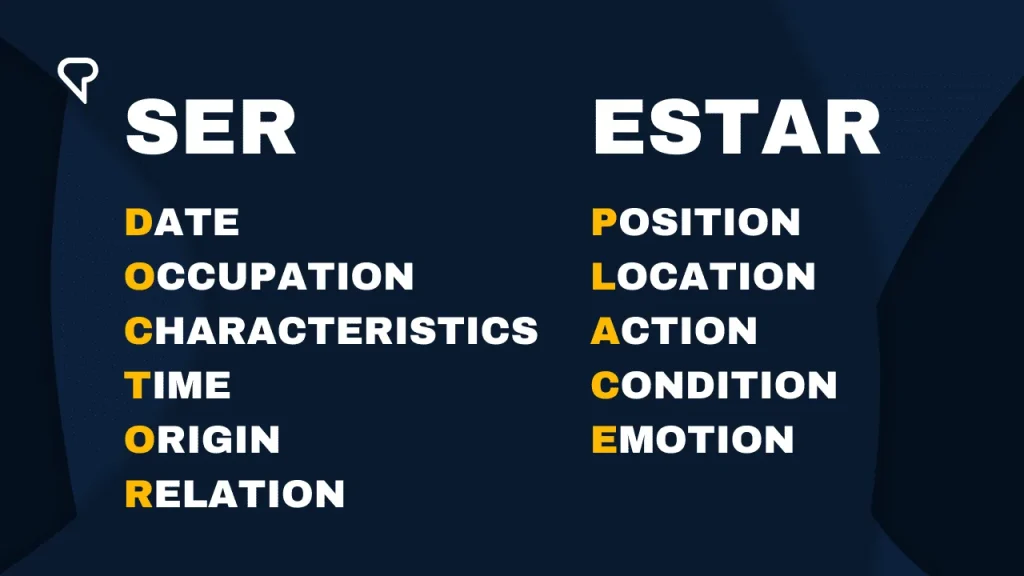
For more examples of the uses of ser and estar, based on this acronym, visit the Spanish Dictionary.
Examples of Real-Life Dialogues
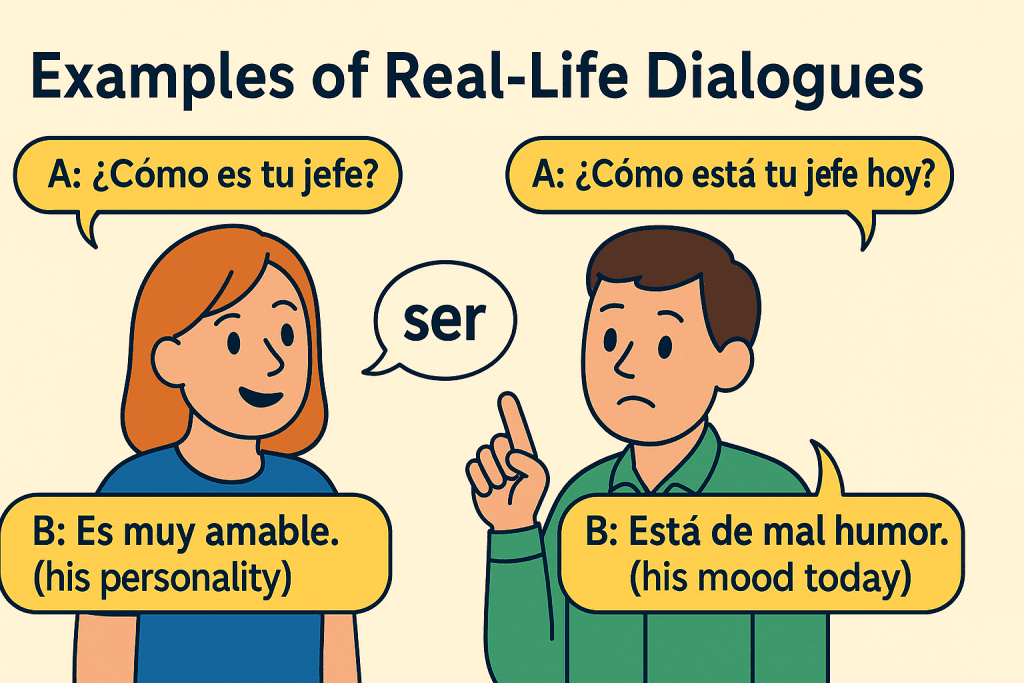
A: ¿Cómo es tu jefe?
B: Es muy amable. (his personality)
A: ¿Cómo está tu jefe hoy?
B: Está de mal humor. (his mood today)
This helps learners see the nuance instantly.
Conclusion
Mastering the difference between ser and estar is a big step in learning Spanish. We use these verbs every day when speaking, so they are two of the most common and important verbs to learn, along with tener (to have) and ir (to go). Knowing how to use these verbs correctly will make you sound much more fluent and natural, but don’t worry about slipping up and making mistakes while speaking Spanish. Native speakers understand that having two versions of the verb “to be” can be complicated for English speakers. They will still be able to understand you with context.
And eventually, with practice and plenty of real-life examples, you’ll start choosing the right verb naturally.
Read more about how to use verbs correctly in Spanish here.