Recently, I watched the 2001 DreamWorks animated classic Shrek with my English-learning students in class at my language school in Panama. It was a fascinating insight into how language learning through media can deepen our understanding of a language and lead to great conversations and realisations about our cultural differences.
As it was the last day of term, I decided my students deserved a treat. It’s Christmas, and who doesn’t love Shrek? Although surprised by my students’ initial reaction when I told them we’d be watching in English. “No, we must watch in Spanish”, they protested. We compromised and used Spanish subtitles. Here’s what I learned from this experience and why rewatching an English movie you already know in your native language can deepen your understanding of English.
Why watch a movie you already know?
If you’re learning English, one of the most powerful (and enjoyable) study techniques isn’t a textbook — it’s rewatching movies you already know in your native language, but this time in English.
Why? Because when you already understand the story, your brain is free to focus on how English actually works.
When you already know a movie well:
· You don’t need to “translate” the plot or stress about missing information
· Your brain can focus on sounds, structure, and meaning
That makes it ideal for language learning. Instead of asking “What’s happening?”, you start asking:
- Why did they say it like that?
- Why not use a literal translation?
Shrek Proves that Direct Translation isn’t Always Possible

My students kept interrupting the movie to say, “But in Spanish Donkey doesn’t say that!” Their reactions highlighted one of the biggest lessons you can take from this activity: to tell me, “But in Spanish Donkey doesn’t say that he says…” This was an important lesson for the class and one of the biggest lessons you can take away from rewatching a movie you already know in your native language in English. That is: Languages don’t translate word-for-word; they translate meaning.
For example, take Donkey’s humor: he is hilariously funny in both versions of the movies, but the jokes don’t translate word-for-word at all.
In the English version, he says, “You might have seen a housefly, maybe even a superfly, but I bet you ain’t never seen a donkey fly!”Whereas in the Spanish version (Latin American), “Has visto una mosca común, tal vez una mosca gigante, ¡pero nunca has visto volar a un burro!”
Now, if we were to translate the Spanish to English word-for-word, it would be, “You’ve seen a common fly, maybe a giant fly, but you’ve never seen a donkey fly”. The problem with this isn’t just that these translations don’t really make sense, but it also disrupts the rhythm and delivery of the line, which takes away from the humor.
You Learn Real, Spoken English (Not Textbook English)
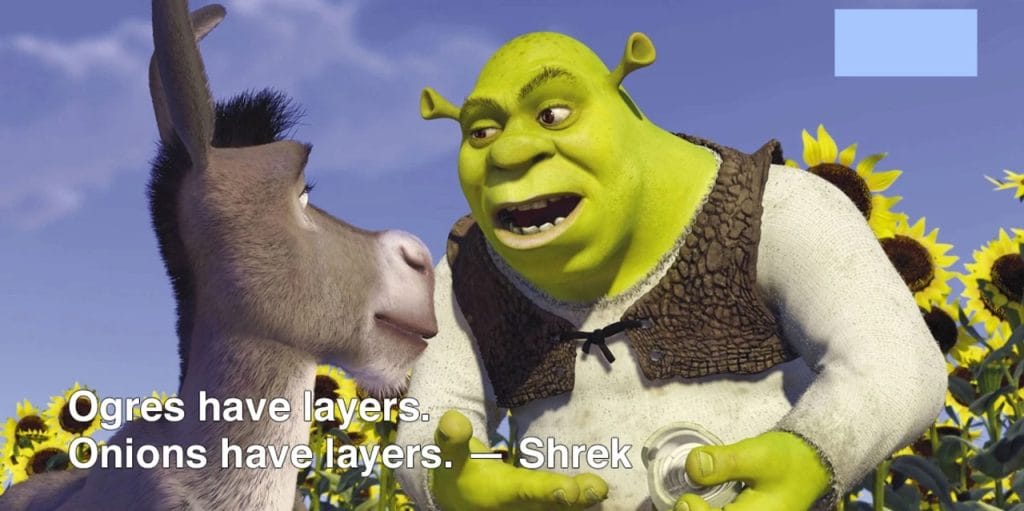
Textbook English tends to be formal and traditional, whereas movies like Shrek contain a lot of slang, idioms and casual expressions. For example, Donkey tells Shrek, “Oh, you’re so wrapped up in layers, onion boy.” This line mocks Shrek, who previously used the metaphor of the onion having layers to describe what it’s like being an ogre.
In Spanish, the line is, “Estás lleno de capas… como una cebolla.” Which is different because it is a lot less sarcastic than the English line and explains the metaphor. This is because “Onion boy” doesn’t work culturally in Spanish; therefore, it would sound strange to a Spanish audience. It is a great example to students of how English can mock or tease people playfully and sarcastically.
Natural English Uses Fewer Words Than Spanish

English often sounds shorter and more direct than Spanish. For example, when Shrek is approached by the angry local village people, he puts out their fire torch with his hands and says, “This is the part where you run away.” In Spanish, the line is “Esta es la parte donde tú sales corriendo.”
This shows that often English cuts unnecessary words and that short sentences are very common in spoken English. Spanish is structured a little differently. Another reason why direct translations don’t always work, especially with phrasal verbs, “tú sales corriendo”. According to data, Spanish is the second fastest spoken language. So, you might not notice how sentences tend to be a little bit longer.
Learning tip:
When watching in English, notice how often characters use short, simple sentences and try copying them.
Conclusion
Rewatching movies you already know in your native language is one of the most effective and enjoyable ways to deepen your understanding of English. Movies like Shrek show learners that real English is not about perfect grammar or direct translation, but about meaning, tone, rhythm, and culture. By removing the pressure of following the story, learners focus on how English is spoken, how jokes are built, how emotions are expressed, and how fewer words often say more. For more examples of how media can deepen your understanding of English, check out this article.
Most importantly, using familiar movies in English encourages curiosity, discussion, and confidence. And when learning sparks laughter, debate, and realisation in the classroom, you know it’s doing exactly what language learning should do.