Por Vs. Para
Por = Reasons, Cause, Motion, Duration.
Para = Purpose, Recipient, Destinations, Deadline,
In Spanish, you cannot use Por for Para or Para for Por because they change the meaning of the sentence dramatically.
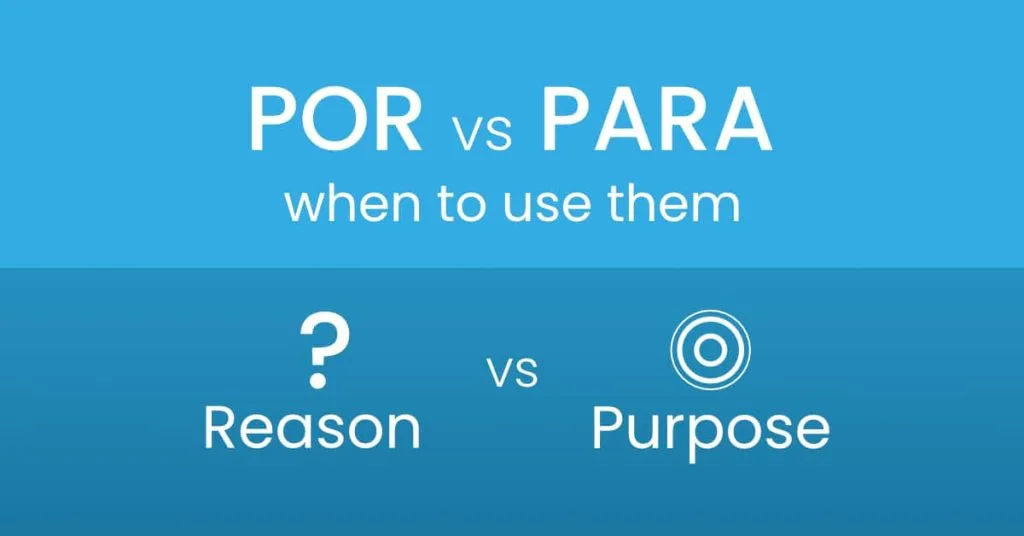
Understanding Por vs Para in Spanish (Why English Speakers Get Confused)
Native Spanish speakers do not fuss about whether to use por or para. It is we, the English speakers, who face the confusion between using por and para.
Why do learners confuse “por” and “para”?
Por and Para can be translated to the English word “ For”.
Sounds too natural!
Right?
As someone who has studied Spanish for years, I know how confusing Por vs Para can be for English speakers. In this guide, I’ll break it down with easy-to-understand rules and examples you can actually use.
EWA Direct conducted a study on The Influence of Mother Tongue on Second Language Acquisition, which states,
“Second language learners think in their own language when they speak a target language they want to acquire.”
How do you learn the core difference between using Para vs Por?
The context.
Yes, the context and the native level intuition play a crucial role in deciding the right usage of Para or Por.
Many Spanish tutorials just list rules. Here, I explain not only what Por and Para mean, but also when to use them based on context and forward vs backward-looking actions.

What Is Para Used For in Spanish?
(Beginner-Friendly Explanation of “Para” with Examples)
Let’s talk about Para first,
Para = future looking
When to use Para in Spanish ( por vs para rules)
Para is used for
- Purpose
- Recipient
- Destinations
- Deadlines
Let’s see examples to make them all clear.
1. Para for Purpose (Forward-Looking Intent or Goal)
Something which seems forward-looking, like a Purpose or a goal.
But I know it is a bit difficult to find purpose in action.
Examples of “para” showing purpose:
I am cooking dinner for the party. (Purpose is “for party”)
(Spanish)Estoy cocinando la cena para la fiesta.
Sabrina and I are both preparing for the test. (Purpose is “for the test”)
(Spanish)Sabrina y yo nos estamos preparando para el examen.
Purpose of an object (How something is used)
The purpose can also be assumed as: the purpose of any object.
The dining table is designed for sitting and eating. (For sitting and eating is the purpose)
(Spanish)La mesa de comedor está diseñada para sentarse y comer.
The air fryer is used for frying without oil. (for frying is the purpose)
(Spanish)La freidora de aire se usa para freír sin aceite.
I bought a machine for making ice cream. (for making is the purpose)
(Spanish)Compré una máquina para hacer helado.
Asking for the purpose using “¿Para qué…?”
Why are you reading this article for? (Purpose is clear: learning for what)
(Spanish)¿Para qué estás leyendo este artículo?
I am reading it for learning Spanish. (For learning is the purpose)
(Spanish)Lo estoy leyendo para aprender español.
Another purpose example:
I am buying an expensive watch for my son’s birthday.(for my son’s birthday is the purpose)
(Spanish)Estoy comprando un reloj caro para el cumpleaños de mi hijo.
Here again, para is showing a purpose.
2. Para for Recipient (Who Receives Something)
Para is used with all the recipients. See the examples to understand.
Examples of Para for Recipient:
Who is getting the prize? (Who is the recipient)
(Spanish)¿Para quién es el premio?
This article is for Spanish learners. (recipients are the Spanish learners)
(Spanish)Este artículo es para estudiantes de español.
Eating healthy is good for you. ( Here, “You” are the recipient)
(Spanish)Comer sano es bueno para ti.
3. Para for Destinations (Where Someone or Something Is Going)
We use Para for destinations.
Examples:
He left for England. (for England is the destination)
(Spanish)Él salió para Inglaterra.
Tricky or confusing example of Para For Destination:
Let’s learn some tricky or confusing examples.
I am going there.
(Spanish)Voy para allá.
Where is “for” in the English sentence? Here “for” shows “there”.
Para here again shows the destinations.
4. Para for Deadlines (Due Dates, “By” + Time Expression)
Para is also used with deadlines like “by”.
We need to finish the race by 6 p.m. (deadline is 6 p.m.)
(Spanish)Necesitamos terminar la carrera para las seis de la tarde.
Remember again, here we are talking about the idea to look forward in the future.
Got it?
The letter must reach the university by next month. (by next month is the deadline)
(Spanish)La carta debe llegar a la universidad para el próximo mes.
Summary of PARA in Spanish (Forward-Looking Uses)
Para = Purpose, Destinations, Deadlines, Recipients.
That’s all for Para.
Do you know that you can learn more about Para and Por on Netflix or YouTube videos with Jolii.ai?
Upload the video you like in the Jolii app and listen to the native style use of Por and Para, and further practice Por vs Para exercises with customized lessons on the same.

What Is “Por” Used For in Spanish? (Por Meaning)
Now, let’s talk about the Use of “Por “In Spanish by English Speakers.
Por = Cause/Reason
Por = Backward Looking( Finding the Cause)
When to Use Por in Spanish? (Beginner-Friendly Rules + Clear Examples)
- Cause Reason
- Passive Voice
- Exchange
- Duration of time
1. Por for Cause & Reason (Backward-Looking: “Because of”)
I did not come to the party because of the meeting.
(Spanish)No vine a la fiesta por la reunión
Schools were closed early because of the smog.
(Spanish)Las escuelas cerraron temprano por el esmog.
2. Por in Passive Voice (Who Performed the Action)
The car was driven by the mad lady.
(Spanish)El coche fue conducido por la señora loca.
The exam was undertaken by the students.
(Spanish)El examen fue realizado por los estudiantes.
3. Por for Exchange (Price, Trade, Substitution)
Use por before the price.
You can buy a pizza slice for $2.
(Spanish)Puedes comprar una porción de pizza por dos dólares.
I exchanged my gold ring for a few bucks.
(Spanish)Intercambio mi anillo de oro por unos cuantos dólares.
4. Por in Fixed Expressions (Must-Know Phrases in Spanish)
At Least Por lo menos (Fixed expression)
On the other hand Por otro lado (Fixed expression)
At last Por fin (Fixed expression)
That’s why, therefore. Por eso (Fixed expression, meaning ‘for that reason’)
5. Por for Duration of Time (“For + Time Period”)
Por is used in front of time.
The Spanish lecture lasted for two hours.
(Spanish)La clase de español duró por dos horas.
Summary of POR in Spanish (Backward-Looking Uses)
Por = Cause, Reason, Exchange, Duration, Passive Voice, Motion
How To Remember Por Vs Para?
You can use a 5-Second Trick to Know if It’s POR or PARA
Ask yourself one question:
Am I talking about the CAUSE (Por) or the GOAL (Para)?
- If you’re explaining why something happened → POR
- If you’re explaining what the action is for / its destination → PARA
Example:
I study Spanish for my job
Goal (future) = Para mi trabajo
I missed class because of my job
Cause (reason) = Por mi trabajo
FAQs
What is the difference between the Por and Para in Spanish?
Por is used to describe the “cause,” and Para is used to describe the “purpose/goal”.
How can I learn the use of Por and Para?
You can use Para to replace “intended for” and can use Por in place of “because of”.