First published: January 2026. Last Updated: May 2026
Quick Answer: How to Start Korean Reading Practice as a Beginner
The best way to start Korean reading practice as a beginner is to begin with short, simple texts — ideally ones that come with audio — and ease into it at your own pace.
So, that’s the whole answer. And honestly, you don’t need anything fancy or overwhelming.
Okay, let’s be real.
At first, reading Korean as a beginner can feel like you’ve just landed in an escape room… because all the clues are written in mysterious symbols.
Like, lines, circles, squares — and then your brain? It freezes.
Back then, I remember looking at Hangul for the first time and thinking, “Yeah, okay, this is cool… but how am I supposed to read any of it?”
In that moment, it felt like trying to solve a puzzle with no edges.
But here’s what changed it for me: I stopped trying to learn everything and instead just started reading tiny things.
Captions. Dialogues. Menu items.
And over time, it stopped feeling like code — until it started feeling like language.
So, this post? It’s a small map to help you get started.
Most importantly, at your own pace.
Before You Start: What Is Hangul?
If you’ve never studied Korean before, the script can look completely impenetrable at first glance. But here’s something most beginners don’t know until they’re already learning: Hangul is one of the most learnable writing systems in the world.
Unlike languages like Chinese or Japanese, which require memorising hundreds or thousands of characters, Hangul was deliberately designed to be logical and systematic. It was created in the 15th century specifically so that ordinary people could learn to read and write — and that intention shows. There are 14 basic consonants and 10 basic vowels, combined into syllable blocks rather than written letter by letter.
Most dedicated beginners can read Hangul — slowly but accurately — within a week. Not understand Korean. Just read the symbols and produce the sounds they represent. That’s the first goal, and it’s more achievable than it looks from the outside.
A few things worth knowing before you start:
It’s a phonetic system. Each symbol represents a sound, not a meaning. Once you know the sounds, you can read any Korean word aloud — even if you have no idea what it means. That’s a powerful starting point.
Syllable blocks look like units. Korean groups letters into square-shaped blocks, one per syllable. 학 is one syllable block made of three letters: ㅎ (h) + ㅏ (a) + ㄱ (k) = hak. Once you see the pattern, the blocks stop looking like symbols and start looking like exactly what they are.
Reading and pronunciation are closely linked. Unlike English, where spelling and pronunciation regularly diverge, Korean is relatively consistent. Learning to read Hangul and learning to pronounce Korean correctly happen at the same time, which makes the first few weeks of practice unusually efficient.
If you haven’t learned Hangul yet, or want to lock in the letters before continuing, the post Korean Alphabet (Hangul) for Beginners: Learn All Letters in 1 Day covers everything you need. Come back here once the symbols start feeling familiar.
1. Why Korean Reading Practice Matters for Beginners
If you’re like I was, you probably think reading comes later. After you “learn enough.” After you master the basics.
But honestly, reading is the basics.
Because it helps you see how the pieces fit together. It also gives you real examples of sentence structure, vocabulary, and rhythm.
And eventually, it shows you things no grammar table or flashcard can really help you feel.
You don’t need to understand every word to benefit from reading.
All you need is to start.
Let your brain notice things, give it room to guess, and let it absorb.
2. Getting Started with Korean Reading Practice
Let me say this upfront: if you try to read a Korean novel on day one, you might feel overwhelmed.
So, don’t do that.
Instead, start small.
Read simple dialogues.
Try children’s books.
Or find beginner-friendly captions.
Anything short, structured, and not intimidating.
A Simple Korean Reading Path for Beginners
Week 1–2
- Learn Hangul sounds and basic syllables
- Read single words and short captions with audio
Week 3–4
- Read short dialogues
- Re-read the same texts multiple times
- Start recognizing sentence patterns
Month 2+
- Read short paragraphs and subtitles
- Focus on understanding meaning without translating everything
- Increase speed and confidence gradually
For example, here’s a classic sentence:
Korean: 저는 학생입니다.
Romanized: Jeoneun haksaeng-imnida.
English: I am a student.
Because this kind of sentence builds your reading memory.
You’ll see the structure again. And again.
Eventually, it just clicks.
3. How to Make the Most of Your Reading Practice
You’ve got your tiny texts. So, what next?
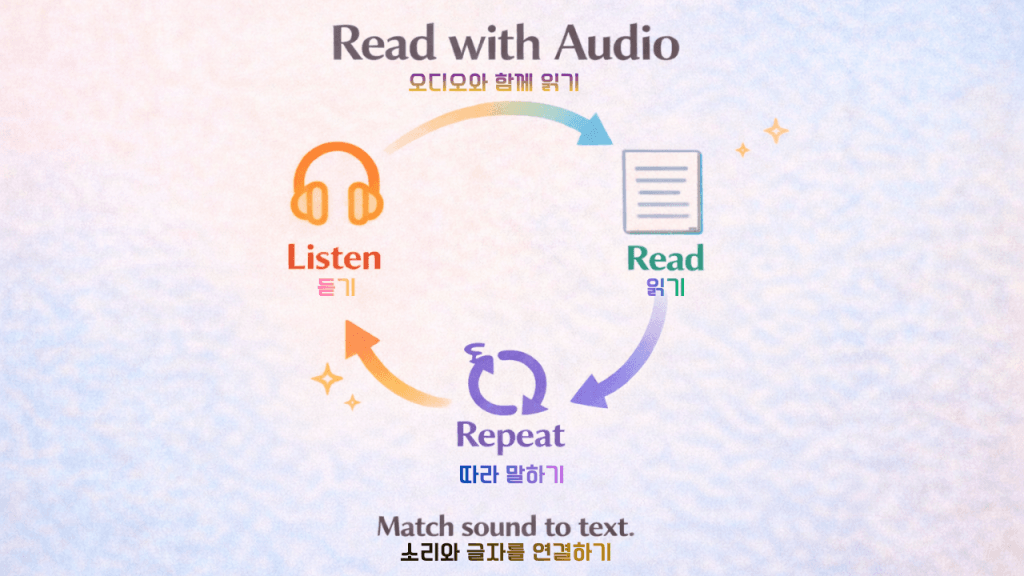
3.1 Read with Audio — Always
This makes a big difference.
Because when you read and listen at the same time, your brain starts linking sound with shape.
It’s no longer just letters — instead, it becomes a voice in your head.
For example, find a short video with subtitles.
Play it once. Then again.
And if needed, try reading along.
Yes, you might feel a bit awkward.
But that’s fine.
A practical starting point: Korean drama clips with subtitles, YouTube channels aimed at beginners, or Jolii’s Korean content, which pairs video input with the Hangul text so you’re always reading and listening at the same time.
3.2 Repeat the Same Text – More Than Feels Necessary
Don’t rush into new material too quickly. Most beginners do it.
Instead, re-read the same short text three to five times across different days. The first time you’re decoding. The second time you’re reading. The third time the structure starts to feel natural rather than constructed. That third read is the one that actually builds fluency — and most learners never get there because they’ve already moved on.
A good target: one new text per week, read multiple times, rather than one new text per day read once.
3.3 Keep a Personal Word Journal
A word journal works best in Korean when you write the Hangul, the romanisation, and the English meaning in three separate columns — and then a fourth column with an example sentence from the text where you found it. That final column is particularly important because, as Stephen Krashen’s theory suggests, we acquire vocabulary most effectively when we understand meaningful messages in context rather than memorising isolated words.
| Hangul | Romanisation | Meaning | Example |
|---|---|---|---|
| 학생 | haksaeng | student | 저는 학생입니다 |
| 날씨 | nalsssi | weather | 오늘 날씨가 좋아요 |
Writing the Hangul by hand rather than typing it has an additional benefit — the physical act of forming the syllable blocks reinforces the visual memory of each character faster than reading alone. Even five minutes of handwriting per session makes a noticeable difference within a few weeks.
These aren’t notes. They’re the beginnings of your personal Korean dictionary — built from texts you’ve actually read, which means every entry already has context attached to it.
4. Real Example: Korean Reading Practice on YouTube
Not in the mood to study hard? That’s okay, watching YouTube still counts as practice — especially if you’re reading along.
You can check out the Learn Korean with DaeHangul channel. It’s a solid source for beginners, and it’s packed with bite-sized content.
For example, a good place to start is this video:
👉 PlaySite – Hangul Reading Practice
It’s short, simple, and helps you connect reading with real-world vocabulary and phrases.
How to use it actively rather than passively:
- Watch once without pausing — just observe what you catch
- Watch again with the Hangul subtitles visible, reading along as the speaker talks
- Pause after each line and try to read it aloud before the speaker does on the next replay
- Write down any syllable block that tripped you up and add it to your word journal
That four-step process turns a ten-minute video into thirty minutes of active reading practice — which is far more effective than watching three different videos once each.
Beyond YouTube
Once you’re comfortable with basic Hangul reading, Korean dramas with subtitles are the natural next step. Short scenes of two to three minutes give you natural speech patterns, emotional context that makes vocabulary memorable, and the kind of sentence structures you’ll actually encounter in real Korean rather than textbook examples.
Jolii’s Korean content works particularly well here — video clips paired with Hangul text and audio, so the reading and listening practice happen simultaneously rather than separately. If you want to track which words you’re recognising and which are still tripping you up, the platform builds that into the learning flow rather than leaving you to manage it manually.
5. Easy Korean Dialogues for Beginners
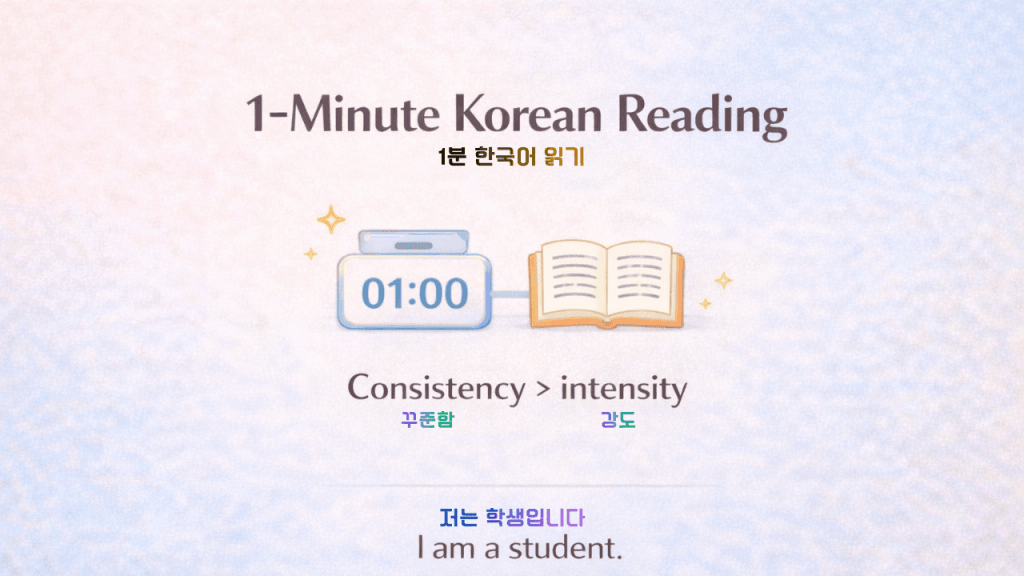
Now, let’s try this out with a few beginner-friendly lines.
Dialogue 1
Korean: 안녕하세요. 저는 민수입니다. 반갑습니다.
Romanized: Annyeonghaseyo. Jeoneun Minsu-imnida. Bangapseumnida.
English: Hello. I’m Minsu. Nice to meet you.
Dialogue 2
Korean: 오늘 날씨가 좋아요. 같이 산책할래요?
Romanized: Oneul nalssiga joayo. Gachi sanchaekhallaeyo?
English: The weather is nice today. Want to go for a walk?
Read them aloud.
Then, let them stick.
And later, revisit them again.
6. Building Speed and Confidence While Reading
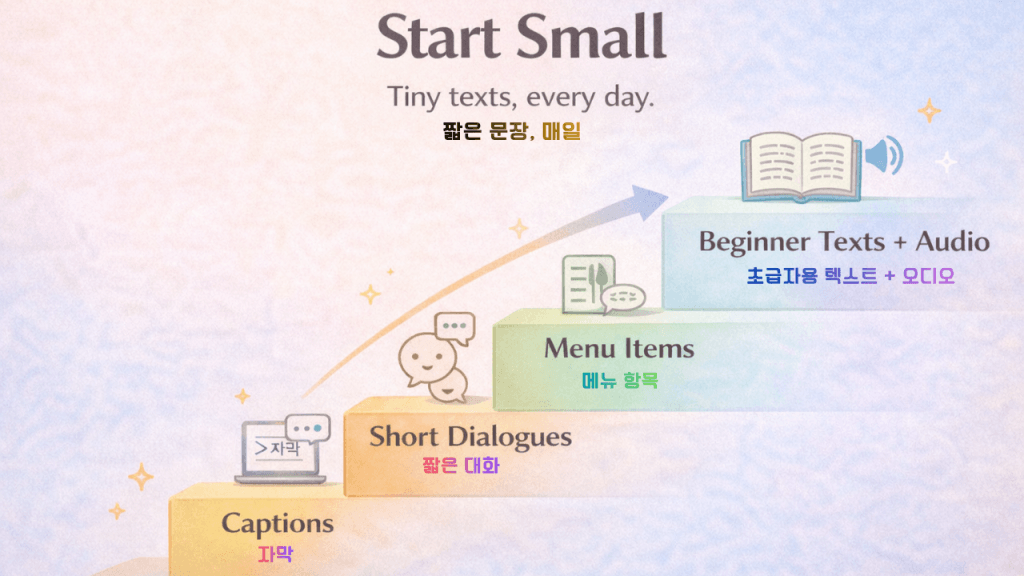
Want to get faster — but without feeling rushed?
Try this:
Don’t translate everything. Instead, focus on the full idea.
Pay attention to sentence endings — because they tell you a lot.
Read aloud. Seriously.
For example, set a one-minute timer and read a short paragraph.
Then try again tomorrow.
You’ll be surprised how quickly it improves.
7. FAQs about Korean Reading Practice
Q: Do I need to learn Hangul before I start reading practice? A: Yes — but the good news is that Hangul is learnable faster than most scripts. Most beginners can read syllable blocks accurately within a week of focused practice. Start there before anything else.
Q: Should I use romanisation while learning to read? A: Only as a temporary crutch, and as briefly as possible. Romanisation helps you understand pronunciation in the very early stages, but relying on it long-term slows your Hangul recognition significantly. As soon as you can connect a syllable block to its sound — even slowly — start reading Hangul directly and let romanisation fade out.
Q: Why does Korean word order feel so confusing when I read? A: Because it’s the reverse of English. Korean is a Subject-Object-Verb language, which means the verb comes at the end of the sentence. “I coffee drink” instead of “I drink coffee.” This feels unnatural at first but becomes automatic with enough reading repetition — which is one of the reasons re-reading the same texts multiple times matters more in Korean than in languages closer to English.
Q: Why should I focus on short texts as a beginner? A: Because finishing builds confidence and repetition builds retention. One short text read five times across a week is more effective than five different texts read once each. Short texts also let you focus on the syllable blocks and sentence patterns without getting overwhelmed by unfamiliar vocabulary every few words.
Q: What’s the best way to use audio with text? A: Read first, then listen, then read again. Starting with the text forces your brain to decode the Hangul actively rather than leaning on the audio for support. After reading, listen once to check your pronunciation. Then read aloud with the audio playing to calibrate rhythm and natural speech patterns. That sequence — read, listen, read aloud — is more effective than simply reading along passively.
Q: How long before Korean reading starts feeling natural? A: Most learners notice a shift around the four to six week mark when Hangul stops feeling like decoding and starts feeling like reading. The syllable blocks begin to register as whole units rather than individual letters you have to assemble. That shift is the clearest signal that the foundation is in place and you’re ready to move into longer, more complex texts.
Q: How often should I practice? A: Consistency matters more than duration. Ten to fifteen minutes daily produces faster progress than an hour once a week because Korean reading fluency is built through repeated exposure to the same patterns — and those patterns need to be encountered frequently enough to stick before they fade. Even reading one dialogue aloud every morning counts.
8. Your Next Step in Korean Reading Practice
Learning to read in Korean isn’t about speed or perfection.
Instead, it’s about showing up.
Noticing what’s familiar. Guessing what’s new.
And slowly, gently, getting better.
Korean reading practice doesn’t need to be dramatic.
It just needs to happen. That’s enough.
So here’s what to do next: pick something simple. One sentence. One video. One line of subtitles.
Read it today — even if it feels small.
Then do it again tomorrow. That’s how progress builds — quietly, patiently.
And hey — if you want a way to track your reading and improve your listening at the same time, check out the Jolii app. It’s designed for language learners like you — simple, friendly, and helps you build habits that stick.